LIKE US? To Receive a Monthly DIGESTWORLD Reminder, Click the Link to Send Email Request: SUBSCRIBE
NOTE: Place Cursor over a photo for a few seconds to read text description.
== == == == == == == == == == == == == == == == == == == == == == == == == 
All the tools you need for a simple Speed Trace
IN ONE PLACE.
== == == == == == == == == == == == == == == == == == == == == == == == ==
~~~~~~~~~~~~~~
~~~~~~~~ In Memoriam: Departed Greats of 2007 ~~~~
~~~~~~~~ Phil Rizzuto (89) New York Yankee shortstop and Baseball Hall of Famer ~~~~~
~~~~~~~~ Ingmar Bergmann (1918 - 2007) Swedish Director, "Virgin Spring", "Seventh Seal", etal ~~~~~
~~~~~~~~ Merv Griffin (82) Talk show host, creator of Jeopardy and Wheel of Fortune ~~~~~
~~~~~~~~ Marcel Marceau (1923-2007) World-famous French Mime — Only speaking role was in Mel Brooks' "Silent Movie" ~~~~~
~~~~~~~~ Luciano Pavarotti (1935 - 2007) Great tenor sings in new venue ~~~~~
~~~~~~~~~~~~~~
~~~ GOOD MOUNTAIN PRESS DIGEST #081 Published January 1, 2008 ~~~ == == == == == == == == == == == == == == == == == == == == == == == == ==Quote for the Frigid Month of January:
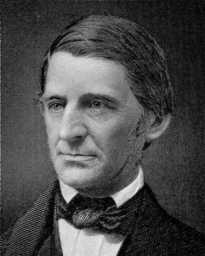
Art is the path of the creator to his work.
Ralph Waldo Emerson, American Philosopher (1802-1882)== == == == == == == == == == == == == == == == == == == == == ==
By Subscription only.== == == == == == == == == == == == == == == == == == == == == ==
Editor: Bobby Matherne
[To Contact Bobby Click Here!]
To Subscribe, Click Here : http://www.doyletics.com/subscrib.htm
or here: <A HREF="http://www.doyletics.com/subscrib.htm">Click here</A>
To Unsubscribe, see bottom of Digest.
©2008 by 21st Century Education, Inc, Published Monthly.
To Read All of Bobby's Writings Click Here!
~~ Click on Heading to go to that Section (Allow Page First To Fully Load). ~~THE GOOD MOUNTAIN PRESS DIGEST #081, January 2008 Archived Digests
Table of Contents1. January's Violet-n-Joey Cartoon
2. Honored Readers for January
3. On a Personal Note
4. Cajun Story
5. Recipe of the Month from Bobby Jeaux’s Kitchen: Vegetable Triage Stir Fry
6. Poem from Rainbows & Shadows:"Something Dewing"
7. Reviews and Articles Added for January:8. Commentary on the World
- ARJ2: What Is Anthroposophy? 3 Lectures, July 20-22, Dornach, GA#225 by Rudolf Steiner
- ARJ2: The Perfect Season — LSU’s Magic Year — 1958 by Bud Johnson
- ARJ2: The Power of the Word and Cosmic Language by Hazrat Inayat Khan
9. Closing Notes - our mailing list, locating books, unsubscribing to Digest
10. Gratitude== == == == == == == == == == == == == == == == == == == == == ==
THE GOOD MOUNTAIN PRESS DIGEST #081 == == == == == == == == == == == == == == == == == == == == == ==
ARCHIVED DIGESTWORLD ISSUES ON THE WEB ~ ARCHIVED DIGESTWORLD ISSUES ~ 2000: INAUGURAL YEAR: Jun #1 Jul #2, Aug #3, Sept #4, Oct #5, Nov #6, Dec #7
2001: Jan #8, Feb #9, Mar #10, Apr #11, May #12, Jun #13, Jul #14, Aug #15, Sep #16, Oct #17, Nov #18, Dec #19
2002: Jan #20, Feb #21, Mar #22, Apr #23, May #24, Jun #25, Jul #26, Aug #27, Sep #28, Oct #29, Nov #30, Dec #31
2003: Jan #32, Feb #33, Mar #34, Apr #35, May #36, Jun #37, Jul #38, Aug #39, Sep #40, Oct #41, Nov #42, Dec #43
2004: Jan #44, Feb #45, Mar #46, Apr #47, May #48, Jun #49, Jul #50, Aug #51, Sep #52, Oct #53, Nov #54, Dec #55
2005: Jan#051,Feb#052,Mar#053,Apr#054,May#055,Jun#056,Jul#057,Aug#058,Sep#059,Oct#05a,Nov#05b,Dec#05c
2006: Jan#061,Feb#062,Mar#063,Apr#064,May#065,Jun#066,Jul#067,Aug#068,Sep#069,Oct#06a,Nov#06b,Dec#06c
2007: Jan#071,Feb#072,Mar#073,Apr#074,May#075,Jun#076,Jul#077,Aug#078,Sep#079,Oct#07a,Nov#07b,Dec#07c
2008: Jan#081,Feb#082,Mar#083,Apr#084,May#085,Jun#086,Jul#087,Aug#088,Sep#089,Oct#08a,Nov#08b,Dec#08c
2009: Jan#091,Feb#092,Mar#093,Apr#094,May#095,Jun#096,Jul#097,Aug#098,Sep#099,Oct#09a,Nov#09b,Dec#09c
2010: Jan#101,Feb#102,Mar#103,Apr#104,May#105,Jun#106,Jul#107,Aug#108,Sep#109,Oct#10a,Nov#10b,Dec#10c
2011: Jan#111,Feb#112,Mar#113,Apr#114,May#115,Jun#116,Jul#117,Aug#118,Sep#119,Oct#11a,Nov#11b,Dec#11c
2012: Jan#121,Feb#122,Mar#123,Apr#124,May#125,Jun#126,Jul#127,Aug#128,Sep#129,Oct#12a,Nov#12b,Dec#12c
2013: Jan#131,Feb#132,Mar#133,Apr#134,May#135,Jun#136,Jul#137,Aug#138,Sep#139,Oct#13a,Nov#13b,Dec#13c
2014: Jan#141,Feb#142,Mar#143,Apr#144,May#145,Jun#146,Jul#147,Aug#148,Sep#149,Oct#14a,Nov#14b,Dec#14c
2015: Jan#151,Feb#152,Mar#153,Apr#154,May#155,Jun#156,Jul#157,Aug#158,Sep#159,Oct#15a,Nov#15b,Dec#15c
2016: Jan#161,Feb#162,Mar#163,Apr#164,May#165,Jun#166,Jul#167,Aug#168,Sep#169,Oct#16a,Nov#16b,Dec#16c
2017: Jan#171,Feb#172,Mar#173,Apr#174,May#175,Jun#176,Jul#177,Aug#178,Sep#179,Oct#17a,Nov#17b,Dec#17c
2018: Jan#181,Feb#182,Mar#183,Apr#184,May#185,Jun#186,Jul#187,Aug#188,Sep#189,Oct#18a,Nov#18b,Dec#18c
2019: Jan#191,Feb#192,Mar#193,Apr#194,May#195,Jun#196,Jul#197,Aug#198,Sep#199,Oct#19a
To Receive a Monthly DIGESTWORLD Reminder — Click Here.
== == == == == == == == == == == == == == == == == == == == == ==
1. January Violet-n-Joey CARTOON:
== == == == == == == == == == == == == == == == == == == == == ==For newcomers to the Digest, we have created a webpage of all the Violet-n-Joey cartoons! Check it out at: http://www.doyletics.com/vjtoons.htm Also note the rotating calendar and clock that follows just to the right of your mouse pointer as you scroll down the page. You'll also see the clock on the 404 Error page if you make a mistake typing a URL while on the doyletics.com website.
The Violet-n-Joey Cartoon page is been divided into two pages: one low-speed and one high-speed access. If you have Do NOT Have High-Speed Access, you may try this Link which will load much faster and will allow you to load one cartoon at a time. Use this one for High-Speed Access.
This month Violet and Joey learn about a nice turtle.
#1 "A Nice Turtle" at http://www.doyletics.com/images/12100701.gif
== == == == == == == == == == == == == == == == == == == == == ==
2. HONORED READERS FOR January:
== == == == == == == == == == == == == == == == == == == == == ==Each month we take time to thank two of our good readers of Good Mountain Press Digest, books and reviews. Here's our two worthy Honored Readers for this month. One of their names will be in the TO: address line of your email Digest notification. Our Honored Readers for January are:
Fred Dent in New Orleans
Fran Randolph Brookins in Texas
Congratulations, Fred and Fran!
== == == == == == == == == == == == == == == == == == == == == == == == == == == == == == == == == == == == ==
3. ON A PERSONAL NOTE:
== == == == == == == == == == == == == == == == == == == == == == == == == == == == == == == == == == == == ==
Out Our Way: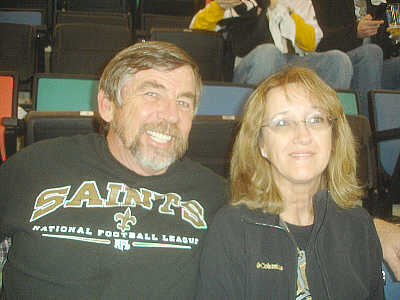
Since we met in these pages last month, LSU has made it to the Bowl Championship Series in New Orleans on January 7, 2008. LSU can win the National Championship by beating Ohio State University. Should be a great game. I like LSU being the underdog — it's like having people taunting a Tiger at the zoo. Never know how high that Tiger can jump till some Midwesterners come to town in a taunting mood.
How the Tigers got to the BCS was no easy feat. Unranked Pitt had to beat mighty No. 2 West Virginia, Oklahoma had to beat No. 1 Missouri, and LSU had to beat Tennessee and win the SEC Championship.
Our other football team, the New Orleans Saints, has completed its home field play for the year. Its scant hope for a playoff berth rest on its winning its last game against Chicago and two other teams losing. If the three Sunday games come out as well as they did for LSU, the Saints will be playing Seattle in the Wild Card game and be back in the Super Bowl hunt. Our quarterback, Drew Brees, is hitting his stride and if our running backs can stay healthy, any scenario is possible, even playing in the Super Bowl. But first the Saints needs to whip Chicago and get payback for its ignominious loss last year at Soldier's Field.
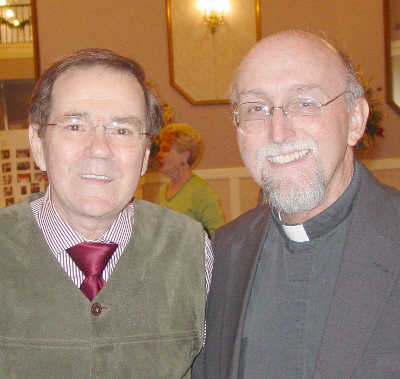
On the first day of December Del and I attended the CODOFIL Christmas Lunch. The invocation was given by Fr. Peter Rogers, SJ, a Loyola professor of French, and the speaker was Ina Fandrich who gave us a comprehensive explanation of Voodoo and history of the famous New Orleans healer Marie Laveau, known as the Voodoo Queen of the city. Marie married a man named Glapion and had two daughters by him, one son who died at age seven. Marie kept a rosary with her at all times and said it many times during the day. She was a Catholic first, apparently, and used the Voodoo as a way of worshiping her God. Voodoo means Great Spirit basically and was an early African way of understanding the spiritual world of God and angels which meshed very well with the Catholic religion when it arrived. St. Anthony of Padua was the Voodoo saint and that explains why so many New Orleans churches have a statue of him in their entrance. Ina said that she even saw St. Anthony in a Black Protestant church, which makes no sense except for the Voodoo roots of its parishioners.
When I was introduced to Father Peter Rogers, he said, "Matherne? I have an aunt who married a Matherne down the bayou." Sure, I thought, what's the chance of her being related to me, with all the Mathernes down the bayou? "Her name was Belle Rogers." Well, what do you know? His aunt was my Grandma Belle! After my grandmother died, Grandpa Clairville married Belle Rogers, and she was our grandma for almost fifty years. That makes us first cousins, once-removed, by marriage.
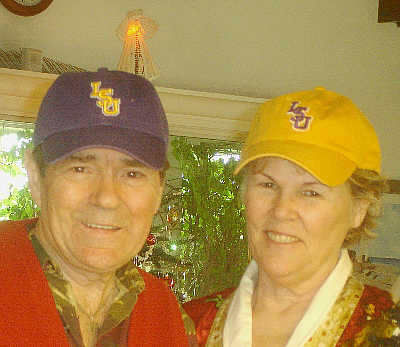
After the luncheon was over I scurried home for 2:40 pm, just in time for the SEC Championship Game of LSU and Tennessee. When I finally got up to go to bed after watching all the important games, it was 12:30 am. After LSU decisively whipped Tenn 21-14, I watched USC win, West Virginia (#2) lose, and Missouri (#1) lose in big games. And the N. O. Hornets beat Dallas Mavericks for the first time in this millennium! Not since 1999 have they beaten their division rival. At one point the OU-Missouri game, the Pitt-UWV games were on side screens while the Hornets game was on, and all three games were in critical win-lose situations. What a rush! Kept popping the sound back and forth across the room. All three came out the way I hoped for. Then at night, 10:30, the Hawaii-Washington game started in Hawaii and Wash got up 3 Tds on the unbeaten Warriors, but I couldn't stay to the end. Hawaii won, stayed undefeated, and when the smoke and mirrors of the BCS voting had cleared, LSU was ranked No. 2 and Ohio State No. 1 and they would play each other in New Orleans for the Championship. What a great thrill to watch Les Miles smiling and jumping up and down like the rest of the LSU Tigers as they watched the announcement on TV! What a great year! WOW!

Del had her investment club over for a lunch meeting and I made a large seafood gumbo for them before I cleared out for a few hours. That night we had a holiday treat, a special Christmas edition of "The Closer." Brenda, her parents, Fritz, Provenza, Flynn, and a fugitive, travel cross-country from Atlanta to California in her parents fancy Motorhome. What a trip! Usually Brenda gets her man, but in the end of this one, her man got his burgular-buddies and himself killed. She needed for him to think his buddies had shot his kid brother before he would help locate them, but he decided to take their trial and execution into his own hands. We seldom watch any first-run series on the networks, but Brenda Lee Johnson is head and shoulder-pads about her competition and well worth the aggravation of all the commercials to be skipped over.

Our preference is to catch great series in reruns when the ads are more predictable and less a hassle. Plus we can follow the shows on a more frequent basis. This has worked well with Nash Bridges, Voyager, and JAG. For Christmas Eve, we watched three TIVO'ed Christmas episodes of JAG and basically said goodbye to the series. We have seen them all at least twice. Voyager we are still occasionally finding an episode we hadn't seen. All the VCR's we made to watch later are sitting untouched thanks to our DVR (TIVO) setup. We get some special treats such as a 1935 David Copperfield movie with W. C. Fields as Micawber, which we DVR'ed and watched to completion. Early Fields reminds me of Steve Martin a bit.
We decorated our Frazer Fir Christmas tree, adding the newly acquired bubble lights which I bought to replace the old set whose last bulb burnt out last year. The new set looks perfect, but unfortunately the bubbling effect is not self-starting. I finally discovered that removing a bulb, turning it upside down, and shaking it would get the bubbling started again. Luckily I had decided to put the bubble lights into some 1950-vintage strings which still had full copper screw-in sockets. These are easy to screw in and remove bulbs from with just one hand, which is important if the bulb is high or hard to reach.
On December 8 four of our kids came to Timberlane for our family Christmas, Kim, Jim, John, and Stoney with all of their offspring. We opened our presents to each other and enjoyed some smoked turkey with my oyster dressing, shrimp potato salad, Del's green bean casserole, my eggnog, fresh-baked bread, and lots of desserts.
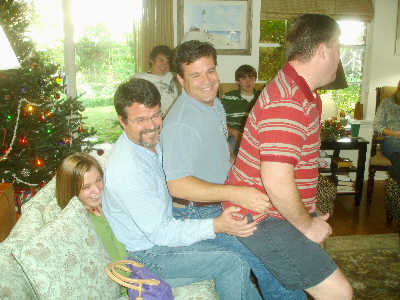
After the kids left to visit the O.P.'s (Other Parents) Del and I had a bit of a laugh. After filling up the 13.5 gallon kitchen garbage bag by topping it off with the turkey carcass, I lifted it out its can and noticed a red blinking light shining through the bag, near the bottom. Must be something valuable that has been accidentally discarded. As the Granpa in charge, I reached gingerly past the turkey carcass, down through the garbage, avoiding the gunky stuff, and as my arm went down the red light slipped further down, eventually all the way to the bottom! Reaching down to the full extent of my arm, I finally came up with what looked like a binky or a pacifier. But it turned out to be a part of a candy-sucker which had been eaten away by our grandson Thomas. He discarded the handle, but its red light remained blinking. That was a first for me! A throw-away blinking red light!
The Gralapp family spent the night, and as Wes and his two sons were loading up the car, he called me urgently to come with my camera. There, at the base of our magnolia tree was a large Great Egret
standing. Wes said he thought at first it was a statue of a bird in our yard, until it began to walk. I took photos of it as it stood, then walked, gravitatishly and majestically, across the middle of our west portico lawn as we watched breathlessly, only 15 feet away from the bird, which was almost as tall as our sixth-grader, Thomas.
During our present opening, one gift from the Gralapps was a box with a card in it promising delivery of "The Perfect Season." It came a few days later and I immediately set to enjoying myself reading about those halcyon days of my freshman year at LSU in 1958 when we won the first-ever National Championship. It was called a "Mythical" championship, because there was no official BCS organization which settled the score at the end of the college football season year. Whoever finished top in the polls was declared champion. There was no dispute. Now that there is an official way of deciding the National Championship, the word Mythical must be reserved for the way USC claimed to win it in 2003 when one poll placed them at top and they grasped at the Mythical Championship straw. LSU in that same year won the National Championship OFFICIALLY. Anyway, you can read about the fun I had at LSU during those exciting years in my review linked from this Digest. For almost two years, I was thinking we might not lose a single game during my four years there. We almost didn't, but 1958 was The Perfect Season.
We went to three more parties before Christmas Day, my club's party, Waterford-3 party, and Edward Jones party. We have one more big party, the Caesar Ball, on Dec. 29, which I hope to have some photos to share with you in the Digest.

This month, a heavy wind came right after the needles on the Louisiana Cypress trees around Timberlane had died. They all fell and covered the East Portico lawn with two inches of "golden brown snow". I took my annual trek across the edges of the roof with a push broom and pushed the several domes of leaves that had been neatly shaped by the stiff winds. Made it a quick and easy job to clean off the leaves from the roof. Maybe will need one more short trip to catch any remaining leaves before the cypress-shedding season is over.
My Christmas Odyssey this year was a solo jaunt to the western suburbs of Louisiana, namely Beaumont and Bellaire to go Christmas shopping with my two daughters. I got delayed by one-lane restriction from Orange to Beaumont and used up the 20-minute lead time that I had planned to use for a nap. Arrived there only five mins before Carla and we had to leave right away. Carla drove me and her to Poblano's for lunch. The Mexican Restaurant sure looked and felt different from the Friday night we came there a year ago. At night it is vibrating and bustling, and at lunch, it is quiet and almost empty. I had a soft taco with shrimp in it and Carla a ribeye wrap.

I mentioned to Carla that I had brought along a 1 Gb memory stick full of photos of the Matherne kids and their families, but she said that she had no space on her 32 Gb hard drive to load it. That settled it, I knew what I would get her for Christmas (in addition to other already wrapped presents in my trunk). I said, "Take us to the nearest Best Buy" and explained to her about the Backup, Backup, Backup
strategy — the three most important things you need to know about computers. Bought her a 320 Gb USB drive to add to her computer, a Seagate model for $77. Next to it was an identical model with 250 Gb but cost $95. Go figure! Probably an older model they hadn't changed the price on yet. Who would buy it now? Note: at the Best Buy near Timberlane, the 320 Gb was $129. Hard to figure that one out.
Went back to Carla's home and plugged the new USB drive in, and it didn't work. Power indication seemed to be on, but no response from the computer. Checked and double-checked the USB connections into the PC. Turns out it was the USB plug into the new disk which was causing a non-connection because I had not plugged it all the way in . It worked perfectly and we quickly loaded my photos onto her newly expanded computer hard drives. She still has no backup, so we talked about
how she might handle that. Everyone needs a way to back up their computer before walking away from it after making a change on the hard drive. The USB drive can do that. Then you need an off-site back-up drive in case a fire were to burn up both drives attached to your computer. Since a double-event like that is less likely than a single-drive failure, the off-site backup can be updated infrequently. It can be kept at a friend's house or in a drawer at work, etc. Then you have managed the backup of your data.
I offered to take Carla and her two kids to a Christmas movie and they accepted. They chose the "Alvin and the Chipmunks" movie. Not my first choice, but we went to watch this movie. Big tub of popcorn which looked like it could feedback a kindergarten class, but halfway through the movie, Carla went out for another tub. When we walked out of the theater, I overhead Garret, the 8-year-old movie critic say to his mom as he grabbed her arm to get her attention, "This was the BEST movie I ever saw! ! !" Made the whole trip worthwhile.
That night I stayed at Carla's, taking the second twin bed in Garret's room. I awoke dreaming of IHOP Pancakes and PJ's coffee, and when I walked into Carla's kitchen she was cooking blueberry pancakes and there was a Starbucks latte on the counter, re-labeled as PJ Special for Bobby. Compliments of Carla's boy friend Patrick. Thanks, Pat!
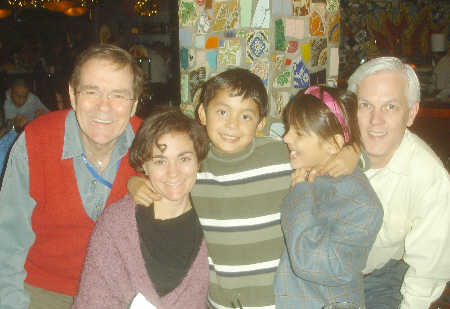
I left about 8:30 am to head for Bellaire (a small city inside Houston) and arrived there about 11 am. Yvette and I went to a Starbucks in the Village Shopping Center. Worked on the New York Times Crossword from one of the papers there. Will Shortz (star of "Wordplay" movie, see below) was the editor — I now knew him from watching the movie. I worked on it and finished it. The Wednesday puzzle. First Times crossword I ever completed. Then Yvette and I had lunch.
I bought Del a fancy silk robe from Chico's Soma and a fuzzy wrap-around sweater for Yvette. Then we drove to a shop owned by Yvette's friend. As she aimed her car into a small strip shopping center, I said, "I hope we're not heading into the Hip-Hop Lollipop Shop over there." We were and did. I bought an angel t-shirt for Del and a pair of pants with pleats and a foldover top which fit Del perfectly when she tried them the next day when I got home. That was her only open before Christmas present because I knew she would love it.

Yvette and I took Greg out to dinner on his fiftieth birthday to a fancy Italian restaurant. I got the salmon with lobster cakes and jumbo shrimp on top. We took photos after dinner. I called Del and she told Evelyn that one of her presents contained a digital camera, and 10-yr-old Evelyn was all excited. As excited before opening it as Garret had been coming out of the Chipmunks movie. On the way back from dinner, Evelyn wanted to go straight home and bypass the Christmas lights. She got outvoted and we drove past large estate homes with huge oaks with hundreds on single strand lights hanging straight down, like icicles hanging to the ground, or a Christmas Banyan tree.
When Evelyn opened her present, her eyes lit up in sheer joy! Brighter and happier than I had ever seen her before. It was THE present she wanted for Christmas and Gramma Del had hit the jackpot!
Our 7-yr-old grandson Aidan opened his remote-controlled tarantula and navigating it around the floor, as his mom, Yvette was helping get his sister Evelyn's camera charged up on her PC. Suddenly Aidan put the moving spider on top of his mom's head and the rolling wheels grabbed onto Yvette's hair and would not let go. She couldn't remove the tarantula. I looked at it and decided that I needed a flashlight and a tweezers. Evelyn found the light and Greg the tweezers. I pulled the hair back through the rollers one hair at a time until I could finally get my fingers between the hair and the rollers and remove the rest
of the hairs. No hair pulled out of Yvette's head except for a few strands which I later removed from the rollers under the tarantula. I can imagine the warning sticker next year on this toy: DO NOT PLACE ON TOP OF YOUR MOTHER'S HEAD.
Unfortunately the tarantula still worked after all the rigmarole!
The next morning I left about 8:30 or so. It was rainy part of the day, but the roads were mostly wet and kept spraying my car almost all the way home. I decided to go the southern route when I noticed the black clouds over I-10 to Baton Rouge. I'd rather get caught in heavy weather on the 90 or I-49 corridor than on I-10 with the raised highway. I did drive through a heavy downpour around Patterson. Didn't stop but kept my blinkers on and most of the vehicles behind me stayed there till it cleared up ahead and I could resume speed.
I hit another spot of heavy weather as I neared Bubba II's Restaurant outside Des Allemands, and I decided to get under the cover and pump some gas. Well, the cover was so small and the wind driving towards the building was so strong I decided to park up against the building next to the covered awning. But it required me to climb over to the passenger's side to exit the car. Well, my Maxima was very upset about what I had done and began beeping like crazy. The alarm system thought I was a burglar who had broken the passenger side window
and reached in to open the door. How could my Maxima do that to me? Did she not recognize the loving owner who fed her the best nutrition available, who lubricated her regularly, and took her to the car wash spa for a bath and full body rub?
I got back in the car from the passenger's side to keep from getting wet and began to drive away with the alarm still going off. Before I could leave the parking lot, the alarm stopped, so I backed into the same spot so that I could exit the driver's side and not trigger the alarm. Soon as I opened the driver's side door, my dearest Maxima began loudly bleating again, alarm on full-force, and I had run out of patience. I walked into the store exasperated, and a guy said, "Put your key in the lock and the alarm will stop." I walked back and did that and the standoff was over. My dear Maxima and I were friends again. I went inside and thanked the guy and asked him, "How did you know to do that?" He said, "Nine years as auto mechanic. If you replace the battery, you have to do that also."
I wondered for several days how my Maxima knew that her driver's side was empty when I exited the car. Later, I asked Chris, my grandson, and he said, "The Maxima has pressure sensors under each seat so that the airbags won't deploy if no one is sitting in the seat." Pressure is set for 40 lbs. so that the airbags won't deploy if a small kid is sitting in the seat. Good thing to know. I suppose the alarm system is linked into those pressure sensors as well, and that's why the alarm kept going off when I exited. Makes me wish for the cars of the Fifties
when you could roll the car without an ignition key, you could start the car by pushing it, and there were no fershslugginer alarm systems to drive you batty. Now I will have much more sympathy for folks whose car keeps on beeping and they don't know how to turn the thing off. Been there, done that.
On the penultimate Sunday of December disaster struck! My computer would not reboot. Some hardware failure. Either a motherboard or hard drive. The red light for the hard drive stayed on for a minute or so and the beginning screen simply froze. I powered it up and down numerous times and the same thing happened. My end of the month rush is coming and my computer guy can't work on it until Wednesday the 26th and if it takes several days to repair, my deadline will be shot. I looked at Laptops at Best Buy and found a HP LT that seemed suitable. Del said, "Go get it, it'll be your Christmas present." The next morning, I came home with the new Laptop and began moving the software over from my Backup USB disk. Remember the "Backup, Backup, Backup"? That's what it's for.
On Christmas Eve, I started up the HP LT at home, getting its Norton Internet protection software validated, and testing out the new Vista system. On Christmas afternoon, after Del and I had exchanged our gifts, I went to work installing the applications from my XP system into Vista to find out if there would work. My photo software was okay, my word processor had a minor problem, and my .html editor, I needed to get the download file from my Backup USB disk, but unfortunately, three folders on the disk were missing including the one I needed! I took the USB disk and put it on my older LT and there were the three folders! What is going on?
Then I went to open a word processing file and noticed that those three folders weren't visible either. So I switched to MS WORD and it showed the folders, but they were lightly shaded. The folders were classified as Hidden in their attributes! Whenever I get a new operating system, the first thing I do is make all Hidden files and folders visible, but it's been six or so years since the last time I loaded a new operating system and I forgot about the Hidden files trap. Sent off an email to Yvette's friend Kent in Bellaire and he sent me instructions for making Hidden files visible. Those instructions are at the bottom of the Digest if you're interested.
But another amazing thing happened on Wednesday. I tore apart my desktop PC, set the main frame in the back seat of my Maxima and drove about 12 miles to Metairie and the Computers-R-Us shop. Carlton, who had worked on my PC previously, listened to my tale of woe and plugged it in. The PC came up right away! Nothing to fix! No backups needed! Nothing to do but just go home, plug it back in and get to cracking. I told Carlton, "It must be your magic hands." He smiled and mumbled something about the trip over reseating something that had come loose. Only problem with that explanation is a bumpy trip is more likely to un-seat a board or component than re-seat one. Plus, the computer was just sitting there on a stationary desk when the problem occurred.

I called Del as I drove homeward in an exuberant mood, "You know what you do with an overdue pregnant woman?" "What?" "Take her for a drive on a bumpy road and the baby will come right out." At least that's the old saying I heard many times during my own fatherhood adventures. Whatever it was, I was delighted. An hour later, my PC was back up and running, and my Vista LT will have to wait a while till it gets some more attention. When I'm finished with the LT, it will be able to replace my PC desktop on a moment's notice, and I will be in a position to upgrade my desktop to Vista at a later date.
BREAKING NEWS: My PC BROKE AGAIN! This time on New Year's Eve. Everything was going swimmingly on a bright and clear afternoon. I was working diligently on my year's end tasks when suddenly the power went out in the house. I closed my work and let the APC UPS take care of shutting down my PC, which it did 15 minutes later. I called 1-800-9OUTAGE to report the outage of power to ENTERGY, who had me check my breaker (OK), and while I was outside I checked with the neighbor on that side of Timberlane and her doorbell rang (power on sign) and she said it was okay. Timberlane had its own underground transformer which broke about ten years ago and I did not know that we were the sole resident on it. So I didn't report it, until it stayed out for about 3 hours. It took another 3 hours to locate a new transformer and replace the broken one, so now I report power outages immediately. Neighbor on the other side is now on the same transformer and her power was out also. A breaker had to be reset at the end of the road and the power came on after a one hour outage.
With the power restored, I went and turned on my PC, and it halted at the same place it had halted about seven days earlier! Would not reboot. I tried thumping the case to simulate the ride to Metairie of last week which seemed to revive it., Even though I reasoned that was not what had done it, I didn't know what else to do. As I sat at the counter drinking my afternoon cup of coffee, a thought occurred to me to try HOLDING the DEL down while hitting the RESET button. The reset button is a HARD BOOT — it shorts all the logic signals to ground and triggers a complete reboot. It's better than a simply three finger salute (CTRL-ALT-DEL) reboot because any stuck devices due to a logic fault will be revived by a RESET. I held down the DEL button and pushed in the RESET button and Lo and Behold! I saw some autoexec.bat instructions being displayed one line at a time instead of the static screen formerly displayed. The red light stayed on as before, but now I could tell where in the bootup sequence it was stuck! The last instruction read: "Initializing USB Controllers". Great news! I had thought the red light indicated a stuck circuit in the system's hard disk controller, but it was the USB controller! I have no USB hard disks connected during bootup, so it couldn't be a hard disk, had to be a memory stick — that was my first guess anyway. I quickly removed two flash card (memory sticks) that were plugged into USB ports and RESET the PC again and it booted up normal! ! ! I had miraculously discovered a way around the problem. Don't know which of the two is bad, but I suspect it's the activa stick. Easy enough to check next time it boots up.
Here's my reconstruction of the events from the previous week. PC would not reboot. I took out all devices connected to the PC mainframe, including the two memory sticks in the USB. Drove it to the computer store and when he powered it up, because the offending stick was gone, it booted up just fine! One of the memory sticks has a faulty circuit which is not responding during the bootup sequence, so the PC simply hangs waiting and cannot proceed to boot up. Remove the stick and boot up and then put the stick back in and it's usable and causes no further problems. The amazing piece of data was to discover that holding down the DEL key during a RESET makes the startup sequence visible. This startup sequence was
ALWAYS visible during the early days of PCs and was very useful. As PCs got dependable and people had no idea how to interpret the sequence, it was made invisible, but designers left a back-door so technicians or savy users could watch the sequence to do exactly the kind of hardware debugging which saved me a couple of days of trips to the computer store to find out that the PC had nothing wrong with it. The offending part had been left back on my empty desktop: a $20 memory stick! I hope this helps you good Readers and saves you unnecessary trips to the repair store.
That brings me up-to-date. It's been a full and exciting Christmas. All the exciting parts were not fun, but I learned how to stop a car alarm which won't stop by pushing the clicker, and I got an hard reminder of the dumbing down of operating systems which leads to files being invisible. Turns out that the three folders I needed the most from my Backup USB disk contained systems files and that causes a Hidden attribute for the folder which can NOT be reset. You must make hidden files visible if you wish to copy those files. The new HP LT is a treat and will open up new vistas of opportunity for media. It could handle the CD Yvette gave me from Greg's Birthday Party with MP3 songs from the 1970s (whereas Yvette's own PC could not). We will be able to watch INSTANT MOVIES from NetFlix in the screening room through the wireless internet ability of the LP and the S-Video output connection.

On December 29th we joined Jim and Gail Webb, Greg and Cheri Deis, Mike and Wendy Jamison, and others at the Caesar's Ball. The Ballroom on the Riverfront Hilton was jammed packed with revelers of all ages. Music, dancing, food, and beautiful costumes filled the night as a parade of Caesar's Dream Destinations walked, danced, boogied, and exploded before our eyes and ears.
On the penultimate day of the year, we went to church in the morning and then I watched the Saints play another credible game in Chicago and lose while remaining within striking distance at the end, 33-25. A losing season 7-9 for our sophomore coach, Sean Payton, who made sophomore mistakes. Pierre Thomas, our remaining healthy halfback, who grew up a Bears fans outside of Chicago,
played the game of his career, gaining over 100 yards rushing and passing, the first Saints to ever have such a double-duty day. He was the also-ran on the squad that the fans loved during pre-season and cheered for him to be kept on the squad. He showed his true colors on this day, scoring a TD both by running and passing. Next year we need a new special teams coach, and much better draft picks than we had this year. Bless you, Boys!
In the evening Del’s mother Doris and brother Dan and his wife Karen joined us for dinner at Gulf Stream Restaurant on St. Charles Avenue, and then at Timberlane for dessert and coffee and to exchange Christmas presents. We are delighted to hear that Dan and Karen are progressing towards moving back to the New Orleans area as they enter this retirement phase of their life. Karen’s jobs as a shipping executive kept her and Dan moving from Florida to Chicago to Puerto Rico to South Carolina every couple of years and they are looking forward to settling down closer to home.
The year 2007 has been a Wild Ride at times, but mostly a time of studying and growing for me. I took about six different Teaching Co. courses which I listened to during my daily drives to PJ's Coffeeshop. I read and wrote detailed reviews about three dozen books. My average monthly output of writing for reviews was about 50 pages. The other major writing task was the monthly Digests. Hard to get an estimate of the writing volume, but each Digest recently has contained about 60 to 70 photos, each of which must be photographed, enhanced, sized, identified, selected, and cropped before finding a place to set it into the Digest. How many people read my Digests each month? My statistics for 2007 show about 30,000 Good Mountain Press Digests are read each month. Just got a new subscriber to the Digest from a Good Reader in Denmark.
In addition, there is a less visible side to my daily activities which has to do with fielding questions about the science of doyletics. As Principal Researcher for the Doyletics Foundation, I am the collection point for the successes that people have with doyletics. I am also the focal point when someone fails. We learn more from our failures than from our successes, and I am always delighted when someone writes with a problem. Sometimes they need some advice in order to do their first speed trace or in figuring out exactly what they should be tracing. Answering these questions are my first priority each day. Sometimes it takes minutes sometimes hours. It all depends. Just got an email from a man who was over-weight and used the speed trace to remove his hunger pangs. Another success. On the World-Wide Doyletics List, we have 140 members from all over the world who read the messages and use doyletics to help improve their daily lives.
In California near San Bernardino, Doyle Henderson is in his mid-eighties and living alone in his luxury motorhome. He has diabetes, heart problems, is on a pace-maker, and on full-time oxygen supply. He has had more near-misses with death than anyone I ever met, but he remains cheerful as ever. All his fear doyles have been traced and he can live in the moment without fears arising from what might happen. He knows his time is limited, but he carries on, still thinking about how to help other people around the world remove their unwanted doylic memories so that they might enjoy their lives to the fullest, without fear, trembling, or depressive moods. Please join me in praying for Doyle Philip Henderson's continued health and happiness during the coming New Year of 2008.May the New Year bring each and every one of you Good Readers: happiness, health, prosperity, and love. Especially lots of love — because one can live without the other things, but without love, life itself is not worth living. Remember Love is a Verb. As such it something you must do, not something you receive. Therefore you can only give love actively. So if you have only one resolution to make for 2008: let it be this one: Give Love this year to each person you meet. Remember God does not make strangers!

Till next we meet again next month in these pages, God Willing, we remain your intrepid editor and copy-editor of the Good Mountain Press Digest, Bobby and Del Matherne.
~~~~~~~~~~~~~~~~~~~~~~~~~~~~~~~~~~~~~~~~~~~~~~~~~~~~~~~~~~~~~~
IMPORTANT MESSAGE:
To those Good Readers who are puzzled by How the Moon could be Rising In Front of a Mountain, Click on Photo. To see 161021 photo, Click Here. ALSO: if you are puzzled because you No Longer get our Monthly Reminder, you may have Changed Your Email Address without notifying us. NOTIFY US NOW by a simple Click Here!
Here's the Sting:
You will NOT receive a Monthly Reminder unless you have Re-subscribed under your new address to DIGESTWORLD.If you've already receiving DIGESTWORLD Reminders, ignore this message.
If you're not subscribed, and would like to Subscribe to DIGESTWORLD Reminders to receive one short email a month to inform you of the latest ISSUE, now's a good time. SUBSCRIBE NOW
by Clicking Here.Yes, this message does no good to those who changed their email address without notifying me — but it can alert those of you who are going to change your address.
If you've changed or are planning to change your email address, Click Here to SEND NEW ADDRESS. (Alternate way is to copy into your Browser this URL: http://www.doyletics.com/subscrib.htm )
EASE OF VIEWING NOTES:
NOTE: For Internet Explorer Browsers, DIGESTWORLD is best viewed at 100% Zoom and the Window's width sized so that Digest Archives lines are single-spaced, just barely. Adjust Window width so that Mountains almost touch the Archive Numbers, especially if you find some Photos overlapping text.PHOTO CAPTIONS (CURSOR FLYOVER ISSUE RESOLVED):If you have been enjoying the photos in DIGESTWORLD, but have wondered who or what you were looking at, you will now be able to hold your cursor still over the photo and the photo's description will appear. (Test on Butterfly-Crab Image at Right.) We spend a lot of time writing these photo captions and hope you will read them. All the Archived Issues have been updated to provide descriptions when your cursor rests for a second on a photo. Note that older Reviews have not been updated. If you haven't finished reading text when description disappears, move cursor away and back on photo to finish. We thank you for your patience and hope this pleases you.
New Quotes Added to quotes.htm this month:The poet has a new thought; he has a whole new experience to unfold; he will tell us how it was with him, and all men will be the richer in his fortune. For the experience of each new age requires a new confession, and the world seems always waiting for its poet. Ralph Waldo Emerson, American Philosopher (1802-1882)
 A preoccupied attention is the only answer to the importunate frivolity of other people; an attention, and to an aim which makes their wants frivolous.
Ralph Waldo Emerson, American Philosopher (1802-1882)New Stuff about Website:
View Mammatus Cloud Formations on new Tidbits Page: Click Here!
The five most popular A Reader's Treasury reviews:
1. Frogs into Princes — Neuro Linguistic Programming by Richard Bandler and John Grinder
2. How to Read a Book by Mortimer Adler
3. The Structure of Magic, Vol. I A Book about Language and Therapy by Richard Bandler and John Grinder
4. The Structure of Scientific Revolutions by Thomas Kuhn, etal
5. Illusions — Adventures of a Reluctant Messiah by Richard Bach
New Stuff on the Internet: Let the computer guy figure out your number: Click Here!
~~~~~~~~~~~~~~~~~~~~~~~~~~~~~~~~~~~~~~~~~~~~~~~~~~~~~~~~~~~~~~
Movies we watched this past month:
Notes about our movies: Many of the movies we watch are foreign movies with subtitles. After years of watching movies in foreign languages, Arabic, French, Swedish, German, British English, Russian, Spanish, Italian, Japanese, Chinese, and many other languages, sometimes two or three languages in the same movie, the subtitles have disappeared for us. If the movie is dubbed in English we go for the subtitles instead because we enjoy the live action and sounds of the real voices so much more than the dubbed. If you wonder where we get all these foreign movies from, the answer is simple: NetFlix. For a fixed price a month they mail us DVD movies from our on-line Queue, we watch them, pop them into a pre-paid mailer, and the postman effectively replaces all our gas-consuming and time-consuming trips to Blockbuster. To sign up for NetFlix, simply go to http://www.netflix.com/ and start adding all your requests for movies into your personal queue. If you've seen some in these movie blurbs, simply copy the name, click open your queue, and paste the name in the Search box on NetFlix and Select Add. Buy some popcorn and you're ready to Go to the Movies, 21st Century Style. You get to see your movies as the Director created them — NOT-edited for TV, in full-screen width, your own choice of subtitles, and all of the original dialogue. Often you get the Director's Cut Edition which adds back excellent footage that was cut from the theater releases.
P. S. Look for HD/DVD format movies which are now available from NetFlix.Hits (Watch as soon as you can. A Don't Miss Hit is one you might otherwise ignore.):
“Vitus” (2007) is a child prodigy whose loving parents wants what’s best for him, er, them, as usual with such parents. He becomes unhappy and in an absolutely remarkable twist of the usual script for a kid who is smarter than his parents, he turns the tables and becomes happy by returning to normal, so far as the most of the world knows, but Granpa knows better. “He’s the on ly one who doesn’t bore me,” Vitus explains. He asks one teacher who believes the teacher is smarter than the pupil, “Why did not James Watt’s teacher invent the steam engine?” Fly with Vitus through this marvelous, insightful, and superbly entertaining movie. A DON’T MISS HIT ! ! ! ! ! !
“Wondrous Oblivion” (2006) Watch this movie and grab yourselves a bit of wondrous oblivion from David, the cricket-player wannabe and his family in lower-class London district. Then an amazing Jamaican family moves in next door and the class of the neighborhood rises. A DON’T MISS HIT ! ! !“Kiss, Kiss, Bang, Bang” (2005) Laugh, Laugh. Funniest part is that we never expected LAUGH! ROTFLOAO, time and time again. Imagine Val Kilmer and Robert Downey as Laurel & Hardy in a Keystone Kops farce: "Harold the Magnificent goes to Gay Perry." Brief nudity and drawn-out nuttery.A DON’T MISS HIT ! ! ! !
“Live Free or Die Hard” (2007) Another Bruce Willis thriller with our hero bloodied but unbowed at the end. A Cyber-Terrorist attempts a “fire-sale” in which every bit of the infra-structure must go. What goes is every bit of the terrorists, one at a time with the help of the deluded hacker who helped them crack the codes.
“Premonition” (2007) a great performance by Sandra Bullock in this psychological suspense movie where she seems crazy, but is merely glimpsing reality sideways.
“Angel-A” (2007) A film noir with a short dark Arab and a tall blonde Swedish bombshell. Andre is a liar, a thief, owes everybody in Paris big bucks, and they’re trying to kill him. He is ready to jump from a bridge and take his own life but instead jumps to save the life of Angela and she returns the favor. A DON’T MISS HIT ! ! !
“The House of D” (2004) is the House of (Chose One): Duchovny, Dentention, Despair, Demeaning, Departing, Delight, Delovely, Delicious, and Deliriously Wonderful. Thomass and Pappas are the odd couple meat delivery boys on bicycles who grow up together and apart. Don’t miss a second of this incredible movie which will do Harpo arpeggios on your heart strings. A DON’T MISS HIT ! ! ! ! !“Night of the Shooting Stars” (1982) A small Italian town must decided whether to stay or leave as the Nazi’s and Mussolino’s fascists approach. Half the town decides to leave and we walk with them through peril-fraught country roads, woods, and fields as they seek the only safety they can hope for, American soldiers. Amazing and marvelous movie. A DON’T MISS HIT!
“Death in Paradise” (2006) Jesse Stone deals with a wife beater and a child molester. But, can he prove that the scumbag author killed the young girl whose decomposed body was found in the water weighed down by cinder blocks and a badly tied knot?
“Mobsters” (1991) are a foursome of street thugs who take on the big mob bosses and with brains and firepower take over and unify the warring factions into a peaceful coalition. Christian Slater as Lucky Luciano along with all the other recognizable mob bosses of the twentieth century.“The Dream Child” (1984) Rev. Charles Dodgson writes a fanciful story to a little girl named Alice which professes his love for her in riddles that take her 80 years to unravel during her commemorative speech to Columbia University. A young Peter Gallagher plays an intrepid reporter and agent of change.
“Pizza” (2005) Cara-Ethel turns 18 in ten hours when the cock crows and no one comes to her birthday party except the pizza man Matt and that was enough to make this a memorable night in her life and a memorable movie.“Saturday Night Fever” (1977) Del and I watched this movie in a theater on one of our first dates. It was amazing and it still is. Always gets us up and dancing. Often the dancing continues in bed. Disco swept the nation and the BeeGees music was ubiquitous. This movie still lives in us and on the big screen of our memories. A DON’T MISS HIT ! ! ! !
“The Mighty Celt” (2005) A young boy raises a champion greyhound racer, loses him, and re-gains his long-lost father in this film.
“Steal a Pencil for Me” (2007) Excellent documentary, switching between 1940s and modern day Amsterdam, showing the lives of a couple who endured two concentration camps together and survived to tell about it in this movie as they celebrated their 60th anniversary together.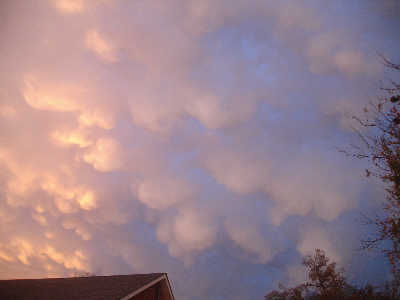
Misses (Avoid At All Costs): We attempted to watch these this month, but didn't make it all the way through on most of them. Awhile back when three AAAC horrors hit us in one night, I decided to add a sub-category to "Avoid at All Costs", namely, A DVD STOMPER. These are movies so bad, you don't want anyone else to get stuck watching them, so you want to stomp on the disks. That way, if everyone else who gets burnt by the movie does the same, soon no copies of the awful movie will be extant and the world will be better off.
“The Second Chance” (2006) is the name of the church and the assignment the minister from the founding church who needed to get real. Get real? That’s what this movie needed to do. It deserves no first chance.Your call on these — your taste in movies may differ, but I liked them:
 “Once” (2006) a street musician in Dublin meets a Czech piano lass, music happens. Classic story of girl meets boy, girl falls in love, and girl goes back to husband.
“Shanghai Triad” (1996) A young boy is assigned to assist a courtesan to a mob boss in Shanghai and gets to observe the life of this country girl turned big city singer up close and personal.
“You, Me and Dupree” (2006) should watch something else than this movie.
“Offside” (2006) is where we watch the soccer game from the penalty box or rather hen’s cage where girls trying to get into to watch Iran qualify for the World Cup are locked up outside the stadium. They have fun anyway, and the game we don’t get to see is won by Iran.
“The Number 23" (2007) Jim Carrey rants his way through a dark movie which runs through every appearance of “23" except the cell number at the end of “A Tale of Two Cities” movie and Mr. Spock’s Vulcan salute. May you also live long and prosper. Carrey is final done in by a Biblical verse, Numbers 32:23 “Be sure your sin will find you out.”
“Alvin and the Chipmunks” (2007) My 7-yr-old grandson Garret said walking out of the movie, “Mommy! This the best movie I ever saw!” I sleep through the good parts apparently.
“Wordplay” (2006) Will Shortz, professor of Enigmatology, has built puzzles since he was nine and now is Editor of the NYT Crossword Puzzle. He shapes them to each day of the week. Didn’t know Monday was the easiest one. This movie is filled solving and building of crossword puzzles including the eponymous one Wordplay and we watch as the constructor builds it from scratch. A must see for those who cross swords with cross words on a daily basis.
“X2: X-Men United” (2003) in a sorry comic-book-movie with too much flash and dash and too little substance.
“Illegal Tender” (2007) is both. Mother had illegal money and she was tender towards her son after his father was murdered by drug lord as she gave birth to his son. With 2 million dollars she laundered from her husband’s drug-selling operation, she invested and put her son through college. We follow her and her son as the drug lord catches up with them.
“Garfield: The Movie” (2005) is true to the cartoon — a charming romp through life with Garfield, Jon, and Odie.
“Heartbreak Kid” (2007) Ben Stiller shows the folly of living your life up to others’ expectations and advice. He marries quickly and then discovers his wife is a freak on his honeymoon and falls in love with Miranda while his wife is recovering from intense sunburn. Few really fun or funny parts in this sad commentary on how parents are raising their children these days.
== == == == == == == == == == == == == == == == == == == == == ==
4. CAJUN STORY:
== == == == == == == == == == == == == == == == == == == == == ==Thibodaux's two sons, Gabe and Felix, were in the same class at school because Felix got left back one year. One day the teacher had the class write reports about their pets. After the reports were all turned in, the teacher called Felix up to her desk."Felix," she said, "This report you wrote entitled 'My Dog' is exactly, word-for-word, the same as your brother Gabe's report. Tell me truthfully now, did you copy from him?"
Felix replied earnestly, "Mais, no Ma'am. Mah story is about de same dog!"
== == == == == == == == == == == == == == == == == == == == == ==
5. RECIPE of the MONTH for January, 2008 from Bobby Jeaux’s Kitchen:
(click links to see photo of ingredients, preparation steps)
= = = = = = = = = = = = = = = = = = = = = =Vegetable Triage Stir Fry
Background on Vegetable Triage Stir Fry:
Ever had leftovers from a veggie tray and wondered what to do with them? Chef Deli Ruth shares Bobby Jeaux's Kitchen and she whipped up this delicious stir fry concoction using most of the veggies shown in the Ingredients photo.
Ingredients
Leftovers used from Veggie Tray: strips of bellpepper, broccoli, cauliflower, zucchini, yellow squash carrot sticks.
1 pk. 8 oz Fresh Mushrooms
2 yellow onions
1 tsp chopped garlic
Seasonings: black pepper, Tony's, Season-All
1 TBSP Bertolli's Extra Lite Olive Oil
Preparation
Parboil broccoli in microwave. (This keeps the broccoli separate and makes the final presentation much prettier.)
Chop onions and fresh mushroomsCooking Instructions
Sautée; onions and garlic in Olive Oil till translucent. Add the cauliflower and carrots and cook until softened. Then the zucchini and squash. Cook till softened. Add mushrooms. Sautée; on MEDIUM HEAT for about 10 minutes. Add broth from broccoli as necessary. Then add broccoli to top before serving, but and stir lightly to distribute the broccoli. Result in pan should look like this.
Serving Suggestion
Serve over long grain/wild rice mixture.
Other options
Add tomatoes and celery chopped up in early portion of cooking process. Add Soy Sauce if you like, but eliminate salt earlier if you wish to add Soy Sauce since it contains salt.
== == == == == == == == == == == == == == == == == == == == == ==
6. POETRY by BOBBY from Rainbows & Shadows:
= = = = = = = = = = = = = = = = = = = = = =Something Dewing
Everlasting day can no more freshen the earth with dew than everlasting night, but the change from night to day and from day back again to night.In the arms of everlasting day
— Owen Barfield
dew dries up and goes away,
But couched in the warm blackness of the night
dew returns in wet delight.
Unless there be an ebb and flow,
night-time come and daylight go,
No dew would e'er intrude
upon the midnight quietude.
The spinning globe creates the dew
and in its wake
It spins a web of life anew.
Thus may we forsake
our pride, vanity, and hubris, too
Remembering our origin is as humble as the dew.
== == == == == == == == == == == == == == == == == == == == == ==
7. REVIEWS and ARTICLES for January:
= = = = = = = = = = = = = = = = = = = = = =And for my Good Readers, here’s the new reviews and articles for this month. The ARJ2 ones are new additions to the top of A Reader’s Journal, Volume 2, Chronological List, and the ART ones to A Reader’s Treasury.
1.) ARJ2: What Is Anthroposophy? 3 Lectures, July 20-22, Dornach, GA#225 by Rudolf Steiner

The 32-page Introduction by Christopher Bamford gives the best overview of Rudolf Steiner and his works that I have found anywhere. How could this polymath genius of philosophy, drama, education, architecture, sculpture, and occult matters remain hidden from the world at large for over a century? It is ironic that Steiner endeavored to make public and open those occult matters that had been hidden under lock and key of the mystery schools, only to have his work remain hidden itself for so long. One answer is that there exists a cultural inertia which any new revelation must overcome, and it can only do so with the passage of time. Bamford offers us two additional reasons:
[page 1] First, Steiner accomplished so much and in so many different fields that it is difficult to categorize him in any conventional manner. Second, he swam unapologetically against the stream, affirming the primacy of the spirit against the ruling dogma of materialism.
In addition, Steiner, born a Catholic, remained a Christian all his life, but a dramatic event happened in his life when around the turn of the twentieth century, he began to ponder "the evolution of Christianity with spiritual perception." You see, Steiner was a mystic, with native clairvoyant abilities from early childhood, so far as we know. Then one day the light dawned on him:
[page 5] "A conscious knowledge of true Christianity began to develop within me. Around the turn of the century, this knowledge grew deeper. The inner test occurred shortly before the turn of the century. This experience culminated in my standing in the spiritual presence of the Mystery of Golgotha in a most profound and solemn festival of knowledge."

Steiner was a most extraordinary Christian, one who took nothing on the word or reports of others, but relied upon his own personal experience. Others may write that he was a Theosophist or a Gnostic, claims one can lay to an inadequate study of his life and works, but Bamford, who has studied these in detail, lays it out directly and emphatically thus:
[page 5, 6] In other words, as he described himself, Rudolf Steiner was an Anthroposophist and taught Anthroposophy from the start and never deviated from it. What Steiner did and taught is, from this point of view, Anthroposophy. From this point of view the two — Rudolf Steiner and Anthroposophy — are interchangeable.
In brief, anthroposophy refers to the wisdom (sophia) of the full human being (anthropos). It is a way of knowledge which "leads the spiritual in us to the spiritual of the universe." (Page 6) The phrase "spiritual science" is a synonym for anthroposophy coined by Steiner. The term anthroposophy itself was first coined by the Welsh alchemist and mystic Thomas Vaughan in the seventeenth century. (Page 10) Steiner saw it as a middle path between anthropology and theosophy and described it this way:
[page 13, 14] If anthropology can be likened to a traveler in the lowlands who gets an idea of the area by going from place to place and house to house, and if theosophy can be likened to the view we can get of the same area from the top of a hill, then anthroposophy can be likened to our view from the slope of a hill, where we can still see the various details, but they come together to form a whole.
Steiner was in a unique position to view the spiritual up the hill and the material down the hill and to bequeath us, via his spiritual science, the linchpin that connects the spiritual and material into one unified, functional whole. Bamford explains that during the time period 1914-1918 Steiner was busy “Recognizing and Overcoming Evil”. (Page 21, 22) He was also building the first Goetheanum in Dornach, Switzerland during the period of the Great War (WWI). During the laying of the foundation stone for the building on a drizzly, thundering night, Steiner read the macrocosmic Lord’s Prayer. I first encountered that prayer when I read Steiner’s The Fifth Gospel and used it later when I studied Adam Bittleston’s book, The Lord’s Prayer. In the full review from which this blurb is excerpted, you can read my synthesis of how to understand the Lord’s Prayer based on the ideas I have pondered many times since studying those books.
[Excerpted from my review of The Fifth Gospel]
In his twenty-fourth year, Steiner reports that Jesus visited a pagan worship site where the people hailed him as a priest come to revive their ancient place of worship. As Jesus neared the altar the people pushed him onto it and demanded he perform an offering service for them. Jesus fell face down on the altar as if in death, and the people scattered in fear. Jesus heard the ancient voice of the Bath Kol saying to him these enigmatic and powerful words: [Note how the macrocosmic Lord's Prayer contains the Lord's Prayer, but it is backwards.]
[page 51 of The Fifth Gospel]
Amen.
The evil holds sway.
Witness of egoity freeing itself.
Selfhood guilt through other incurred.
Experienced in the daily bread.
Wherein the will of the heavens does not rule.
Because man separated himself from your realm.
And forgot your names.
You Fathers in the heavens.Without Rudolf Steiner, we would not have come to understand the spiritual depths in the one prayer which Christ Jesus specifically directed each human being to say. With Steiner's help, we can see clearly the path we each must take from the material world to the spiritual world. Bamford explains:
 The three lectures of this book deal with 1) The Physical Perspective, 2) The Psychological Perspective, and 3) The Spiritual Perspective.
[page 25] Steiner's description of Jesus' experience of the "macrocosmic Our Father" provides a clue to its inner meaning . . .
Echoing the definition of anthroposophy as the path of knowledge that connects the spiritual in the human being with the spiritual in the universe, Steiner says: "The realization dawned in Jesus . . . 'What I have to tell human beings is not how the gods prepared the path from the spirit to the Earth, but how humanity can now find the path that leads from the Earth to the spirit.' "In the Physical Perspective lecture Steiner says, “I will limit myself to the very first phase of life after passing through the gate of death.” The four bodies of Man are the physical, etheric, astral, and I. During sleep periods, the four bodies separate into two bundles: the physical and etheric bodies remain attached while the astral and I separate. These two bundles come together during day-time consciousness and separate in twain at night when we are unconscious. This is repeated daily until we die, and then a different process occurs. The physical body is left behind and the remaining three bodies remain united while the etheric body undergoes a dramatic conversion.
[page 36, 37] This happens as follows. Imagine that, after death, the whole etheric body is turned inside out like a glove — so that the inside, the part that touches the skin, is now on the outside. . . . The whole etheric body gets turned inside out. As the transformation occurs, the etheric body expands astonishingly fast. It becomes immense and spreads out immeasurably into the universe.Our experience fills, not with sense impressions (like the red color of a rose), but instead with how “the redness of the rose formed within us as a concept.”
[page 38] On Earth, in earthly life, we used to allow our gaze to glide from rose to rose. As we moved from rose to rose we formed representations of them within our soul: first one rose, then another, and yet another. Now they succeed each other, weaving in lightning waves, as if in the living process of becoming, not as roses, but as ideas, inner realities. These enter our inner life as if we were in a sea of events.We begin to see and to understand how our soul life develops upon Earth and how our earthly life develops out of the cosmos. We see that we are in fact “children of the universe.”[page 38] Indeed, as everything we that we experience on Earth grows into the immeasurable, the cosmos, and as we ourselves grow outward with it, we realize that what was formed within us in our life on Earth was likewise formed — built — out of the universe.Our bodies, mine sitting here and yours sitting there reading this, have all their cells changed in the course of seven or so years, that much is known by materialistic science. What Steiner adds is that the heart and other organs are “renewed out of the ether” of the cosmos over an equivalent period of time. The substances we eat create the etheric forces which renew our body’s organs.
[page 41, 42] Therefore, nine or ten years ago, everything sitting here was still in the heavens. It was in the heavens, in the stars. In fact, whatever matter remains behind and pervades where etheric forces should by rights have been working, we find a predisposition toward illness. Illness is caused by the presence within us of physical matter that remained . . . Deep insights into the nature of illness are gained when we understand how matter can remain stuck, instead of being expelled, as it should have been. Any substance we absorb as physical matter is meant to be eliminated again. If it remains in the organism, it becomes a cause of illness.In the Psychological Perspective lecture Steiner asks us to ponder a question he had asked himself some forty years earlier, “Who is the most intelligent person today?” The answer may surprise you: it was Eduard von Hartmann, who wrote “The Philosophy of the Unconscious” in 1869. The proof that Steiner felt that way toward Hartmann can be found in Steiner’s first book, “Truth and Knowledge,” which was dedicated to Hartmann “with the warm regard of the author.” What was it about Hartmann that Steiner admired so much? Here was a man of the highest intellect who was able to conceive of the spiritual world’s existence!
[page 52] He penetrated human consciousness as it is attached to the earth. But he saw this attachment as the attachment to a human physical body. Because he was clever, he did not deny the spirit. As I said, he was very intelligent. However, he placed the spirit in the sphere of the unconscious, in what can never support a body or enter into intimate union with the physical world, and which therefore, because it is always extraphysical — that is, purely spiritual — can only be unconscious. . . . [His] philosophy is a philosophy of the spirit, but a philosophy of the unconscious spirit.It occurred to Steiner that an “unconscious spirit can never penetrate any reality outside itself except through a physical human body” and this implies “that the intellect that rises to establish the unconscious lacks love.” (Page 52) Lacking love leads to lacking soul.[page 53] Wherever there is no place for love, anything of a soul nature gradually disappears. Hence we can sense of an atmosphere of lovelessness in the best productions of the later nineteenth century on whose shoulders our own civilization now stands.Apparently our current civilization in the nascent twenty-first century is still standing on those broad shoulders because one can find evidence of soullessness in every daily newspaper, often on a national scale where a gunman goes on a rampage killing people in shopping malls, churches, schools, and office buildings. Von Hartmann’s philosophy led him to imagine that our soul-spirit did not merge with our physical body. From other writings of Steiner we know that one can see with clairvoyant vision when a portion of one’s etheric body is detached or otherwise not fully immersed in the physical body. During waking consciousness this occurs when there has been some physical injury and there will always be pain at the location where the etheric body is missing. The phenomenon of one’s arm or leg “being asleep” is an example of a time when the etheric body can be spied as poking out from the dormant limb. Then when the limb begins to awaken, who has not felt the sharp “pins and needles” experience as the etheric body re-enters the limb and brings it to life and normal sensation again.
[page 54] If our spirit-soul were not merged with our physical body, but instead lived cut off from it, our soul would experience unfathomable, intolerable pain. Pain arises when an organ does not function correctly and the organ becomes sick and we are excluded from a part of our physical body If we were kept out altogether, we would, if I may put it this way, literally be “extraphysical,” out of the body, and we would suffer unspeakable pain. Each morning when we wake up, the threat of this suffering is to some extent present. We overcome it by submerging into our physical and etheric bodies and uniting ourselves with them.Steiner reveals to us the three soul-forces: our etheric body’s thinking-force as the font of freedom, our astral body’s dreaming-force as the font of memory, and lastly we come to our I or Ego body’s love-force as the font of morality. Our soul can thus be said to contain 1) freedom, 2) a life of memory, and 3) a force of love. (Pages 74, 75)
Everyone has lost some loved one at some point in one’s life, and we all deal with such loss in unique ways. Some of us have good memories of the loved one which makes them feel bad when they recollect them, because the person is not here. Others with the same good memories, recollect themselves being in the physical presence of the loved one and feel good. But we all preserve those good and bad memories after a loved one has gone from the physical world.
Those of us that are blessed with the ability that Steiner describes above may be given a rough time by those who can only sob and grieve and pine away for a loved one. They get upset because they perceive us as being un-caring whereas the exact opposite is the truth. Our loved one, yes, has died to the physical world, but that loved one can remain, with a little practice, a living presence of lovingness and good feeling, by following the process that Steiner outlined above. Theveneration of saints by the Catholic Church provides an opportunity for us to liberate our astral body and our “I” if we will learn to contemplate the saint’s image in the same way we contemplate a living person.
If we could learn to do this fully, we could be shocked to find ourselves having stepped momentarily over the threshold into the spiritual world and perceive the dead person as present in full reality. (Page 76, 77) Some people will not experience the appearance of a dead loved one who is present in full reality as a shock at all — they will be unconscious that the person had actually died. This may be due to senility, dementia, or various age-related diseases which cause loss of memory. Their so-called disease can be seen from the other side as a calculated albeit unconscious way of protecting themselves from the shock they would otherwise experience. This way of interpreting these experiences that many aged people have with their deceased loved ones is deprecated by establishment science, and its cohorts in the medical community prescribe drugs to prevent their “sick patients” from having what they label as “hallucinations” or “wild imaginings”.
Note how contemporary science ignores the reality of people who step into the spiritual world consciously (like Steiner) or unconsciously (like those with Alzheimer’s), preferring to substitute its own illusion (“hallucination”) in the place of reality. Such science tries to bury reality in order to protect its own dogma. A dog buries its bone in the darkness to safeguard its livelihood. Rightly understood, reality is a bone buried by dogma to safeguard its livelihood. We have freedom, but to the extent the dogma of science has buried reality to protect itself, if we are unaware of this deception, we are forced to deny our freedom as full human beings, our freedom as a human being.
 [page 77] But we deny our freedom. We deny it under the authority of contemporary science. Why? Because contemporary science sees only the mechanical, where what comes earlier is always the cause of what comes later. Therefore this science states dogmatically that everything must have a cause. It dogmatically affirms causality. Because causality must be correct, because we swear by causality as a dogma, we deafen ourselves to the feeling of freedom. reality is buried in darkness to protect dogma — in this case the dogma of a powerful science exercising its authority.The great delusion of our time, what Owen Barfield called the Great Tabu, is that the spirit comes first and activates the physical, but no reputable physical scientist can keep a job who acknowledges that openly and publically. Even Carl Gustav Jung came to understand that his “Archetypes” were in fact spiritual beings, and yet he never wrote of his understanding for fear of retribution from his colleagues. It was only on his deathbed that he revealed this fact to a close friend. Steiner reveals the presence of the delusion, and the scientific establishment, by ignoring Steiner and calling him names like “gnostic mystic”, keeps Steiner’s revealed reality hidden in a dark place where few will dare to enter given the warning signs posted by King Science: “ABANDON HOPE ALL YE WHO DARE ENTER HERE!” Let that sign remind you of why you may have never heard of what Steiner reveals in this book and in particular in the page 79 passage below.
 [page 79] The spirit incarnates in the physical. If the spirit forgets itself, if the spirit is only conscious of the physical, it will seem as if the physical activates what is actually activated by the spirit. This is the great delusion of our time.In other words, the ghost enters the machine, the machine springs to life, and science says, “See! The machine has created life!” Today thousands of scientists in various fields of biology, artificial intelligence, etc, are trying to create life, and their products so far have gone and will continue to go inevitably the way of Frankenstein’s monster. The one thing a machine cannot do, no matter how sophisticated its artificial intelligence, is to love. Science and love, like vinegar and oil, simply do not mix. You can shake and stir them together and they seem to mix, but soon it becomes obvious that only superficial, temporary mixing ever occurred. When materialistic science talks of love, it is talking about sexual attraction, not love. Through science, by denying the Genius of Love, we have replaced it by the Demon of Love. Steiner says it clearly, “The genius of an age always appears in the form of its demon, for the demon steps in wherever the genius is denied.” (Page 79) We have freedom and that includes the ability to deny our own being. We have science which fosters its own livelihood by encouraging us to deny our own being — its dogma buries selective portions of our reality in the dark, underground, and guards it with a warning sign that few dare to ignore.[page 80] It is in the power of human beings to deny their own being. They deny it when they sink down from the genius of love to the demon of sexuality — by which I mean above all the way our present time feels these things, the way they are mostly present.Rudolf Steiner is our guide who points out the warning signs and then leads us, if we freely decide to continue, to the graveyard where the bone of reality has been buried by the dogma of science and religion. We follow him there to exhume the living reality which has been buried alive for millennia and bring it out into the light of day where we may bask in its warmth-filled Light.
Read the Review at:
http://www.doyletics.com/arj/whatisa.htm2.) ARJ2: The Perfect Season — LSU’s Magic Year — 1958 by Bud Johnson

This was the perfect Christmas present for me this year as my alma mater will attempt to achieve its third National Championship in January in the BCS Bowl in New Orleans. While waiting for that game to begin is a great time for me to reminisce about my freshman year in 1958 at Louisiana State University. It was the year the LSU Tigers won their first National Championship at the end of the “perfect season” in which they went undefeated: 10 wins, no losses, no ties. It was a syzygy of elements: talent, platooning, and morale which led to this perfect season, and no one but Bud Johnson, the sports information director of LSU during that year, is better suited or more capable of compiling the statistics, personal comments, photos, and news reports to give us an inside look at the people and circumstances which brought LSU to the fore of college football in that magic year of 1958. It was impossible for me to ignore football because I lived in the cheapest dorms on campus, the North Stadium dormitory, Section H2, right over the athletic offices, ticket windows, and lockers rooms of the football team. Plus, on football nights, the student section sat directly above my head. You either went to the game and or went home each Saturday, and it was cheaper for me to go to game on my student pass than to buy a ride home some 90 miles away down river.
How the stadium got built with student dorms under the seats is an object lesson in Louisiana politics. Governor Huey P. Long was the biggest LSU fan ever. He marched with the band before and during games and even wrote an LSU fight song. He wanted a huge stadium for his Tigers to play in and the legislature was balking at the price tag. He decided to submit a bill for the construction of dormitories and they passed that bill. Then he had the architects design the dormitory in the shape of a football stadium!
About the third or fourth game of the “Perfect Season”, Coach Dietzel dubbed the defensive platoon the “Chinese Bandits” after a character in the “Steve Canyon” comic strip who called Chinese bandits the most feared bandits in the world. Soon my fellow dorm residents and I were banging on garbage can lids and gathering a crowd as we donned Coolie hats and marched across campus to the girls’ dorms. These impromptu pep rallies happened sometimes several times a week, and my ears kept perked up as I studied in my room for the sound of one beginning, and would close my physics text and jump down the stairs to join the fun. The avenue for letting off the steam of freshman libido, which panty raids provided on other campuses of the time, came from these spontaneous pep rallies to support the football team in 1958. The girls would be there, leaning out their balconies as we arrived and would join us in the cheering. Then we would return to our rooms. As the season progressed, we began to end our pep rallies outside Broussard Hall, the football dormitory and on occasion, Coach Paul Dietzel would come outside to address us for a few minutes.
Then came the Ole Miss game at LSU Stadium, Nov. 1, 1958. Two undefeated teams were meeting each other, No. 1 LSU and No. 6 Ole Miss. The National Championship could be riding on this game. Our “impromptu pep rallies” became a regular event every night that week. In addition, someone planted an “eternal flame” atop one of the two mammary-like Indian Mounds in front of the Huey Long Field House.
Was it Dietzel? We never knew. It just showed up on Monday night, this pyramidal shape of aluminum with a propane flame burning at the top. Every night, LSU men from all classes gathered around the flame to protect it from the Ole Miss fans who threatened to put out the flame. It was all-night vigils, made more difficult because beer and alcohol was forbidden on campus back then. But we were drunk on our libido and our intoxication was higher than any Jack Daniels or Dixie beer could instill. Cars passed by at all hours of the night, and we were sure that one of those cars would contain some Ole Miss Rebel fans ready to snuff our flame. By the end of the week, we heard about a plane flying over the Ole Miss campus in Oxford, Mississippi dropping leaflets which echoed our nocturnal war chant, the one we yelled as we circled the flame atop the ancient Indian burial ground: “GO TO HELL, OLE MISS, GO TO HELL!” We all suspected that it was Coach Dietzel who paid for the plane and leaflets, and his denial to that effect made no difference. We knew that once more he had stoked the fires of the eternal flame of spirit which was burning in our hearts. It was the most magical week in this magical year, and the game had not even started!
I suspect the author of this book, Bud Johnson, was probably home asleep while we cavorted on the Indian Mounds through the night because he mentions nothing about it. We figured that if LSU were going to climb to the top of the mountain of college football, we should go to the top of the highest point of the flat LSU campus and keep that fire burning until the fires burned in Tiger Stadium lights on Saturday night.
Bud Johnson closes the Introduction to his book by saying, “. . . there was never a year like 1958 in Baton Rouge.” Amen! I agree wholeheartedly. I was there. And there has yet to be another year like it in the fifty years since then. It was and remains to this date, “The Perfect Season,” undefeated and untied in ten games.

What happened in 1958 was not only perfect, it was unprecedented.
[page 1] LSU came out of nowhere. The Tigers had not won a Southeastern Conference championship in 22 years. Other places celebrated the bowl season. Other teams got national television exposure. For most of the 1950s, LSU had its nose pressed against the candy store window of college football.And there I was, a freshman born inside the candy store helping myself to unlimited goodies of pep rallies, football games in the stadium, on the radio, in bowl games, and on television. How did I find time to study during football season? Studying was my first priority along with working to keep myself in school. I went to LSU with the little bit of money I’d saved, enough to get me barely through two semesters. Basically I studied when I wasn’t in class, working, or watching football. It was the most exciting time to be in college. The only thing I missed from the college experience that I had expected was the panty raids. I had heard about them, but the pep rallies took up so much libido energy that there were never any panty raids while I was at LSU.LSU was a team of destiny it seemed, and the gods seem to be on their side, even anointing them with a lightning bolt strike during practice in Alex Box Stadium for the first game of the season. No one was hurt, but the bolt hit close enough to knock out Scooter Purvis and send Durel Matherne and trainer Marty Broussard to the training room for observation. (Pages 89, 90) It was from that very field that several decades later LSU was to go on to win five National Championships in college baseball.
Another part of being a team of destiny was the curious coincidence that eight players on the 1958 football team had experienced undefeated seasons earlier in their football past, including Billy Cannon, Mickey Mangham, Tommy Lott, and Duane Leopard. (Page 93)
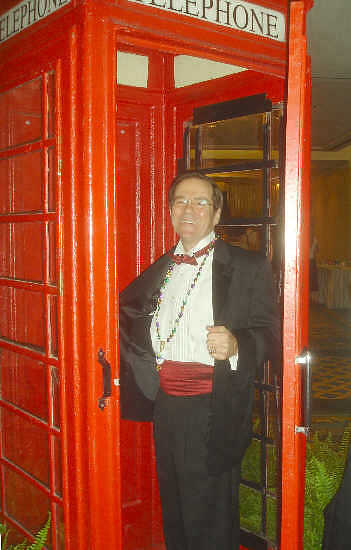
There were other great games, but none brought more relief to Tiger fans than the final game of the season. This was against their traditional SEC across-state rival Tulane in their own turf in New Orleans. Tulane’s premier running back made an off-hand comment to a sportswriter, Cro Duplantier, of the New Orleans States-Item, “LSU will choke.” When that comment appeared in the Monday edition, Dietzel had hundreds of flyers printed and papered the Tigers’ locker room. In addition, the Tulane quarterback, Richie Petitbon, was due to break the 1,000-yard mark for offense, and Dietzel challenged his team to stop him short. Someone hung an effigy of Billy Cannon on the Huey Long Field House and students took it right down, put some green clothes on it, re-dubbed it “Paul Tulane” and set fire to it. The game was settled definitively in the second half when Billy Cannon scored 3 TD’s and Johnny Robinson scored 4. The regular season was over, and the Tigers had done it in telling fashion, 62-0. It was enough for LSU to easily reach No. 1 over the second place team, Iowa, from whose coach Dietzel had received valuable instruction in how to apply the Wing-T Offense earlier in the year.
LSU won the National Championship by virtue of finishing No. 1, while Iowa finished No. 2 in 1958. But Iowa got a curious bit of payback almost 50 years later in 2004. The LSU Tigers played Iowa in a big bowl game Jan. 1, 2005. It was the first time that Iowa had climbed so high in the rankings since 1958 or so. With the Tigers leading, and only seconds left on the clock, an LSU defensive back made the wrong call, allowing an uncovered Iowa pass receiver to catch a pass and run untouched into the end zone to win the game!
To culminate their first National Championship year the Tigers beat Clemson in the Sugar Bowl. It was called the mythical championship because back then the championship wasn't official, just a presentation from the Associated Press for the team finishing No. 1 in its poll. But there was nothing mythical about the championship to the LSU Tigers and their fans. We had climbed to the top of the mountain, the ultimate Indian mound of college football, and the view was great. It still is!
Read the Review at:
http://www.doyletics.com/arj/perfects.htm3.) ARJ2: The Power of the Word and Cosmic Language by Hazrat Inayat Khan

With our senses of sight and touch we only experience the surface of things, but with hearing we can experience the inside of things. Who can deny that the sound emitted by a drum, by a trumpet, or by a human voice reveals to us the center of what is sounding forth? Thus it is that sound reveals to us the center of things. When we speak we reveal what is in our soul to others. If we lie, we reveal that aspect of ourselves as well. The words we speak through our mouths are like a carrier wave of the feelings in our soul which are there independent of the meanings of the words we express. This is why we cannot lie — because the very sound of our voice carries the meaning of our soul. If we would dissimulate, we must mask our soul feeling and that masking itself reveals the presence of an untruth.
What Hazrat Inayat Khan reveals in Chapter IV of “The Power of the Word” is that the words we speak also have an effect upon ourselves, our body, mind, and spirit. Words can help us or hurt us, especially the ones we say with our own mouths.
After Hurricane Katrina, many people were in a pessimistic mood about the prospects for New Orleans. Some moved to other areas, saying they couldn’t go through this again. Others, like myself, had been through Hurricane Betsy forty years earlier, and knew that such terrible storms are unlikely to return to the same area within forty years. Before Betsy, I believe there was a big storm some forty years earlier as well. Those who express pessimistic wishes about big storms coming back indicate to everyone that their own lives are still so stifled that only a big storm could shake them out of their own torpor and bring some relief. And by expressing that wish, they increase the probability of a big storm visiting them. What they dread, they attract to themselves.
The Newman Club has a motto that I recall from my college years, “Heart Speaks To Heart”, and I daresay I didn’t understand what it meant, except in the most general of terms back then. Now I understand it to mean this: when we speak from the deepest center of our soul, what we refer to as the heart, our voice reaches the deepest center of the other person, their heart. When we do that, we are truly speaking heart to heart.
 [page 175] This world is to a mystic like a dome; a dome that re-echoes all that is spoken beneath it. What is spoke from the lips reaches only as far as the ears, but what is spoken from the heart reaches the heart. The word reaches as far as it can, and that depends from what source it has come and from what depth it has risen.Ralph Waldo Emerson knew of the power of the word. “Every word was once a poem,” he wrote. He also knew that the word sounding out from a human being speaks volumes, independent of the words being spoken. It is Emerson who first spoke the saying that Khan quotes in this next passage.[page 176] But what is a word? Is the word just what we speak? Is that the word? No, that is only the surface of the word. Our thought is a word, our feeling is a word, our voice, our atmosphere is a word. There is a saying, ‘What you are speaks louder than what you say.’ This shows that even when man does not speak, his soul speaks.Khan asks us to imagine an exhibition room through which we walk and the only illumination comes from a flashlight in our own hand. What is revealed to us of the contents of the room through our own action of searching can rightly be called revelation.[page 194] There is another form of [artistic inspiration] which is attained by a greater enlightenment, by a greater awakening of the soul; and this form can be pictured as a person going through a large room where there are all kinds of things exhibited, and yet there is no light except a searchlight in his own hand. If he throws its light on music, on notes and rhythm, the music becomes clear to him; if he throws his light on words, the words becomes clear to him; if he throws his light on color, all colors become distinct; if he throws his light on line all lines in the most harmonious and beautiful form become clearly visible to him.
This passage inspired me on October 25, 1986 to write the following lines:

Paint a song of sculpture
Sketch an azure sound
Listen to the velvet moor —
Those tinkling apples all around.Fly on wings of reason
Inside a mason jar,
Buzz your yellow season
Pollinating yonder Star.We pollinate our own yonder star as we walk through the world shining our flashlight of reason, perception, and imagination upon what we find around us. We are born into this world as a baby crying. We are lost in an empty world until we turn on our flashlight and begin to make sense of the mason jar world into which we are born.
There is much more in the full review of Volume II of Hazrat Inayat Khan’s Sufi Message which will enrich you, dear Reader, if you will read and ponder it directly. I have been pondering Khan’s Sufi Message Series of books for over twenty years, and re-reading this volume for the purposes of this review brought home to me how much his insights have filled my life since I first read his works. Get to know a little about Hazrat Inayat Khan — it is the best way I can recommend for you to learn about yourself.
Read the Full Review at:
http://www.doyletics.com/arj/pow2rvw.htm= == == == == == == == == == ==
I hear often from my Good Readers that they have bought books after reading my book reviews. Keep reading, folks! As I like to remind you, to obtain more information on what's in these books, buy and read the books — for less information, read the reviews.
== == == == == == == == == == == == == == == == == == == == ==
8. COMMENTARY:
= = = = = = = = = = = = = = = = = = = = = =In this section I like to comment on events in the world, in my life, and in my readings which have come up during the month. These are things I might have shared with you in person, if we had had the opportunity to converse during the month. If we did, then you may recognize my words. If I say some things here which upset you, rest assured that you may skip over these for the very reason that I would likely have not brought up the subject to spoil our time together in person.1. Padre Filius Reads the New Orleans Times-Picayune this Month:
Padre Filius, the cartoon character created by your intrepid editor and would-be cartoonist, will appear from time to time in this Section of the Digest to share us on some amusing or enlightening aspect of the world he observes during his peregrinations.
This month the good Padre spots a billboard advertising a Landscape Supply House in Gray, Louisiana.
2.Comments from Readers: 
- EMAIL from Josef Graf on Bison and Bees:
On the disappearing honeybee situation, Josef Graf sent this link to his website: http://www.evbooks.net/earth_vision_021.htm Here is my compilation of Graf's pertinent information on Bison and Bees from that link:BEEF gets weaker, BISON stronger:
The situation is not unlike problems in other areas of modern agriculture. Using the cattle industry as a choice example, it is not actually pathogenic forces that are threatening stocks but, rather, decades of contrivance and intercession by means of antibiotics, hormones, and other artificial “propping up” of the species that have weakened and degraded the overall constitution of the species. (And let us call events like Mad Cow disease a symptom, not a cuase, of the cattle industry bottoming out.)
Witness the decidedly hale condition of the bison alongside the debilitated circumstance of cattle. In a word, predation strengthens a species, and interference with that predation leads to debilitation. The finest shepherd ever invented, in terms of a keeper for the bison herds, was Canis lupus, the common wolf.
There are times, and this includes livestock, bees, and any other biological form, when a producer has to “take it on the chin” and let the species evolve by allowing the surviving, adaptable members of the population reproduce. The result will be an enviable level of wholesomeness in both species and product.
BEES — Excessive interference and the foresight of Rudolf Steiner:
In deference to the spiritual science of Rudolf Steiner, it needs to be said that this modern Renaissance man predicted in 1923 that if humanity continued to cultivate the honeybees by artificial means, we would, within eighty years, witness the mass disappearance of the bees.
Arguably the best-kept secret of the 20th Century, in terms of a resource for social transformation, Rudolf Steiner, in his series of lectures entitled “The Bees,” gave numerous indications to portray the intricate nature of the honeybee community. In capsule, Steiner warned against both meddling with the natural process of hive society and artificially manipulation of queen bees.
The following list of ways humanity is known to interfere with the natural process of bee life, while substantial, is no doubt incomplete:
 - The raising of larva in separate quarters, arbitrary feeding of royal jelly to produce queens, then shipping by post to keepers.
- Selection of bee populations for docility, de-selecting for aggression.
- In contrast to the normal 5 or 6-year life span of a queen is, “re-queening” after one or two years.
- The grafting of queens - moving larva to artificial cups, then cages for transport.
- Supplanting guard bees with protective measures of humans.
- Keeping hives hyper clean, to reduce production of “nuisance” propolis.
- Using chemical control agents for disease and pests.
- Providing ready-made combs in place of bee-constructed, to save work (production time) for bees.
- In a similar vein, supplying sheets of wax, so bees don’t have to gather and secret their own wax.
- Use of ventilators so the bees don’t have to tend this.
- Use of queen excluders to prevent eggs being laid in inconvenient areas of the hive.
- Moving of hives over long distances at the will of human intention.
- Clipping of queens’ wings.
- Agricultural practices consisting of monocultures that wreak havoc on honeybee diets, limiting options once the dominant crop is no longer flowering.. . . The most essential thing we learn from reviewing the Steiner material is that beekeepers would do well to acquire a metaphysical understanding of bees and the complex masterpiece of the hive. Mystery lives in the hive, and within the golden elixir that is honey, mystery we have yet to, or may never, discover.
Spiritual ecology holds that the first step in addressing an issue pertaining to the realm of nature is to deepen our understanding of the overall synergy of the particular eco-community in question. A useful place to begin the process is a review of Steiner’s lectures by Bobby Matherne (see link below). It is a lengthy piece — be prepared to dive into a deep pool. Meanwhile, the short answer, at least for consumers, is to buy only honey produced in an organic manner.
Bobby's Review of Steiner's The Bees
- EMAIL from Kiki about a tired old dog:
Don't know if this is a true story, but anyone who has raised kids can relate to it:An old tired-looking dog wandered into the yard. I could tell from his collar and well-fed belly that he had a home. He followed me into the house, into the kitchen, and onto the couch.
An hour later he went to the door, and I let him out. The next day he was back, resumed his position on the couch, and slept for an hour. This continued for several weeks.
Curious, I pinned a note to his collar, "Every afternoon your dog comes to my house for a nap."
The next day he arrived with a different note pinned to his collar, "He lives in a home with ten children. He's trying to catch up on his sleep. Can I come with him tomorrow?"
- EMAIL from Kent in Houston about how to see Hidden Files in Vista:
[RJM NOTE: My PC crashed and I got a new Vista-based HP Laptop from Del for Christmas. But I could not find three of my backup disks on the USB Back Up drive. Finally discovered what they had in common was they contained some system files which MS like to Hide away from naive users to keep them from messing up their system. I always turn these on right away when I get a new operating system, but Vista has also hidden the way to reveal Hidden Files. Thanks to a knowledgable friend of my daughter Yvette's in Bellaire, I can share how to do this with you. Thanks, Kent!
— Bobby]Hi Bobby.Here are the steps in Vista to reveal Hidden Files:
1. Click the round blue Start thing in the lower left corner
2. Click Control Panel
3. Click Appearance and Personalization
4. Click Folder Options
5. Click the View tab
6. Click Show hidden files and folders
7. If you want to see system files as well, unclick Hide protected operating system files (Recommended)
8. Click OKHappy Holidays,
Kent
- EMAIL from a cousin in California, Louise Lewis:
We is Friends!
You smile, I smile . . .
You hurt, I hurt . . .
You cry, I cry . . .
You jump off a bridge
I gonna miss your E-mails.
- EMAIL from Betty in Louisville, KY:
BobbyThe personal note is great!
I think you and Del seem to get younger each picture I see of you both — a handsome couple to say the least.The flowers and fruit look almost like I could touch them.
It seems all is going well for you both, and that makes me happy.Happy holidays to both of you,
Betty== == == == == == == == == == == == == == == == == == == == ==
9. CLOSING NOTES:
= = = = = = = = = = = = = = = = = = = = = =
Thanks to all of you Good Readers for providing the Chemistry which has made this site a Glowing Success. — Especially those of you who have graciously allowed us to reprint your emails and show photos of you and by you on this website — you're looking good! As of June 1, 2019, it enters its 20th year of publication. The DIGESTWORLD Issues and the rest of the doyletics website pages have received over 21.6 MILLION VISITORS ! ! !
We have received over ONE MILLION VISITORS per Year to the Doyletics Website since its inception June 1, 2000, over twenty years ago. Almost 2 million in the past 12 months. We are currently averaging about 150,000 visitors a month. A Visitor is defined as a Reader who is new or returns after 20 minutes or more has passed. The average is about one visitor for every 10 Hits.
IMPORTANT NOTES about DIGESTWORLDtm Our DIGESTWORLD came into existence years before Facebook and all the other social media which interrupt people's schedules many times a day. All our photos, reviews, cartoons, stories, etc, come to you via a link inside of one short email Reminder at the beginning of each month. We hope you appreciate how we let YOU choose when to enjoy our DIGESTWORLD Issues. To Get a Monthly Reminder, Click Here .
We especially want to thank you, our Good Readers, in advance, for helping our readership to grow. NOTE our name is now: DIGESTWORLD. Continue to send comments to Bobby and please do create links to DIGESTWORLD issues and Reviews on LinkedIn, on your Facebook page, and on other Social Media. When you copy any portion of a webpage or review, please include this text: "Copyright 2018 by Bobby Matherne".
Email your friends about the reviews, the handy doyletics Speed Trace, the Household Hints, the cartoons, the Cajun jokes, the recipes, the poems, and the photos in all the DIGESTWORLD Issues archived on our website. Urge them to subscribe to the DIGESTWORLD Reminder so they won't miss a single issue!
The Subscription Process SIMPLE: no Reply Confirmation is required. An email to the Editor with your First and Last names is all that's required. There is never a charge for viewing any page on our website; nor for any of the guidance we offer to people using the FIRST AID KIT or asking for help with doyletics in any other areas.
For those who are able to contribute to the site we offer a year's subscription for receiving the DIGESTWORLD Monthly Reminders for $50.~~ NOTE: DIGESTWORLD is a Trademark of 21st Century Education, Inc. ~~ The cost of keeping this website on-line with its 300 Gbytes of bandwidth a month is about $50 a month. Thank you, our Good Readers, for continuing to patronize our advertisers when they provide products and services you are seeking as you visit any of our web pages. Remember the ads are dynamically displayed and every time you read even the same page a second time, you may find new products and services displayed for your review. Our reviews, digests, tidbits, etc, all our webpages act as Google magnets to bring folks to the website to learn about doyletics and frequent our advertisers, so they support one another in effect.
We wish to thank all Good Readers who have made a contribution to the doyletics.com website! Special thanks go to Chris and Carla Bryant in Corpus Christi and Gary Lee-Nova in Canada!We welcome your contributions to the support of the website and research into the science of doyletics. To obtain our street address, email Bobby at the address found on this page: http://www.doyletics.com/bobby.htm and we will send it to you. Every $50 subscription helps toward keeping this website on-line for another month. If you can't send money, at least show your support by sharing your favorite Issue of DIGESTWORLD and Reviews with a friend.
You can read a description of how to do a Speed Trace (either in English or Spanish):Learn to Do a Speed Trace Here

Or Watch Bobby extemporaneously explain How to Do a Speed Trace on Video:
To make a connection to the Doyletics website from your own website, here's what to do. You may wish to use the first set of code below to link to the site which includes a graphic photo, or to use the second set of code for a text-only link. Immediately below is how the graphic link will look on your website. Just place this .html in an appropriate place on your website.
<CENTER> < — with graphics link — >
<A HREF="http://www.doyletics.com/index.htm">Learn to Do a Speed Trace Here<BR>
<IMG SRC="http://www.doyletics.com/doylepb.gif" width="309" height="102" border="2" TITLE="Learn to Remove Doyles — all those Unwanted Physical Body states of fear, depression, migraine, etc." ALIGN=middle><A/></CENTER>
<CENTER> < — text only link — >
<A HREF="http://www.doyletics.com/introduc.htm">Learn to Do the Speed Trace at doyletics.com <A/>
</CENTER>Check out the new additions to the Famous and Interesting Quotations at:
http://www.doyletics.com/quotes.htm== == == == == == == == == == ==
My reviews are not intended to replace the purchasing and reading of the reviewed books, but rather to supplant a previous reading or to spur a new reading of your own copy. What I endeavor to do in most of my reviews is to impart a sufficient amount of information to get the reader comfortable with the book so that they will want to read it for themselves. My Rudolf Steiner reviews are more detailed and my intention is bring his work to a new century of readers by converting his amazing insights into modern language and concepts.
== == == == == == == == == == ==The Good Mountain Press Digest is mailed monthly to:
Friends and associates
Individuals who have expressed interest in the Digest
Persons who have subscribed at the Digest Subscription Page.Please Don't Bug Us


Nothing BUGS US more than losing Hale-and-Hearty, Ready-to-Read Good Friends from the DIGESTWORLD Reminder List.
So we've made it easy for Good Readers who have changed their Email addresses and Friends who would like to begin receiving the DIGESTWORLD Reminder at the first of each Month:
IT'S EASY to RE-SUBSCRIBE or SUBSCRIBE:
CLICK HERE!
As of August, 2011 we have begun using a Contact Manager with an Email Merge feature which allows us to send personalized Emails to everyone in our Contact List. You can receive the colorful Email containing the DIGESTWORLD Reminder beginning with "Dear [Your First Name]". It is important that we have your First Name, so if the name you are addressed by in your Reminder is not your first name, please notify us of the name you wish us to use. For convenience you can send a quick email to give us your name by Clicking Here. To Contact Bobby, his Email address is visible on this page.
NOTE: As of 2018 the Topica.com List messages are NO LONGER READABLE!
Please do your part by letting us know of any email address change so that you may continue receiving the DIGESTWORLD Reminders. Most of our Readers come from folks who don't get these Reminders, but we offer the DIGESTWORLD Reminder as a service to our regular Good Readers. To send us your new email address, CLICK HERE! .
If you discovered this page by a Google Search and want to SUBSCRIBE NOW
If you have enjoyed a particular issue, let us know, especially around the first of each month when those "lost soul" messages are bugging us, Send us a quick email by Clicking Here!
Simply Click the Link at right to send an Email Request: SUBSCRIBEIf you have a friend or two that you think would enjoy reading the DIGESTWORLD, suggest they view the current DIGESTWORLD Issue and perhaps they'll decide to Subscribe.To unsubscribe from the DIGESTWORLD Reminder List:
Click Link at right to send a Blank email to: UNSUBSCRIBEIf the above links which provide canned emails don't work on your system, you can send a Subscribe/Unsubscribe request to the address found on this page: http://www.doyletics.com/bobby.htm Please include your first and last name when Subscribing.
== == == == == == == == == == == == == == == == == == == == ==
10. GRATITUDE - in Three Easy Steps:
= = = = = = = = = = = = = = = = = = = = = =

Maintaining a website requires time and money, and apart from sending a donation to the Doyletics Foundation, there are several ways you can show your gratitude and support our efforts to keep doyletics.com on-line.
One would be for you to buy a copy of my Dolphin Novel, The SPIZZNET File. Books May be ordered in hardback or paperback form from Xlbiris the Publisher here:
online: http://www.xlibris.com/TheSPIZZNETFILE.html
email: orders@xlibris.com
The best source at the best price is to order your copies on-line is from the publisher Random House/Xlibris's website above.
Two would be for you to use the Google Search Engine for your web searches or to find an item on doyletics.com website. New reviews will have a place to do a Google Search at the top and the bottom of the reviews. Just enter a search phrase in the box below to do a Search. Note you can check whether to Search just this site or all websites.
Three would be for you to let us know you like us by Subscribing to our monthly Reminder. One short email each month with a link to our Latest DIGESTWORLD Issue will keep you apprised of our latest reviews, photography, poetry, Cajun stories, recipes, Movie Blurbs, Travels, and even more! Simply Click Here: Subscribe Me!
Thank you in advance!
~~~~~~~~~~~~~~~~~~~~~~~~~~~^~~~~~~~~~~~~~~~~~~~~~~~~~~~
LIKE US? To Receive a Monthly DIGESTWORLD Reminder, Click the Link to Send Email Request: SUBSCRIBE
NOTE: Place Cursor over a photo for a few seconds to read text description.
All the tools you need for a simple Speed Trace
IN ONE PLACE.== == == == == == == == == == == == == == == == == == == == == ==
== == == == == == == == == == == == == == == ==
22+ Million Good Readers have Liked Us
22,454,155 as of November 7, 2019
Mo-to-Date Daily Ave 5,528 Readers
For Monthly DIGESTWORLD Email Reminder:
Subscribe! You'll Like Us, Too!
== == == == == == == == == == == == == == == ==
Any questions about this DIGESTWORLD ISSUE, Contact: Bobby Matherne
CLICK HERE TO OPEN OUR FIRST-AID KIT. Does your Face sometimes resemble the Faces Below? If so, Click on the Faces or Flags to Dig into our First Aid Kit.
To follow Research in the science of doyletics, Read our Monthly DIGESTWORLD Issues.
Click Here to get Monthly Reminder.
For Copies of Reviewed Steiner Books, Click on SteinerBooks Logo below.
Visit Bobby's Other Reviews, Articles, and Essays
Books are Lighthouses Erected in the Sea of Time
Counselor?
Visit the Counselor's Corner for Suggestions
on Incorporating Doyletics in Your Work.
e-mediatelytm is a Trademark of 21st Century Education, Inc. Prototyped 2000.