LIKE US? To Receive a Monthly DIGESTWORLD Reminder, Click the Link to Send Email Request: SUBSCRIBE
NOTE: Place Cursor over a photo for a few seconds to read text description.
== == == == == == == == == == == == == == == == == == == == == == == == == 
All the tools you need for a simple Speed Trace
IN ONE PLACE.
== == == == == == == == == == == == == == == == == == == == == == == == ==
~~~~~~~~~~~~~~
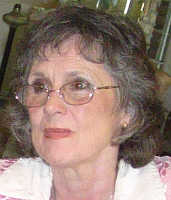
~~~~~~~~~~~~~~ In Memoriam: Patricia "Lovey" Moore (1942 - 2008)~~~~~~~~~~~~~~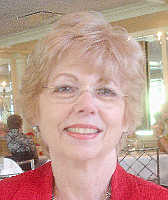 From Obituary: Lovey was a creative entrepreneurial spirit who worked for and operated several small businesses during her career. Outside of her family, Lovey's greatest loves were sewing and quilting. Her sewing and quilting projects received various awards and other recognition. Lovey's innate sense of style and design was reflected in all of her artistic endeavors. She was a fantastic cook and leaves behind many memories of her favorite Cajun specialties. She will be dearly missed by her two boys and her cousin, Adele Matherne, among many others. She will be remembered by a large network of friends for her generosity of spirit, optimistic perseverance, and a wonderful sense of humor. Click Here to Read Poem by Christine Rossetti dedicated to Lovey.
~~~~~
~~~~~~~~~~~~~~
~~~ GOOD MOUNTAIN PRESS DIGEST #08b Published November 1, 2008 ~~~ == == == == == == == == == == == == == == == == == == == == == == == == ==Quote for the Thanksgiving Month of November:If you think health care is expensive now, wait until you see what it costs when it's free.
— P.J. O'Rourke , Political Humorist== == == == == == == == == == == == == == == == == == == == == ==
By Subscription only.== == == == == == == == == == == == == == == == == == == == == ==
Editor: Bobby Matherne, Asst. Editor: Del Matherne
[To Contact Editor Click Here!]
To Subscribe, Click Here : http://www.doyletics.com/subscrib.htm
or here: <A HREF="http://www.doyletics.com/subscrib.htm">Click here</A>
To Unsubscribe, see bottom of Digest.
©2008 by 21st Century Education, Inc, Published Monthly.
To Read All of Bobby's Writings Click Here!
~~ Click on Heading to go to that Section (Allow Page First To Fully Load). ~~
THE GOOD MOUNTAIN PRESS DIGEST #08b, November 2008
Archived Digests
Table of Contents1. November's Violet-n-Joey Cartoon
2. Honored Readers for November
3. On a Personal Note
4. Cajun Story
5. Recipe of the Month from Bobby Jeaux’s Kitchen: Grilled Tilapia/Flounder and Asparagus
6. A Petrarchan Sonnet from 1862 by Christina Rossetti: "Remember"
7. Reviews and Articles Added for November:8. Commentary on the World
- ARJ2: Old and New Methods of Initiation, GA#210 by Rudolf Steiner
- ARJ2: Night Flight, A Novel by Antoine de Saint-Exupéry
- ARJ2: Into the Silent Land — Travels in Neuropsychology by Paul Broks
9. Closing Notes - our mailing list, locating books, unsubscribing to Digest
10. Gratitude== == == == == == == == == == == == == == == == == == == == == ==
THE GOOD MOUNTAIN PRESS DIGEST #08b == == == == == == == == == == == == == == == == == == == == == ==
ARCHIVED DIGESTWORLD ISSUES ON THE WEB ~ ARCHIVED DIGESTWORLD ISSUES ~ 2000: INAUGURAL YEAR: Jun #1 Jul #2, Aug #3, Sept #4, Oct #5, Nov #6, Dec #7
2001: Jan #8, Feb #9, Mar #10, Apr #11, May #12, Jun #13, Jul #14, Aug #15, Sep #16, Oct #17, Nov #18, Dec #19
2002: Jan #20, Feb #21, Mar #22, Apr #23, May #24, Jun #25, Jul #26, Aug #27, Sep #28, Oct #29, Nov #30, Dec #31
2003: Jan #32, Feb #33, Mar #34, Apr #35, May #36, Jun #37, Jul #38, Aug #39, Sep #40, Oct #41, Nov #42, Dec #43
2004: Jan #44, Feb #45, Mar #46, Apr #47, May #48, Jun #49, Jul #50, Aug #51, Sep #52, Oct #53, Nov #54, Dec #55
2005: Jan#051,Feb#052,Mar#053,Apr#054,May#055,Jun#056,Jul#057,Aug#058,Sep#059,Oct#05a,Nov#05b,Dec#05c
2006: Jan#061,Feb#062,Mar#063,Apr#064,May#065,Jun#066,Jul#067,Aug#068,Sep#069,Oct#06a,Nov#06b,Dec#06c
2007: Jan#071,Feb#072,Mar#073,Apr#074,May#075,Jun#076,Jul#077,Aug#078,Sep#079,Oct#07a,Nov#07b,Dec#07c
2008: Jan#081,Feb#082,Mar#083,Apr#084,May#085,Jun#086,Jul#087,Aug#088,Sep#089,Oct#08a,Nov#08b,Dec#08c
2009: Jan#091,Feb#092,Mar#093,Apr#094,May#095,Jun#096,Jul#097,Aug#098,Sep#099,Oct#09a,Nov#09b,Dec#09c
2010: Jan#101,Feb#102,Mar#103,Apr#104,May#105,Jun#106,Jul#107,Aug#108,Sep#109,Oct#10a,Nov#10b,Dec#10c
2011: Jan#111,Feb#112,Mar#113,Apr#114,May#115,Jun#116,Jul#117,Aug#118,Sep#119,Oct#11a,Nov#11b,Dec#11c
2012: Jan#121,Feb#122,Mar#123,Apr#124,May#125,Jun#126,Jul#127,Aug#128,Sep#129,Oct#12a,Nov#12b,Dec#12c
2013: Jan#131,Feb#132,Mar#133,Apr#134,May#135,Jun#136,Jul#137,Aug#138,Sep#139,Oct#13a,Nov#13b,Dec#13c
2014: Jan#141,Feb#142,Mar#143,Apr#144,May#145,Jun#146,Jul#147,Aug#148,Sep#149,Oct#14a,Nov#14b,Dec#14c
2015: Jan#151,Feb#152,Mar#153,Apr#154,May#155,Jun#156,Jul#157,Aug#158,Sep#159,Oct#15a,Nov#15b,Dec#15c
2016: Jan#161,Feb#162,Mar#163,Apr#164,May#165,Jun#166,Jul#167,Aug#168,Sep#169,Oct#16a,Nov#16b,Dec#16c
2017: Jan#171,Feb#172,Mar#173,Apr#174,May#175,Jun#176,Jul#177,Aug#178,Sep#179,Oct#17a,Nov#17b,Dec#17c
2018: Jan#181,Feb#182,Mar#183,Apr#184,May#185,Jun#186,Jul#187,Aug#188,Sep#189,Oct#18a,Nov#18b,Dec#18c
2019: Jan#191,Feb#192,Mar#193,Apr#194,May#195,Jun#196,Jul#197,Aug#198,Sep#199,Oct#19a
To Receive a Monthly DIGESTWORLD Reminder — Click Here.
== == == == == == == == == == == == == == == == == == == == == ==
1. November Violet-n-Joey CARTOON:
== == == == == == == == == == == == == == == == == == == == == ==For newcomers to the Digest, we have created a webpage of all the Violet-n-Joey cartoons! Check it out at: http://www.doyletics.com/vjtoons.htm Also note the rotating calendar and clock that follows just to the right of your mouse pointer as you scroll down the page. You'll also see the clock on the 404 Error page if you make a mistake typing a URL while on the doyletics.com website.
The Violet-n-Joey Cartoon page is been divided into two pages: one low-speed and one high-speed access. If you have Do NOT Have High-Speed Access, you may try this Link which will load much faster and will allow you to load one cartoon at a time. Use this one for High-Speed Access.
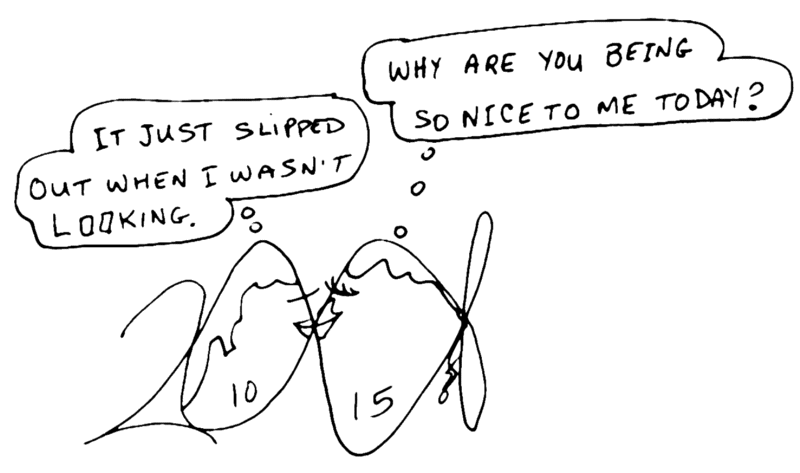
This month Violet and Joey learn about Being Nice.
#1 "Being Nice" at http://www.doyletics.com/images/101508jv.gif
== == == == == == == == == == == == == == == == == == == == == ==
2. HONORED READERS FOR November:
== == == == == == == == == == == == == == == == == == == == == ==Each month we take time to thank two of our good readers of Good Mountain Press Digest, books and reviews. Here's our two worthy Honored Readers for this month. One of their names will be in the TO: address line of your email Digest notification. Our Honored Readers for November are:
Teresa Seed in the UK
Hy McEnery in New Orleans
Congratulations, Teresa and Hy!
== == == == == == == == == == == == == == == == == == == == == == == == == == == == == == == == == == == == ==
3. ON A PERSONAL NOTE:
== == == == == == == == == == == == == == == == == == == == == == == == == == == == == == == == == == == == ==
Out Our Way:Thankfully October was a normal month as far as the amount of activities and allowed us to recover from the busy cruise month of September. In addition to reading and reviewing three books this month, Del and I managed to fit in my 50th High School Reunion, Dinner at Victoria Inn, SOFAB Museum Trip, the Red Lobster, and a miscellany of other activities.
Worked the hardest I ever have on the October digest, with only a handful of days to edit the 800 photos of the cruise, write the personal notes, and arrange the 135 photos into place in final digest. It was the largest digest to date in overall size, 50% larger than the previous largest. Whew! That was a lot of concentrated attention and clicking of the mouse and keys before the day was over. After dinner I created the template for your notification emails, including links to the various Shutterfly.com photo albums of the trip. Sent out the digest on time, October 1, if a little late in the day but hey! what a month! Was glad when it was over. If anyone missed the email for the October newsletter or deleted it without looking at photos of cruise and now wants to, send me an email and I'll send it for you.
Lunches and Present Delivered
Our good friend, Sharon Roberts, now returned to New Orleans from her extended Katrina dislocation, came to visit, and we took her to lunch at a new business/retail complex with beautiful outdoor spaces along Manhattan Boulevard near Timberlane. We ate at Parrot Pete's Restaurant. "Looks like we're in San Diego," she commented.
She lived there several years post-Katrina, unsure whether to rebuild her home inundated with 10 feet of water by the storm. It is now completely renovated and filled with bright colors of the Sicilian pallette on all the walls and furnishings. Of several friends who had just renovated their homes only to have them devastated by Katrina, Dave and Sharon Roberts were the only ones to return to New Orleans and do it all over again.Our first project for the month was cleaning up from Hurricane Gustav modifications which had been left in place. Del and I cleaned out garage, moved empty boxes from garbage to attic, then removed Window AC Unit from house and installed in garage. I will now be able to work on my B17 bomber model year-round in the garage. It's been sitting in boxes since Katrina wiped out the hobby store where I got my glue and dope from. Hope I have enough to finish the job. I started it when our oldest grandson, Chris Bayhi, was three and he worked along with me. Chris is now about 23, and the wings and fuselage are ready for covering with paper for the final assembly of the plane.
Then we felt so good we decided to have lunch at Red Lobster in Lakeside. But first a trip to buy a new desk phone to replace my broken one. The $41 one I wanted was unavailable on the West Bank, so we went to the Office Depot in the old Service Mchdse building on Vets. They weren't sure if they had one in stock, and I decided the hell with it, and bought the $79 RCA one with duplex sound and speaker phone, but no answer phone.
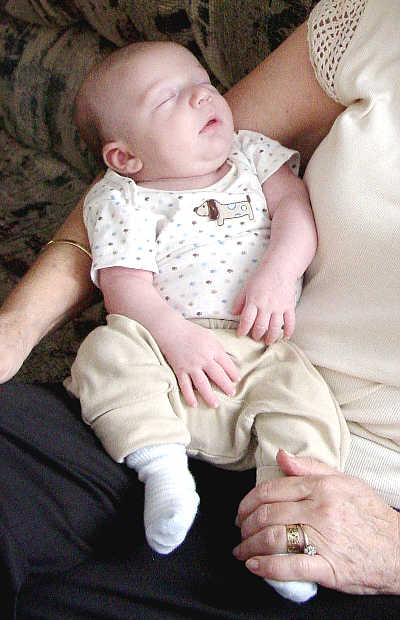
On the way to Red Lobster, we stopped at Academy and bought a 10x10 LSU canopy for John for his birthday. Luckily, it shoe-horned into the Caddy's trunk. Prior to our trip across the river we visited the new Marshall's in the old Service site on WB and Del bought clothes for our latest great-grandson, Preston Michael Ostarly. Saw Tiffany and gave baby Preston his present. Then saw Ben, Gabe, Steve, Brian Bairnsfather, and neighbor Ed at Marcie house. Then we drove to Prairieville to deliver John's birthday present. Grandson Collin was leaving for a sleep over at a friend's house. John was showing me his new TV Room and he and I were watching Alabama game when his father Bill Hatchett's name appeared on the bottom of the screen. All I could think of at first was his fireworks had burnt a hole in another football field's turf like happened on the Saints field several years ago. Then I remembered that John had the on-screen caller ID of cable tv-tel providers. That's something I would not care for. I would'n want names and numbers interrupting our TV watching. I want to be able to ignore all phone calls when we're in the middle of a movie, which is mostly what we use our TV sets for.
Green Beans and Angry Gators
Our fall garden was growing while we were on a cruise and by October I was picking the first green beans from Timberlane. By the second week I had a mess of beans ready and cooked the first ever green beans that I had grown myself. I cooked them with store-bought small red potatoes using the recipe my mother used when I was a kid, but without the salt meat for seasoning. My recipe can be found here: http://www.doyletics.com/digest44.shtml#section5. Then I cut the front and back yards' grass. Then came in and watched OU and Texas game. Texas looked sloppy and almost lost. No big upsets today. Miss State did drop Vandy from unbeaten corps. Del and I ate the green beans for lunch and enjoyed it very much. While I was watching the college games Del's brother came over with his wife and son. They're in the process of building a home across the lake in preparation for moving back to Louisiana from North Carolina. When Dan, Daniel, and Karen arrived, I pulled myself from the football games in progress and joined them. Showed Karen around the yard, and gave her one of the radishes from my garden to eat. After they left, I sat down to watch LSU tackle the angry Florida Gators who had lost to Ole Miss. LSU lost to Florida, 21 to 51, with sloppy play and bad luck.
LSU never should have chosen to defer after winning the toss. If LSU had scored on first possession, they could have won the game by keeping Florida off-balance. Deferring the option today is like losing the toss before the rule change. Never made sense to me to give a high-powered offense the football first and let your own high-powered offense sit on the bench. Clearly LSU's freshman quarterbacks were not up to the task, tossing incomplete passes and interceptions instead of TD's. Upshot was LSU learned this lesson: Never tackle angry Gators with a new gun — by the time you get it loaded and shooting right, you'll be lucky to get out alive!Handheld Vibrator Turned Back into Camera Just in Time
On our cruise, my new SONY T300 camera began vibrating at random intervals. I had no backup camera with me, so I was stuck with this camera. Luckily it only kept me from taking two shots that I wanted. It would mostly stop when I turned it off and back on, or tapped it on the edge. So I took over 800 great photos. Then one day this month, our East Portico lawn was visited by a great egret, about 4 feet tall. I watched it land on the south fence and took a couple of shots of it with the T300 which was behaving okay. Then as the egret walked behind a vine, I snuck out the glass door into the yard, and took some close up shots of the egret through the vine. Then, just as I was ready to take more photos, the camera turned once more into a handheld vibrator! Nothing would get it to stop, so I said goodbye to the egret and with regret, went into the house and called SONY to schedule a warranty repair.
I took it immediately to the Post Office and mailed it off to Laredo, Texas. After it was gone, I realized suddenly that I was scheduled to be the designated photographer for the Hahnville High School 50th Reunion in about 2 weeks. I called my friend Seth and he agreed to let me use his P200 SONY if I needed it. I had given my old P200 to my daughter Carla, but she lives in Beaumont, Texas, and Seth nearby in New Orleans. Luckily my T300 came back from Warranty Repair in time for the reunion and it worked perfectly. Only glitch during my photo session was not getting the house lights turned on for the whole graduating class photo. By the time you got far enough back to take in the whole group, the camera was out of range of its tiny flash gun in the semi-darkened room. I was in the group, not taking the photos, so I didn't notice the problem till the next day. The group photo came out good, but not the fine resolution one could have achieved by the simple expediency of turning the house lights on during the class photo.American Destiny, Volitional Science, Poetical Pirates, and a Surprise Lecture
On one day I received a book about "American Destiny", a set of CDs of Volitional Science lectures, and a notice about a book of poems called "Raising Black Flags" written by and about pirates. The first book was from a good friend, Kevin Dann, whose full title is: "A Short Story of American Destiny, 1909 - 2009" just published. I put up the scaffolding and wrote Kevin with a link to my review so he would think it was done. The scaffolding is just the header and footer with a Work in Progress note where the review will eventually go. Here was the response I got from Kevin who had received my email about an apparently finished review of his book that I had just received that very morning. It had the desired effect.
Bobby,
Yes, I was slackjawed thinking that you had even gotten past the preface, and was relieved when I took the first look and found all the "Under Construction" signs. I mean, it took me about 20 years to incubate the damn book, and it is more than a little humbling to think that you'd swallow it faster than a spoonful of jambalaya. If the magazine and newspapers would act with 1/100th of your speed, the book might get a few readers before Ahriman makes his entrance on July 22, 2009. I'll be glad to count you as my first reader, and I've no doubt the best reviewer.
Yours,
KevinLater, as a joke, I placed an insert to INCLUDE oldnewme.shtml inside the american.htm file, so that when Kevin went to read it, thinking it was done, he'd have to read my newly completed review of Rudolf Steiner's Old & New Methods of Initiation. When he wrote back and asked me why there was a different review where his book should be, I told him, it's just a new method of initiation. I hoped he would read it right away, and he did, after getting this unorthodox introduction to it. Below is what he wrote back, and you will have to read the review to learn about soft-brain thinking and its relationship to what brain doctors call "holes in the brain", the cerebro-spinal fluid cavities of the brain.
Bobby,
I have just happily fallen for your little trick, and under the beckoning light of the near-full moon, just read your review of "Old & New Methods of Initiation." Your last paragraph — and a number of others — is answered by your review — which is, to quote yourself: "the best example I know of someone who combines soft-brain thinking and hard-brain thinking in his life and work." There is always a meta- level to a Bobby Matherne review, and this one has it in spades.
I'm going to pull up a chair to the window and let the Moon work on the holes in my brain. Thanks for that invitation.Yours,
Kevin
But there was more fun this month between Kevin and me. We had spoken over Skype on a video-phone connection the previous day and I noticed that if I disconnected the LAN cable from my Lap Top that the wireless connection did not kick in as I expected it to. Didn't know why. So about 1 pm the next day, I disconnected its LAN connection and took my LT to the kitchen breakfast bar. The connection broke. Unsure what was wrong, I chose the Diagnose Problem option which came up in a dialogue box, chuckling to myself, "Sure, it'll know what to do. Fat chance!" Amazingly, it did! I followed its suggestion to TURN ON the WIRELESS SWITCH on my LT and everything worked fine. This was very surprising to me — I didn't know such a manual switch existed on the front edge of my LT. It was so unobtrusive and hard to see. Turned the switch to ON and I had instant wireless on my LT. I could now take my LT into the yard, sit on the swing, and basically give Kevin a short glimpse of our grounds at Timberlane. I decided to call Prof Kevin Dann on Skype right away, and said, Hi, Kevin when he answered. He said, "Hi, Bobby, but my class calls me, Professor Dann."
I realized that he had answered the Skype videophone call in the middle of a lecture to his history students, and the class could see and hear me! He asked me to participate by answering this question for the class, "Why should the Chinese choose opium as a drug of choice?" I said, "Since the ancient Chinese could consciously see into the spiritual world in their time, the Chinese today use opium to achieve that vision semi-consciously or unconsciously." He asked the class to respond and they gave me a rousing round of applause! I actually took my LT to the swing outside on a beautiful day and while Prof Dann was talking let them see the South and East Portico gardens and even get a closeup of our schnauzer, Steiner. Was fun! I had participated in a surprise lecture to a college history class halfway across the country.The book of Poetry by and for Pirates was edited by my friend from the Pyrate Con, Steve Sanders. We had talked about his pirate poetry and I had a chance last year to read one of his poems. Now his book of poems, including his own poems, his wife Melody's poems, and those of several other pirates were all included in the brand new book, "Raising Black Flags." You can see Steve's photo in his pirate persona, Blackbead, and order a copy of his new book in the Email Section of this Digest. http://www.doyletics.com/digest08b.shtml#section8

The Volitional Science lectures are another exciting addition to my library. 19 lectures of 3 hours each on the basic principles of freedom that you cannot find anywhere else except from the mind of Dr. Andrew J. Galambos. The lectures were created by a long-time associate of his, Jay Snelson, based on Galambos' innovative ideas about freedom, and were known as course V50. The CDs are available here. http://www.volitionalscience.org/products.htm for $125 plus shipping. Given that I took the course in 1982 at a cost of $300, about $900 in today's currency, these CD's are a great value. Since they're already in .mp3 format you can easily listen to them in your car through the radio with an inexpensive mp3 player.
Hahnville 50th Reunion
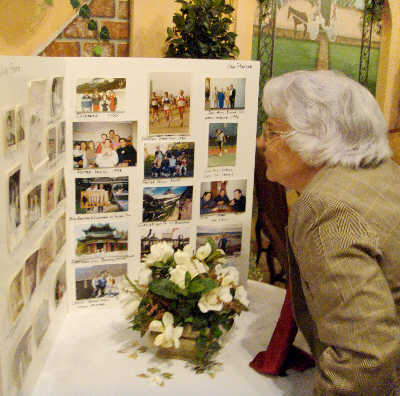
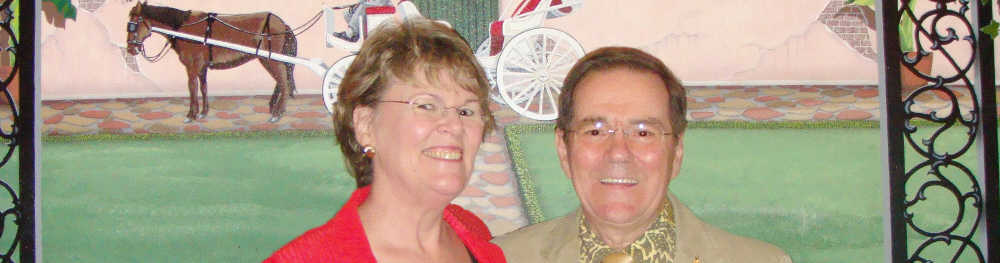
Del lost her dear cousin, Lovey (Patricia) Moore, who was the closest thing Del had to a sister when they were young. She died in Richmond, Virginia, and Del decided to fly to the Charlotte airport where her brother Dan met her and they drove five hours to the Friday evening memorial service. Then the two of them drove back to Dan's home in Charlotte and Del flew back to New Orleans the next morning so she could drive directly to the Hahnville Reunion from the airport. She had about a 25 minute drive just upriver to the town of Norco. Meanwhile that morning I had a breakfast meeting at my club uptown from which I had leave early and drive to Norco for 1 pm. As the photographer, I had to be early. We were asked to set up some kind of display showing our life over the past 50 years, and I had organized photos from my entire life, from a baby to the present day, into chronological sequence and placed it into a digital photo frame. I needed to find a table next to a wall outlet and set that up before I could even start taking photos. It was a fun and busy afternoon. The La Maison banquet hall was elegant, the food was ample and tasty, and the music was pleasant and not intrusive. Plus there were two ideal locations against the walls for shooting couples photographs. I chose the one which looked like the couple had just gotten out of a horse-drawn carriage and walked through an archway into the hall.
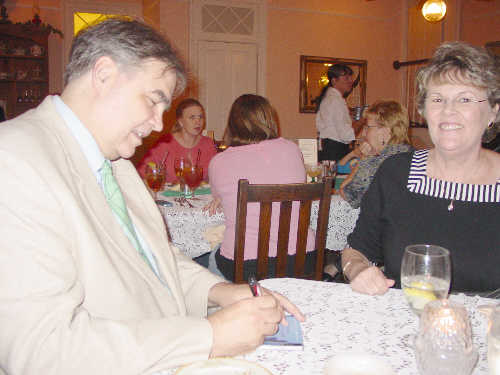
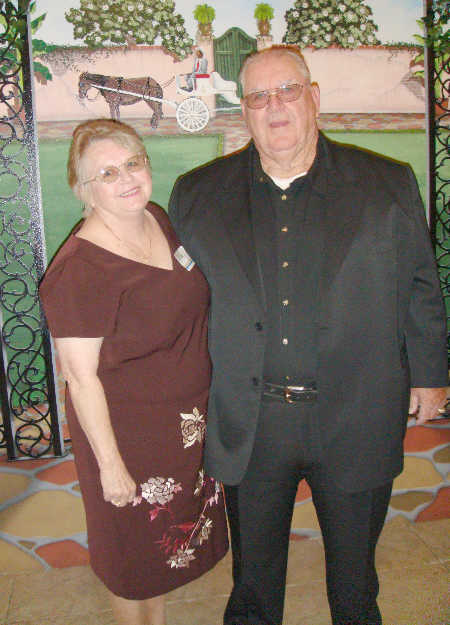 Clearly this was designed for photos of newly married couples. It gave me the idea to arrange the couples like a newly married couple with the bride on the left as they looked towards the camera. To increase the illusion of them walking up the path, I had them stand with their backs to the wall so no shadows would break the illusion. I will include several of these couples photos from the reunion. My entire set of photos are on Shutterfly.com, so if you are a Hahnville Graduate who didn't make the reunion and would like to see them, send me an email and I'll send you a link.
Football Foes and Woes
Some Saturdays I devote to watching all the important college football games beginning at 11 am and ending late into the evening. With five screens I can usually cover all the ones I'm interested in without having to flip screens. The Saturday of the LSU-Georgia game, all the teams I wanted to lose, won and vice versa. Seemed clear to me early on that LSU was going to lose as well. It was too early for a Christmas present, but on the first play of the game LSU QB Lee threw a TD pass into a Georgia receiver's hands. He repeated that gift to the same player in the fourth quarter when LSU had gotten to within one TD of tying Georgia. Three interceptions of Lee, two pick 6's. Big step on the learning curve for that young man. How to fake out the defensive back field by scanning in the opposite direction you intend to throw and then throwing the pass so they cannot be waiting to pick it off. Our two Matts (Mauck and Flynn) knew how to do that trick, and Lee must learn it also or get replaced by someone who can. That run of 7 incomplete passes by Lee killed LSU's chances of winning the game. As it was, we only lost by the 2 TD margin corresponding to Lee's gift tosses. One wonders if the best QB of the three, Jordan Jefferson, was sitting on the bench. We may find out during the upcoming Tulane game.
At noon the next day I watched the Saints play San Diego in London's Wembley Stadium. The high wet grass and soft turf had players slipping and sliding. But the Saints were on course to win it big. Leading in the fourth quarter by 14 points, it looked like the Saints could run out the clock, but San Diego, after a score, kicked a surprise on-side kick and scored a TD a few plays later. Then they were driving for a TD at the 15 when the Saints intercepted and took the ball and tried to run out the clock. With 29 seconds left on fourth down and a 7 pt lead, Payton had Brees run out of the endzone for a safety and we free kicked at the twenty with only 8 seconds left. A long runback to the 50 ran the clock down to zero, but the refs added 1 second back on the clock and a Hail Mary pass to the endzone could have won it for San Diego, but it was batted away by the Saints. This one game featured several field goals, a block extra point, an on-side kick, lots of TD's running and passing, and even a safety! Great game to show the Brits all the aspects of scoring and strategy in one cliff-hanger of a game.
Patty and Armand St. Martin CD Release Events
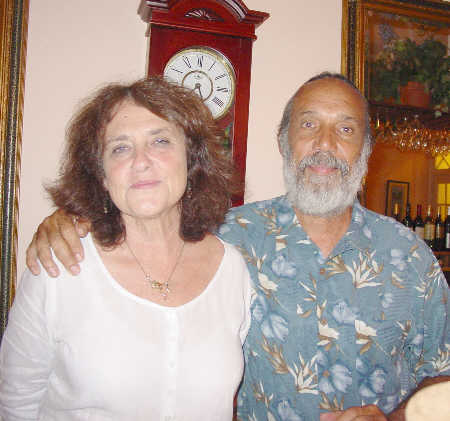
Our favorite piano player, singer, composer, and crossword puzzle creator, Armand St. Martin and his wife Patty Lee organized several Release parties for Armand's "Katrina Anthem" CD. The first one was at a place we'd never heard of before, the Victoria Inn Bed & Breakfast and Restaurant. It's located several miles past Lafitte near the end of the road. We found it on a large piece of landscaped property, a beautiful two-story building with a view of a lake right behind it. Unfortunately Hurricane Gustav had just covered the plants with salt water and the grounds were brown until they could be refurbished. The raised walkway to the swimming pool and deck with the view of the lake was broken in places and unpassable. But the restaurant was re-opened and Del and I had a delicious gourmet meal. We met the owners, Roy & Dale, like the famous cowboy couple, but it was Roy Ross and Dale Marcombe. Dale was from Westwego and in talking we discovered that I had been in the same ninth grade class at Wego High as her brother Roger Marcombe. Del and I ate while Armand played the piano and Patty Lee came over and sat with us and talked. We learned that she and Armand met in Hollywood where they still visit often. We had a lovely time and bought a CD to take home with us.
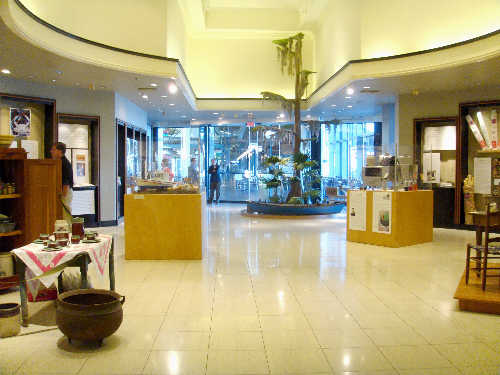
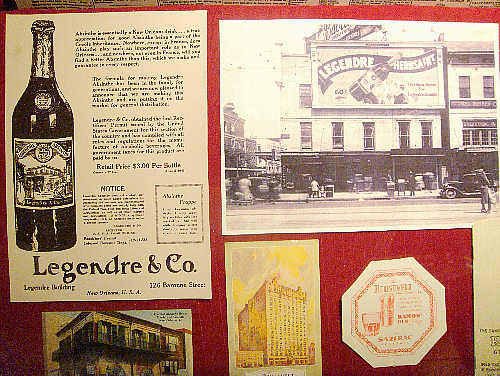
A couple of weeks later, we went to the Southern Food And Beverage Museum, known as SOFAB, for short. And it is SO FABulous — its new location in the Riverwalk. Located in a former clothing store at the Food Court end of the shopping center, it has a large elegant interior and is filled with interesting food and beverage historical displays. I saw an old snowball making ice-scraper. These were used to make the original 5 cent snowballs of my youth in the square flat cups. These have disappeared along with 2 cent Jack's Cookies in the large glass jar, 1 cent 4-pack of Kits candy and 2 cent Mary Janes. I also saw a display of Legendre's Absinthe, a Louisiana Cypress with cypress knees, ducks, and a pirogue, and a St. Joseph's Altar showing a small sample of the types of foods displayed every year on March 19, St. Joseph's Day in the New Orleans area. This SOFAB Museum is a must stop for tourists to New Orleans. Go there first, and many of the other things you encounter around town during your stay will make more sense.
Last Minute Notes

David, a drummer in the band Sustenance which played to a large crowd at the House of Blues right after Gustav, also fixes my daily café latte at PJ's Coffeehouse where I go on my morning break from writing. I had been reading Kevin Dann's book, "A Short Story of American Destiny", and on page 117, I encountered a reference to the Aztec Moon Goddess, Tonantzin, one of whose titles was the "Goddess of Sustenance." I told David about this and he got all excited. Said his band may adopt the goddess Tonantzin and print her on their Sustenance T-shirts.
On a sad note, our friend Eric Szuter died suddenly this month. We'll be attending a memorial to him early in November. I had reviewed his novel, Unconditional Surrender, back in 2006. Our sincere condolences go out to his former wife, Bonnie Schindler, his family, and friends.

My Celeste fig tree did not bear fruit this year and for the second year in a row. Meanwhile a sprout which grew up from a dropped fig had grown to about two feet high. I kept it in a bucket for two years to replace the tree, but when I put it in the ground right before Gustav, it died. I had already trimmed away the original tree to make room for the new tree, so I needed to get another fig tree to take its place. I hope the large tree will fruit for several more years while the new one is growing up alongside it.
With that in mind, I went to Gretna Farmer's market and bought a Celeste fig tree in a pot, about 5 feet high, and immediately planted it in the spot of the little one I had earlier planted which dried up and died away. I first took mulch from the front yard. Dug the hole wider and deeper than pot, trimmed away bottom of pot, then made two slices halfway up the pot from the bottom of the pot (each 180 degrees apart) and two short slices on the top edge as markers for the bottom slices. I filled the bottom with about 4 inches of mulch, emptied a bucket can of water into the hole (which I had added my bodily chemicals to as Anastasia recommends) then placed the pot into the hole, packed mulch around and on top of the dirt in the pot; and dumped second can of water around the fig tree base and packed the rest of the dirt on top of the pot's dirt. Should be good till Spring when I will remove the black plastic pot to allow the roots of the fig tree to spread out horizontally. This planting in the pot is the best way I know to avoid root shock when planting a tree. If you're carefully the roots never know they've been planted because no air gets to the roots to dry them out, which is what causes root shock.
HAPPY THANKSGIVING! ! !We hope you will have a very happy Thanksgiving Day with good food, family and friends. Till next month when, through the Grace of God, we will return to these pages with more original photos, reviews, cartoons, Cajun jokes, and other things to help make your life fun and happy.
~~~~~~~~~~~~~~~~~~~~~~~~~~~~~~~~~~~~~~~~~~~~~~~~~~~~~~~~~~~~~~

IMPORTANT MESSAGE:
To those Good Readers who are puzzled by How the Moon could be Rising In Front of a Mountain, Click on Photo. To see 161021 photo, Click Here. ALSO: if you are puzzled because you No Longer get our Monthly Reminder, you may have Changed Your Email Address without notifying us. NOTIFY US NOW by a simple Click Here!
Here's the Sting:
You will NOT receive a Monthly Reminder unless you have Re-subscribed under your new address to DIGESTWORLD.If you've already receiving DIGESTWORLD Reminders, ignore this message.
If you're not subscribed, and would like to Subscribe to DIGESTWORLD Reminders to receive one short email a month to inform you of the latest ISSUE, now's a good time. SUBSCRIBE NOW
by Clicking Here.Yes, this message does no good to those who changed their email address without notifying me — but it can alert those of you who are going to change your address.
If you've changed or are planning to change your email address, Click Here to SEND NEW ADDRESS. (Alternate way is to copy into your Browser this URL: http://www.doyletics.com/subscrib.htm )
EASE OF VIEWING NOTES:
NOTE: For Internet Explorer Browsers, DIGESTWORLD is best viewed at 100% Zoom and the Window's width sized so that Digest Archives lines are single-spaced, just barely. Adjust Window width so that Mountains almost touch the Archive Numbers, especially if you find some Photos overlapping text.PHOTO CAPTIONS (CURSOR FLYOVER ISSUE RESOLVED):If you have been enjoying the photos in DIGESTWORLD, but have wondered who or what you were looking at, you will now be able to hold your cursor still over the photo and the photo's description will appear. (Test on Butterfly-Crab Image at Right.) We spend a lot of time writing these photo captions and hope you will read them. All the Archived Issues have been updated to provide descriptions when your cursor rests for a second on a photo. Note that older Reviews have not been updated. If you haven't finished reading text when description disappears, move cursor away and back on photo to finish. We thank you for your patience and hope this pleases you.
New Quotes Added to quotes.htm this month:
A bank is a place where they lend you an umbrella in fair weather and ask for it back when it begins to rain.
— Robert FrostPoetry is what is lost in translation. It is also what is lost in interpretation.
US writer
— Robert FrostNew Stuff about Website: Check out new items on these Tidbits Pages: One-Liners and Humorous Sayings
FIVE PERENNIAL FAVORITE doyletics WEBSITES:
1. Art Is The Process of Destruction,
An Essay By Bobby Matherne
It came as a great surprise to me to discover that “art is the process of destruction.” Nothing that I had ever encountered or noticed before prepared me for that revelation. Art was surely creation, I had thought previously. It was only over time that I became to realize how wrong I had been, and that I was bound to write up my discovery in an essay. It was my way of continuing my research into the nature of art. I wanted to learn if I were right about art and whether any others had written about art this way.In the six years since I first wrote this essay, I have come upon many other writers who have expressed thoughts similar to mine, but none quite as dramatically. I have each time added quotations from those writers to support my thesis. The most recent addition came this past month, October, 2008, while I was listening to Prof. John Sutherland lecture on Oscar Wilde. His quotation on the subject is famous, but few might connect to my thesis, and yet I did so immediately and call your attention to it: “Life imitates Art far more than Art imitates Life.” The very process of “imitating life” is the process of creation: one takes something which appears in the natural world (life) and makes an imitation of it. That ersatz of real art is in fact mere replication, no matter how intricately or ingeniously it is done. It is not true Art. Oscar Wilde recognized that aspect of Art.

What is destroyed by Art? Sameness. Sameness as it refers to all of the subjects, methods, and techniques of what currently exists and called art. When a true artist comes into the world, we recognize that we are looking at something we have never seen before, as Picasso did with his first cubist paintings. They were nothing if not original. They were true art. Nothing the real world nor the world of art existed like that at any time before. About the word “original”: we do well to avoid watering down the adjective by using it to mean “a work of art by an artist” rather than a copy. A watercolor, say, instead of a print. It may be difficult to avoid calling the watercolor an “original”, but one should remain clear that one is watering down the adjective. Hundreds of similar watercolors are exhibited in shopping malls any given weekend. They may pass as art, but they are not true art. Rather they are replications of a technique used by thousands of other artists.
When a true artist destroys the sameness which currently exists in art, exciting possibilities are liberated! At first that artist’s works might seem crude and unpolished, but with repetition the elements of the artists style emerges, and, gradually, from these possibilities a multitude of artworks are created using the model of that one true artist. Years after Picasso's first cubist paintings, they were prized by collectors, but the cubist style was taken up by other artists, and, decades later, his techniques may appear in any weekend painter’s canvas. Want to learn more about art as the process of destruction? Click Here.
2. Shingles, How they Happen, How to Remove Them
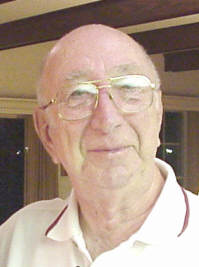
Shingles is a painful rash caused by the same virus which causes chicken pox. This much is known by medical science. What is not known is that a person cannot get shingles as an adult unless they had chicken pox before they were five years old. The reasons for this are explained in the science of doyletics and elaborated on the Shingles page here. Why this is so, is not so important as how this knowledge can help someone suffering from shingles to recover quickly from the painful itching and rash and never have shingles again.Shingles, according to a theory which Doyle Henderson and I first discussed about ten years old, are the healing states of chicken pox being recapitulated in the absence of the disease. Something triggers the healing states which are stored in doylic memory and the itching and rash outbreaks occur, perhaps worse than the original chicken pox.
How does one cure themselves of shingles? Simply do a Speed Trace as soon as the first symptoms of shingles appear. At some age below five, the symptoms will seem to be alleviated, and within a few hours or a day or so the lesions and itching will be all gone, never to return.

I must explain that this is still a theory as no definitive studies with thousands of people have been made, but given the few minutes it takes to learn to do the Speed Trace and the salubrious benefits which accrue to a shingles sufferer, it would behoove you to avail yourself of the Speed Trace when a bout of shingles occurs. That is exactly what the man in the photo, Warren Liberty, did he got shingles back in the year 2000. He has had no recurrence of shingles since.
Read about Warren's experience here.
3. TOP TEN THINGS PEOPLE WANT Click Here!
Maybe there are some things you want in this List, and learning about doyletics can help you to get them. Check it out.
4. FAMOUS AND INTERESTING QUOTES Click Here!
This webpage is another perennial favorite of visitors to this website. People want a quote of Winston Churchill or Ambrose Beirce or Ronald Reagan. They Google the name of the person they want and arrive here. But you can get here even faster: just Click Here!
5. TRAINING EXERCISE Learn to Do the Speed Trace
There are several places to learn about doing the Speed Trace. The two best ones are in the INTRODUCTION and in the TRAINING EXERCISE. Most people go to the Training Exercise. Don't have any Shingles, but you're just curious about how one does a Speed Trace anyway? Perhaps you get butterflies in your stomach when called up to talk in public? Perhaps you have a fear of heights? Perhaps snakes scare you? Click on one of the links about to learn how to do a Speed Trace and you will find that relief from your particular areas of dis-ease or dis-comfort is just a Speed Trace away.
~~~~~~~~~~~~~~~~~~~~~~~~~~~~~~~~~~~~~~~~~~~~~~~~~~~~~~~~~~~~~~

Movies we watched this past month:
Notes about our movies: Many of the movies we watch are foreign movies with subtitles. After years of watching movies in foreign languages, Arabic, French, Swedish, German, British English, Russian, Spanish, Italian, Japanese, Chinese, and many other languages, sometimes two or three languages in the same movie, the subtitles have disappeared for us. If the movie is dubbed in English we go for the subtitles instead because we enjoy the live action and sounds of the real voices so much more than the dubbed. If you wonder where we get all these foreign movies from, the answer is simple: NetFlix. For a fixed price a month they mail us DVD movies from our on-line Queue, we watch them, pop them into a pre-paid mailer, and the postman effectively replaces all our gas-consuming and time-consuming trips to Blockbuster. To sign up for NetFlix, simply go to http://www.netflix.com/ and start adding all your requests for movies into your personal queue. If you've seen some in these movie blurbs, simply copy the name, click open your queue, and paste the name in the Search box on NetFlix and Select Add. Buy some popcorn and you're ready to Go to the Movies, 21st Century Style. You get to see your movies as the Director created them — NOT-edited for TV, in full-screen width, your own choice of subtitles, and all of the original dialogue. Often you get the Director's Cut Edition which adds back excellent footage that was cut from the theater releases.Hits (Watch as soon as you can. A Don't Miss Hit is one you might otherwise ignore.):
P. S. Look for HD/DVD format movies which are now available from NetFlix.“The History Boys” (2006) Brit version of “Dead Poets Society” about history and getting into Oxford or Cambridge. A tour de force by Harry Potter’s movie uncle as Hector the General studies teacher. Amazing skits, dialogue, and insights into teaching and life. A DON’T MISS HIT ! ! !
“My Kid Could Paint That” (2007) is filled with a lot of trashy ideas about what constitutes real art. Watch this movie and forget what you hear, but believe what you see. This kid was receiving inspiration from the spiritual world and painting it. If your kid could actually receive that kind of inspiration, give it some paint, otherwise keep your trap shut. Shows the venom with which 60 Minutes attacks its innocent victims in order to keep its ratings. The art of this little pre-five girl almost never recovered from the CBS hatchet job. “Romance & Cigarettes” (2005) takes its lead from Woody Allen’s innovative approach to music in “Everyone Says I Love You” and each of the stars a takes turn singing through a song, this time karaoke-style, often in public places — the garbage men, for example, join the song and dance. A feel good movie with an amazing performance by Kate Winslet as a Chelsea hooker who talks dirty.
“Saving Sarah Cain” (2007) Is Sarah more interested in her sister’s five newly orphaned children or in her own career? Clearly this new burden on Sarah is saving her career and her own barren life with little to write about except the joys of cheese. Did God err in having Sarah living in a Portland, Oregon high-rise raise these Amish farm children? Watch and see for your self that God did not waste this mistake. A DON’T MISS HIT!
“Rambo” (2008) is romping in the jungles of SE Asia again on a mission to rescue missionaries. The mercenaries sent by the church are barely ept at doing the job, but Rambo with his home-made knife is everywhere. Well-done sequel to Rambo movies.
“How to Make an American Quilt” (1995) Wonderful movie with Jean Simmons, Anne Bancroft, Ellen Burstyn, with new stars Winona Ryder and Dermott Muroney as young would-be lovers. A DON’T MISS HIT !
“Valley of Elah” (2007) filled with heavy-duty performances by Tommy Lee Jones and Charlize Theron. Who/what is the David and Goliath of the eponymous metaphor? A haunting portrayal based on actual events.
“December Boys” (2007) Maps, Misty, Sparks, and Spit — four orphans on summer holiday at the seashore and the adventures they had one December before they headed back to the Outback and adulthood. You’ll be all Misty-eyed before this one is over. A DON’T MISS HIT ! ! ! !
“Outsourced” (2006) Todd runs a call center in the States which is moved to rural India outside Mumbai and he has to train them how to sell tacky trinkets like plaster cast of American Eagle and Red, White, and Blue hats, hot dog toasters, and Eraser, among other things. Imagine if caller hears a suggestion, “Would you like to buy a pack of rubbers to get rid of mistakes?” Rubbers are the British name for erasers. Both Mr. Toad (how the locals pronounce his name) and the call centers employees have a lot to learn and love about each other. A DON’T MISS HIT ! ! !
“Lie With Me” (2005) — Leila’s pickup line as she filled her life with the steamy sex her mother lacked from her father for twenty years. Then love interfered.
“He Was a Quiet Man” (2007) and carried a large six-shot revolver to work to kill off five hated employees and then himself. Dropping one cartridge on the floor proves fateful as a fellow employee shoots all the employees on the floor except Christian Slater’s Bob, who fills the murderer’s body with the five slugs and becomes a hero. The anti-hero hero ala Dustin Hoffman in the “Hero” Bob must deal with having saved the life of a gal he wanted to be sweet on and who is now pissed at Bob that he relegated her to a quadriplegic lifetime because now she wants to die. It gets better . . . or worse depending on how you like it, but overall you’ll like this movie.
“The Squid and the Whale” (2005) When Walter revisits the giant squid and whale locked in mortal combat, he realizes that his parents had to separate or else die fighting each other. This movie is Walter’s story.
“Don’t Mess With the Zohan” (2007) When a super hero becomes a hair dresser, you know you’re in for a big DO! Also a lot of big DON’Ts in this tacky, but, at times, side-splittingly funny classic.
“CJ7" (2008) Dickey Chow is a seven-year-old boy is the son of a widowed laborer living in a hovel, poor but happy. The father finds a green ball left by aliens which turns into a cute green puppy who brightens Dickey’s world. A Christ story told in modern China. A DON’T MISS HIT ! ! !
“Chinatown” (1974) Nicholson and Dunaway star in this flick about Los Angeles when the river is mysteriously flowing during a drought.

“Across the Universe” (2007) A “Mama Mia” type movie-musical written around Beetles songs. Names of characters will be recognizable: Prudence, Lucy, and Jude. All wound into a nostalgic acid trip into the 60s when war mongers were talking peace and peace mongers were throwing rocks. Makes today’s troubles seem normal.
“Kingdom” (2007) gives us a look behind the headlines of a terrorist attack in Riyadh, Saudi Arabi. The Kingdom is all shook up and the four counter-terrorists from the USA are kept on tight tethers until all hell breaks loose again.
“My Best Friend” (2007) To Francois everything is business until he discovers all his so-called friends are only business associates and everyone hates him. He has no friend and no best friend. On a bet he strives to prove that he has a best friend and enlists a talkative taxi driver Bruno to help him. Will he and Bruno become best friends or is this just another business deal? A DON’T MISS HIT ! ! !
Misses (Avoid At All Costs): We attempted to watch these this month, but didn't make it all the way through on most of them. Awhile back when three AAAC horrors hit us in one night, I decided to add a sub-category to "Avoid at All Costs", namely, A DVD STOMPER. These are movies so bad, you don't want anyone else to get stuck watching them, so you want to stomp on the disks. That way, if everyone else who gets burnt by the movie does the same, soon no copies of the awful movie will be extant and the world will be better off.
“Before Night Falls” (2000) a Cuban poet gets hit on and a DVD gets Stomped.
“The Boondocks Saints” (1999) should be cannonized instead of canonized because they are a couple of murdering thugs who kill other murdering thugs, thinking somehow that stems the killing instead of expanding it. If you buy that paradox, you might like this bloody awful movie.
Your call on these — your taste in movies may differ, but I liked them:
 “Penelope” (2007) — a modern fairy tale about a little girl who is cursed to grow up with the nose of a pig until “one of her own status loves her for herself”. A spoiled rich kid who can have anything she wants, her parents try to find a suitor to love her for herself. A young boy says near the end of the movie, “It’s not the power of the curse, but the power you give to the curse.” Penelope has an epiphany and the world looks different to her from then on. Too much sitcom hysteria to make this one a hit, but your maya may vary.
“Steep” (2007) After one man skied down the Grand Teton from top to bottom, high-risk ski adventures around the world began. Like running across a high-wire without a net.
“Meet Bill” (2007) A dysfunctional tango takes two, Bill and his wife. Hates his job, loves donuts, beats up a news reporter, and mentors a precocious prep school druggie. Bill needs to meet bIll, his own “I” and this movie shows him on that tortuous route to salvation.
“Kiss Me Deadly” (1995) Ralph Meeker as Private Eye Mike Hammer trails bad guys and blondes. Beats us the bad guys and kisses the blondes (and brunettes). Ends with bang. And a poem. Poem is “Remember” by Christina Rossetti, which poem I was to encounter the next day in the book, “Into the Silent Land” by Paul Broks. “June Bug” (2005) is a neck twister — it’ll have you shaking your head in disbelief as when the guy gets a tick on his anus and thinks it’s a hemorrhoid. Big art dealer in Chicago accomplanies hubbie to rural North Carolina to meet his family, the Family from Well . . . no place you’ve ever seen or heard before.
“A Dirty Shame” (2004) Tracey Ullman turns from a crochety old wife into a sexaholic and she has to go to those darn ASS (Association of Sexy Sexaholics) meetings where they are too busy to drink beer, coffee or smoke cigarettes, in fact, the whole small town turns into sexaholics. A continuous romp of sexual innuendos, gropes, and dopes.
“There Was a Crooked Man” (1970) Kirk Douglas in a memorable role as Paris the red-haired armed robber who went to a territorial prison in the Old West and his adventures there with Henry Fonda, Warren Oates, Burgess Meredith and many other fine actors.
“Balls of Fury” (2007) Who knew ping-pong could be so funny? Not a great movie but a funny one.
== == == == == == == == == == == == == == == == == == == == == ==
4. CAJUN STORY:
== == == == == == == == == == == == == == == == == == == == == ==Cajun joke suggested by my cousine Ginny Matherne in her email of 10/12/2008:
When Boudreaux was right out of Breaux Bridge High School, he went to college at USL in the big city of Lafayette. He was soon sharing his 2 bedroom apartment with a luscious looking coed from St. Martinsville named Clothilde. One night Boudreaux invited his mama over for dinner. During the course of the meal, Mrs. Boudreaux couldn't help but notice how beautiful Boudreaux's roommate, Clothilde, was. She had long been curious of the relationship between Boudreaux and Clothilde — whether they were sleeping together. Over the course of the evening, while watching her son and his roommate interact, she felt that her suspicions were correct, and wondered how she might find out for sure.
Reading his mom's thoughts, Boudreaux said, “Mama, Ah know wat you must be tinking. Dere’s not’ing goin’ on with me and Clothilde. We jes friends.” Turning to Clothilde for confirmation, he said, “Dat’s right, eh, Cher?” Clothilde nodded her assent, and Boudreaux finished by saying, “See, we jes roommates.”
About a week later, Clothilde came to Boudreaux saying, “Boudreaux, since yo’ mama came to dinner, the soup ladle done disappeared. Did you move it or somet’ing?” Boudreaux shook his head, and Clothilde added, “You don't t’ink maybe she done took it wit her?”
Boudreaux said, “Mais, non! Ah don’ t’ink so, but let me wrote her a letter to axe her.” He took out some of that new stationery he bought at the college bookstore and wrote this note:
Mama,A week later, Boudreaux received a note back from his mother that read:
De soup ladle been missing since you come to eat. Ah don’t say dat you took the soup ladle from de house. Ah don’t say dat you don’t took the soup ladle. But de soup ladle done been missing ever since you come to dinner.
Yo’ son,
Boudreaux
Mon Petit Garcon,
Ah don’t say dat you sleep wit Clothilde. Ah don’t say dat you don’t sleep wit Clothilde. But if Clothilde done been sleeping in her own bed, she would have found dat soup ladle by now.
== == == == == == == == == == == == == == == == == == == == == ==
5. RECIPE of the MONTH for November, 2008 from Bobby Jeaux’s Kitchen:
(click links to see photo of ingredients, preparation steps)
= = = = = = = = = = = = = = = = = = = = = = Grilled Tilapia or Flounder and Asparagus
Background on Grilled Tilapia and Asparagus: A quick and tasty dinner. About ten minutes preparation time and 20 minutes cooking time.
Ingredients
Two or three tilapia filets
TBSPN Butter
TSP Tarragon and Marjoram
1 fresh lemon
Preparation
Tilapia Prep:
Melt butter in small glass container. 30 seconds in microwave should do it.
Squeeze half of lemon, pour half of melted butter, then sprinkle each spice liberallyover top side of filets. Season with Season-All, Tony's, salt and pepper lightly. Repeat on other side. If not cooking immediately, cover and place in fridge till ready.Asparagus Prep:
Trim base of asparagus to fit into 2 qt. pot. Pour Bertolli's Extra Virgin olive oil over the tips. Add a tsp of salt. Cover with ample water.
 Cooking Instructions
It takes about 10 to 15 minutes to boil the asparagus at sea level and just about the same amount of time to sautée the tilapia. Heat the frying pan while the asparagus is also heating up. With practice you can have both of these dishes ready within a minute of each other and serve them immediately. If the fish has been chilled in the fridge, simply scrape the fish and the cold butter off and place in hot fry pan. If not, pour the melted butter on top the fish after placing them in. Sautée till fish is cooked all the way through on each side, about 5 minutes or less. See photo of cooking in progress here.
Serving Suggestion
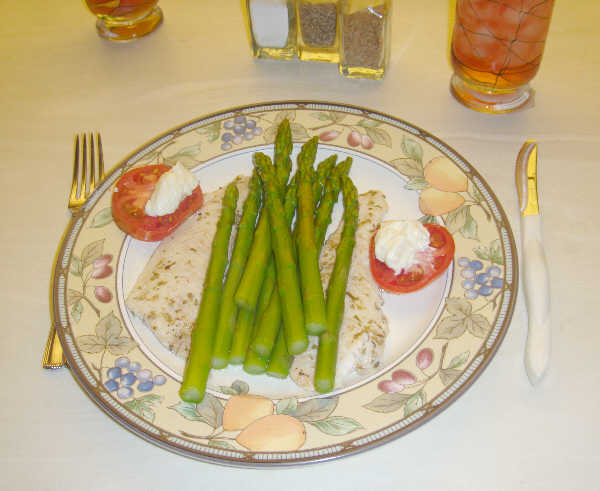
Place filet on one side of plate and line up asparagus on the other as shown. Place a pat of butter over the tips of the asparagus on the plate.
Optional: Flounder and Tomato Sides
Grill a flounder filet instead. Open the filet and place asparagus spears inside the flounder. Garnish the sides with slices of Creole Tomato and Mayonnaise on top.
== == == == == == == == == == == == == == == == == == == == == ==
6. POETRY by Christina Rossetti (1830 - 1894) from 1862:
= = = = = = = = = = = = = = = = = = = = = =
Remember
Background on the poem: On the night of October 7, 2008, Del and I watched a 1955 Mike Hammer movie "Kiss Me Deadly" (Based on Mickey Spillane's 1952 novel). She didn't like the movie, but I insisted on watching it even though I couldn't explain why. Near end of movie, Mike finds a poem in a book of the murder victim's. From the phrase "if the darkness and corruption leave/A vestige of the thoughts that once I had" Mike decides to visit the morgue and finds that the coroner had taken a key from her body. That key was to the safety deposit box where the "Whatzit" was hidden. I made a special note of the author's name at the time. On the next day, I was finishing a book entitled "Into the Silent Land" when on page 235, I found the eponymous quote in the second line of this same poem. Only the first four lines were quoted, but a quick Google gave me the rest of the poem and the key words "darkness and corruption" clued our memory to which movie of several Del and I had watched that night this poem had appeared. Later Kevin Dann, a friend of mine sent me this poem sung by the group, Village Harmony, Track 9 on their Album: Endless Light. Click Here to hear the poem sung by a Village Harmony Chorus.Remember me when I am gone away,
Gone far away into the silent land;
When you can no more hold me by the hand,
Nor I half turn to go, yet turning stay.
Remember me when no more day by day
You tell me of our future that you plann'd:
Only remember me; you understand
It will be late to counsel then or pray.
Yet if you should forget me for a while
And afterwards remember, do not grieve:
For if the darkness and corruption leave
A vestige of the thoughts that once I had,
Better by far you should forget and smile
Than that you should remember and be sad.
== == == == == == == == == == == == == == == == == == == == == ==
7. REVIEWS and ARTICLES for November:
= = = = = = = = = = = = = = = = = = = = = =And for my Good Readers, here’s the new reviews and articles for this month. The ARJ2 ones are new additions to the top of A Reader’s Journal, Volume 2, Chronological List, and the ART ones to A Reader’s Treasury.
1.) ARJ2: Old and New Methods of Initiation, GA#210 by Rudolf Steiner
We live in a world which has become increasingly materialistic since the fifteenth century and has experienced a precipitous increase during the past century since Steiner wrote and gave his lectures. With that materialistic view of life, humans have lost their moral compass. What they previously looked up to in the spiritual world and in their religious beliefs has faded away, replaced a belief in materialistic science. A science which contains no moral compass, so far as the average person knows. Read how Steiner described the situation about a century ago, in 1922, in the first lecture:
[page 1] A profound breach now runs through the whole of civilization, a breach which brings much chaos to the world and which people who are fully aware cannot but experience with a sense of tragedy. One expression of this breach is the fact that human beings, when considering human dignity and their worth as human beings, can no longer find any connection with a world to which they look up — that world which gives the human soul religious feelings both profound and uplifting — namely, the world of moral values.
He describes how humans today look to the world of nature, but that world is "indifferent to moral values" and runs its course whether humans are moral or not. Natural science has explained all of human life as if it sprung from some materialistic origin, a primordial soup, and exists independently of all spiritual inputs or guidance. Thus understood, no scientifically minded person can find in their sensory data and experiments any reason or rationale for morality. Steiner rightly observes that there was no knowledge available during his day capable of showing the necessity of morality or its benefits. The moral compass which came from belief in religious doctrines lapsed into disuse when the belief in the tenets of materialistic science with its amazing technologies began to replace the tenets of religion.

[page 1] Human beings have to look up from the world of nature to the world of moral values. We have to see the content of this moral world as something which ought to be, something which is the ideal. Yet no knowledge which is current today is capable of showing us how moral ideals can flow into the laws of nature and how necessity can be made to serve moral values.
Some forty years after Rudolf Steiner died, a Hungarian physicist by the name of Andrew Joseph Galambos tackled the problem of getting moral values into human beings. To my mind, Galambos filled the knowledge gap which Steiner discussed above. Galambos's landmark lecture series V50, the introduction to his innovative Volitional Science curriculum, shows how moral values become a necessity. He does this by a leap of consciousness in which he provides an operational definition of freedom. No such definition has ever existed before. Rightly understood, Galambos does something with that definition that few thinkers have ever done before: he changes people. It is one thing to change society, bureaucracies controlling society, or other forms of interaction and control by writing, but it is a far more difficult thing to change the people which make up the society, and change them for the better. Turn them into moral people.
Why did Galambos tackle this problem? He came to the USA as an astrophysicist and wanted to help build rockets to power Man to the Moon. He created an innovative design for a rocket motor, showed it to his department head, who promptly submitted it as his own creation and took all credit for it. Like many innovators before him — e. g., the Wright Bros and Nikola Tesla — Galambos had his ideas taken from him and used by others to profit only themselves. Galambos left the large aerospace corporation and worked on a solution which would prevent such immoral acts as his boss did to him from ever happening again, either to him or other innovators. Only a naive person, which Galambos was not, could believe that such acts could be prevented by passing a law. The laws protect such thieves, even considering them innocent until proven guilty by the aggrieved party in a civil suit not a criminal court.

Try to find a law in the code of the USA which protects people from having their ideas stolen. Copyright laws protect only a given incarnation of an idea. Patent laws require lascivious disclosure of an idea in exchange for the illusion of protection. Consider the utter incapability of a patent protecting someone like Galambos who shares a patentable idea with his boss, only to have it stolen. The boss gets the patent, not Galambos. Fight it in court? The Wright Bros. did that when their official patent's ideas were stolen and used to manufacture and sell aircraft by competitors. They won their suit but lost their chance to actually manufacture aircraft during their pursuit of an elusive justice.
Galambos studied the history of innovators in detail and decided that the only solution was to reform the people, not the laws. He perceived that the laws themselves were the problem, not the solution. The laws were created by people who lacked the knowledge necessary to understand "how necessity can be made to serve moral values." The only solution he saw was to provide that knowledge and create moral people out of immoral people. How do I know that to be a fact? Not by studying other peoples lives, but from my own personal experience. I went into his V50T (T indicates the lectures were on Tape, not live) as an immoral person and came out moral. Not perfect, just moral. I came out with a moral compass which allowed me for the first time in my life to make accurately moral decisions.

My wife, Del, was one of the most moral people I knew at that time, around 1982. After I completed the V50T course I had trouble explaining my decisions to Del. She didn't understand what I was talking about. It was like I had become another person, and she wasn't sure what to make of me. I suggested she take the course herself. After she completed V50T course, we once more understood each other. From my own personal experience, I can point to two people who were reformed by Galambos's thoughts and innovative knowledge. The major reforming that Galambos did with his landmark lectures in Volitional Science is now embodied verbatim in his posthumous book, Sic Itur Ad Astra.
In a curious irony, the two classic books on freedom originate from the materialistic thinker, Andrew Galambos, and the spiritual thinker, Rudolf Steiner. Taken together, Galambos provides a view of how freedom flows from human actions and Steiner gives a view of how freedom flows into human actions from the spiritual world. I can only imagine that their spirits are sharing with delight how their two-pronged approach to freedom is lifting humanity into a morality which is long overdue. This new approach to freedom can only be appreciated one person at a time, which, rightly understood, is the only way freedom as a society can be achieved. Freedom cannot be fought for — it can only be built, one person at a time. This is the legacy which Steiner and Galambos leave us. The rest is up to you, dear Reader, to decide if you wish to live in freedom. You will have to tread both the spiritual and materialistic sides of life.
There are two kinds of material in our brain: one consists of neurons and glial cells interwoven and compacted into the structure of the brain. This material is visible and may be called the "hard brain" to distinguish it from the "soft brain", which is basically a clear, colorless fluid which flows in the ventricles of the brain, the cerebrospinal fluid. This fluid area of the brain was deemed to be the seat of perception, memory and other cognitive functions by famous thinkers as recently as Leonardo da Vinci. Modern brain theorists disdain any function of the cerebrospinal fluid and refer to the places where it resides as "essentially holes in the brain. Clearly modern day materialistic scientists consider all thinking and sensory processing to be done by the "hard brain" and not those "holes in the brain" which I call the "soft brain". Da Vinci was right about the feasibility of heavier-than-air flying machines, even though he was not able to create one himself, although he made some detailed models. Was he perhaps right about the soft brain as an organ of perception, memory, and other cognitive functions? Can we not have a hard brain and soft brain which act together to create that magical process of thinking, sensing, and operating in the world? Is it not better to hold this possibility as an unanswered question? In other words, is it possible that our brain, like the rest of our body, has a phosphoric warmth side in the clear ventricular fluid and a sclerotic cold mineralized side in the visible brain tissue? If Leonardo da Vinci was a "soft brain" thinker and came up with his many innovations and theories using "soft brain" thinking, perhaps our materialistic scientists with all their many useful technologies may be missing something, up until now.

The only way to make sense of this hard-brain, soft-brain duality would be to rise above such sterile right-wrong questions as "Which is better: hard-brain or soft-brain thinking?" When you have only one option, you are stuck, when you have two options, you have a dilemma; only when you have three options do you have a real choice. The real choice here would be that we use a combination of hard-brain, soft-brain thinking all the time. Yet, for the time being, soft-brain thinking is out of the question for materialistic scientists, who are primarily hard-brained thinkers. Any scientist who would dare to use soft-brain thinking would derisively be called "soft-headed." It's not that we don't know about soft-brain thinking, but that we disdain it when it appears in ourselves and others, up until now.
Even when we address moral issues using hard-brain thinking, we go very much astray, becoming rule-bound, duty-bound, and law-bound, all of which removes us from the very morality we seek. The countries of the West are dominantly hard-brain thinkers and of the East, soft-brain thinkers. This leads the forces of the West to be concepts and the forces of the East, feelings. It is easy to see this dichotomy at play in the two leaders of the USA and Russia. The American president describes concepts and principles behind deploying anti-missile defenses in Poland and the Russian leaders talk about feeling threatened by them. First the forces of the West need sharply defined concepts. The Russians and other peoples of the East do not reach for their highest aspirations in concepts, but rather in feeling states. This is difficult for Americans on the whole to understand, and leads to many of the standoffs at a national level over the past hundreds between the two countries.

How do the feelings show themselves when we travel to the East and regions bordering the East? Steiner points to the appearance of Madonna images, altars, and first greetings given to the Mother of God when entering a room. In the whole area of Southern Louisiana, such images of the Blessed Mother are found in people's homes, and altars or grottos with Madonna images in them grace many front yards of suburban homes yet today. Somehow the deep feelings of the East have reached into the area surrounding the long-time port city of New Orleans and taken root here. Steiner gives us a way of understanding the presence of these images as an outward show of deep inner feelings.
As I think about my own mother, she was no one to talk in abstract concepts, but was always in touch at the level of feelings, something which took me several decades to come to understand. In the Russian philosopher, Soloviev, Steiner found someone who could write in the ways of the West and yet could find ways to express the feelings of his compatriots as they stood before the Madonna icons. By bridging the East and the West, Soloviev is a harbinger of the new world which Steiner visions in our own future, one in which no one region of the world dares proclaim that it holds the whole truth of the only right way of life on Earth.
In one passage Steiner describes for us the pre-Tower of Babel times when all humans spoke the same language. It was a time of unity, but an enormous evolution of consciousness was due to arise in human beings as they grew from the universal "interjection-language" which used mostly gestures and various grunts and single syllable words for communication. This was the language of Neanderthal times, so well described by Jean Auel in her Clan of the Cave Bear series of novels.
Christ is known in spiritual science circles as the great "I" or "I Am" which we are to strive to become more like. In this next passage we can read where Steiner is exhorting us to become "Christ-I-sh" or "Christish". We must ever recognize that Christ became Man and gave his life to teach us this most important lesson: that we are to strive ever to become more like the universe, like Himself.

In Lecture Three, Steiner gives us the history of the evolution of human consciousness in ten short pages, as it evolved in the first "hard" human being symbolized by Adam. This consciousness flowed through four earlier cultural epochs until it reached ours, the Fifth-Post Atlantean epoch in the 15th century. The Indian epoch brought a deep spirituality whose remnants can be still found in the sub-continent of India and its peoples today. The Persian epoch moved toward the physical world and began building of large structures and the spiritual aspects moved more inward and worshiped as Ormuzd and Ahriman, the light and dark spiritual beings of the Sun. In the Egypto-Chaldean epoch, the spiritual beings seen by the ancient Indians in the heavens at night were tracked as the movement of stars and planets across the heavens in their astrology. When the Greek age began, they focused their knowledge upon the Earth, a -sophy of Gaia or a geosophy. With the advent of our fifth cultural epoch, this geosophy evolved into geology, becoming thus a more abstract and conceptual based knowledge of the Earth.
Here we are at the beginning of the second third of the fifth cultural epoch, and we find all around us a plethora of "-logies" replacing the "-sophies" of previous epochs. What is the different between an "-logy" and a "sophy"? Steiner tells us that a "-logy" is an abstract idea which emerges when we combine logical concepts of the world. A "-sophy" on the other hand represents a direct knowledge — this distinction is clear in his descriptions of geosophy and geology in this lecture.

Is there hope for us humans? Can we fly on the wings of their "-logies" or will we crash and burn like Icarus? Yes, Steiner gives us hope, but his vision is not one that would meet the approval of our scientists with their "-logies" built of abstract phantoms. Scientists today can be reckoned as the King paraded the streets of his Kingdom in his new clothes. He is proud of his new garments, but those who, with the eyes of a child, can see through the camouflage of descriptive words will find that in fact the King is naked. But all is not lost, this fabric of words and abstract thoughts will allow humans to ascend to spiritual worlds again, but this time carrying with them their new tools of logic and conceptual thinking. We humans will arrive where we were ages ago, and we will be completely different, having completed an important phase of our journey into the spirit. Obviously we are in the early stages of developing Imaginations, Inspiration, and Intuition, and the scientists with their hollow "-ologies" will be the last to recognize and validate the progress being made. Were they forced to examine the works of Rudolf Steiner on this issue, their results would be akin to giving someone a book to read and having them return to you an analysis of the ink spread across the pages of the book. Yes, they may have done a masterful job of ink-analysis, but what about the content of the words which were formed by the ink in the book?
Why do pathological killers exist? They seem bent on killing everyone in the range of their weapons. By what process do they arrive at such thoughts and goals? Psychiatrists talk about brain chemistry and structure going awry, but this seems to be a plausible cover story for what they really don't know. What if someone enters the spiritual world without adequate preparation — in other words, without having won their way through hard work to love creation and come to an understanding and appreciation of how the world has arrived at its present condition, not by acts of random natural events, but acts of love — how might someone like that feel upon awaking in the morning?
[page 37] In order to enter well prepared into the spiritual world we must first have thoroughly understood the meaning of earthly life. Otherwise on waking up every morning we would return to the world of sense perceptions filled with a terrible hate for this world and with an urge to destroy it. Simply out of the necessity of human existence we would wake up full of hate and anger if we spent the time between going to sleep and waking up in a state of consciousness such as that.

To pathological killers, life began at birth and ends at death, so there is no hope for their brutish and imperfect life but to end it as soon as possible and sometimes to take as many people with them as possible. The very idea that one could be an infinite being living through multiple lifetimes of which this is only the current one never occurs to such a person. Our very language does not even have a word which describes an immortality which precedes birth, an "unbornness", as Steiner points out. Clearly, our language is a work-in-progress and, in my opinion, such a word is necessary. Without it we human beings will be unable to understand the physical and the spiritual world. The concepts of karma lying instinctively behind that word will help any who might inadvertently slip into the spiritual world. It will help them to return without being full of anger and hate, an event which seems to be happening with increasing frequency around the world.
[page 41, 42] Even our language shows that we only have a half knowledge about the eternity of man. We speak only about immortality, 'undyingness'. What we need in addition is a word denoting 'unbornness'. Only when we can grasp both will we finally understand the eternity of the human being. Right down into language, human beings of our time have abjured their links with the spiritual world. These links must be found once more. If they cannot be found it will be totally impossible to carry on living in a proper way, and today's culture and civilization could fall into absolute decline.
We will languish with our language if we do not infuse it and ourselves with the living spirit from which we have cut ourselves off, up until now. Want an example of how we have cut ourselves off from the spirit? Look no further than at your school children. Do they come home from school enervated? Do they abhor going to school each morning? Do they delight in snow days which give them a respite from the hated classroom? If your answers are all yes, they are typical school kids, except for those of the Steiner-designed Waldorf School system. This system has created an entire no-tire school system, and back in the time Steiner was giving this lecture, they were not praised for this accomplishment, but derided for not taking fatigue into account!!! This would be humorous if it were not such a serious subject. Our school children deserve a system which keeps them energized not enervated, excited and not bored, loving school time not detesting it. Don't you think so?

Steiner is writing here of the very first school he founded in Stuttgart for the children of the people who worked at the Waldorf-Astoria Cigarette Factory.
[page 42] In Stuttgart we have founded the Waldorf school and Waldorf education. All sorts of things are said about this. Recently somebody said: Why does Waldorf education take so little account of fatigue in the children? Fatigue ought to be carefully studied nowadays. In so-called experimental psychology it is pointed out with pride how children tire after repeating unconnected words or following lessons about a sequence of subjects. And then it is said: Waldorf education is not up to date because it does not take the fatigue of the children into account. Why is this? The Waldorf school does not speak much about fatigue. But it does speak about how children ought to be tended and educated after the change of teeth, namely by basing the education mainly on the rhythmic system — which means that the artistic element is cultivated, since this is what stimulates the rhythmic system. Abstract writing comes later, and abstract reading later still. Demands are made, not of the head but of the artistic realm. But those who work with children only at those things which make demands on the head will, of course, have to reckon with fatigue. When, however, we make claims on the rhythmic system, on the artistic element, then we are justified in asking: Does our heart tire throughout life? It has to go on beating, and we have to go on breathing. So Waldorf education need not concern itself too much with fatigue because it aims to educate children in a way which tires them very little.
With the physicists of the world predicting a heat death due to global warming or a nova explosion of the Sun, the Earth seems doomed to be obliterated. What is the point of being good and moral? This is a big question of our time and one that deserves a big answer. Scientists who put their faith in the abstract logic of their theories and equations, which work so well in the physical world, will be the very ones doomed to perish, satisfying their deadly self-fulfilling prophecy. None of the tenets of physics allows anything to survive when the Earth perishes.
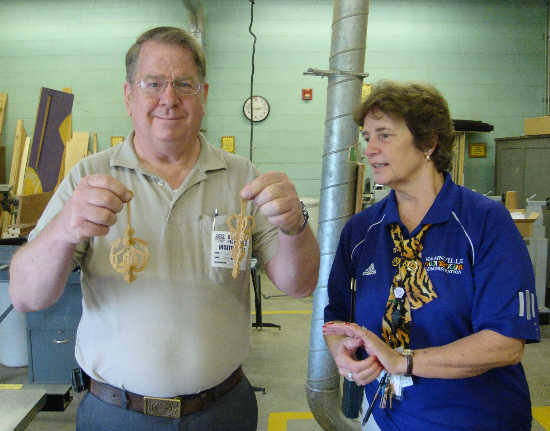
Let us read Steiner's summary of soft-brain thinking in which we move our thinking into the fluid cavities of the brain in order to make more intense and mobile thinking than is possible in the rigid neuronal networks which provide our hard-brain thinking.
[page 66] Yesterday I described how in the ancient Mysteries the bodily nature of man was treated so that it became able to free its soul nature in both directions. I said that the two main aspects of this in the ancient Mysteries were, on the one hand, the draught of forgetfulness, and, on the other hand, the occasioning of states of anxiety, fear, shock. The draught of forgetfulness, I said, wiped from memory everything pertaining to ordinary earthly life. But this negative effect was not the main point. The main point was that during the process of coming to Mystery knowledge the brain was actually made physically softer, as a result of which the spiritual element which is usually held off was no longer held off by the brain but allowed through, so that the pupil became aware of his soul and spirit element and knew that this had been in him even before birth, or rather, even before conception.
Dr. Jeanette Norden, the neuroscientist mentioned earlier in a footnote, by her very specialized training, is taught to think with her hard-brain structures. No wonder she disdains the cavities holding cerebral fluid, calling them mere holes in the brain and therefore of no use.

During birth the soul and spirit dies from the point of view of the spiritual world. Birth and death are mirror images of each other as regards the body versus the soul and spirit. When one dies the other is born and vice versa. Once one fully grasps the significance of this fact of human existence, one's mourning of a so-called lost one becomes a recognition of an important passage for their soul and spirit which are born once more from the perspective of the spiritual world.
[page 72] When a human being descends from the world of spirit and soul to physical incarnation, his element of soul and spirit, in a way, dies from the point of view of the soul and spirit world. When a human being is conceived and prepares to be born he dies as regards the spiritual world. And when he dies here in the physical world and goes through the portal of death he is born in the spiritual world. These concepts are relative. We die in respect of the spiritual world when we are born. And when we die in respect of the physical world we are born in the spirit. Death in the physical world signifies spiritual birth, birth in the physical world signifies spiritual death.
Steiner reveals to us that our overweening concern about life after death in our time reflects our lack of concern over what we brought with us from our previous lifetimes. This lack of concern is due to our inability in modern times to directly perceive our previous lifetimes as the ancients were able to. This leads directly to a modern day lack of understanding of karma and destiny.
[page 92] Human beings used to have a strong feeling of what they had been before they descended into earthly life. This was strongly developed in primeval times. But hope of a life after death was less strongly developed in primeval times. This was something that was taken for granted. Today we are chiefly interested in what we might experience after we die. In primeval times, thousands of years ago, people were more concerned about their life prior to descending to the earth.

In the pre-Mystery of Golgotha times, there were two streams of human evolution with their distinctive modes of operation. One was among the ancient Greeks and the other among the peoples of the Old Testament. The Greeks had an understanding of destiny and a direct knowledge of nature as perception rather than our present descriptive knowledge of the external effects of nature. On the other hand, the second stream of human evolution among the peoples of the Old Testament knew nothing of nature as we or the ancient Greeks did. Instead they followed an invisible god who ruled the moral order of the world, and to emphasize the god's invisible nature, no images were allowed to be made and even the one name of this god was not allowed to spoken or written. Even today, in a curious atavism, some descendants of these people will omit the letter o to spell God: G-d.
[page 93] The Old Testament knew only a moral world order, and Jahve is the ruler of this moral world order; only what Jahve wills takes place. So in the world of the Old Testament the view arose as a matter of course that one must not make images of the soul and spirit element. The heathen world could never have come to such a view, for it saw images of the spirit in every tree and every plant. In the world of the Old Testament no images were seen, for everywhere the invisible, imageless spirit ruled.
In an amazing insight, Steiner sees that the image-less form of a worship in the Old Testament peoples corresponds to a science in which the material world is presumed to be spirit-less. Rightly understood, science as we know it today, with all its technological breakthroughs and insights, is atavistic when it takes a hard line against the presence of spirit in the material world. Said another way, Old Testament people would likely be right at home with our materialistic sciences today because our sciences have yet to become Christian.

[page 93, 94] In many ways modern materialistic science contains an echo of the Old Testament, of the imageless Old Testament. Materialistic science strives for a clear distinction between the material element in which no trace of spirit is left, and the spiritual element which is supposed to live in the moral sphere only, and of which no image may be made, or which we may not be allowed to see in the earthly realm.
This particular characteristic which is prevalent in today's materialistic form of science is, actually, an Old Testament impulse which has come over to our time. Science has not yet become Christian. The science of materialism is fundamentally an Old Testament science. One of the main tasks as civilization progresses will be to overcome both streams and resolve them in a higher synthesis. We must understand that both the heathen stream and the Jewish stream are one-sided and that, in the way they still exercise an influence today, they need to be overcome.In the Gospels we read of a lot of humans who did not recognize Christ when He walked the Earth, but the demons surely recognized Him instantly and they rebelled against him. The demons knew their rule was nearing an end, but they found hope in the heathen consciousness of some humans who sought them out in the old way, even while Christianity was providing a new way of finding spirituality in human life. Even Goethe missed the point during his struggles to understand human life in his magnificent opus, Faust. Goethe failed to come to grips with the Mystery of Golgotha, something which Steiner, with all his esteem for Goethe, must admit that the great dramatist lacked.
[page 110] This is not intended to belittle the Faust drama. But it has to be said that Goethe, who wrestled in the deepest sense of the word to depict how the spiritual world should be found in earthly life, did not, in fact, succeed in discovering a way of depicting this finding of spirituality in earthly life. To do so, he would have had to come to a full comprehension of the meaning of the Mystery of Golgotha. He would have had to understand how the Christ-being came from the expanses of the cosmos and descended into the human being, Jesus of Nazareth, and how he united himself with the earth, so that ever since then, when seeking the spirit which ebbs and flows in the stormy deeds of man, one ought to find the Christ-impulse in earthly life.
Remember when we discussed soft-brain and hard-brain thinking earlier in this review? The soft-brain thinking is the direct experience of the spiritual realities which flows into the "holes in the brain", the cavities which contain the cerebrospinal fluids. It is in these fluid-filled cavities that the spiritual world enters our brain and from which we think in new ways far beyond the ability of our hard-wired, neuron-based hard brain. In Goethe, we find soft-brain thinking and in Voltaire we find hard-brain thinking. Hard-brain thinkers utilize the neuron-based brain matter and create cold, abstract thoughts and dead concepts. Soft-brain or hard-brain thinking — Which is better? Rightly understood, we need both soft-brain thinking and hard-brain thinking in our time. Rudolf Steiner is the best example I know of someone who combines soft-brain thinking and hard-brain thinking in his life and work.
As I examine my "limitation eraser" which I created years ago(7), I find that I had created a hard-brain tool which when applied has beneficial soft-brain effects. What is the limitation eraser? It is the adding of the curious phrase ", up until now" to end of a sentence expressing a limitation. If you apply it correctly by pausing at the comma and taking a deep breath before saying "up until now" right before the period of the sentence, amazing results can be achieved. Namely this: the limitation which had you completely in its thrall, lets you go. You sense a relief and release that will allow all sorts of creative and helpful thoughts to arise in you immediately or over time. Apply the limitation eraser and set yourself free from your limitations. Allow yourself to use your limitations as launching pads into new ideas and deeds. Any hard-brain thinker will scoff at such a plan of action and likely will not even attempt it, having decided in advance that his time would be wasted on such a folly. In the same amount of time he could have applied the limitation eraser by saying, "I'm sure my time would be wasted on such a folly, up until now." By doing so, he would have likely felt a distinct change in his feeling state about the efficacy of the limitation eraser and proceeded from there to applying it in other more important areas of his life.
How might the limitation eraser help you in your life? I don't know, but that very question, if held by you as an unanswered question, will lead you to discover new and interesting aspects of your life, especially if you are a hard-head, hard-brain thinker, up until now. Clearly holding an unanswered question is another soft-brain technique which can benefit a hard-brain thinker in the modern world.
These tools describe how to improve one's soul mood, something that few hard-brain thinkers know how to do. Mostly hard-brain thinkers seem intent on destroying any beneficial soul-mood the moment one creeps up, as if such a mood were an obstacle to getting their real work done, up until now.
The hard-brain Professor of Neurology views soft-brain thinking as nothing because she is convinced that no thinking can occur in mere "holes in the brain." And yet, we can say to her in the words of Faust, "In this, thy Nothing, may I find my All." (Page 148) These words appear in Faust, Part Two as Steiner describes it below:
[page 148] So now Goethe leads us in sublime fashion through the experiences depicted in Part Two. We see how the strong inner being of man asserts itself: "In this, thy Nothing, may I find my All!" We need only think of words such as these with which a strong and healthy human nature confronts the one who corrupts.
One who corrupts seems to refer to the hard-brain thinking scientist who seems to offer us everything, but in essence offers us nothing but dry, abstract, dead concepts devoid of all life. It is not thinking, per se, that Steiner is suggesting we avoid, but a skewed hard-brain thinking which locks forever out of our reach the spiritual realities we can achieve by soft-brain thinking which opens us to receiving flowing Imagination from the spiritual world.
When we formulate our questions, we do best not to answer them right away, but to hold them as unanswered until the answer arrives in its own good time.
This next passage, Steiner discusses the process one must go through in reading truly innovative books such as his Occult Science. I read that book, and noted a similar process that I went through when reading other innovative classics such as Ludwig Mises's Human Action and Alfred Korzybski's Science and Sanity — I could only read a handful of pages by day and then would have to absorb what I had read overnight before continuing on the next set of pages. Reading these books, like reading Occult Science require some active reading on my part to grasp the meanings in the books.

[page 172] Without developing any great inner activity it is possible to absorb everything written today in a book about botany or zoology. But it is not possible to absorb what I have described, for instance, in my book Occult Science, without inner energy and activity such as that needed also for ordinary healthy common sense. Everything in this book can be understood, and those who maintain that it is incomprehensible are simply unwilling to think actively; they want to absorb it as passively as they absorb a film in the cinema. In the cinema there is certainly no need to think very much, and it is in this manner that people today want to absorb everything.
With the advent of television, this manner of absorbing without thinking has become even more prevalent in our time than a hundred years ago in Steiner’s time. The three important processes of receiving information from the spiritual world for humans are Imagination, Inspiration, and Intuition. A long course or series of lectures could be given on these three processes, and how to achieve them, but in a short few paragraphs Steiner explains why these they are important for all humans in our time. Can't we just read a book to get meaningful content, some might ask. The answer is simply, No. It requires work. Work to assimilate the content, and work to develop the processes which accompany the content. With content only, one can be smart in knowledge, but, lacking the processes, dumb in deed. It requires work to develop a living appreciation of the spiritual world and to become a full human being. This is the aim of Steiner's anthroposophy and it is one worthy of any human being. Especially for one who wishes to do more than just shout, Here! during one's time on Earth.
Read the Review at:
http://www.doyletics.com/arj/oldnewme.htm2.) ARJ2: Night Flight, A Novel by Antoine de Saint-Exupéry

His first novel on flying was Southern Mail and the flying then was only from France to Africa along the northwestern coastline. In this novel we meet Fabien who is flying from the southernmost tip of South America carrying the mail. St-Ex takes us inside the pilot's head as he imagines himself first as a ship entering a harbor and then as a shepherd moving from one flock to another, only his flocks are small clusters of lights and civilization thousands of feet beneath his wings.
[page 1] Fabien, the pilot bringing the Patagonia air mail from far south to Buenos Aires, could mark night coming on by certain signs that called to mind the waters of a harbor — a calm expanse beneath, faintly rippled by the lazy clouds — and he seemed to be entering a vast anchorage, an immensity of blessedness.
Or else he might have fancied he was taking a quiet walk in the calm of evening, almost like a shepherd. The Patagonian shepherds move, unhurried, from one flock to another; and he, too, moved from one town to another, the shepherd of those little towns. Every two hours he met another of them, drinking at its riverside or browsing on its plain.
Sometimes, after a hundred miles of steppes as desolate as the sea, he encountered a lonely farmhouse that seemed to be sailing backwards from him in a great prairie sea, with its freight of human lives; and he saluted with his wings this passing ship.With this wingtip salute we climb in the cockpit with Fabien and join him and his navigator/wireless operator in a 5,000 lb hunk of metal with a constant stream of fireworks spraying backwards from its five-hundred-horsepower engine just outside his window . In the rear is his precious cargo destined eventually for France, the Patagonian airmail, the only communication link with the rest of the world for this isolated outpost of humanity. In this cockpit we will be treated to the poetry in motion of St-Exupéry. Likely he sharing with us thoughts he had while flying the night mail himself.
[page 12] But night was rising like a tawny smoke and already the valleys were brimming over with it. No longer were they distinguishable from the plains. The villages were lighting up, constellations that greeted each other across the dusk. And, at a touch of his finger, his flying-lights flashed back a greeting to them. The earth grew spangled with light signals as each house lit its star, searching the vastness of the night a s lighthouse sweeps the sea. Now every place that sheltered human life was sparkling. And it rejoiced him to enter into this one night with a measured slowness, as into an anchorage.
A pilot in those lonely days and nights of solitary flights carrying the mail apparently needed an imagination to carry him through the otherwise utter boredom which might cut short his lucrative flying career.
In the next storm, we follow Fabien carrying the Patagonian mail and flying into a black wall of storm ahead. The navigator has just leaned forward and tapped on Fabien's back, but the pilot did not move.
[page 35] Now the first eddies of the distant storm assailed them. The mass of metal heaved gently up, pressing itself against the operator's limbs; and then it seemed to melt away, leaving him for some seconds floating in the darkness, levitated The clung to the steel bulwarks with both hands. The red lamp in the cockpit was all that remained to him of the world of men and he shuddered to know himself descending helpless into the dark heart of night, with only a little thing, a miner's safety lamp, to see him through. He dared not disturb the pilot to ask his plans; he tightened his grip on the steel ribs and, bending forward fixed his eyes upon the pilot's shadowed back.
Fabien was too busy flying to respond to his navigator.
[page 35] In that obscurity the pilot's head and shoulders were all that showed themselves. His torso was a block of darkness, incline a little to the left; his face was set toward the storm, bathed intermittently, no doubt, by flickering gleams. He could not see that face; all the feelings thronging there to meet the onset of the storm were hidden from his eyes; lips set with anger and resolve, a white face holding elemental colloquy with the leaping flashes ahead.
No one who has not flown or navigated under such conditions could write so vividly about the experience. Obviously St-Ex had done both, and his writing flashed as brilliantly as the lightning bolts as Fabien's plane entered the storm.
Meanwhile on the ground, the boss Rivière reveals to us his innermost thoughts about how he must push his pilots to drive through storms, while one of his pilots who has heeded his exhortations is driving through a storm from which he may never return.
[page 53] No the Patagonian mail was entering the storm and Fabien abandoned all idea of circumventing it; it was too widespread for that, he reckoned, for the vista of lightning flashes led far inland, exposing battlement on battlement of clouds. He decided to try passing below it, ready to beat a retreat if things took a bad turn.
This was a night flight which seemed fated never to see the light of day. We are in the tight compartment of the cockpit with Fabien, our eyes straining into the darkness, striving to make sense of the dimly lit instruments, muscles aching from holding onto the controls of this airplane turned roller coaster in the thundering zephyrs of the clouds.
[page 68] It was as if dead matter were infected by his exasperation; at every plunge the engine set up such furious vibrations that all the fuselage seemed convulsed with rage. Fabien strained all his efforts to control; crouching in the cockpit, he kept his eyes fixed on the artificial horizon only, for the masses of the sky and land outside were not to be distinguished, lost both alike in a welter as of worlds in the making. But the hands of the flying instruments oscillated more and more abruptly, grew almost impossible to follow. Already the pilot, misled by their vagaries, was losing altitude, fighting against odds, while deadly quicksands sucked him down into the darkness. He read his height, sixteen hundred — just the level of the hills. He guessed their towering billows hard upon him, for now it seemed that all these earthen monsters, the least of which could crush him into nothingness, were breaking loose from their foundations and careering about in a drunken frenzy. A dark tellurian carnival was thronging closer and closer about him.
Rivière knew that, if Fabien didn't make it, he would have to break the news to his wife.
[page 74] Rivière knew all the tenderness of Fabien's wife, the fears that haunted her; this love seemed only lent her for a while, like a toy to some poor child. He thought of Faien's hand which firm on the controls, would hold the balance of his fate some minutes yet; that hand had given caresses and lingered on a breast, wakening a tumult there; a hand of godlike virtue, it had touched a face, transfiguring it. A hand that brought miracles to pass.
But Rivière, Fabien, and Fabien's wife all have to wait throughout this night. Will the Patagonian mail get through to Paris? Will Fabien and his wife be reunited in another joyful embrace? Will Rivière change his mind about letting Roblet go? So many themes to play out, so few pages remaining to go. One can only enjoy to the fullest every page as one enjoys every day, every minute of one's life.
Read the Review at:
http://www.doyletics.com/arj/nightfli.htm3.) ARJ2: Into the Silent Land — Travels in Neuropsychology by Paul Broks
"Why does raw meat give me a hard-on?" is an amazing first sentence for a book, right up there with "It was the best of times; it was the worst of times" by Charles Dickens. And "Into the Silent Land" is about the worst times which humans have to go through — journeys into neuropathology, when suddenly parts of their body act in strange ways or just go silent on them. Michael, who spoke that first sentence above had a dent in his head about three inches up from his right eyebrow, indicating some injury involving damage to his brain.
The next day the author Paul Broks is visiting another patient with a dent over his left eyebrow, Stuart, which he received when his head hit a rock in the grass after a fall from a tree.
[page 4] We sit in his stuffy front room. An ornate black clock (his early-retirement present) clings to the wall like a huge fly. As I struggle with milky tea, Stuart locks me in his gaze. He is about to say something, but doesn't. It is a long pause. Eventually he speaks.
"I don't love you any more, do I, love?"
The words are intended for his wife, Helen, who sits beside him. "No, love," she replies. "So you say."Mirror image sides of the brain are damaged in Michael and Stuart and the effects on their life are completely different. In the next patient we find an autistic man, Martin, who acted similar to the one played by Dustin Hoffman in the movie "Rain Man". When Broks's research assistant arrives, she asks Martin a simple question, but the answer is one that Broks has trouble dealing with.
[page 8] "And what have you been up to?" she asks him.
"I've been masturbating quite a lot," he replies, as if through a tiny loudspeaker. I press mouth against knuckles to block the laughter. It's no good. I snort and cough.Broks talks about sleepwalking and gives an example from his own life when he was young as an example of acting without awareness.
[page 16] I was in the Combined Cadet Force in my teens. One night, at camp, I somnambulated through the barracks and mistook the NCO's quarters for the lavatory. I shuffled in and urinated over one of the officers as he slept. Unfortunately, the following morning I was fully conscious.
How convenient it would be sometimes to turn off consciousness and carry on with ordinary behavior. Imagine flicking a switch on difficult days and flipping into oblivion, knowing that your body will continue going about its normal business. No one would notice. A pre-programmed wake-up call would return you to sentience in time for a film or the football. Controlled automatism might be preferable to periods of physical or emotional discomfort, or sheer boredom. If everyone had a consciousness switch then the world, most of the time, would be teeming with zombies. Perhaps it already is.These few paragraphs gives us a good idea of the humor which Paul Broks mixes in with the insights in the course of this book. If one looks at the people who are taking various conscious-altering prescription drugs for depression, bi-polarity disorder, and various other medical condition, one might agree that the world is teeming with half-conscious zombies already.
Let us pause to consider that Paul Broks is a materialist scientist. As such he can recognize the effects of spiritual phenomenon, but lacks the tools to understand them within his sensory-based instruments. When he looks into a person's face, he see an "I" — that glimmer of recognition which survives throughout a person's lifetime when all the other features have changed. That look in the eye is the person's spirit, the "I", looking out at us. But, being a neuropsychologist, Broks tries to locate the "I" within the skull of the brain and cannot. His described attempt to do so reminds me of my friend's looking inside a PC case and asking me to show him the software that makes the computer operate. I cannot show him the software in the computer: it does not exist in visible things, but rather in the status of minute positions of electromagnetic fields and voltage levels lying unseen within the visible hardware. Yes, I can show him the book the software came in, the memory chips and hard drives which the software was loaded in, but I cannot show him the software while it is in the computer and operating. It's just there.

Broks might say, "Oh, yeah, that's true. But one could detect the status of those bits and voltage levels while the software is operating. True, but the computer is man-made and we have developed man-made instruments to allow us to do this. Human beings are not man-made, and the only instruments we have are built into us. One of those instruments is the "I-detector" which allows us to recognize a person we knew from 50 years earlier by looking into their eyes, and it is really their "I" we recognize, not the shape or color of their eyes. Give a PC to any animal and it will never discover the presence of the software within. Its tools are sub-human and it is unable to comprehend what software is, much less locate it. We humans are in that position of being unable to comprehend our own "I" using our human tools and are the same position vis-à-vis comprehending our body as animals with respecting to computers. Broks illustrates this dramatically in this next passage, going so far as to say, "There's no one there."
[page 17] The illusion is irresistible. Behind every face there is a self. We see the signal of consciousness in a gleaming eye and imagine some ethereal space beneath the vault of the skull, lit by shifting patterns of feeling and thought, charged with intention. An essence. But what do we find in that space behind the face, when we look?
The brute fact is there is nothing but material substance: flesh and blood and bone and brain. I know, I've seen. You look down into an open head, watching the brain pulsate, watching the surgeon tug and probe, and you understand with absolute conviction that there is nothing more to it. There's no one there.It is interesting to note that Broks can "imagine some ethereal space . . . charged with intention", but imagination is not enough, he must look at only dead tissue for what can only exist in live tissue and which exists in an ethereal space indeed, one that is by definition not amenable to observation with one's physical eyes and instruments.
In a science which includes only materialistic hypotheses, one would certainly define brain function as extending the beyond the body to other humans, but in a science which includes soul and spirit within its domain in addition to the material, one would describe this comforting not a brain function, but as a soul function. To a full science, there is much more to know about how our mind works that a mapping of the brain. For matters of inspiration, intuition, the brain is the not the originator of these ineffable thoughts, but merely the receiver of them and converts them later in thoughts which can be expressed to others. Scientists like Broks, on the other hand, exclude such possibilities, not by proof, but by the strongly held beliefs or dogma — if you will. The chapter ends with Broks' example of what I would call the Materialist's Litany.
[pag 56, 57] Like the surface of the Earth, the brain is pretty much mapped. There are no secret compartments inaccessible to the surgeon's knife or the magnetic gaze of the brain scanner; no mysterious humors pervading the cerebral ventricles, no soul in the pineal gland, no vital sparks, no spirits in the tangled wood. There is nothing you can't touch or squeeze, weigh and measure, as we might the physical properties of other objects. So you will search in vain for any semblance of self within the structures of the brain: there is no ghost in the machine. It is time to grow up and accept this fact. But, somehow, we are the product of the operation of this machinery and its progress through the physical and social World.
Minds emerge from process and interaction, not substance. In a sense, we inhabit the spaces between things. we subsist in emptiness. A beautiful, liberating, thought and nothing to be afraid of. The notion of a tethered soul is crude by comparison. Shine a light, it's obvious.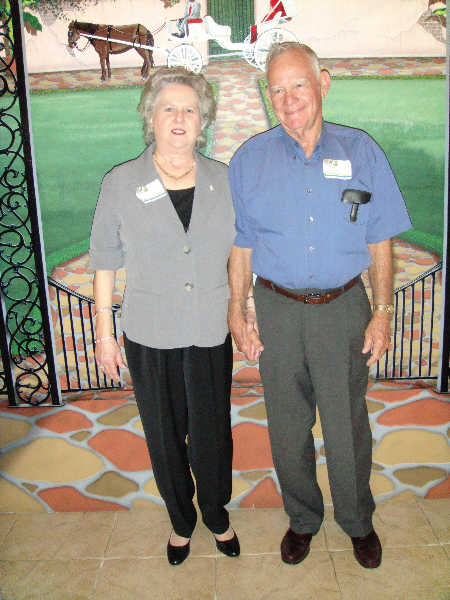
To identify humans as mere machines and a product of the machinery of bodies, Broks uses the English verb "to be" several times in the above passage, apparently oblivious to the harmful effects of such usage as described by Korzybski. He warned specifically against such usage in any field of science, comparing it to donning semantic blinders. A scientist with semantic blinders on cannot catch a glimpse of the peripheral phenomena of soul and spirit. Shine a light and such a scientist will miss the obvious.
To Broks, one's marvelous human brain never receives inspirations or intuitions, but instead it and one's self is either meat or a fiction.
[page 63] When we see the brain, we realize that we are, on one level, no more than meat; on another, no more than fiction.
Broks finishes the chapter by saying, "Despite myself, I fear for my soul." (Page 64) I suspect that "myself" refers to his "Doctor Self" which had to be "carefully taught" to think of humans as meat and the mind as a fiction, which leaves the possibility of a soul out of the question, in fact, non-existence. The fact that he would write, "I fear for my soul" seems to indicate that his Soul has some existence apart from the Doctor self.
Broks equates mind and brain the way a computer engineer might think of hardware and software, you can't have software without hardware and you can't have mind without a brain. But you can have the hardware without software in it, and it becomes useless; so, too, you can have a brain without any life (soul and spirit gone) and it is useless and quickly decays to nothing. Does the brain support the soul and spirit? If so, why does the brain collapse after the soul and spirit leaves the brain? If you scoop away the brain, the soul and spirit will also leave. Yet, Broks must demand that brain and mind are equal as a matter of dogma. (Page 123)
Broks is writing using his PC.
[page 126] Both hardware and software are irrelevant to the content of the text. I happen to be writing about minds, brains, and selves, but it could be anything — a guide to sea fishing, a suicide note or a Japanese haiku. Think of the brain as the hardware, the mind as software, and the self as the text on the screen.
In fact, why not a haiku?A true enigma:
The self looks inward and finds
Nothing but neurons.Why don't I write a haiku which counters his nothing but neurons dogma haiku? — A haiku which, instead of Broks' blatant statement about an empty self, asks an intelligent and non-dogmatic question. — An unanswered question for materialist scientists to hold onto. My haiku is titled "Where's the Programmer?":
If the brain is hardware
And the mind is software
Where's the programmer?Broks tries to play on both sides of the fence, but his medical training prevents him from doing so and restricts him to the materialist side. He reminds me of a kid is forced by his mother to play in his own yard, while he spies kids playing in other yards through his chain link fence and yearns to go play with them. Unfortunately his mother will not relent and he must satisfy his yearnings in his dreams and vivid imaginations, many of which he shares with us in this fine book.
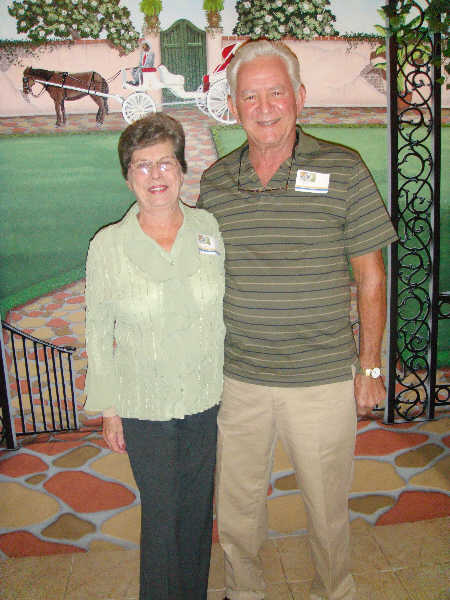
In his "Right This Way, Smiles a Mermaid" chapter, he meets Collicula Brodman, President of the Academy, who pops into his midtown Manhattan apartment during thunderstorm blackout. She says, "Come with me." and leads him through a door he hadn't "noticed before." They have a dialogue about his yearnings with respect to the other side of the materialistic fence, which can be sampled in this next passage. Broks is in front of the Investigatory Panel and is questioned about his beliefs:
[page 142, 143] "Are these your beliefs?" Number 1 asked.
Come to think of it, I really wasn't sure, and the words spilled out in the thinking: "I'm really not sure."
"So, what do you believe?" Collicula demanded for a second time.
"I am a materialist," I said. "I believe that the world and everything in it is made of physical stuff and, whatever the origins of the universe, we are a natural product of its material evolution: sentience, intellect, emotions, moral codes and all. All behavior and experience, all knowledge and understanding of the world and ourselves, depend upon the workings of a physical device: the brain."Later, playing in that longed-for yard across the fence, Broks sees a vision of an apple tree which is not really there, but seems to be there. He calls it a ghost tree and dismisses it as an hallucination, an artifact of the dim light. Someone told me once if one person says you're a horse's ass, you can ignore it, but if another person tells you the same thing, perhaps you should buy a saddle. The ghost tree will re-appear later as a vivid Christmas tree.
[page 151] It is getting dark now. The clouds have thinned and a crescent moon is visible. At the bottom of the garden there is an apple tree. It looks tired and forlorn. This, instantly, is how I see it. It is an old tree, bearing fruit for the last time. I see not just the fading shape of the trunk, the twisting branches, the leaves darkening in the gloom and the pale, half-grown apples; I see the age of the tree and its weariness. I have in mind the sharp taste of the fruit. This is how it appears to me. And how do I know it is bearing fruit for the last time? Because I realize it is not there at all. My brain has conspired with the failing light to conjure a fleeting illusion of the tree from memories of similar grey evenings a year ago, before it was felled by a February gale. It is a ghost tree, rooted only in thought.
I have now finished the text of the book and there is a surprise waiting for me on page 235: the eponymous quotation — the quotation from which the title was taken. It's from a poem by an obscure nineteenth century poet, Christine Rossetti. Here are the first two lines with the title text:
Remember me when I am gone away,
Gone far away into the silent land;
People who suffer neurological disorders often enter a silent land from which they do not return. Broks gave us examples of many different disorders in people for whom it was too late to counsel or pray. He also assembled a book which will leave a vestige of the thoughts he once had when he has gone into that silent land when his brain must decompose because his soul and spirit, no doubt much to his chagrin, has left it. We will remember him and smile. Till then do yourself a favor and read Paul Broks book or at least my full review of it.
Read the Review at:
http://www.doyletics.com/arj/intothes.htm= == == == == == == == == == ==
I hear often from my Good Readers that they have bought books after reading my book reviews. Keep reading, folks! As I like to remind you, to obtain more information on what's in these books, buy and read the books — for less information, read the reviews.
== == == == == == == == == == == == == == == == == == == == ==
8. COMMENTARY:
= = = = = = = = = = = = = = = = = = = = = =In this section I like to comment on events in the world, in my life, and in my readings which have come up during the month. These are things I might have shared with you in person, if we had had the opportunity to converse during the month. If we did, then you may recognize my words. If I say some things here which upset you, rest assured that you may skip over these for the very reason that I would likely have not brought up the subject to spoil our time together in person.1. Padre Filius Reads the New Orleans Times-Picayune this Month:
Padre Filius, the cartoon character created by your intrepid editor and would-be cartoonist, will appear from time to time in this Section of the Digest to share us on some amusing or enlightening aspect of the world he observes during his peregrinations.
This month the good Padre celebrates the end of the so-called Hurricane Season by reading a Headline about the Latest Impending Hurricane. Sooner or later it will be correct. This cartoon inspired by actual headline of the New Orleans Times-Picayune on Aug. 30, 2008 which read "Waiting for Gustav" who never really came but caused a lot of people stranded on crossroads and in countraflow to wait for him, like in Beckett's famous play.
 2.Comments from Readers:
- EMAIL from Effie Daigle about our 50th Hahnville High Reunion:
Bobby, thank you so much for taking the photos. You did a great job. The reunion was a great success. It's a shame some chose not to come, they missed a good time.Ethelyn Feehan Daigle (Effie)
PS: I think you should run a photo of Joann.
Love her to pieces.EMAIL from Rose Ann Loupe re Reunion Photos:
Bobby, you did a very good job.Thanks so much.
Hugs,
Rose AnneEHAIL from Blackbead the Pirate: "Some News For Ye!"
AHOY, SHIPMATE !
Raising Black Flags, ISBN 978-0-615-25535-4, Blackbead Books, 2008, is available for purchase! This anthology of over 80 pages of poetry and artwork about and BY pirates contains the works of fourteen very different poets and two artists!
It includes such poems as "The Homecoming of Danny Fry," "Steal from Me Tonight," "Springs and Neaps," "So You Want to Be a Pirate," "A Tale from the Devil's Tavern," One day in the life," "The Golden Age of Piracy," "The Last Watch," and "God Take the King!" Look for it soon on Amazon.com or you can order it now at Blackbead Books for only $11.95 plus shipping!Sorry if I sound like a salesman but that seems to be the only way to get this sucker out there! I'm going to attach a .jpg of the cover for your use if you would be so kind as to include this as a part of your next issue! Thanks, amigo! I hope like all get out to see you this coming year in New Orleans for PyrateCon 2009 but I hear some whisperings in the wind!
More to come. Your friend, Steve (aka Blackbead)
EMAIL from Jo Anne in Florida:
Hi again, Bobby,I've just returned to your email to click on the link to your Shutterfly pics of Venice having enjoyed your storyboard from aboard the ship.
What a fabulous gorgeous ship, and both you and Del certainly look emaculate and relaxed and fancy and handsome and what a time you must have had! I just love looking at such albums, and you have such a travel reporter's eye, don't you!
Honestly, the pic of the orchid makes me feel as if it's in a vase right here on my dining room table.
Now, on to Venice!
Jo Anne

EMAIL from Debbie in Chicago:
Hi, Bobby,
I just read your review of Oliver Sacks' book, Uncle Tungsten. It is one of my favorite books (as Oliver Sacks is one of my favorite authors and phenomonologists) — and one aspect that I truly love it the picture of Oliver's extended family — as literally the history of exploring the frontiers of science at the turn of the 19th century into the 20th century. I think that is also a very exciting element of his history — to live into the excitement of all that new scientific discovery — everyone relishing the discovery and not yet aware of the downside of what all these things would bring...Anyway, I truly enjoyed your review . . . thanks! Debbie Barford
EMAIL from Josh:
Hi Bobby. How are you?Just wanted to let you know that though I am a big believer in doyletics, as you know, I was, I admit skeptical of using it for weight loss (tracing away the hunger). Well that was 10 pounds ago. I am now at 167 (and dropping). I have not been this trim since my wedding — 9 years ago.!!
Thanks as always
JoshEMAIL from George in reply to this message from me:
Dear Bobby,Thank you so much! This really clarifies it for me. The speed trace is quite possibly the most useful thing I have ever been taught, and I will always be grateful for your guidance and information.
George
EMAIL from Chris Bryant re my transmission of doyles between generations answer to George:
Bobby,The Saints, Jets, and Ravens gave the Broncos a great gift this week I hope they will appreciate it and make use of it. You gave a good mini-course on Genetics it was easier to understand than either my high school bio teacher or Bio 101 in college. I also like the cockroach illustration you used for George. I was at a loss to explain how I had passed my doyles on to my son in a manner that would have been understandable and not too much information for strangers.
Chris
EMAIL from Professor Dann in New York. I'd asked him about the music to our poem of the month "Remember" which he sent had me, and here's his Reply. [Click Here to hear the poem sung by Village Harmon Chorus.]
Here is the place where you can learn all about Village Harmony: http://www.villageharmony.org/The singers on each album are different, as the groups are many, and change from year to year. The amazing thing though is that most of the kids are inexperienced singers. In each camp, they take a couple of dozen enthusiastic but green teens, and in just two weeks, turn them into extraordinary choirs.
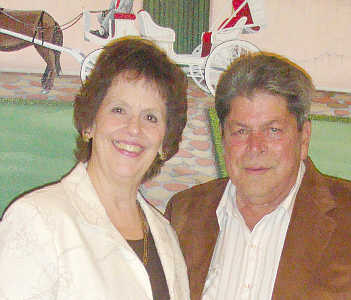
You'll notice that they have a lot of sample music at their website; these are 1 minute cuts, and "Remember" isn't on there. But I'm sure it is fine to upload the link; if you want, I can query Larry and Patty — the directors, and get official permission.
Yours,
KevinEMAIL re: my Photos of Hahnville 50th Reunion:
Thanks, Bobby. I have already enjoyed pouring over these a number of times. I was very happy to have a decent one of Lenny and me. We are rarely "dressed up" together at the same place. The one you took with my camera wasn't bad either. Kudos! . . . Polly Duhe
EMAIL our daughter Yvette Clark about our grandson football game:
Here's your Invitation to view photos of Mustangs Game 3 by Elizabeth. Aiden is #35. He plays offensive line - blocking. Enjoy!
[RJM: See photo of Aidan Clark, No. 35, in action for the Mustangs below.]EMAIL from Beverly in Gretna re our cruise:
Bobby - Beverly Carroll here.
Sure did enjoy Del and your's trip - - - have been to a few places but not to Croatia. I did enjoy that part of your tour. And you and your bride enjoy being together so much, it's a joy to see. Thanks and God Bless - -EMAIL from Renee in Meraux, LA re: our cruise:
Dear Bobby and Del,Your trip must have been FABULOUS! The pictures were great, and the scenery was incredible! Better than dealing with hurricanes!
A bientot, Renee
EMAIL from Theresa in New Orleans:
How exciting for you guys to spend such a lovely vacation crusing the Mediterranean. I am really enjoying your pictures since the pictures my daughter took this summer while backpacking throughout Europe (3 months) were stolen when her camera and some of the other nice things that she and her friends had were stolen from their room in Switzerland. Jessica especially captured Monaco for me with her pictures as that is a place I've always wanted to go, but they were but a memory for her and stories for me, up until now. Til now, we had no real life photos of that beautiful place. Thanks so much for sharing. My love to both you and Del.Theresa Chatelain
3. POLITICIANS and the ART OF LYING
While listening to Prof. John Sutherland lecturing on Oscar Wilde's contribution to Classical British Literature (A Teaching Co. course), I became aware that Oscar Wilde understood the process of art as the process of destruction of samenes, which is another way of saying that original art comes from what seems to be artifice, but has its origin as a direct input from the spiritual world. The artifice is the result of the human conversion of soft-brain insights into hard-brain productions over time. True art appears as a blatant lie, because nothing in the material world resembles it when it first arrives.
Oscar Wilde was filled with such inspirations and his work reflected it. No one had ever seen a subject in a painting who grow older while the man it was painted of remained young, as in "The Portrait of Dorian Gray." But his play, The Decay of Lying, lays bare the spiritual roots from which Wilde extirpates the process of lying.
Read how Wilde in the voice of the young man, Vivian, rebuts Cyril who immediately thinks of politicians as liars, although few if any of that ilk can be deemed true artists. Politicians in the coercive bureaucracies extant across the world can only further themselves immorally (by supporting coercion) and thus cannot utilize the necessarily moral impulses which flow from the spiritual world.
[From this source]CYRIL. Lying! I should have thought that our politicians kept up that habit.
In the summary at the end of this play Vivian makes the case for art as the process of destrution of sameness:VIVIAN. I assure you that they do not. They never rise beyond the level of misrepresentation, and actually condescend to prove, to discuss, to argue. How different from the temper of the true liar, with his frank, fearless statements, his superb irresponsibility, his healthy, natural disdain of proof of any kind I After all, what is a fine lie? Simply that which is its own evidence. If a man is sufficiently unimaginative to produce evidence in support of a lie, he might just as well speak the truth at once. No, the politicians won't do.
[Excerpted from this source, Roman numbers added.]Thought also arrives from the spiritual world and is converted into words and images in our brain. Like Thought, Art (true art) arrives unbidden and fresh in our brain and nothing like it has ever existed in the materialistic world before, such Picasso's first cubist painting was unique.I. Art never expresses anything but itself. It has an independent life, just as Thought has, and develops purely on its own lines. It is not necessarily realistic in an age of realism, nor spiritual in an age of faith. So far from being the creation of its time, it is usually in direct opposition to it, and the only history that it preserves for us is the history of its own progress.
What is "bad art" but the replication of true art (e. g. imitations of Picasso's cubist paintings, typical shopping mall artwork, etal ) or the replication of things of the material world (Life and Nature) with photographic or otherwise exact versimilitude. If Art cannot imitate Life and remain Art (true art), the Oscar Wilde has it rightly; Art is the process of the destruction of sameness found in the material world when it first appears.II. All bad art comes from returning to Life and Nature, and elevating them into ideals. Life and Nature may sometimes be used as part of Art's rough material, but before they are of any real service to art they must be translated into artistic conventions. The moment Art surrenders its imaginative medium it surrenders everything. As a method Realism is a complete failure, and the two things that every artist should avoid are modernity of form and modernity of subject-matter.
What humans do in life imitates whatever we find around us, so whenever we find Art, we can replicate it by creating new incarnations or example of it. This devolves eventually into the form of art we know as kitsch followed its being unpopular over time. Our sensory apparatus is such that once we are sensitized to a certain perception, we find more and more examples of that perception around us, and this leads more credence to Wilde's at first preposterous claim that Life imititates Art, rightly understood.III. The third doctrine is that Life imitates Art far more than Art imitates Life. This results not merely from Life's imitative instinct, but from the fact that the self-conscious aim of Life is to find expression, and that Art offers it certain beautiful forms through which it may realize that energy. It is a theory that has never been put forward before, but it is extremely fruitful, and throws an entirely new light upon the history of Art. It follows, as a corollary from this, that external Nature also imitates Art. The only effects that she can show us are effects that we have already seen through poetry, or in paintings. This is the secret of Nature's charm, as well as the explanation of Nature's weakness.
Another claim by Wilde, which prima facie seems preposterous, but, upon deeper reflection and thought, is seen as a deep insight into the process of Art. With the statement that "Lying is the proper aim of Art" Wilde points to Art paradoxically as "the process of destruction", the destruction of the sameness we find laid all around us in the physical world, up until now.IV. The final revelation is that Lying, the telling of beautiful untrue things, is the proper aim of Art.

== == == == == == == == == == == == == == == == == == == == ==
9. CLOSING NOTES:
= = = = = = = = = = = = = = = = = = = = = =Thanks to all of you Good Readers for providing the Chemistry which has made this site a Glowing Success. — Especially those of you who have graciously allowed us to reprint your emails and show photos of you and by you on this website — you're looking good! As of June 1, 2019, it enters its 20th year of publication. The DIGESTWORLD Issues and the rest of the doyletics website pages have received over 21.6 MILLION VISITORS ! ! !
We have received over ONE MILLION VISITORS per Year to the Doyletics Website since its inception June 1, 2000, over twenty years ago. Almost 2 million in the past 12 months. We are currently averaging about 150,000 visitors a month. A Visitor is defined as a Reader who is new or returns after 20 minutes or more has passed. The average is about one visitor for every 10 Hits.
IMPORTANT NOTES about DIGESTWORLDtm Our DIGESTWORLD came into existence years before Facebook and all the other social media which interrupt people's schedules many times a day. All our photos, reviews, cartoons, stories, etc, come to you via a link inside of one short email Reminder at the beginning of each month. We hope you appreciate how we let YOU choose when to enjoy our DIGESTWORLD Issues. To Get a Monthly Reminder, Click Here .
We especially want to thank you, our Good Readers, in advance, for helping our readership to grow. NOTE our name is now: DIGESTWORLD. Continue to send comments to Bobby and please do create links to DIGESTWORLD issues and Reviews on LinkedIn, on your Facebook page, and on other Social Media. When you copy any portion of a webpage or review, please include this text: "Copyright 2018 by Bobby Matherne".
Email your friends about the reviews, the handy doyletics Speed Trace, the Household Hints, the cartoons, the Cajun jokes, the recipes, the poems, and the photos in all the DIGESTWORLD Issues archived on our website. Urge them to subscribe to the DIGESTWORLD Reminder so they won't miss a single issue!
The Subscription Process SIMPLE: no Reply Confirmation is required. An email to the Editor with your First and Last names is all that's required. There is never a charge for viewing any page on our website; nor for any of the guidance we offer to people using the FIRST AID KIT or asking for help with doyletics in any other areas.
For those who are able to contribute to the site we offer a year's subscription for receiving the DIGESTWORLD Monthly Reminders for $50.~~ NOTE: DIGESTWORLD is a Trademark of 21st Century Education, Inc. ~~ The cost of keeping this website on-line with its 300 Gbytes of bandwidth a month is about $50 a month. Thank you, our Good Readers, for continuing to patronize our advertisers when they provide products and services you are seeking as you visit any of our web pages. Remember the ads are dynamically displayed and every time you read even the same page a second time, you may find new products and services displayed for your review. Our reviews, digests, tidbits, etc, all our webpages act as Google magnets to bring folks to the website to learn about doyletics and frequent our advertisers, so they support one another in effect.
We wish to thank all Good Readers who have made a contribution to the doyletics.com website! Special thanks go to Chris and Carla Bryant in Corpus Christi and Gary Lee-Nova in Canada!We welcome your contributions to the support of the website and research into the science of doyletics. To obtain our street address, email Bobby at the address found on this page: http://www.doyletics.com/bobby.htm and we will send it to you. Every $50 subscription helps toward keeping this website on-line for another month. If you can't send money, at least show your support by sharing your favorite Issue of DIGESTWORLD and Reviews with a friend.
You can read a description of how to do a Speed Trace (either in English or Spanish):Learn to Do a Speed Trace Here

Or Watch Bobby extemporaneously explain How to Do a Speed Trace on Video:
To make a connection to the Doyletics website from your own website, here's what to do. You may wish to use the first set of code below to link to the site which includes a graphic photo, or to use the second set of code for a text-only link. Immediately below is how the graphic link will look on your website. Just place this .html in an appropriate place on your website.
<CENTER> < — with graphics link — >
<A HREF="http://www.doyletics.com/index.htm">Learn to Do a Speed Trace Here<BR>
<IMG SRC="http://www.doyletics.com/doylepb.gif" width="309" height="102" border="2" TITLE="Learn to Remove Doyles — all those Unwanted Physical Body states of fear, depression, migraine, etc." ALIGN=middle><A/></CENTER>
<CENTER> < — text only link — >
<A HREF="http://www.doyletics.com/introduc.htm">Learn to Do the Speed Trace at doyletics.com <A/>
</CENTER>Check out the new additions to the Famous and Interesting Quotations at:
http://www.doyletics.com/quotes.htm== == == == == == == == == == ==
My reviews are not intended to replace the purchasing and reading of the reviewed books, but rather to supplant a previous reading or to spur a new reading of your own copy. What I endeavor to do in most of my reviews is to impart a sufficient amount of information to get the reader comfortable with the book so that they will want to read it for themselves. My Rudolf Steiner reviews are more detailed and my intention is bring his work to a new century of readers by converting his amazing insights into modern language and concepts.
== == == == == == == == == == ==The Good Mountain Press Digest is mailed monthly to:
Friends and associates
Individuals who have expressed interest in the Digest
Persons who have subscribed at the Digest Subscription Page.Please Don't Bug Us 
Nothing BUGS US more than losing Hale-and-Hearty, Ready-to-Read Good Friends from the DIGESTWORLD Reminder List.
So we've made it easy for Good Readers who have changed their Email addresses and Friends who would like to begin receiving the DIGESTWORLD Reminder at the first of each Month:
IT'S EASY to RE-SUBSCRIBE or SUBSCRIBE:
CLICK HERE!
As of August, 2011 we have begun using a Contact Manager with an Email Merge feature which allows us to send personalized Emails to everyone in our Contact List. You can receive the colorful Email containing the DIGESTWORLD Reminder beginning with "Dear [Your First Name]". It is important that we have your First Name, so if the name you are addressed by in your Reminder is not your first name, please notify us of the name you wish us to use. For convenience you can send a quick email to give us your name by Clicking Here. To Contact Bobby, his Email address is visible on this page.
NOTE: As of 2018 the Topica.com List messages are NO LONGER READABLE!
Please do your part by letting us know of any email address change so that you may continue receiving the DIGESTWORLD Reminders. Most of our Readers come from folks who don't get these Reminders, but we offer the DIGESTWORLD Reminder as a service to our regular Good Readers. To send us your new email address, CLICK HERE! .
If you discovered this page by a Google Search and want to SUBSCRIBE NOW
If you have enjoyed a particular issue, let us know, especially around the first of each month when those "lost soul" messages are bugging us, Send us a quick email by Clicking Here!
Simply Click the Link at right to send an Email Request: SUBSCRIBEIf you have a friend or two that you think would enjoy reading the DIGESTWORLD, suggest they view the current DIGESTWORLD Issue and perhaps they'll decide to Subscribe.To unsubscribe from the DIGESTWORLD Reminder List:
Click Link at right to send a Blank email to: UNSUBSCRIBEIf the above links which provide canned emails don't work on your system, you can send a Subscribe/Unsubscribe request to the address found on this page: http://www.doyletics.com/bobby.htm Please include your first and last name when Subscribing.
== == == == == == == == == == == == == == == == == == == == ==
10. GRATITUDE - in Three Easy Steps:
= = = = = = = = = = = = = = = = = = = = = =
Maintaining a website requires time and money, and apart from sending a donation to the Doyletics Foundation, there are several ways you can show your gratitude and support our efforts to keep doyletics.com on-line.
One would be for you to buy a copy of my Dolphin Novel, The SPIZZNET File. Books May be ordered in hardback or paperback form from Xlbiris the Publisher here:
online: http://www.xlibris.com/TheSPIZZNETFILE.html
email: orders@xlibris.com
The best source at the best price is to order your copies on-line is from the publisher Random House/Xlibris's website above.
Two would be for you to use the Google Search Engine for your web searches or to find an item on doyletics.com website. New reviews will have a place to do a Google Search at the top and the bottom of the reviews. Just enter a search phrase in the box below to do a Search. Note you can check whether to Search just this site or all websites.
Three would be for you to let us know you like us by Subscribing to our monthly Reminder. One short email each month with a link to our Latest DIGESTWORLD Issue will keep you apprised of our latest reviews, photography, poetry, Cajun stories, recipes, Movie Blurbs, Travels, and even more! Simply Click Here: Subscribe Me!
Thank you in advance!
~~~~~~~~~~~~~~~~~~~~~~~~~~~^~~~~~~~~~~~~~~~~~~~~~~~~~~~
LIKE US? To Receive a Monthly DIGESTWORLD Reminder, Click the Link to Send Email Request: SUBSCRIBE
NOTE: Place Cursor over a photo for a few seconds to read text description.
All the tools you need for a simple Speed Trace
IN ONE PLACE.== == == == == == == == == == == == == == == == == == == == == ==
== == == == == == == == == == == == == == == ==
22+ Million Good Readers have Liked Us
22,454,155 as of November 7, 2019
Mo-to-Date Daily Ave 5,528 Readers
For Monthly DIGESTWORLD Email Reminder:
Subscribe! You'll Like Us, Too!
== == == == == == == == == == == == == == == ==
Any questions about this DIGESTWORLD ISSUE, Contact: Bobby Matherne
CLICK HERE TO OPEN OUR FIRST-AID KIT. Does your Face sometimes resemble the Faces Below? If so, Click on the Faces or Flags to Dig into our First Aid Kit.
To follow Research in the science of doyletics, Read our Monthly DIGESTWORLD Issues.
Click Here to get Monthly Reminder.
For Copies of Reviewed Steiner Books, Click on SteinerBooks Logo below.
Visit Bobby's Other Reviews, Articles, and Essays
Books are Lighthouses Erected in the Sea of Time
Counselor?
Visit the Counselor's Corner for Suggestions
on Incorporating Doyletics in Your Work.
e-mediatelytm is a Trademark of 21st Century Education, Inc. Prototyped 2000.