LIKE US? To Receive a Monthly DIGESTWORLD Reminder, Click the Link to Send Email Request: SUBSCRIBE
NOTE: Place Cursor over a photo for a few seconds to read text description.
== == == == == == == == == == == == == == == == == == == == == == == == == 
All the tools you need for a simple Speed Trace
IN ONE PLACE.
Great Way to show Gratitude for DIGESTWORLD is to use the above Google Search Engine to Search this Site
or the entire Web wherever you find it in DIGESTWORLD pages. Much Thanks in Advance for Clicking on Rainbow-Colored +1 Above to Show You Liked Us.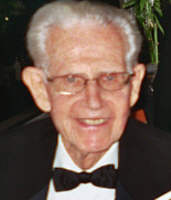
== == == == == == == == == == == == == == == == == == == == == == == == ==
~~~~~~~~~~~~~~
~~~~~~~~ In Memoriam: Bil Keane (1922 - 2011) ~~~~
~~~~~~~~ Family Circus Cartoonist, William Aloysius Keane,
who wrote in a Family Circus Cartoon once,
'Time seems to be running out instead of moving on.' ~~~~~
~~~~~~~~~~~~~~
WELCOME TO DIGESTWORLD ISSUE#122 February, 2012 == == == == == == == == == == == == == == == == == == == == == == == == == Quote for the Super Bowl Month of February:
The best argument against a democracy is a five minute conversation with the average voter.
— Winston Churchill , Prime Minister of England, Author, Artist== == == == == == == == == == == == == == == == == == == == == ==
By Subscription only.== == == == == == == == == == == == == == == == == == == == == ==
Editor: Bobby Matherne, Asst. Editor: Del Matherne
[To Contact Editor Click Here!]
To Subscribe, Click Here or copy into your Browser
this URL: http://www.doyletics.com/subscrib.htm
To Unsubscribe, see bottom of any DIGESTWORLD Issue.
©2012 by 21st Century Education, Inc, Published Monthly.
To Read All of Bobby's Writings Click Here!
~~ Click on Heading to go to that Section (Allow Page First To Fully Load). NOTE: DIGESTWORLD is a Trademark of 21st Century Education, Inc. ~~
DIGESTWORLD Archived DIGESTWORLD Issues
GOOD MOUNTAIN PRESS Presents ISSUE#122 for February 2012
Table of Contents1. February's Violet-n-Joey Cartoon
2. Honored Readers for February
3. On a Personal Note
Flowers of Shanidar Poems
Movie Blurbs
4. Cajun Story
5. Recipe of the Month from Bobby Jeaux’s Kitchen: Artichoke & Spinach Dip
6. Poem from JIR 1985: "THE POSTMAN KICKED THE DOG"
7. Reviews and Articles Added for February:8. Commentary on the World
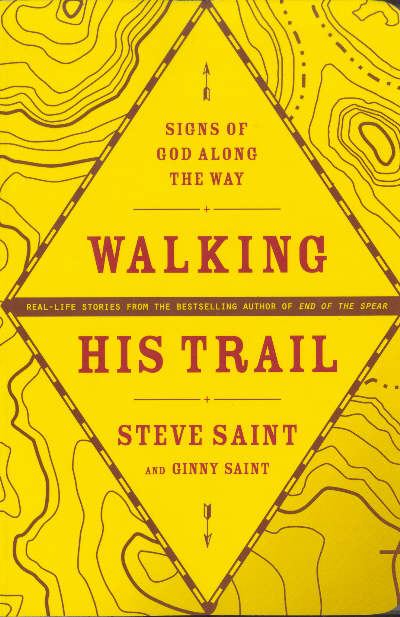
- ARJ2: Walking His Trail — Signs of God Along the Way by Steve Saint and Ginny Saint
- ARJ2: To Engineer Is Human — The Role of Failure in Successful Design by Henry Petroski
1. Padre Filius Cartoon
2. Comments from Readers
3. Freedom on the Half Shell Poem
4. BICYCLE RIDING
5. MYOPIA TUTORIAL
9. Closing Notes — our mailing list, locating books, subscribing/unsubscribing to DIGESTWORLD
10. Gratitude== == == == == == == == == == == == == == == == == == == == == ==
DIGESTWORLD ISSUE#122 == == == == == == == == == == == == == == == == == == == == == ==ARCHIVED DIGESTWORLD ISSUES ON THE WEB ~ ARCHIVED DIGESTWORLD ISSUES ~ 2000: INAUGURAL YEAR: Jun #1 Jul #2, Aug #3, Sept #4, Oct #5, Nov #6, Dec #7
2001: Jan #8, Feb #9, Mar #10, Apr #11, May #12, Jun #13, Jul #14, Aug #15, Sep #16, Oct #17, Nov #18, Dec #19
2002: Jan #20, Feb #21, Mar #22, Apr #23, May #24, Jun #25, Jul #26, Aug #27, Sep #28, Oct #29, Nov #30, Dec #31
2003: Jan #32, Feb #33, Mar #34, Apr #35, May #36, Jun #37, Jul #38, Aug #39, Sep #40, Oct #41, Nov #42, Dec #43
2004: Jan #44, Feb #45, Mar #46, Apr #47, May #48, Jun #49, Jul #50, Aug #51, Sep #52, Oct #53, Nov #54, Dec #55
2005: Jan#051,Feb#052,Mar#053,Apr#054,May#055,Jun#056,Jul#057,Aug#058,Sep#059,Oct#05a,Nov#05b,Dec#05c
2006: Jan#061,Feb#062,Mar#063,Apr#064,May#065,Jun#066,Jul#067,Aug#068,Sep#069,Oct#06a,Nov#06b,Dec#06c
2007: Jan#071,Feb#072,Mar#073,Apr#074,May#075,Jun#076,Jul#077,Aug#078,Sep#079,Oct#07a,Nov#07b,Dec#07c
2008: Jan#081,Feb#082,Mar#083,Apr#084,May#085,Jun#086,Jul#087,Aug#088,Sep#089,Oct#08a,Nov#08b,Dec#08c
2009: Jan#091,Feb#092,Mar#093,Apr#094,May#095,Jun#096,Jul#097,Aug#098,Sep#099,Oct#09a,Nov#09b,Dec#09c
2010: Jan#101,Feb#102,Mar#103,Apr#104,May#105,Jun#106,Jul#107,Aug#108,Sep#109,Oct#10a,Nov#10b,Dec#10c
2011: Jan#111,Feb#112,Mar#113,Apr#114,May#115,Jun#116,Jul#117,Aug#118,Sep#119,Oct#11a,Nov#11b,Dec#11c
2012: Jan#121,Feb#122,Mar#123,Apr#124,May#125,Jun#126,Jul#127,Aug#128,Sep#129,Oct#12a,Nov#12b,Dec#12c
2013: Jan#131,Feb#132,Mar#133,Apr#134,May#135,Jun#136,Jul#137,Aug#138,Sep#139,Oct#13a,Nov#13b,Dec#13c
2014: Jan#141,Feb#142,Mar#143,Apr#144,May#145,Jun#146,Jul#147,Aug#148,Sep#149,Oct#14a,Nov#14b,Dec#14c
2015: Jan#151,Feb#152,Mar#153,Apr#154,May#155,Jun#156,Jul#157,Aug#158,Sep#159,Oct#15a,Nov#15b,Dec#15c
2016: Jan#161,Feb#162,Mar#163,Apr#164,May#165,Jun#166,Jul#167,Aug#168,Sep#169,Oct#16a,Nov#16b,Dec#16c
2017: Jan#171,Feb#172,Mar#173,Apr#174,May#175,Jun#176,Jul#177,Aug#178,Sep#179,Oct#17a,Nov#17b,Dec#17c
2018: Jan#181,Feb#182,Mar#183,Apr#184,May#185,Jun#186,Jul#187,Aug#188,Sep#189,Oct#18a,Nov#18b,Dec#18c
2019: Jan#191,Feb#192,Mar#193,Apr#194,May#195,Jun#196,Jul#197,Aug#198,Sep#199,Oct#19a
To Receive a Monthly DIGESTWORLD Reminder — Click Here.
== == == == == == == == == == == == == == == == == == == == == ==
1. February Violet-n-Joey CARTOON:
== == == == == == == == == == == == == == == == == == == == == ==For newcomers to DIGESTWORLD, we have created a webpage of all the Violet-n-Joey cartoons! Check it out at: http://www.doyletics.com/vjtoons.htm Also note the rotating calendar and clock that follows just to the right of your mouse pointer as you scroll down the page. You'll also see the clock on the 404 Error page if you make a mistake typing a URL while on the doyletics.com website.
The Violet-n-Joey Cartoon page is been divided into two pages: one low-speed and one high-speed access. If you have Do NOT Have High-Speed Access, you may try this Link which will load much faster and will allow you to load one cartoon at a time. Use this one for High-Speed Access.
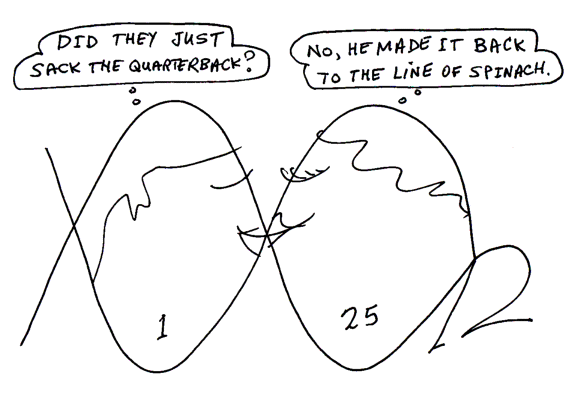
This month Violet and Joey learn about the Line of Spinach.
#1 "Line of Spinach" at http://www.doyletics.com/images/012512vj.gif
== == == == == == == == == == == == == == == ==
2. HONORED READERS FOR February:
== == == == == == == == == == == == == == == ==Each month we choose to honor two Good Readers of our DIGESTWORLD from those all over the World. Here are the two worthy Honored Readers for February, 2012:
Anne Kotch in Algiers Point, LA
Kresimir Skender in Croatia
Congratulations, Anne and Kresimir!
== == == == == == == == == == == == == == == == == == == == == == == == == == == == == == == == == == == == ==
3. ON A PERSONAL NOTE:
== == == == == == == == == == == == == == == == == == == == == == == == == == == == == == == == == == == == ==
Out Our Way:NEW YEAR'S EVE AND ALL SAINT S DAY
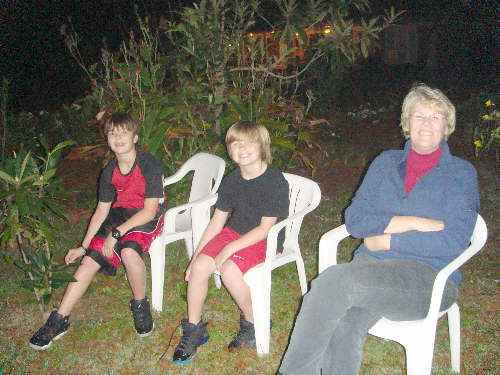
Last New Year's Eve we were in Los Angeles and the year before that we also missed the New Year's Eve celebration because we had just moved into our new home and were getting to bed about 8 PM exhausted from all the unpacking, moving things around, and working in the house and yard every day for two full months. This year we had our two sub-teen grandsons Collin and Kyle with us for the weekend. They were all excited about the neighbor's fireworks going off in a 360 degree circle around us. At midnight we walked to our "hill" and oohed and aahed at all the fireworks being fired off. It was the best fireworks display I had ever seen. There were only four of us and we had an unimpeded view of the entire horizon. And we were only a few footsteps from our cozy home at all times. The next day was the Saints-Panthers game at noon in the Superdome and Collin was going to his first-ever Saints game with his Granpa. Before we left I showed him the short video of Dean Matherne (Sargent Saint) and we walked to meet Dean and Inga pre-game. Dean gave Collin his specially minted Sgt. Saint coin and Collin was impressed. "It's heavy," he said. Then we walked to the Dome.
Entering on Claiborne side, we walked and I saw this lady with some fried shrimp that looked good and we found the place which sold it and bought a platter so we could eat it on the way up to our seats. Coach Sean Payton had promised the first stringers would play and they played great. There were a record number of records set by the Saints during this game. Usually our games against Panthers have been close ones to the end, but although this one began as a close game, tied up 17-17 with under a minute left in first half, it was enough time for Brees to air out a long TD to Marcus Colston in the end zone and the Panthers never scored again. Once they got close and Patrick Robinson picked off a pass in the end zone. The defense gave the Panther highly-touted QB the first two sacks of his rookie career. It was an ALL SAINTS' day!We stayed until the end of the game and walked back to the car. Collin wanted to leave early, and I explained, "The usual reason for people to leave early is to avoid the traffic leaving the stadium. We will walk to car, and drive right up ramp and be home in 12 minutes, so it makes no difference when we leave. Might as well enjoy the entire game." Del and Kyle came home from the movies right after we arrived. She said about her first Alvin & the Chipmunks movie, "It was the bestest movie I ever saw!"
She was imitating what grandson Garret had said the previous Christmas season as we walked out of that year's Chipmunk movie. Del wanted to get started on the New Year's Day meal and I wanted a nap. When I got up from a short nap, all the things were prepared for the Blackeye Peas and Rice, Steamed Cabbage, and Cornbread. We ate a New Orleans-style New Year's Day meal and the boys went up to play, while I watched the remaining NFL games, and put on the Hornets game while Del and I watched the movie: "Soul Surfer" . People often ask when they see our Screening Room, "What do you need 5 TV's for?" Del and I often wonder how people can live with only one TV on at a time.With New Year's Day being on a Sunday, the usual bowl games were moved to Monday so the next day all five screens were blaring away: watched the Rose Parade, several bowl games, the Ice Hockey Classic outdoors, the Rose Bowl and Outback Bowl, part of Fiesta Bowl, LSU nearly beat UVA, and Hornets played against the Jazz. Plus three 1940s movies: "Corn is Green" , "Our Vines Have Tender Grapes", and "Portrait of Jennie". Nothing like a good old movie to fill the long gaps in football games due to commercials and time-outs.
GONNA TAKE A PANAMANIAN JOURNEY
[NOTE: to allow you to see more photos than could fit in this Issue, we've added extra photos which you can see by clicking on Underlined Words. These will be in high resolution.]Our bags were all packed and we headed to Louis Armstrong Intl Airport early in the morning. Found a great parking spot, had breakfast at the Acme Oyster House, latte at PJ's Coffeeshop, got our boarding tickets at the American Airlines automated kiosk, then looked for what to do next. Finally I walked down the last lane before the baggage loading place and this ebullient New Orleans gal resembling a young Mahalia Jackson helped us get luggage tags.
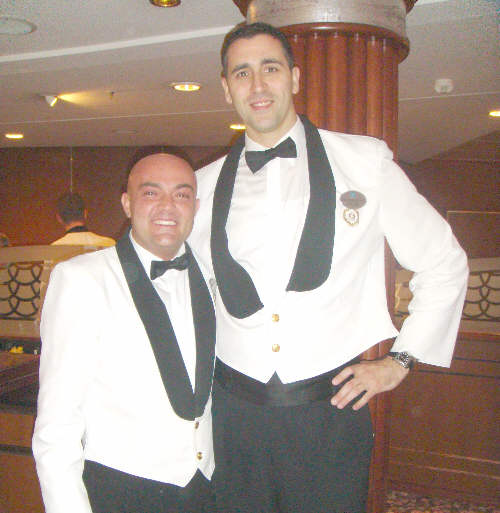
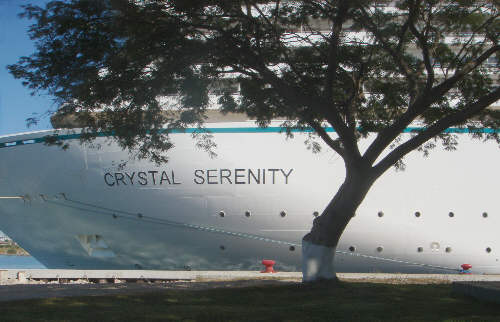
She and I got to talking about LSU's upcoming BCS Championship game and I told her I was a freshman at LSU in 1958 when we won our first national championship and went undefeated. She said, "I was only two at the time!" I said, "And I'll bet you were cute as a button!" She laughed out her reply, "Well, Honey, de button done dropped!" She was a lot of fun and helped us get all our bags checked.Crystal Cruise Lines personnel escorted us to our bus and after a long slow drive through Miami, we landed at the Cruise Terminal and were soon aboard and having dinner at Table 60. On previous cruises we had never been inside the circle area in the Crystal Dining Room, so I was delighted about this, but soon I discovered it was the noisiest place in the room. Our previous spots in the far right of dining room around Table 23 seemed much quieter, so we chose that area for breakfast and lunch and met a wonderful waiter named Sergio, a 6-6 tall Serbian with a great sense of humor. Our first lunch at his table was memorable for the dessert. It was a light bit of apple strudel covered with vanilla ice cream, light whipped cream and shredded pieces of fila dough on top. Ice cold and absolutely delicious.
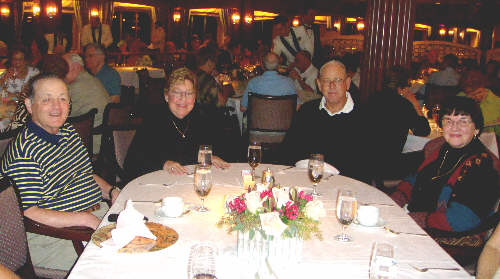
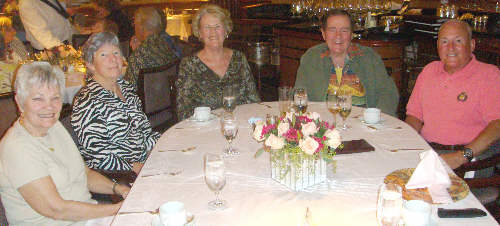
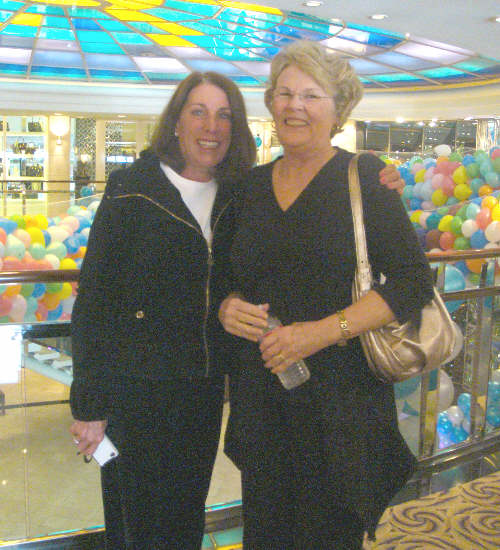
At our Table 60 we met two guys who were each married to Barbara Conners. Hugh Conners's wife was Barbara and Curtiss's wife was Hugh's sister, so her maiden name was Barbara Conners. To Del's right was a gal named Johnny and her friend Sarah. Due to hubbub around us, I could barely hear what Johnny and Del talked about. Easy for me to remember Hugh and Curtiss as their names were Aircraft Companies at one time. The next night Johnny and Sarah left and were replaced by Jane and another Barbara. Daniel and Frank, two bachelors, also joined us, so we had expanded to ten folks on nights when everyone was there. In four Crystal Cruises, this was one of the liveliest and most fun groups we had shared a table with. Hugh had been on so many cruises, to so many places, it was like having a cruise director at our table. He knew where to go in all the ports we visited. We look forward to seeing these folks again when they come to New Orleans.If you are going on a cruise, you will enjoy the reserved seating arrangements for dinner. Why? Because you will meet new friends, your head waiter and his crew will become friends. The Sommelier will get you whatever your favorite drink is and ensure that it arrives at the table on succeeding nights before you sit down. You'll meet the Maitre D' and he can help you change tables if you wish to and obtain any special foods you like. I had grits specially made for me one morning thanks to our Maitre D' Igor. We remembered each other from our previous cruise on the Crystal Serenity. Our Head Waiter Crunch's real name was something like Kvunch, but everyone called him Crunch. An incredible combination of efficiency and smiling service with good humor. We had daily dinner service matching any Five Star hotel. A wide variety of menu items which changed each day. Formal nights with lobster and caviar and cherries jubilee, e. g. Small servings of appetizer, soup, entree, and dessert allows one to enjoy the variety without putting on pounds. One lecturer, Steve Saint, commented that he and his wife Ginny always used the stairs to keep their meals from "piling up on top of one another."
At lunch Del ordered some tea, and the description on the label was rather effusive:
GREEN TEA PASSION
Smooth finest-grade China green tea leaves infused with tantalizingly sweet tropical fruits jettison you to a remote South Pacific isle, where you will be whisked off into the ease of a life sans care while tanned Polynesians will satisfy your every sexual desire.
Okay, I added the final Polynesian phrase, but you get the picture, a sensuous hypnotic trance induction comes with every tea bag.
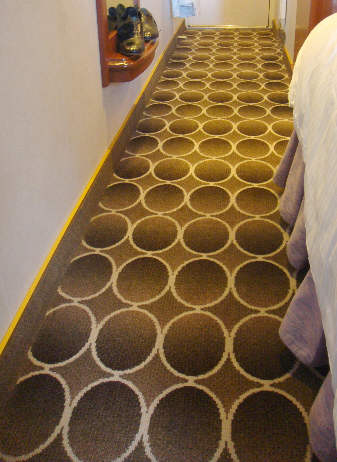
On the first day at sea we watched as the coast of Cuba sailed by on our left for most of the afternoon as we motored to the Grand Cayman Islands and Georgetown. I noticed the flooring carpet of our stateroom is a trompe d'oeil which looks like it has waves but is entirely flat. Hard to remove the persistent illusion once I saw it. I could only do so by blocking off all but one row of the "wave" as I walked. Neat illusion, but C'mon Man, not in our stateroom! Take a look at it and you'll quickly see the waves, it looks like a carpet that didn't get stretched perhaps. We walked through the streets of Georgetown next to the tender dock and enjoyed looking in the shops. I bought a cap from a street vendor which said Grand Cayman on it.
On January 7, the New Orleans Saints playoff game against Detroit Lions from the Superdome came on at 8 pm, and we were able to watch it in our room in comfort. Well, let me not exaggerate by saying comfort: we had to stare up at a screen instead of looking straight ahead as in our better designed Screening Room at home. We had to work to get the TV close to eye level when we're seated by sitting on the back top of the couch. I moved the couch away from wall about 6 inches or so and we sat on two cushions. Only problem with Crystal staterooms is the placing of the TV set above the small fridge which is desk level. The Saints took over the game in the second half and intercepted Detroit twice, converting turnovers to TD's and the Saints were at the goal line doing the kneel-down victory formation as time ran out, so the 45 -28 score could have been much higher. We were surrounded by many nice people from Michigan on the ship, several of them at our table, so we were as gracious in winning as they were in losing. Found a couple of Saints fans Don and Della from Tucson and several leftover fans from the Saints' previous Super Bowl run and victory.
CARTEGENA CATHEDRAL, MONASTRY, AND FORTRESS
Our first shore excursion with a tour guide was in Colombia in the old port city of Cartegena, a city whose origins pre-date New Orleans by about a hundred years. Can you say Pirates of the Carribean? This was their original home, the port out of which they sailed to plunder the high seas and to which they returned for security and comfort.
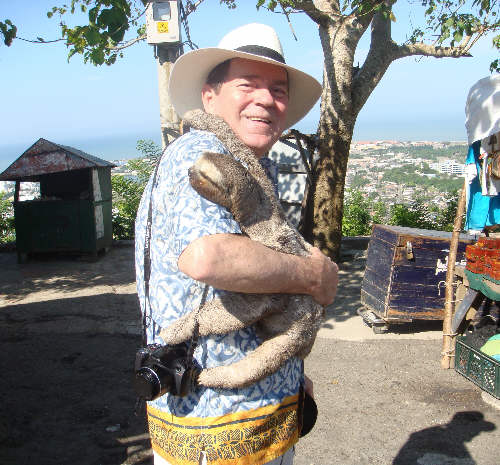
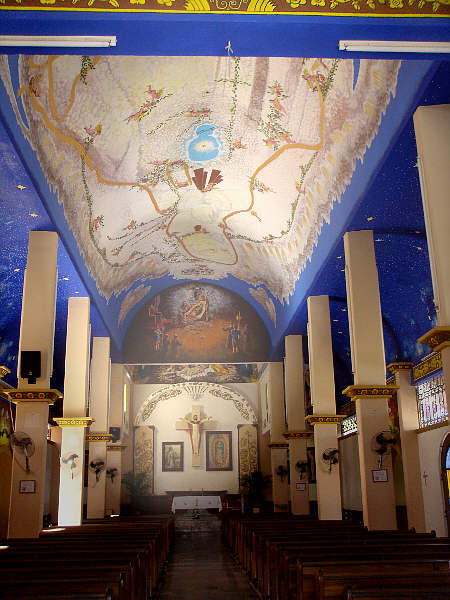
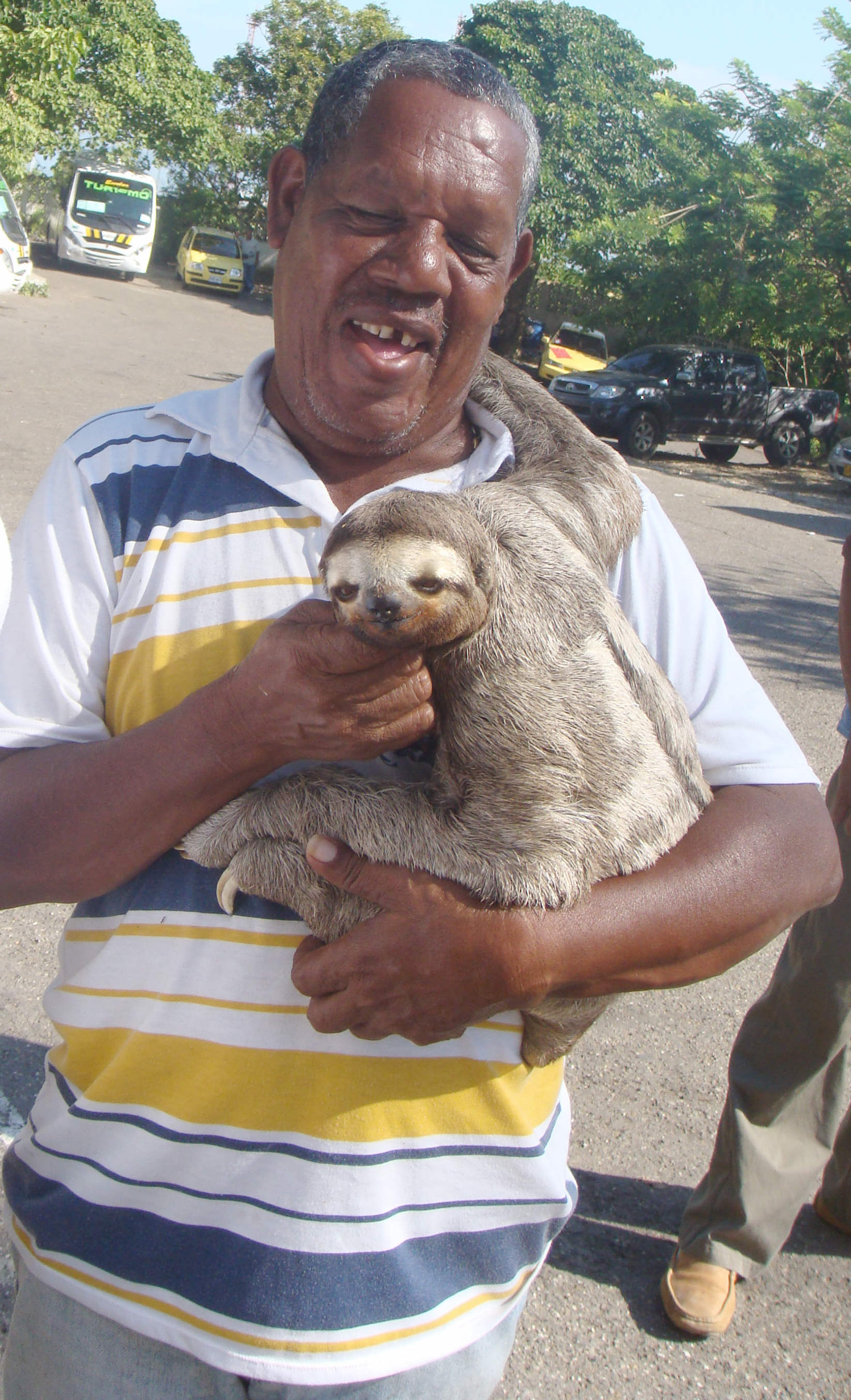
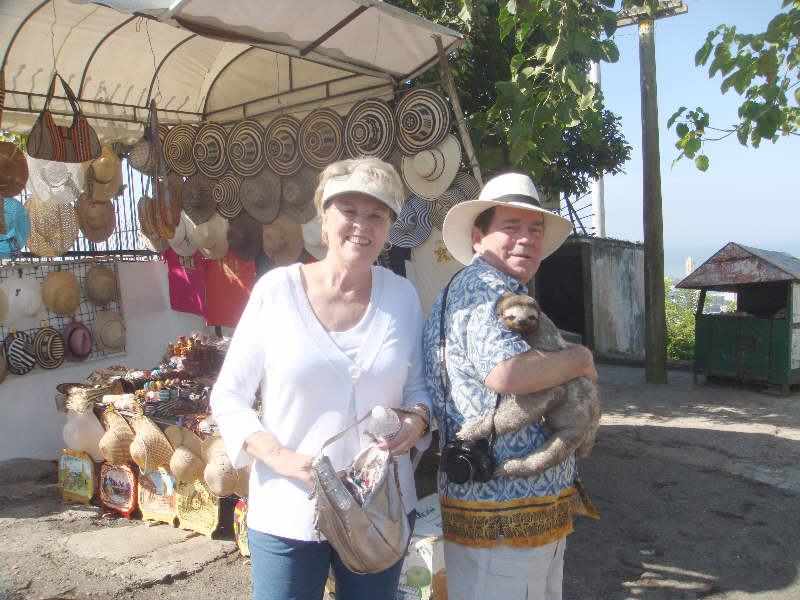
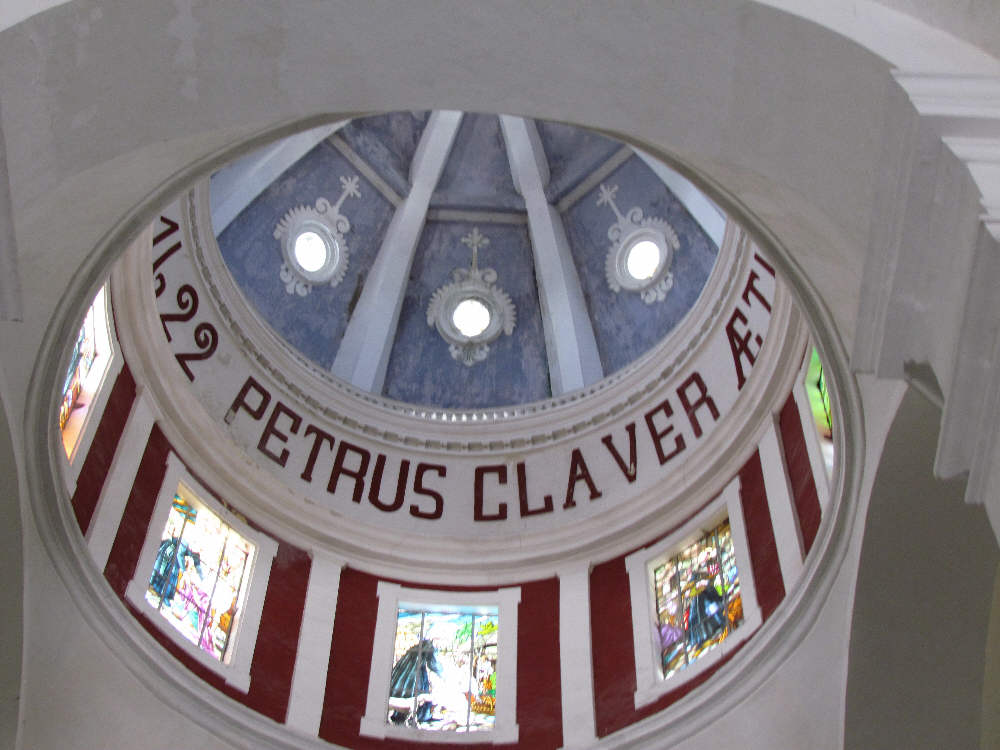
We were on the Cartagena excursion to Fortresses and Cathedral. Peter Claver Church was amazing, as was Our Lady of the Candles on the top of the hill overlooking the city, about 500 feet elevation. Her big day is the Blessing of the Candles on February 2, the same day Catholics in New Orleans do the blessing of throats and candles on St. Blaise Day. We each were given a name tag with RICHARD on it, our Guide's name, and all lined up, we looked like a Richards' Reunion (Del's maiden name). I met a Colombia native with a sloth draped over his chest who wanted me to take his photo. I said no and he said, "On way back". He was waiting when I returned from the church tour and I said this to get him to smile for his photo, "You know they say if you have a pet long enough, you begin to look like your pet." He smiled but I was laughing at his reaction and missed photographing his big smile. But we became friends. Then he insisted I hold his pet, and reluctantly I relented. It felt like a sack of beans, no movement at all or a small baby who was asleep on my chest. A nice quiet pet, more movement than a Pet Rock, but just barely. Someone even offered to take a photo of Del and me with the sloth.
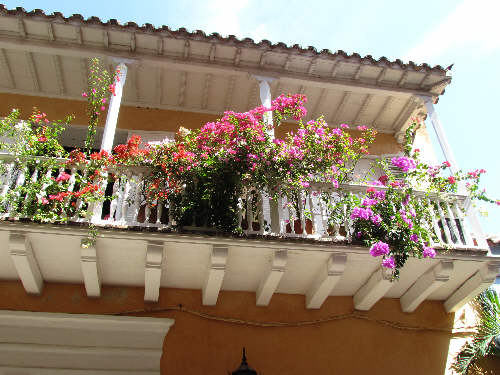
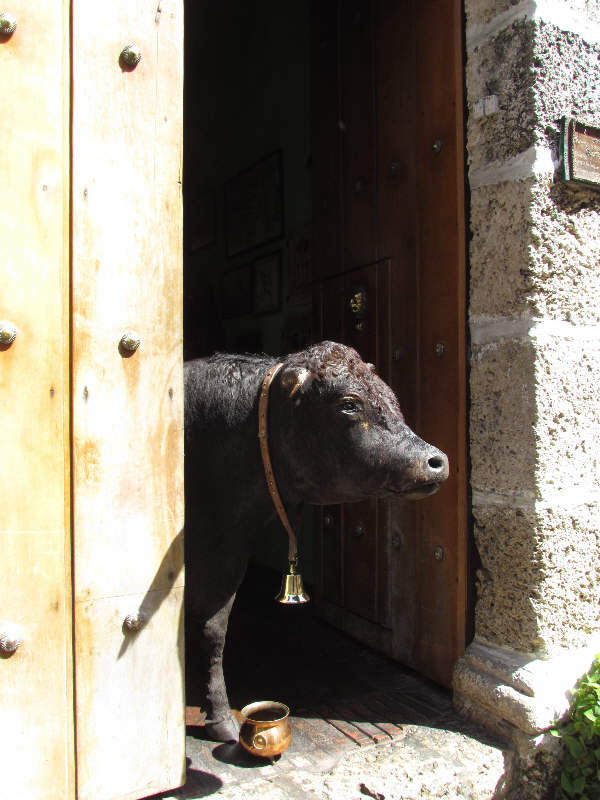
By the time I got the 7th offer to buy a Panama hat from a street vendor, I relented, and it made the rest of my day more peaceful. Price was $25 but I offered the guy $20 after I tried on the hat and he demurred, so I returned the hat to him and started to leave with my twenty. He relented. Later the guide Richard said I could have got it for ten (Jerk!), and he lost my tip with that insult. I could have worked the man down to ten, but I liked the guy and wanted him to get a good profit from our friendship. A good deal for both of us instead of just for me.In our journy through old Cartegena, Richard fooled us when he warned everyone to watch out for the bull in a doorway up ahead. I was busy at the time taking photos of the wonderful wooden balconies, looking so much like our French Quarter. I could have sworn I saw the bull move as I approached, but I soon noticed that its left ear was patched and it was clearly stuffed. The wooden balconies looked like New Orleans's wrought iron ones, but the colors were other were white, green, and colors other than black. In the park was a life-size Simon Bolivar statue on a horse. Cartagena was a lovely and colorful old city, and we enjoyed our tour. When Richard showed us the Sundial in concrete on a wall near the park, he noted the time was 11:20 just as our watches showed. I asked the people around me, "How do they adjust it for Daylight Savings Time?" and some lady actually laughed, catching the joke. (See photo near bottom of Issue.)
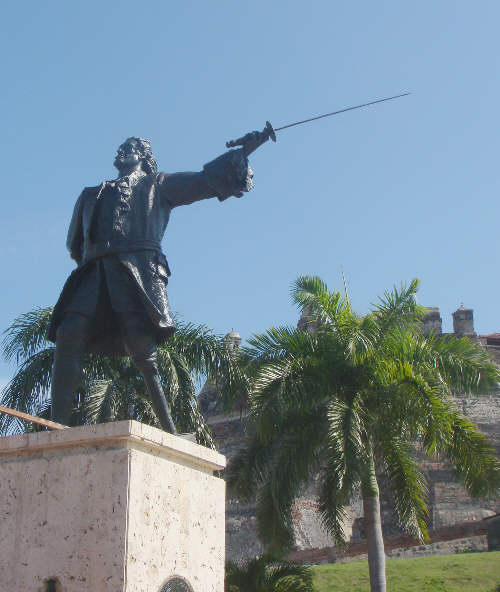
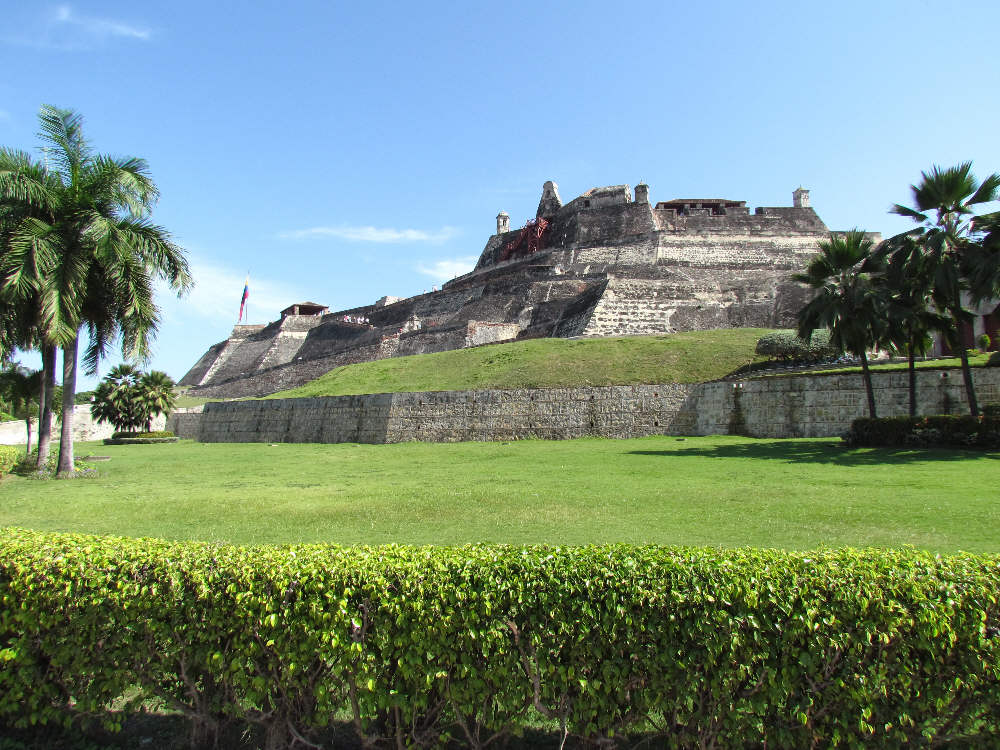
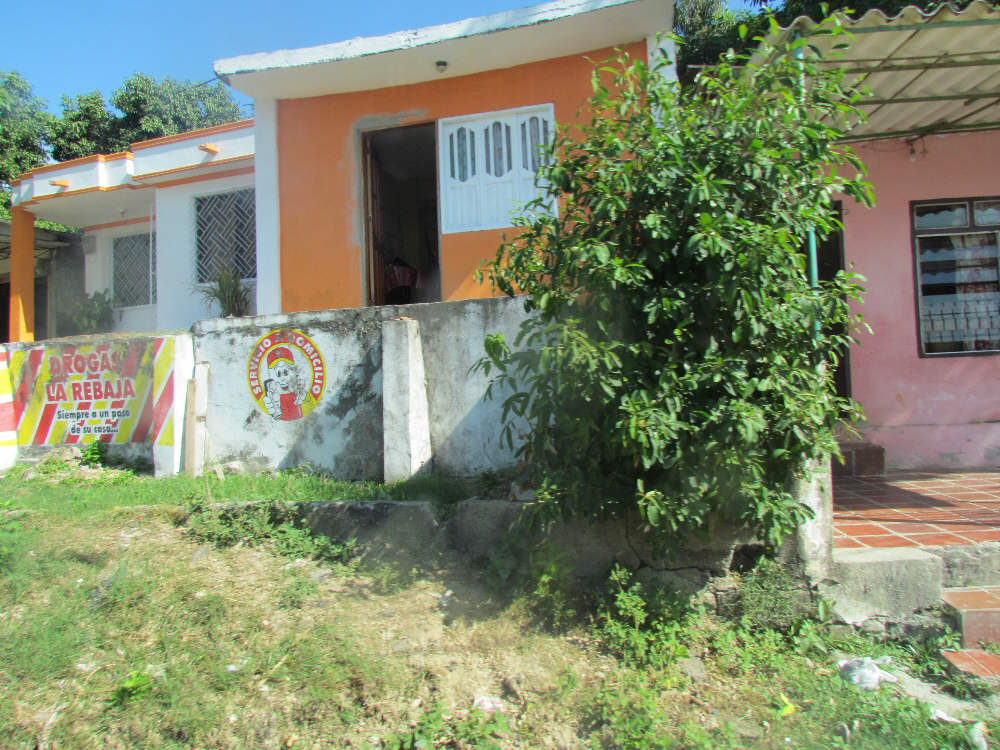
At the fortress Del went with the group but I skipped the walk in the sun up the Fortress's steps and walked around the area at its base and took a few photos of the statue of the pirate with a peg leg raising his sword in the air. Didn't get the name of the guy. Going up the hill, I was reminded how in Hollywood this kind of hilly area is home to richest people in L.A and here it's home to poorest. Most homes seem patched together hovels of one or two rooms.
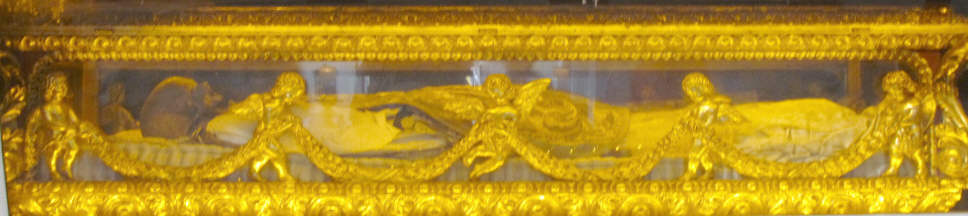
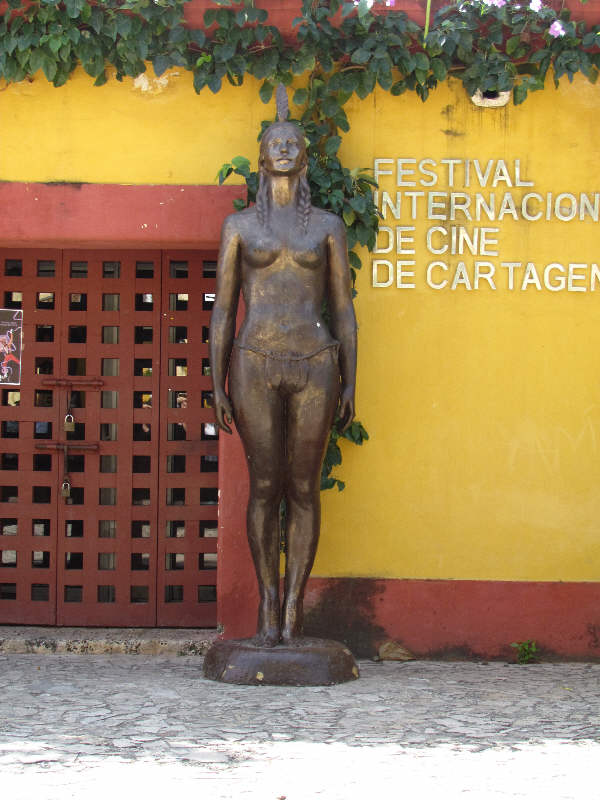
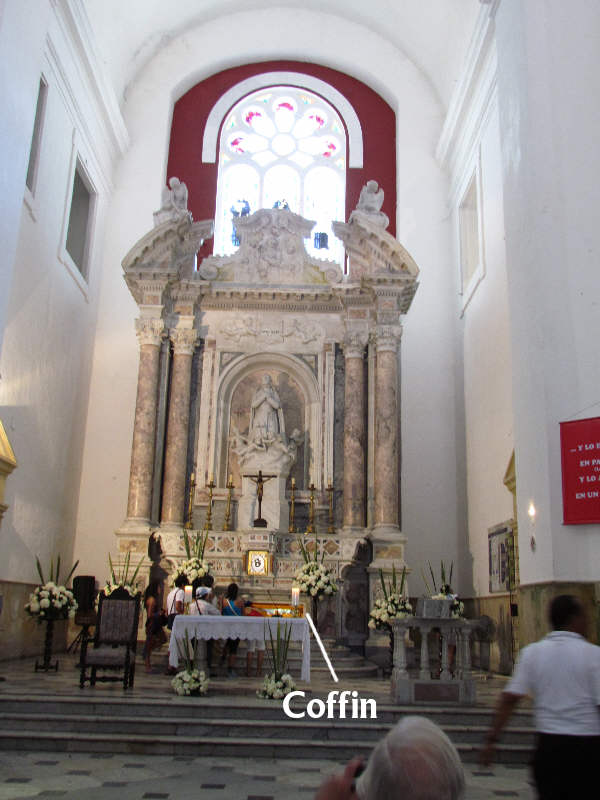
Under the altar of Peter Claver, the slave who became a Saint, was the body of the Saint laid to rest in a glass coffin in full view. Claver was a slave who became a saint and Catalina was a native who was martyred, and her statues are all around, with many miniature sculptures and etchings to be purchased as souvenirs. I took a photo of a prominent life-size bronze statue of her in front of what seemed to a Tourist Bureau.
A MAN, A PLAN, A PALIDROME BETWEEN TWO OCEANS
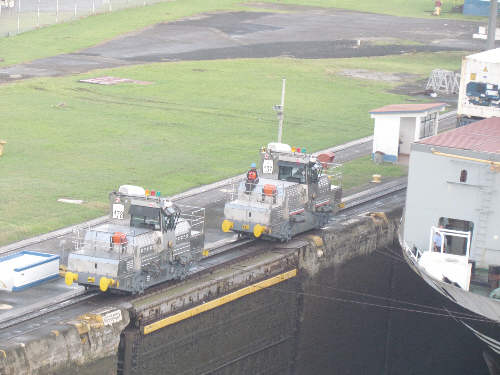
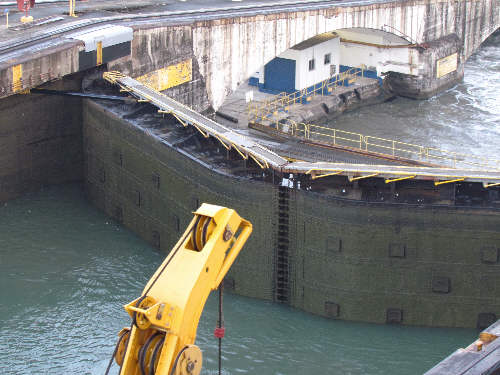
What's a palindrome? A phrase which reads the same backwards and forwards, like "Madam, I'm Adam" or "A Man, a Plan, a Canal, Panama". But who was the Man most responsible for this ingenious Canal between the Atlantic and Pacific Oceans? Was it the Frenchman who spent 20 years trying to dig a sea-level canal, losing 20,000 men in the endeavor? Or what it Teddy Roosevelt, the American President who bought the barely begun canal from France and then had to get Panama to be an independent country to get rights to build the Canal Zone? Or was it the American railroad engineer who took over from the first year's digging failure and spent an entire year building railroads to haul away the spoil (dirt and rocks dug up)? Or was the doctor who had led the fight to eradicate Yellow Fever and malaria which had killed so many Frenchmen earlier? Or was the masses of West Indian natives who flocked for the good paying jobs working on the canal? Or the person who had the idea for damming up the raging river to form the large freshwater reservoir of Lake Gatun whose water lifts and lowers the very large ships pulled by ingenious electric locomotives through the canals? All of these and many more were responsible for building a true Wonder of the World, an achievement which will be transiting Supertankers by its 100th birthday in 2014, when the new, larger locks are opened alongside the older locks.
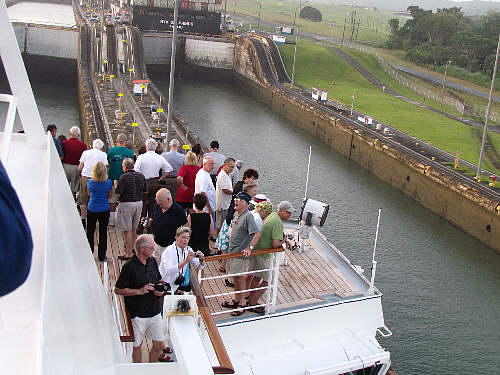
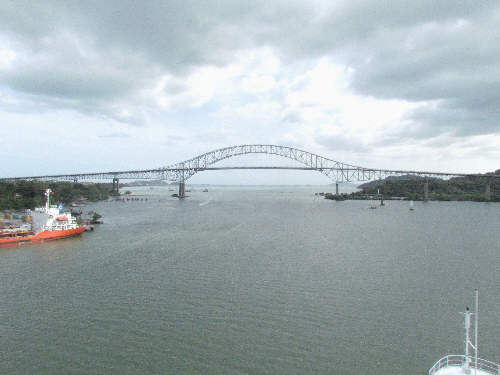
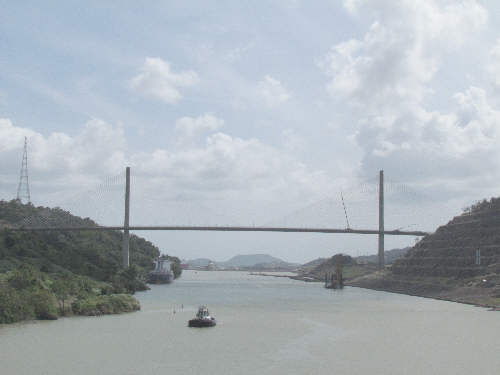
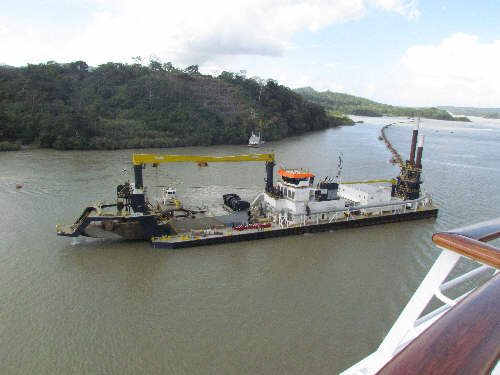
The day after we left Cartagena, we transited the Panama Canal. We entered the locks early in the morning at sunrise and watched as a large container ship passed us in the other locks, going in the other direction. We passed under the Bridge of the Americas in the afternoon. That bridge marks two divides: the Continental divide and the Americas divide, the horizontal divide and vertical divide: the West-East divided by mountain ridge from Alaska to Patagonia and the divide between North America and South America, all in one place.
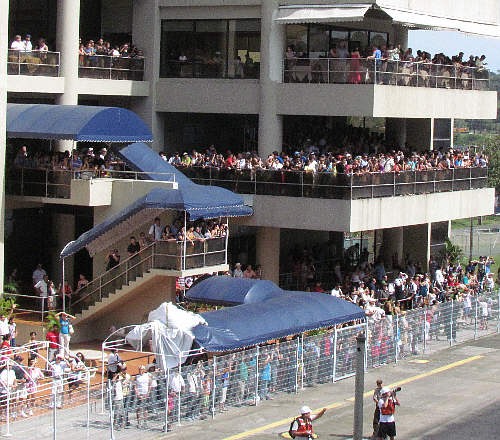
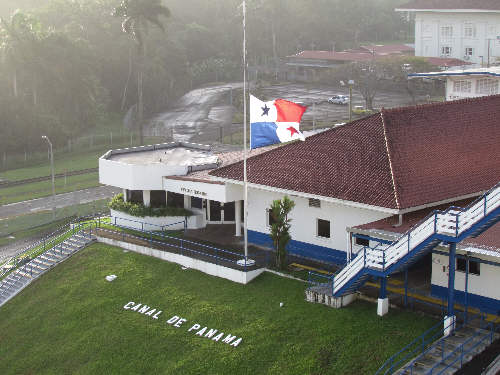
As we were transiting the final set of locks, we approached a three-story building which looked brand-new, complete with large open air patios on each level facing the Canal. As we got closer, from our veranda I could see that each patio was filled with a crowd of people and they were cheering for us! This was the most amazing and heart-filling sight, I had ever seen on a cruise. I was reminded of the old days when crowds bid adieu at New York docks for trans-Atlantic passenger ships and similar crowds greeted arriving ships with grand ovations and sprinkling of confetti and streamers. Later on my excursion from Panama City we drove our bus to the other side of the Miraflora Visitor Center. Why was it so full of people on a Monday, I wondered. I had seen Panamanian flags at half-mast during our transit, which seemed unusual for a national holiday, unless it were Panama's equivalent of our Memorial Day, which it turned out to be. It's the day they commemorate those youths who stormed the Canal Zone and helped Panama achieve its independence from the United States.
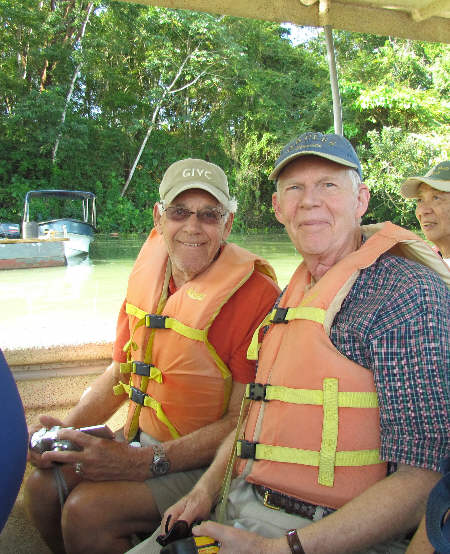
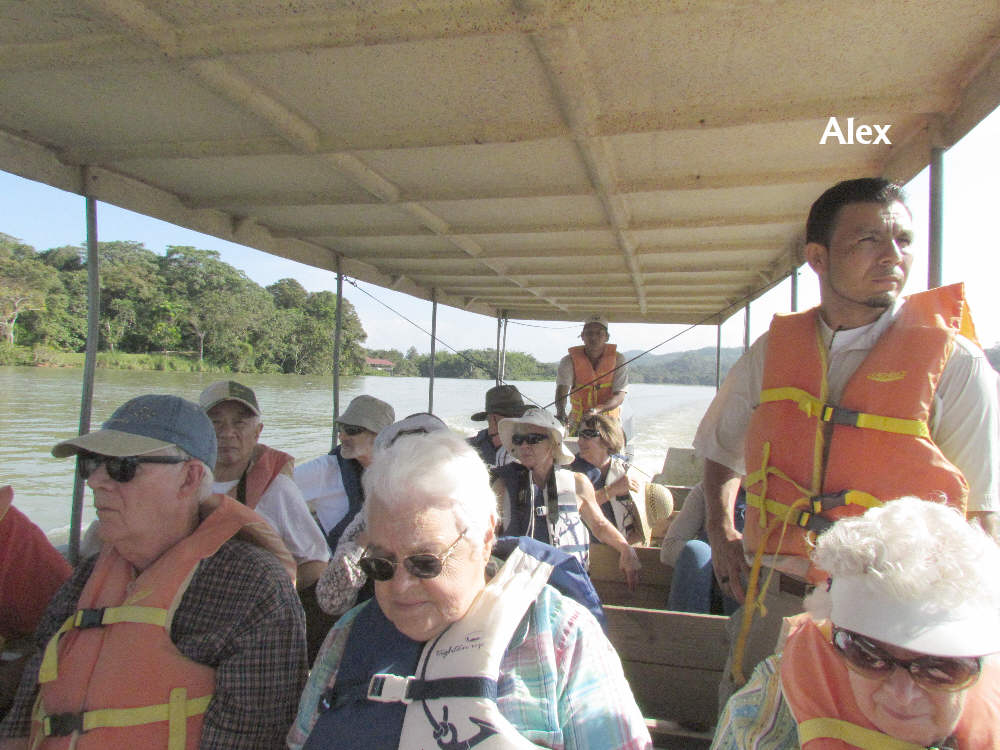
Del stayed on the boat to play bridge and I went on the dumb Eco-cruise with Panama native Alex as our guide. Alex explained how important the turn of the Millennium was to him and other Panamanians, "2000 was the first time I ever saw the Canal! Before then we were not allowed in the Canal Zone." He did a good job as tour guide, but I suggested he drop talking about the "wasting of millions of gallons of water" whenever even a small sailboat transits the Canal. I reminded him that all the water would be wasted every day if there were no Canal, the raging Gorgas River would dump hundreds of millions of gallons into the ocean every day.
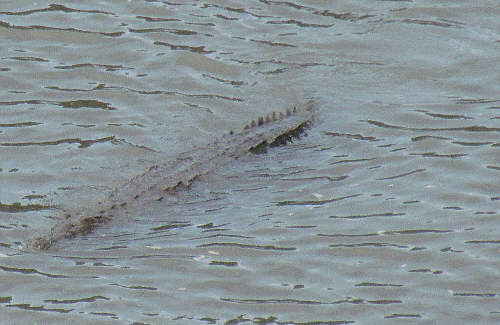
Panama, by his own figures, makes $4 million a day from the Canal traffic and has the greatest fresh water reservoir in the world in Gatun Lake created to preserve the river's water not let it go to waste. I think he got the message. He's a learner. He listened.Why I call the excursion dumb was that I could see more varieties of wild life on an average trip to in a South Louisiana bayou. First wildlife we saw was a brown pelican at the top of a high tree, whooppeee! Pelicans are Louisiana's state bird. I can see some flying over our home from time to time. On the bus trip to the boat launch, we nearly ran over a coati mundi, but he quickly disappeared again. It's a native animal very much like our local racoons. In the boat somebody saw a sloth in a tree and I may have gotten a partial photograph of its arm and tail, but the day before I had an up-close-and-personal experience with one in Cartagena. Wild howler monkeys live in the tree tops and appeared as a small black dot, at least the one Alex saw did. But we did see a lot of capuchin monkeys who were very friendly and dropped down from the trees to get a look at us and kidnap some food. Several jumped on our boat, ate grapes from Alex's hand, and hopped back. They look upon us as a floating fruit wagon apparently. Got lots of photos of them, but none of the promised wild flowers, fruit, caymans, alligators or anything else. The one alligator we saw was a very large one, perhaps 15 feet long, which we passed during our transit of the Canal the previous day.
WHAT A WONDERFUL WORLD
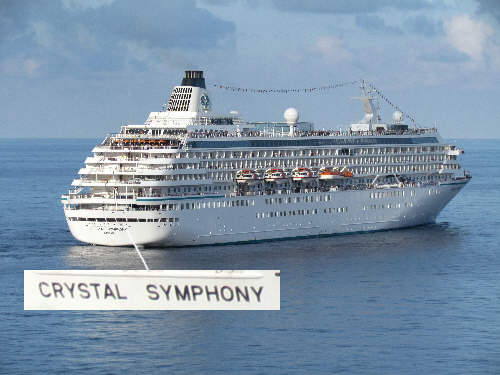
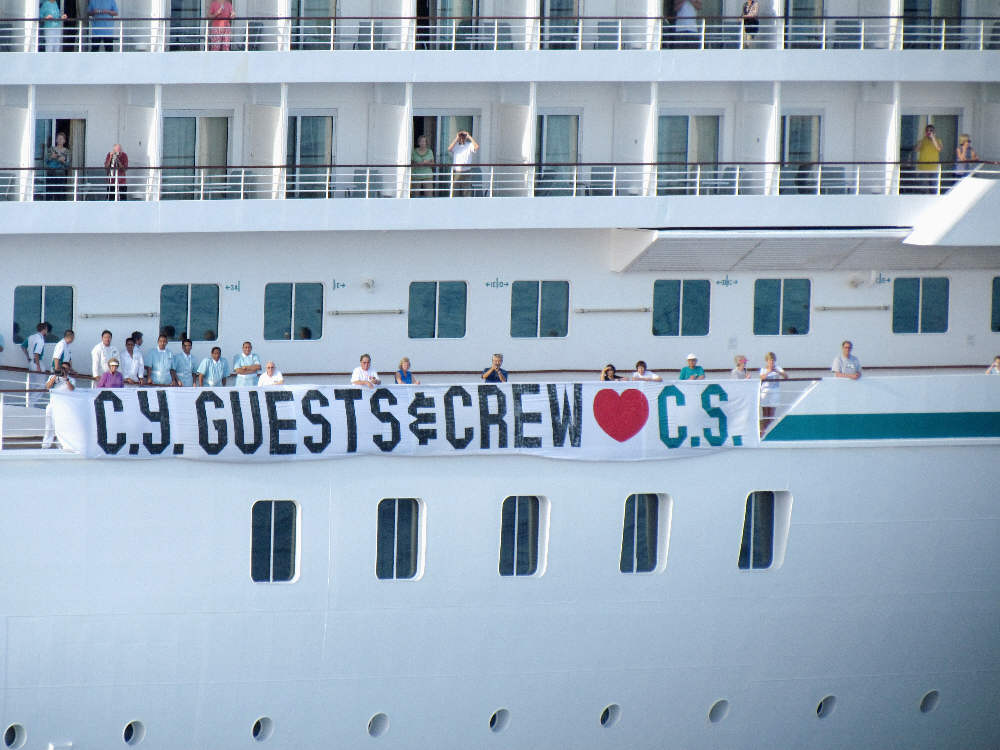
The day we left Panama City harbor for a sea day began with a cruise alongside the Crystal Symphony in the Pacific Ocean about 8 am. We had our choice of the two ships when we booked our cruise, either we could fly to Miami or Los Angeles as both were going to transit the Canal from opposite directions. We could have seen the event from our veranda, but we went to Palm Court to watch it and I decided to go up one more deck to get photos from the Sun Deck. As the Symphony approached alongside (after doing a 180 turn) I could barely hear Cruise Director Paul MacFarland's voice over the speakers as he talked to its passengers. They had a sign on side which said, CY (Symphony) Guests & Crew Love (red heart) CS (Serenity). Ours said, We are No. 1. Both ships played together "We are Champions" and greeted each other with an orchestrated big HELLO and wave. As the Symphony pulled away we played Louis Armstrong singing "What a Wonderful World" and the Symphony at this time about a ship's length ahead of us played the same song as a goodbye refrain in its turn.
How incredible it was to hear the voice of this waif who grew up in the seamy Back o'Town district of New Orleans. Louie was arrested about age 7 and that was the best thing that ever happened to him, as they put him is an orphanage and the headmaster gave him with a trumpet. The rest is history, he went on to become Ambassador to the World and here he was, singing a goodbye greeting between two great ships in the Pacific Ocean. No matter what other cruise ships you hear about, nothing is more magnificent than sailing on Crystal ships.
There was a minor sour note struck on the Serenity's Sun Deck that day, the only one I could recall from my four cruises on Crystal which spoiled my serenity for a short time. It was a nice sunny day, and I couldn't find a vacant lounge on the Sun Deck for reading my book, so I stopped to talk to our new friends, tablemates, Hugh and Barbara. They explained that the stuff on the chairs across from them belonged to some couple who were rude when they left and had been gone for over an hour. Since 45 minutes was the longest one could hold a seat without being present, I decided to move their stuff to the side and continue my conversation with my friends. Another hour passed and this couple came and were mad at Hugh for allowing me to sit in their place. I explained that it was not Hugh's fault, they had simply been gone too long. They went off in a huff and Hugh, thinking they were long gone, hummed New York, New York, and the man came back even more mad, but eventually left in another huff. Clearly Hugh had pinned the ingracious couple as being from New York.
HUATULCO QUINTA REAL AND LSU UN-REAL
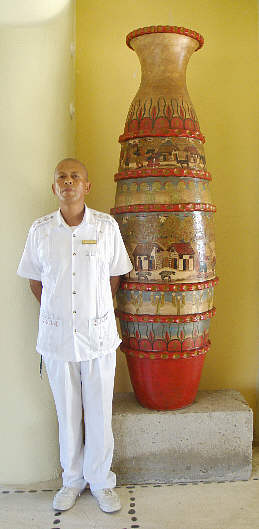
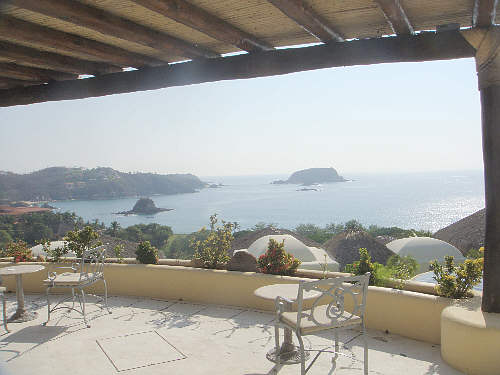
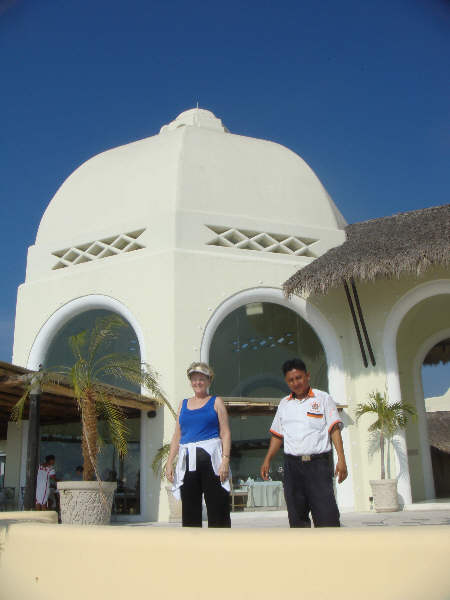
Hugh had been in Huatulco recently and recommended a taxi ride as the best way to see the sights there. We engaged Fidel Garcia as our tour guide and he took us to a prominence overlooking our cruise ship, then along the coast past all the new hotels being built. Having been on tours of new areas being built several times with sales people trying sell property and condos, we felt like Fidel was trying to sell us something. But it was just his zeal for his country and his own pride for the new construction going up all over, at least until the financial crash of several years ago. About as many of the large new hotels were unfinished as were open. Quinta Real was open and Fidel walked us through the airy lobby to show us the spectacular views of the ocean from the open veranda and restaurant area. With such views, one wouldn't want to stay in one's room, but each room seemed to have an equally great view of the ocean and beach areas. The tall uniformed doorman posed for a photo by a vase which was taller than the was.
We then headed for the middle of town and it main square. Del and I walked up to view a pretty church on a high point overlooking the square. We were back on board ship in time to have lunch in the dining room with Sergio and then, after a post-prandial repose, we watched a movie in the Hollywood Theater.
Must I mention the BCS Championship game? Almost forgot. Well, that's okay, because LSU forgot to show up for the game, at least its offense didn't. Similar to what happened in 1959 when LSU lacked one point from having a second in a row unbeaten season, and would have made it, if instant replay were available to confirm that Billy Cannon had made that 2-pt conversion going over right tackle in Tennesse's stadium. It was the year we battled Ole Miss who was number 2 in nation to a 7-3 win in regular season, and then lost to them in a never-should-have-happened rematch in the Sugar Bowl 21-0. Yes, that is the score by which LSU lost in this BCS to a team which our offense could have beaten if they had been given a chance to get their hands on the ball. Instead the coaches gave the ball to a jittery QB who only knew how to run, fumble, throw interceptions, and stay alive for four quarters while being beaten up. By the fourth quarter I was no longer upset, but laughed out loud whenever the QB fumbled, tripped, or was sacked. I lost all my respect for coaches who could allow such an inept QB to run so pathetically LSU's potent offense for the entire game while two championship caliber QB's sat on the bench!
SAINTS LOSE SECOND PLAYOFF GAME
After watching my LSU Tigers go undefeated through the 2011 season and win their first post-season game, the SEC CHAMPIONSHIP against Georgia, it was tough watching them lose their second post-season game in the BCS Championship game in Sugar Bowl Stadium by the same score they lost in the Sugar Bowl game of 1960. Our Heisman Trophy winner Billy Cannon signed a contract with the Houston Oilers of the brand new AFL under the goal posts of that game, leading us to suspect he already had one foot in the AFL during the game.
After the Saints lost their second post-season game to the 49ers in a Battle Royale to the last seconds, the lead changing four or five times in the fourth quarter and the Saints getting the ball back with only 9 seconds left on their own 2-yard line. How could the defensive coach allow his team not to go into umbrella coverage to prevent that last minute 80 yard TD pass? Well, we found out when we arrived back in New Orleans, that during the 49ers game the Saints' defensive coach Gregg Williams had one foot in St. Louis where he immediately signed as coach after the loss to the 49ers.
Next year, the Saints will be shooting for Home Field advantage all the way to the 2013 Super Bowl which will be played in the Mercede-Benz Superdome in New Orleans.
DUMB THING AND DUMB CITY
During our sea day on the way to Puerto Vallarta, I took the Adobe Print Shop class and learned about using tools to add lipstick, whiten teeth, etc — on digital photographs, of course. Really basic stuff, but I was only interested in learning how to find the things I already knew how to do with Picture Publisher. To my chagrin I learned that the Clone Tool on PS does not have any Mirrored Clone options, something I have found very handy on PP. But with the use of layers I can do many of the things I used Mirrored Cloning for, plus a lot of other things.
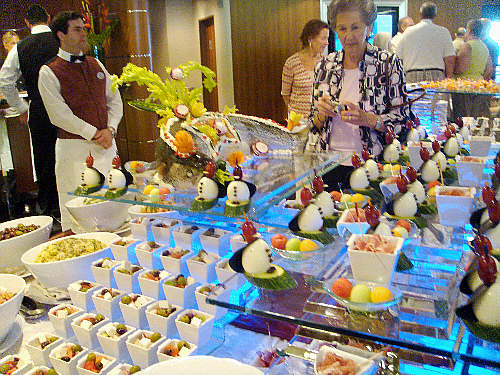
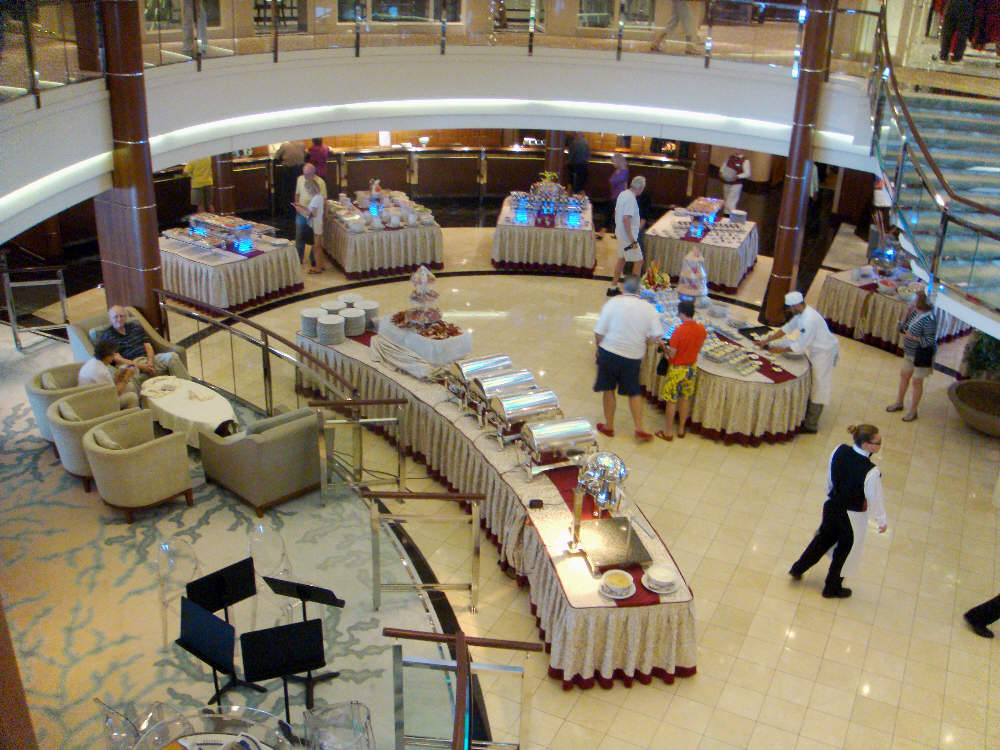
Soon came the day of the Grand Buffet which fills the Crystal Cove area. Del and I got a table in the Dining room near the door before the pig trough opened so we'd have a spot close by to go back for other food. We ate very little, just a few small lobster tails and side dishes.
Then I did a DUMB THING, the dumbest thing ever: I registered for the Slots tournament. Here's the instructions: Push One Button. And do it Over and Over again for five minutes, yelling and screaming all the way. No one said the screaming part was necessary, but almost everyone else did it anyway. I got into finals and won a half of a T-shirt. Del fronted the money (backed me) on the condition she gets half of what I win. $20 for half a T-Shirt. I'll give her my half of it. Don't want no Casino label on me plus I never wear any pullover shirts. Barbara Conners from our Table 60 gang won $150 by dint of a better playoff game than I had. Was to be an ominous omen for the Saints playoff game the same night. At least I thought it was a night game until I got back to my room and checked. I found out the Saints game was starting in just a few minutes at 3:30 pm. Del quickly re-scheduled her massage in the Spa so we could watch it together in our stateroom, for the third time propped up on the back of the sofa.
We had to miss dinner at Table 60 to watch the Saints game on TV. Reception was lousy, blurred and at times scrambled for an entire play. The Saints lost three fumbles and 2 interceptions for 5 turnovers and no team has ever won a playoff game losing that many. The helmet to helmet hit on Pierre Thomas was a blatant penalty but wasn't called. Loss of his running and screen pass receptions neutered our running game and kept our third down conversions down. Brees had to throw to survive, which he did, but the defense let several long yardage plays cause us to lose the lead with 9 seconds left and that was the game. We foundered on turnovers and yet nearly won the game on Brees' arm and game smarts. The next day, I watched part of Giants-Packers game with some NY'ers who said they were trembling at the possibility of playing our Saints in the Superdome. Yes we would have relished playing the Giants at home instead of the Packers in frigid Green Bay.
Del didn't want to go down so late to Table 60 at first, but eventually we joined our friends after dressing for informal night. When we sat down, Barbara said, "Are you sad because you lost?" I thought she was referring to the Saints game, but no, she was referring to the dumb Slots tournament which I had already forgotten about. Pushing a single button for 5 minutes is not a skill and doesn't require any of my talent. If curiosity killed a cat, I figured it could help me kill 5 or 10 minutes.
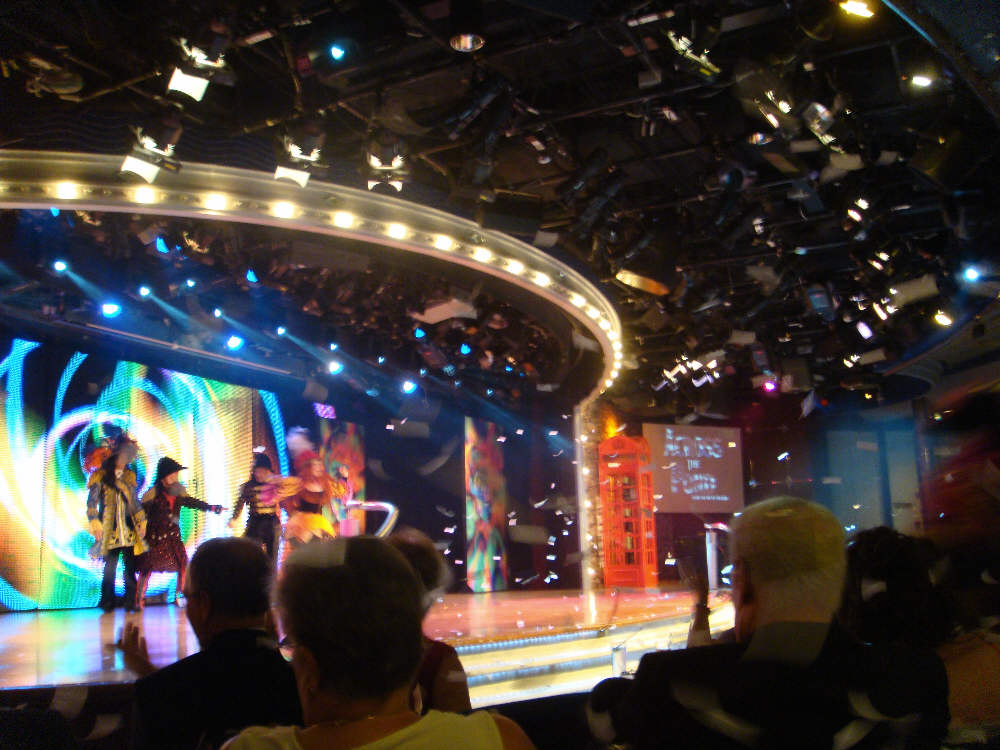
After dinner we went to the Galaxy Theater and watched the show "SRO" with excerpts from Cats, Evita, Les Miz, etal, ending with a spirited ABBA finale.
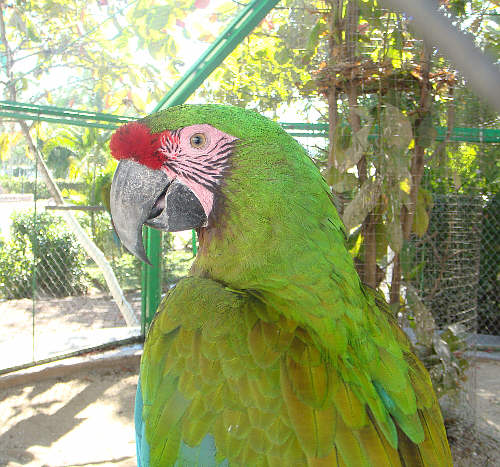
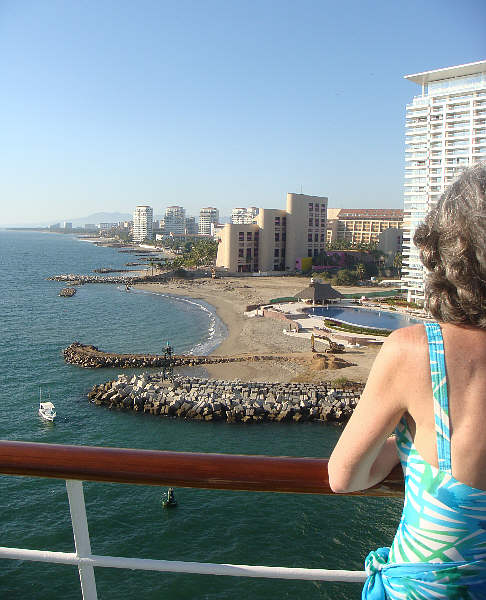
Puerto Vallarta was the DUMB CITY — they refuse to allow cruise ships to run shuttle buses into the city because of objections from their taxicab drivers. Well, I refuse to go into the city center of a city like that. It was the only stop where we didn't go shopping and sight-seeing in the center of the city or take some excursion. Never before have we docked in a city where no shuttle buses were allowed because of taxicab objections, so far as I know. Del and I walked to look at the parrots in the cage, walked down a small shopping area, and then went back on ship.
The ship skipped Alcapulco because the drug trade has escalated the violence in the metro area so much, cruise ships rarely dock there anymore because of concerns for their passengers. While in the Mexican ports of Huatulco and Capo San Lucas, we saw gunboats, police with rifles, and sniffer dogs, but no violence.EL ARCO, MONA LISA SUNSET, CACTUS GARDEN AND GLASS BLOWHARDS
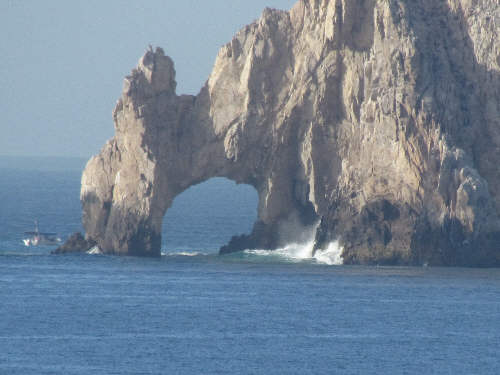
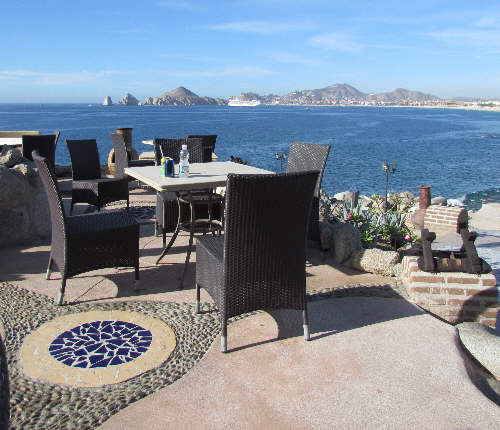
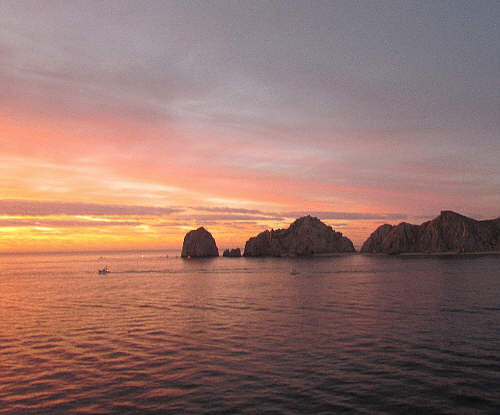
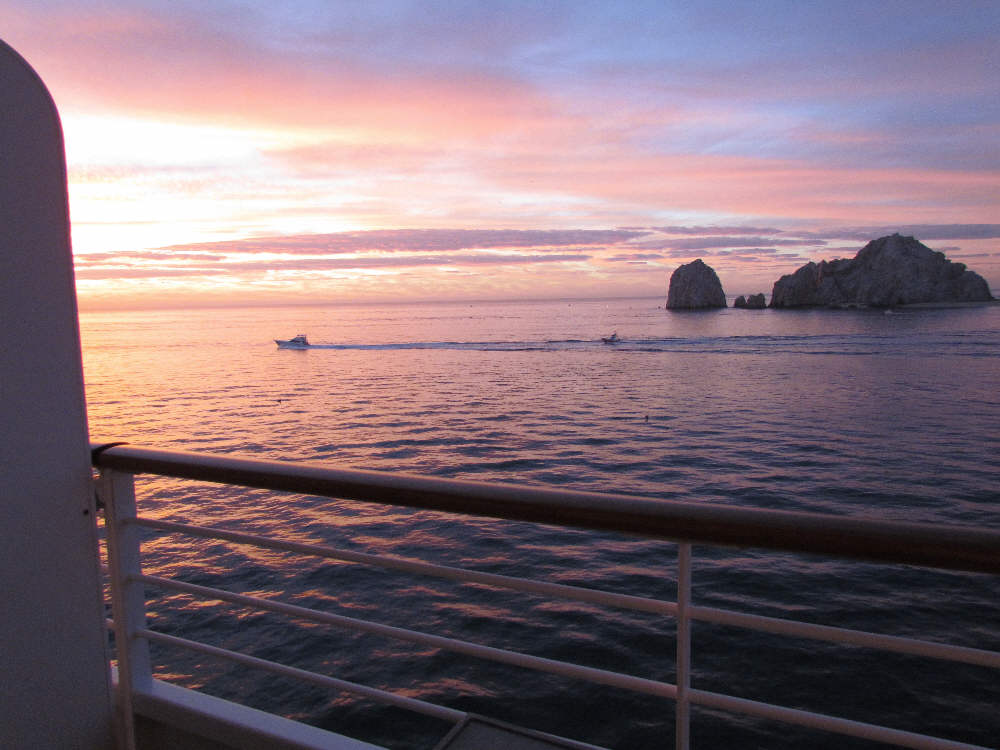
At dawn, I looked out our veranda to see the tip of the Baja Peninsula where the Pacific Ocean joins the Gulf of California. I went upstairs to the top floor on the Sun Deck and a gal next to me with a thick Latin accent asked me in halting English, "Is this where the Pacific meets the Mare de Cortez?" I was unfamiliar with the Gulf of California being called the Sea of Cortez so I had to say I didn't know. She also asked about a hole in the rock and I didn't know that either. But about an hour or so later, our excursion drove out to a lovely spot known as Mona Lisa Sunset Restaurant, where a grand rock-based patio sits on top of a prominence with a great view of the tip of Baja and the famous hole in the rock, El Arco.
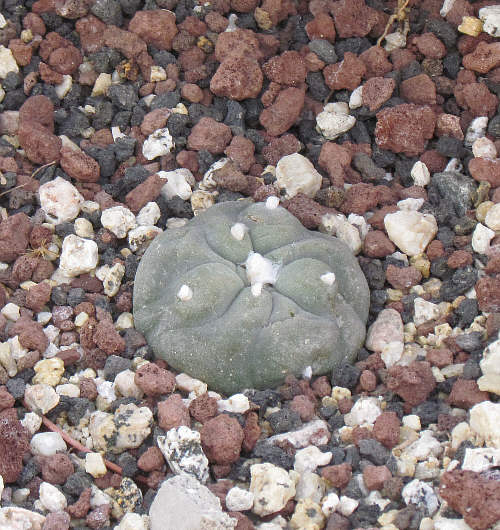
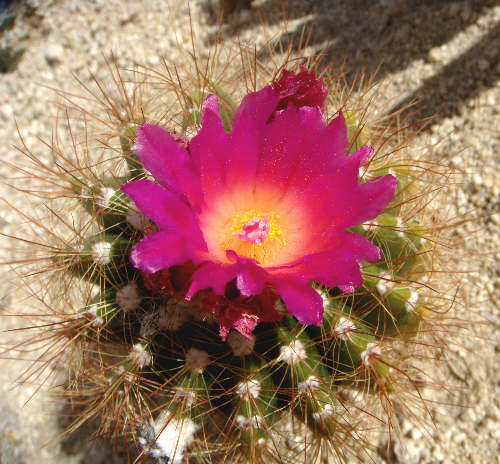
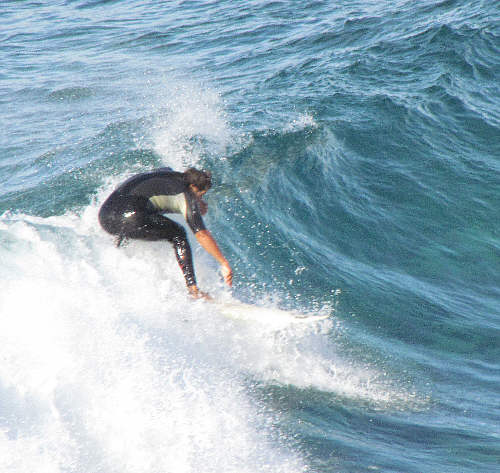
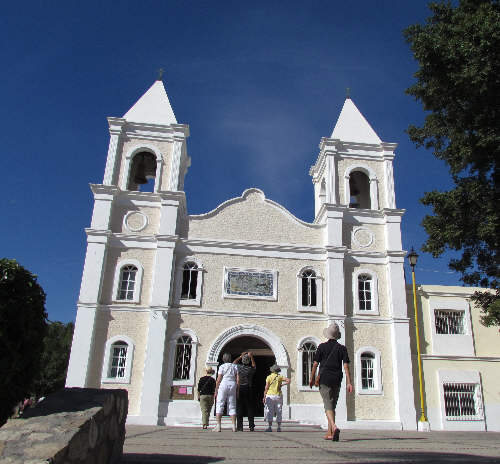
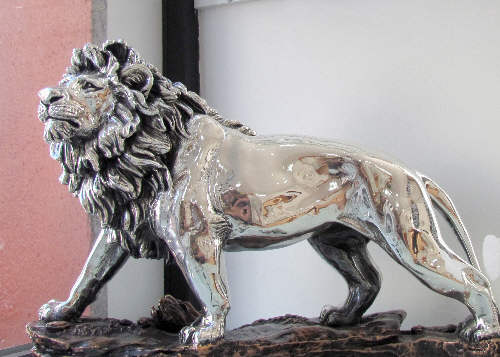
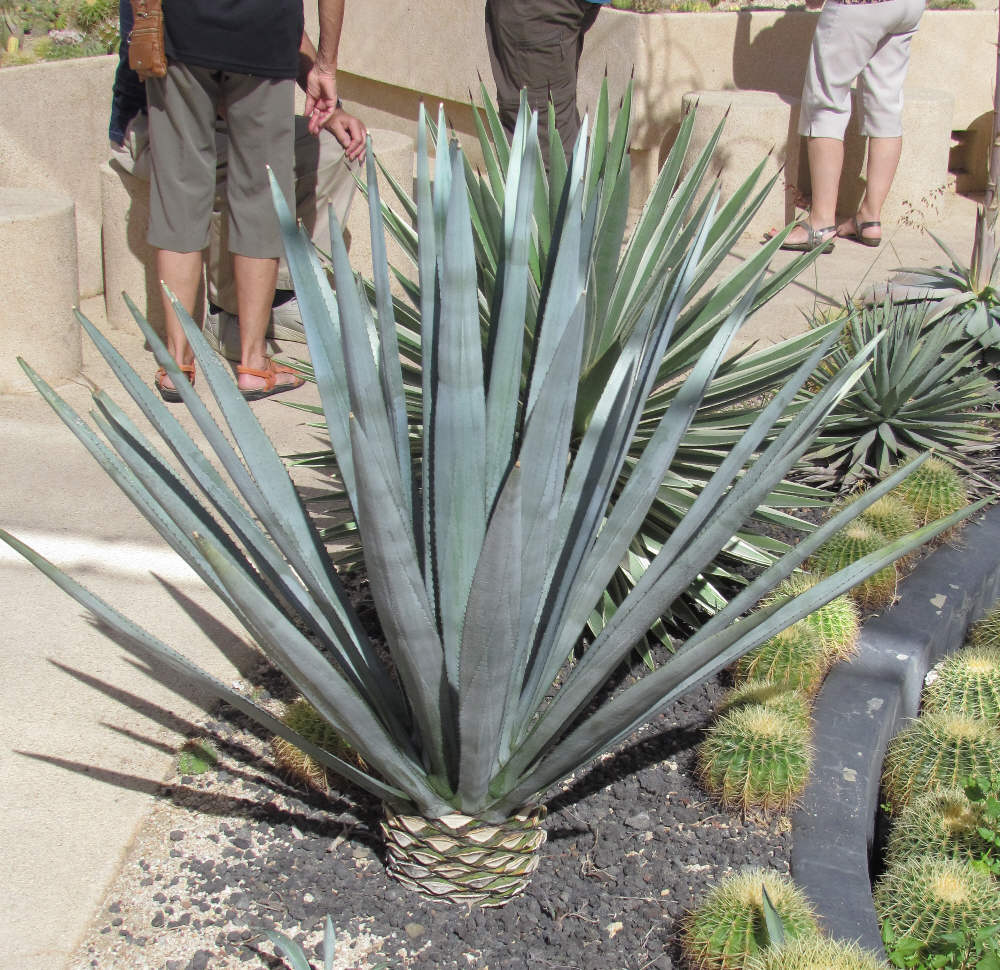
On this side, the guide told us the beach under the Arch is called Lover's Beach on this side and on the other side it is called Son-of-a-Beach, er, actually it is called Divorce Beach. I told someone after hearing about Lover's Beach and Divorce Beach, "I've been to both of those, several times; I like this side better." As we walked back to our bus, we noticed a surfer waiting for a rare wave in the surf below us. Got a couple of photos of him riding the wave to shore.Our bus next stopped in the town of San Jose del Cabo in the main square by City Hall. There was a quaint church dedicated to a priest who was martyred by the local Indians. There were many shops where folks were ready to sell , but not begging you to come in and buy from them. Saw a pure silver Lion and a Tiger for about $2000 each. Then we bussed to Cactus Mondo and where I took photos of various cacti, including a tequila Blue agave, a Mescal agave (Green with yellow stripes), and a bashful peyote about the size of a donut, with its divided buttons clearly visible. Guide said it was planted in the shade of a rock away from prying eyes and hands.
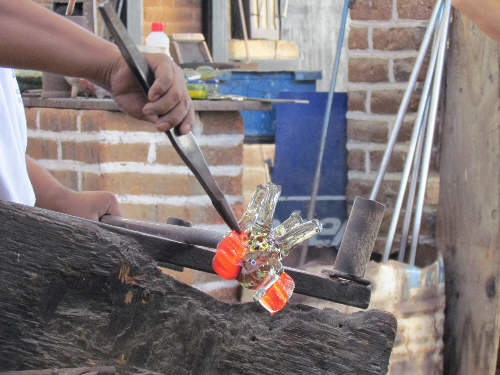
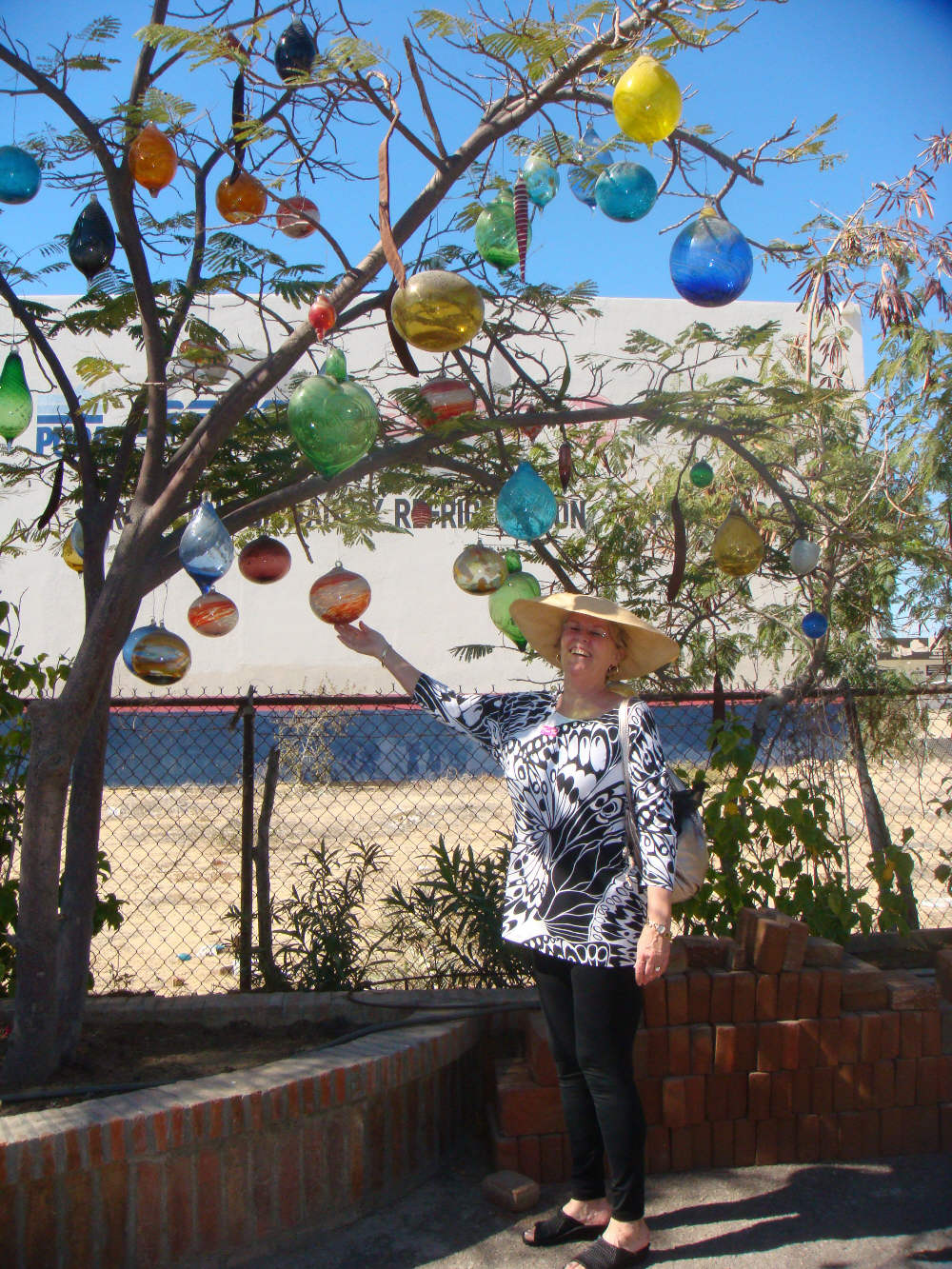
Next was the glass blowing factory. It was surprisingly cool with lots of open air space where Del and I watched this artisan form an elephant out of glass with his helper fetching heated glass for each appendage. Sort of what the GOP debates are doing back in the States: trying to create a transparent elephant as their nominee for President by heating up prospective candidates in caucuses, debates, and primary elections.
Finally we headed back to the ship. Stopped for a latte in Le Bistro, then up to the Lido Café for a veggie taco and topped it off with strawberry ice cream in a waffle cone.
Came back to 8082 Stateroom for a post-prandial nap, then shower and shave, wrote some journal notes, sent a couple of emails, while Del was in the Spa getting her hair done for tonight, the final Formal Night preceded by the Captain's party at 5 pm. Got dressed in my Black Tie Tuxedo and we finally got to talk to Captain Økland. With a Carnival Cruise liner lying on its side in shallow water killing almost a dozen people, it was good to know our lives were in his capable hands.
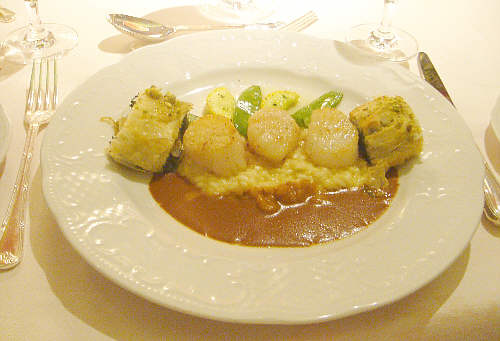
The dinner was great with truffles, paté, caviar, lobster, and Baked Alaska. All of Table 60 were there except Curtis and Barbara. I sat next to Barbara Baker this time. Passed around our directory to get everyone's email address. The show was great, a tribute the Brit rock stars of the 60s to 80s. The end was rousing and got everyone on their feet clapping. Gained another hour overnight as we slid into PST and headed into Los Angeles.
LONG BEACH, LAX, DFW, MSY and HOME
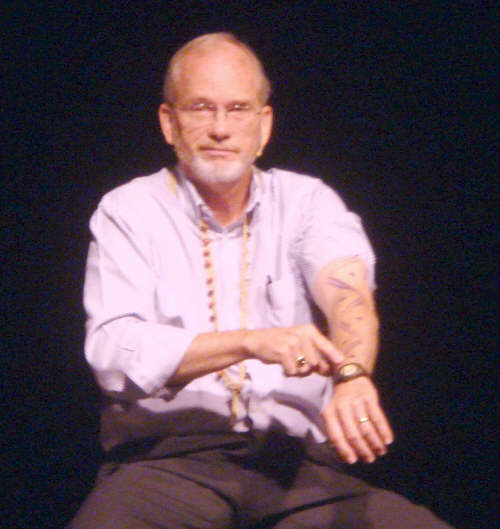
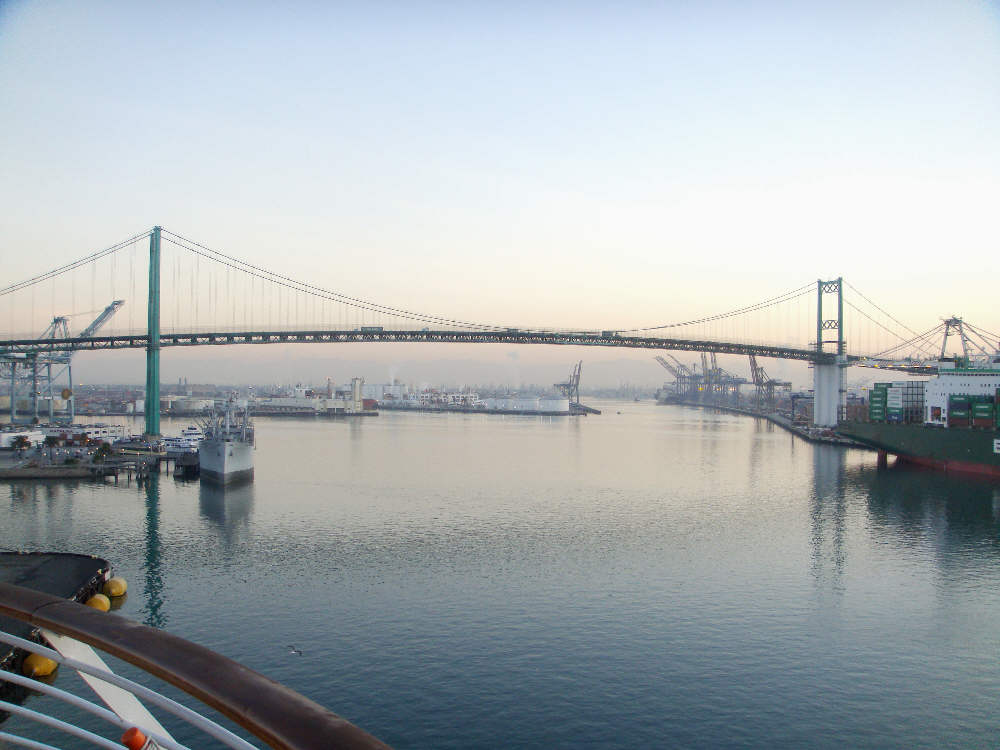
The morning we arrived in Long Beach, I went up to Lido Deck to get Sunrise over Long Beach photo. Met Curtiss and told him we'd join them for breakfast in the dining room. We said our goodbyes there and proceeded to exit. Along our way leaving the ship, we saw Steve and Ginny Saint. Del went up to him to thank him for his work. I asked him if I could have an email or contact information and the only writing paper he had was a copy of his book Walking His Trail which he inscribed to me and Del and gave it to us. What a treat! It is one of two books I was able to finish reading and reviewing in time for this Issue of DIGESTWORLD.
Had another good Goodbye with our Table 60 friends then headed to the exit ramp. Bus trip to airport was easy, Crystal had arranged for late flights like us to have lunch on them at the Airport Renaissance Hotel, all costs were covered including tax and tips. It was much more pleasant waiting at Hotel than LAX. When we had eaten and were ready to go, we simply had our bags checked out of the locked room and loaded onto the next shuttle and off we went. American Airlines had someone to issue our boarding passes take care of our luggage at curbside.
When we arrived in Dallas, we remembered the sordid episode from our last trip through DFW, when we had to rush at full speed to go from one concourse to another and we arrived only 2 minutes late and the doors had closed and we had to rebook the next flight home and sit down for 3 hours. Curiously on a previous flight on same airline (not American) we sat in the airplane for an extra 23 minutes and were told that we had to wait for late boarding passengers. So this time we shuttered at the possibilities, but 95% of the things you worry about never happen, and this time, our connecting flight to New Orleans (MSY) was only a short walk down the same concourse and we got a leisurely supper and a pleasant wait for our flight home.Everything went well. We arrived at MSY on time about 11:45 pm, got our bags, got a nice porter to load up and push our bags to the parking lot. Our car was conveniently close to the Skywalk so we didn't need to wait for elevators. We arrived at the car right away and were very ready to drive home. Del got in and started the car. It started right up which is good, since it had been sitting in the frigid air of the airport garage on Level 4 for two weeks. The trunk was inaccessible and Del pulled the car forward for loading as I was talking Saints football with the porter. How is Pierre Thomas? How did Gregg Williams leave the Saints? I didn't notice that Del had stopped the car. It never occurred to her that she had used up all the battery juice left in the frigid battery. If I had started it, I would have left it running, if we'd parked in a normal spot, the trunk would have been accessible, but this one had to be backed into and the trunk was blocked.
The porter said goodbye and left, and I got behind the wheel to go and the battery was dead. No juice left after the one start. The entire level 4 was completely empty with no one coming or leaving. It was almost 1 am already. I waited ten minutes. Nothing. Calling AAA and trying to explain how to find us did not seem a good option. After several waits for battery to recover, I decided to walk back to Baggage Claim to find the nice porter and there were two young guys with bags headed for their car. I asked what level they were on, 5. "Could you jump my car?" Yes, they said, they could if we had jumper cables. Del had told me she keeps them in her car. I walked back to car and we had to unload the four large bags from trunk. No jumper cables. Somehow they never migrated from her previous car. The two arrived in their black Jaguar and I broke the news to them. One of them said, "We saw a security guard on Level 5, we'll ask if he can help you." I breathed a sigh of relief and thanked them. In about 5 minutes the guard arrived, and he called for the battery unit. We talked about the Saints until it arrived. Within minutes we were on our way home. We hit the bed at Timberlane about 2 am completely exhausted and glad to be on terra firma and home again.HOME AGAIN
First day home was daunting for me with 14 Times-Picayunes to read fast and fast. Okay the first fast was an adverb and the second fast was a verb. Reading the TP fast was aided enormously by being able to skip over the two final games by LSU and the Saints. Bad news is like old fish, it stinks. Skimming over the national news was possible as we had a daily two sheet update delivered to our stateroom. The comics page never makes the national news, however, and must be read normal speed to enjoy. How else can you enjoy Dr. Mel of Brewster Rocket comic strip when he sticks a pin in a doll and Winky says "I have an overwhelming feeling I've experienced this before." To which Dr. Mel looks at the doll and says, "This must be a deja voodoo doll." Our trip to Rouse's to restock our groceries was made with our plans to fast in mind. Those cruise meals did pile up on top of each other and we each gained about 5 lbs so it was time to fast and by the 28th as I write these notes, I have removed 10 lbs and reached a weight I had been aiming for before the cruise, though it's hard to pass up those King Cakes which abound during Carnival Season which is in full swing from now until the end of February. Del is doing as well as I have with her fasting since we eat the same foods mostly. The green onions, broccoli, and brussels sprouts in the winter garden are still producing. My spontaneous grape tomato plant died during a light freeze while we were gone, unfortunately, just as they were getting ripe. A local gardener was featured in the Gretna section of the newspaper showing a similar tomato plant which had also seeded itself in his mulch bed as mine had.
Two of our daughters have called and reserved a place at Chateau Matherne for the weekend before Mardi Gras, and we're looking forward to their visit and to two days of active parade going. Some years if the kids don't come in from points West, we save our celebration for Mardi Gras when the entire city of New Orleans shuts down for a huge block party with everyone in costumes, parades all day long, and music everywhere. We walk through the French Quarter and enjoy a "movable feast" where the scene moves and morphs with every step we take and if we sit to rest and eat at a window café, the scene moves and morphs by us.
One night Jarrett Lee was playing QB for the new NFL College Bowl and I wanted to see if maybe his legs were broken (since Les Miles didn't play him in BCS game), and sure enough he was ambulatory and sailed one TD pass into the end zone, something he was never given a chance to do in the crucial BCS game. In addition to that game there was the following on at the same time: LSU Basketball game, New Orleans Hornets NBA basketball, and the results of the South Carolina election. Big night. Watched the three games and election coverage, so all five screens in the Timberlane Screening Room were turning and burning the whole night. Great to be home again!
Thanks to my new Adobe Print Shop on my laptop, I was able to process my 450 plus photographs while I was at sea and that saved an enormous amount of work when I arrived home. It made it possible for me to finish reading the two books this month and write my reviews for them. I also learned the difference between a bed spread and a bed covering. Men, you will want to learn this distinction in case you were to hear those two fateful words, "bed covering". What the difference? The bed covering costs about 20 times as much as a bed spread! I know because we acquired one this month after some weeks of design and custom quilting by Marian Giardino and her crew at AMAR.
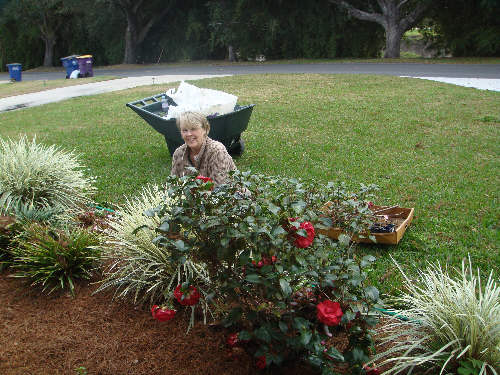
In our garden I found two blooms, first of the year for a small plant that was my mother's favorite flowering shrub, called a "Yesterday, Today and Tomorrow". It gets its name because the barely open deep purple flower which will fully bloom the next day is called a Tomorrow. The fully open flower is slightly lighter, a purple-blue flower called a Today. The following day the fully open bloom from the previous day has turned almost white and is called a Yesterday The first two blooms I found on our Yesterday, Today, and Tomorrow plant were one deep purple and one purple-blue. All of which allows me to say this: "One is a Today and the other is a Tomorrow. The Yesterday will come Tomorrow." Nice to have a linguistically fun flowering bush around the house, don't you think?
EVERY GOOD THING MUST COME TO
A NEW BEGINNING, SO UNTIL NEXT MONTHThe past 31 days of this New Year has been a month of glorious cruising through the Caribbean and lost football games and lost basketball games. May this next month of February be a month of Mardi Gras celebrations of family and friends, of returning hours of sunshine every day bringing new life and resurrection, rolling as inexorably as the Rex Parade towards Spring and Easter festivals! Till we meet again in the blustery days of March, God Willing and the River Don't Rise, whatever you do, wherever in the world you and yours reside, be it frigid or warm, snowy or sunny, Remember our slogan:
Take Care of Yourselves in Twenty-Twelve ! ! ! ~~~~~~~~~~~~~~~~~~~~~~~~~~~~~~~~~~~~~~~~~~~~~~~~~~~~~~~~~~~~~~

IMPORTANT MESSAGE:
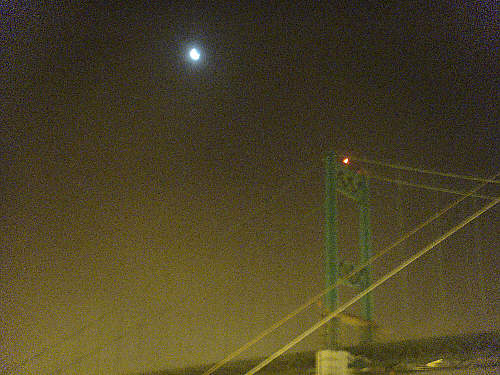
To those Good Readers who are puzzled by How the Moon could be Rising In Front of a Mountain, Click on Photo. To see 161021 photo, Click Here. ALSO: if you are puzzled because you No Longer get our Monthly Reminder, you may have Changed Your Email Address without notifying us. NOTIFY US NOW by a simple Click Here!
Here's the Sting:
You will NOT receive a Monthly Reminder unless you have Re-subscribed under your new address to DIGESTWORLD.If you've already receiving DIGESTWORLD Reminders, ignore this message.
If you're not subscribed, and would like to Subscribe to DIGESTWORLD Reminders to receive one short email a month to inform you of the latest ISSUE, now's a good time. SUBSCRIBE NOW
by Clicking Here.Yes, this message does no good to those who changed their email address without notifying me — but it can alert those of you who are going to change your address.
If you've changed or are planning to change your email address, Click Here to SEND NEW ADDRESS. (Alternate way is to copy into your Browser this URL: http://www.doyletics.com/subscrib.htm )
EASE OF VIEWING NOTES:
NOTE: For Internet Explorer Browsers, DIGESTWORLD is best viewed at 100% Zoom and the Window's width sized so that Digest Archives lines are single-spaced, just barely. Adjust Window width so that Mountains almost touch the Archive Numbers, especially if you find some Photos overlapping text.PHOTO CAPTIONS (CURSOR FLYOVER ISSUE RESOLVED):If you have been enjoying the photos in DIGESTWORLD, but have wondered who or what you were looking at, you will now be able to hold your cursor still over the photo and the photo's description will appear. (Test on Butterfly-Crab Image at Right.) We spend a lot of time writing these photo captions and hope you will read them. All the Archived Issues have been updated to provide descriptions when your cursor rests for a second on a photo. Note that older Reviews have not been updated. If you haven't finished reading text when description disappears, move cursor away and back on photo to finish. We thank you for your patience and hope this pleases you.
Quotes Selected from quotes.htm this month:New Stuff on Website:
- In a recipe, the cook is always the invisible ingredient.
Henry Petroski ( 21st Century Engineer in his book, To Engineer Is Human) US writer- Every excess causes a defect; every defect an excess.
— Ralph Waldo Emerson (American Writer in his Essay Compensation)LADIES: Check out these NEW SHOES on our Latest TIDBITS Page!!I received an email from a friend about Will Rogers containing material in this TIDBIT, so I thought it was about time to remind my Good Readers that it exists.Five Flowers of Shanidar Poems, One from each Chapter:
These poems are from Bobby Matherne’s 1990 book of poetry, Flowers of Shanidar. and have never been published on the Internet before. Each month this section will have five poems, one from each Chapter of the book. (Flowers drawn by Artist Maureen Grace Matherne)1. Chapter: Hollyhocks
A Conspiracy of Roses
Locked in step
The bushes bend
Phototropically
To squeeze out every second
of sunlight slipping silently
past the overhanging leaves.In an instant
A movement
A wave of shimmering energy
Moves in the far off reaches
of the galaxy.In the same instant a movement
Begins in the far off reaches
of the sea.Locked in step
The wills of the rosebushes
Dance with the galaxy and the sea
and the winds that whistle
through the tree.The dance is done ... the galactic wave subsides ...
the sea is quiet again ...
the tree is resting on its side ...
and the roses are smiling in the sun.
2. Chapter: Hyacinths
100 Decimals of Pi
Never joke with a teacher
The humor will never reach her,
It's like a fundamental preacher's pun
Or a slug in his collection."You can't fight in here, this is a War Room,"
said Dr. Strangelove.Hiya, Daddy, come and play.
Shine your shoes, you lazy kid,
there'll be no play today. The twig is bent, the kid goes to his knees,
Thus is the origin of twisted trees.God help me to see
That forgiveness is something that I do for me.What esoteric pleasure
To get together by and by
With a few mnemonic friends
To recite in unison the first 100 decimals of Pi.There ought to an expedition soon
That creates a colony on the moon.
The little dog will laugh to see such sport
And CBS'll do a lunatic report.3. Chapter: Rose Mallow
A Lotus Grows
A lotus grows
in a still forest pool
Stuck in the mud
of the deep fertile earth.A lotus grows
in a still forest pool
Inching upward its pendulous spire
feels its way to the sky.A lotus grows
in a still forest pool
Floating on the surface
the bud thinks itself awake.A lotus grows
in a still forest pool
A blaze of golden color
flashing in the noonday sun.A lotus grows
in a still forest pool
Its seed drops into the water
and floats in search of home.
4. Chapter: Shamrocks
Dancing Eyes
In that long silent moment
Their eyes danced the dance of no movement.He saw in her the place where
when she is in that place in her
and when he is in that place in him
They are in the same placeLooking into the depths of forever
in the middle of Nowhere.
5. Chapter: Violets
All At One
Someday when I'm all at one
I will drink the nectar
of bereavement
and stray outside heaven's doors
I will hold the one
who loved me
and take her home once more.
Someday when the sun is bright
and the morning clouds
of springtime
fill my window
I will fly away
once more into forever
I will hold the one
who loved me
and take her home again once more.Someday when the sky is blue
and the balmy breath
of summer
stills my sails
I will sail away
once more into forever
I will hold the one
who loved me
and take her home once more.Someday when the leaves delight
and the nippy brace
of autumn
clears the air
I will walk away
once more into forever
I will hold the one
who loved me
and take her home again once more.Sometime in the winter's night
as the moondrops sparkle
in the snow
I will dance with Venus
round the crescent Moon
into forever.
~~~~~~~~~~~~~~~~~~~~~~~~~~~~~~~~~~~~~~~~~~~~~~~~~~~~~~~~~~~~~~
Movies we watched this past month:
 Notes about our movies: Many of the movies we watch are foreign movies with subtitles. After years of watching movies in foreign languages, Arabic, French, Swedish, German, British English, Russian, Spanish, Italian, Japanese, Chinese, and many other languages, sometimes two or three languages in the same movie, the subtitles have disappeared for us. If the movie is dubbed in English we go for the subtitles instead because we enjoy the live action and sounds of the real voices so much more than the dubbed. If you wonder where we get all these foreign movies from, the answer is simple: NetFlix. For a fixed price a month they mail us DVD movies from our on-line Queue, we watch them, pop them into a pre-paid mailer, and the postman effectively replaces all our gas-consuming and time-consuming trips to Blockbuster. To sign up for NetFlix, simply go to http://www.netflix.com/ and start adding all your requests for movies into your personal queue. If you've seen some in these movie blurbs, simply copy the name, click open your queue, and paste the name in the Search box on NetFlix and Select Add. Buy some popcorn and you're ready to Go to the Movies, 21st Century Style. You get to see your movies as the Director created them — NOT-edited for TV, in full-screen width, your own choice of subtitles, no commercial interruptions, and all of the original dialogue. Often you get the Director's Cut Edition which adds back excellent footage that was cut from the theater releases. With a plasma TV and Blu-Ray DVD's and a great sound system, you have theater experience without someone next to you talking on a cell phone during a movie plus a Pause button for rest room trips.Hits (Watch as soon as you can. A Don't Miss Hit is one you might otherwise ignore.):
P. S. Ask for Blu-Ray DVD movies from NetFlix.“Midnight in Paris” (2011) is a wonderful time to let your soul wander into previous times like the 1920s with Scott & Zelda, Hemingway, Dali, Gaugin, Getrude Stein, etal or the Belle Epoque with the Can-Can and Toulouse Latrec. One can lose one’s heart in Paris and find one’s life. A Woody Allen Impressionist Masterpiece! A DON’T MISS HIT ! ! !
“The End of the Spear” (2006) Watching this movie six years later, it had a dramatic effect on us. The five men who were speared, including Steve Saint's father, sacrificed their lives to bring a primitive people into a peaceful existence. They died at the end of the spear to create the end of the spear. Have your tissue box ready. A Don’t Miss Hit!
“Dream House” (2011) Daniel Craig in a thriller. Working on a novel, he returns to the new home he’s just acquired for his family to find it was the site of horrible murders. As he investigates further he is led to an insane asylum where the doctor shows him a video of the madman recently released who had been charged with the murder of his wife and daughter. He doesn’t have to seek that man as it was himself! A DON’T MISS HIT ! ! !
“Margin Call” (2011) with Kevin Spacey stars a young analyst who discovers on data stick left behind by Stanley Tucci that the firm is facing complete collapse along with all others firms in the world. Suddenly “firm” became “squishy” in the 2008 financial collapse and morality flew out the window.
“Overboard” (1987) Goldie Hawn and her husband Kirt Russell have fun in this turn-about bedroom drama. A DON’T MISS HIT! ! !
“No Highway in the Sky” (1951) Jimmy Stewart as aircraft engineer investigating the structural strength of a plane’s tail section and has to fly in that same type plane to investigate the cause of a tail section falling off in two other planes of that type! Marlene Dietrich is aboard to add a bit of glamour to the doomed flight.
“Atlas Shrugged, Part 1” (2011) Ragnor, D’antonio, and John Galt were the three great students of the professor we learn, only John Galt disappeared and is taking the great thinkers and doers with him. Suspect D’antonio and Ragnor are in cahoots with Galt. Dagny. Will Part 2 happen soon? Who is John Galt? A DON’T MISS HIT ! ! !
“Beyond the Gates of Splendor” (2005) Early documentary of Steve Saint’s family who pacified the Waodani tribe in Ecuadorean Rain Forest, keeping them from being wiped out by encroaching civilization.
“Corn is Green” (1945) Bette Davis as Welsh Schoolmaster who rescues teens from the coal mines. Great line, “When the corn is full, its head bends down; when the corn is empty, its head stays straight up.” Will Morgan make it to freedom over the stonewalls of Wales? A DON’T MISS HIT!
“Portrait of Jennie” (1948) Joseph Cotton as artist with “painting block” and Jennifer Jones as his eponymous time-traveling Muse.
“Our Vines Have Tender Grapes” (1945) with Edward G. Robinson with Margaret O’Brien who endure a flood and a barn burning and rise above it.
“Soul Surfer” (2011) is a true story about a gal who lost her left arm to a shark bite and her road to recovery which included returning to surfing competition and becoming a professional surfer. A wonderful feel-good-in-the-water story. A DON’T MISS HIT! ! !
"Warrior" (2011) Nick Nolte as the father of two brawlers who compete with hating their father and with other brawlers in extreme fighting competition. A DON’T MISS HIT ! ! !Misses (Avoid At All Costs): We attempted to watch these this month, but didn't make it all the way through on most of them. Awhile back when three AAAC horrors hit us in one night, I decided to add a sub-category to "Avoid at All Costs", namely, A DVD STOMPER. These are movies so bad, you don't want anyone else to get stuck watching them, so you want to stomp on the disks. That way, if everyone else who gets burnt by the movie does the same, soon no copies of the awful movie will be extant and the world will be better off.
“The Black Widow” (2005) arrives at mysterious ‘Rubber House’ to fall in love with Caretaker Willem Defoe in a film noir worth nada.
“Margaret” (2011) Lisa causes a bus driver’s attention to be distracted and he runs over a woman, severing her leg and she dies in Lisa’s arms. Lisa lies about the details of the traffic light being green, but later recants and livens up her formerly boring teenage life by setting other people’s life on fire: bus driver, her teacher, her mother, her father, dead woman’s cousin, dead woman’s friend.
“Bridesmaids” (2011) stupidity to the Nth Degree! 2 hrs and 5 minutes of it — could have shaved off 2 hours by cutting out the gross parts. AAACYour call on these — your taste in movies may differ, but I liked them:
“One Day” (2011) in July each year is shown as a Harry Met Sally friend romance moves forward, but without the verve, the humor, the great fun, and great ending! Even the comedian in film is not funny. The day announcement pops up at odd places in the screen, watch for it. Ann Hathaway’s charm and sweetness is wasted in this movie on a Peter Pan who wastes his own life away.
“A New Earth” (2011) second movie in two days in which someone gets killed by a vehicle slamming into them. A drunk teenager freshman headed for MIT is sent to jail for 4 years for killing a man’s wife and boy when her attention is capture while driving by report of a new Earth appearing in the sky. This is the story of her life as details on the new Earth begin to be discovered. Haunting images and synchronicity but no follow through makes it a Your Call.
== == == == == == == == == == == == == == == == == == == == == ==
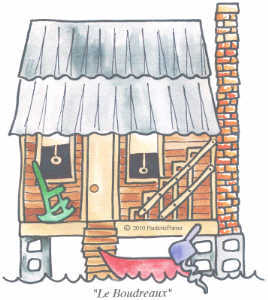
Le Boudreaux Cajun Cottage, drawn by and Copyright 2011 by Paulette Purser, Used by Permission
4.STORY:
== == == == == == == == == == == == == == == == == == == == == ==
Boudreaux went fishing with his good buddy Theophile one day. They liked to get into Hackberry Bayou before daybreak to catch some sac-au-lait, so they always let the boat into water while it was still dark and motored out to their favorite spot where the fish started biting before the sun even came up. It was a great day for fishing and they had caught 47 sac-au-lait plus some Lake Runners and Goggle-eyes before they took a break.
Theophile took off his cap and Boudreaux noticed two bumps on the side of his head, one a little bigger than the other. “Tay,” he called over to his buddy, “what’s dem two bumps on yo’ head from?”
Theophile was reluctant to speak, but he eventually said, “Mais, Boudreaux, Ah must confess, it was because of a horse named Jenny.”
“Mais, you was riding dat horse?” Boudreaux asked.
“You could say dat, Ah suppose,” Theophile replied.
“So wat happened? You fell off?”
“Mais, non. You see Ah was sitting at breakfast last week when Clothilde came over to the de table and whacked me up side de head with the frying pan!”
“How come she done dat?” Boudreaux asked.
“She said she found a piece of paper with the name Jenny on it in my pants pocket.”
“Ooh, dat’s bad. Wat you tole her, huh?"
“Ah said dat was de name of a filly Ah liked at Evangeline Downs racetrack. Ah was dere de day before. Den she said she was sorry and everything was okay.”
“Ah’m glad, me. But Tay, you got a second bump. How dat happen?”
“Wahl, de next morning at breakfast Clothilde picked up the empty grits pot and hit me upside de head.”
“Sacre Bleu! How come?”
== == == == == == == == == == == == == == == == == == == == == ==
5. RECIPE of the MONTH for February, 2012 from Bobby Jeaux’s Kitchen:
(click links to see photo of ingredients, preparation steps)
= = = = = = = = = = = = = = = = = = = = = =Artichoke & Spinach DipBackground on Artichoke & Spinach Dip:
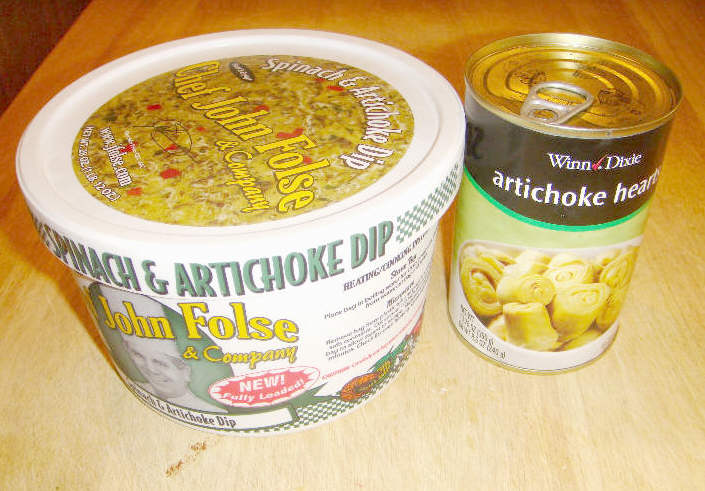
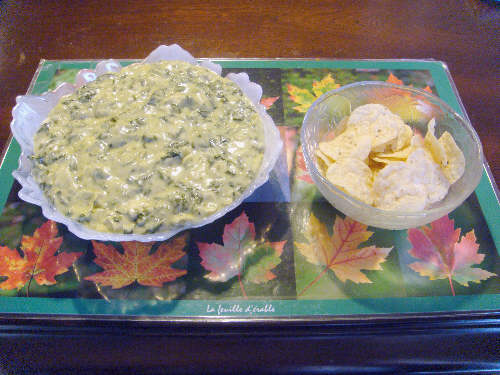 Want something quick and delicious to make for an impromptu drop-in crowd for the Super Bowl? These delicious dip will serve several hungry football fans and can be eaten warm or cold. Just add your favorite dipping chips. Look for the Container of Folse's Spinach and Artichoke dip in the Frozen Food department of supermarket. If you live outside the area where it is sold, you will need to make the entire dip from scratch. This recipe adds some savour and texture by upgrading the amount of artichoke hearts.
Ingredients
One Container of John Folse's Spinach & Artichoke Dip
One can of artichoke hearts
Preparation
Allow the frozen container to defrost in fridge over night. Open can of artichoke hearts and chop into smaller pieces.
Cooking Instructions
Cut slits in the bag and place in microwave oven for about 7 minutes. Dump into a serving container and mix in the chopped up artichoke hearts. Heat in microwave again for about 3 minutes. Can be served immediately.
Serving Suggestion
Place in an open serving dish with your favorite chips alongside and take to TV Room for hungry football fans.
Other options
GO SAINTS ! ! !
== == == == == == == == == == == == == == == == == == == == == ==
6. POETRY by BOBBY from JIR 1985:
= = = = = = = = = = = = = = = = = = = = = =NOTE: This poem was written by Bobby in 1981 and was published by the Journal of Irreproducible Results in 1985.THE POSTMAN KICKED THE DOG
The postman kicked the dog
and how could we discern:the postman from the kick— It All Happened at the Same Time —
the cat from the grin
the dancer from the dance
the system in process from the system in content?
The system, in process, generated the system in content.There is always a delay betweenAre you certain said I
the postman and the kick
the cat and the grin
the dancer and the dance
the territory and the map
the mapping and the territory
the dancing and the dancer
the grinning and the cat
the kicking and the postman
said Werner Heisenberg
No, uncertain said He
You see
it is always necessary to discern:the postman from the grin
the cat from the dance
the dancer from the kick
the poet from the poem
and the poem from the pen.
== == == == == == == == == == == == == == == == == == == == == ==
7. REVIEWS and ARTICLES for February:
= = = = = = = = = = = = = = = = = = = = = =And for my Good Readers, here’s the new reviews and articles for this month. The ARJ2 ones are new additions to the top of A Reader’s Journal, Volume 2, Chronological List, and the ART ones to A Reader’s Treasury. NOTE: these Blurbs are condensations of the Full Reviews sans footnotes and many quoted passages.
1.) ARJ2: Walking His Trail — Signs of God Along the Way by Steve Saint and Ginny Saint
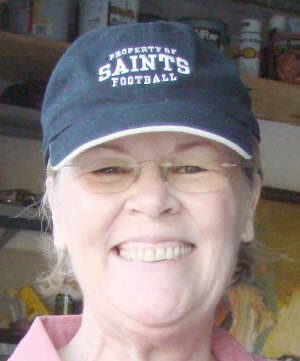
We watched the movie "The End of Spear" in 2006 shortly after it was released and now six years later we were on a Crystal Serenity cruise ship when it was being shown. As we watched, we realized we had seen this movie long before, but this viewing was different — the young nine-year-old boy Stevie portrayed in the movie, whose dad was speared to death by Mincaye, a Waodani tribesman, was going to be lecturing about the movie the next day. This time we found the movie riveting and tears filling our eyes as it came to an end. The next day I was wearing Del’s baseball cap with “Property of SAINTS” on it because our NFL football team was playing a playoff game against Detroit Lions that night. As Steve Saint told the story about his sainted father, Nate Saint, who gave his life to help stop the cycle of violence in the primitive Waodani tribe, I realized that the cap I had on belonged to Steve, and, with Del's permission, I approached Steve after his lecture, took off the cap and gave it to him, saying, "Steve, I think this belongs to you." He gave me a warm embrace of thanks, and donned the hat. Later in the cruise he mentioned losing his favorite cap a day earlier, so he wore the Saints cap the rest of the cruise. On the last day, after watching the third lecture by Steve, Del went up to him and Ginny to thank him for his work, and I asked if I might have some contact information and the only piece of paper he had on him was this book which he autographed to me and Del. We were both walking God's trail and our paths had finally crossed.
This book records key events in Steve and Ginny's lives, how they found each other and how they went back to live with and came to love the people who killed Stevie's dad. Not just the Waodani tribe, but the actual men who did the killing. Steve is now the adopted grandson of Mincaye and they are best friends.
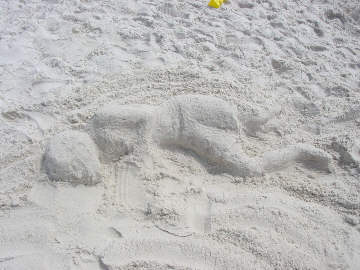
Once in a visit to New York City for interviews and speaking engagements, Mincaye told Steve, "See those trees over there? They're filled with fat squirrels. Let go get us some." The trees were in Central Park and their method of getting squirrels involved two 8' long blowguns with poisoned darts. Steve tried to talk Mincaye out of the hunt, explaining what jail was like, but Mincaye thought jail sounded like fun — keep one's wife away for a while, free food, talking pictures on screen on wall, etc. Then Steve remembered how blasé New Yorkers are, so they donned their brightly colored tribal hats, shouldered their blowguns and began walking across traffic to Central Park. No one even noticed them. "Just two more guys with blowguns." In the park, they shot at several squirrels, hitting none — without being stopped — but when word of a nearby Park Ranger reached them, they decided to go back to their hotel. One guy recognized them from the CNN interview the night before and had walked along into the park with them, taking a home movie on his phone which was shown during Steve's lecture.Ever meet someone who doesn't believe in God? Steve did, a young man Pablo, who challenged Steve to provide proof of God's existence. The finding of a watch in the middle of a forest is a long-used metaphor of proof for intelligent design of the cosmos because it can make us realize that a working watch presumes an intelligent being who designed and built it. Steve however imagined a sand castle on the beach and confronted Pablo with it.
[Page xii, xiii Introduction] "Pablo, let's suppose you are stranded like Robinson Crusoe on a deserted island. Desperate for company, you search the small island repeatedly, looking for another human. Finally, after exhaustively searching the entire island, you resign yourself to the fact that you are totally and completely alone. Then one morning you walk down to the ocean, and there on the beach you find a finely detailed and elaborate sand castle. Now what would you believe? Would you prefer to believe that some rogue wave from the last receding tide created the castle, or would you decide that in spite of your belief to the contrary, there must be other intelligent life on the island?"
Pablo looked as though he felt trapped, but he didn't hesitate long. "I would have to believe that someone else was on the island," he responded. "Waves don't make sand castles; people do." Then with an intense expression that hinted at defiance but spoke clearly of a deep-seated yearning I have often felt myself, he demanded, But where are life's sand castles? Where are the signs of God along the way?"Steve realized that Pablo didn’t want logical proofs of God’s existence, but rather Steve's own stories of God's intervention in people's lives — that people were God's sand castles!
In the parts of books left unread by most people, the Author’s Note, Introduction, Preface, Prologue, etc, are stories of the sand castles that authors found along their way which led them to write the book. In Steve's Introduction we discover the inspiration for the book's subtitle, "Signs of God Along the Way". If you are walking a trail, like skeptical Pablo, and looking for signs of God along the way, this book is a great place to start. If you wonder why bad things happen to good people and think God has senselessly let them die, read how Nate Saint and his friends have helped changed the world for the better as a result of the bad thing which happened to them.
When I listened to Steve lecture, he quoted a passage from the spiritual writer, C. S. Lewis, who began his life like Pablo, a skeptic, found signs of God along the way, and became known famously as "apostle to the skeptics". Death can only be understood meaningfully if it works backwards to create life. That's my summary of Lewis who writes eloquently thus, "There is a magic deeper still which the Witch did not know . . . When a willing victim who had committed no treachery was killed in a traitor's stead . . . Death itself would start working backwards.(1)" I have looked for signs along my way for an insight which came to me decades ago, and Steve and Ginny Saint have given me a book of signs for that insight: There are no innocent victims or meaningless deaths. Rightly understood, the words innocent and meaningless reveal our present lack of knowledge of spiritual realities, up until now.
In the Chapter Miracle Wife Steve relates the story of how he met and came to marry Virginia Lynn Olson, his wife Ginny of thirty-three years now. His plea for a wife and companion was met so amazingly that he finds it hard to explain, and knows it was no coincidence, but rather that Ginny was one of His carefully designed and crafted sand castles.
[page 116] Why God chose to answer my plea for help so wonderfully and explicitly I cannot tell. I have called out for help and direction often. I know He still guides me, but never again have I discovered a sand castle so intricately detailed and custom built on my beach. Mostly I see fainting marking in the sand now and again, but I recognize the origin and know I have company on my island.
I could write a chapter about my Miracle Wife of thirty-three years, Adele Ruth Richards, known to all her friends as simply Del, and, if I did, it would have to begin with the story of writing down my goal to "Fall in love three times before Spring". This unusual plea came about because my wife of five years had decided to stay behind in New England after I had moved back to my hometown of New Orleans at age 36. Unexpectedly I had become a bachelor for the first time in my lifetime, having been married to my high school sweetheart at age 20, then divorced and immediately re-married to my new sweetheart. I was in a new job, in a new city (as an adult), and had to make new friends and learn to date women for the first time. After about six months, I had dated a handful of women, some more than once, and I had become the very model of a bachelor, that is, a man who drives to work from a different direction each morning. But I hadn't met anyone I could say that I loved.
So, one August day, I was writing down my goals as was my habit to do from time to time, and this one goal came off the tip of my pen, much to my own amazement, "To fall in love three times before Spring." I was aghast at the thought and the very impossibility of that prospect overwhelmed me. But a goal is a goal, I thought, and maybe that's what I need. I had really only been in love officially twice before, to my wife at the time, so the idea of it happening again, three times, in such short order was a tall order! So, I put the goals away and was invited to a picnic one afternoon in September and met a dark-haired beauty named Terése. I was smitten. We spent a lot of time together and we were happy, but in about six weeks, we had split and a blonde named Lucy grabbed hold of me and there I was smitten again. We dated, lived together, I met her parents, and at a party around Christmas I met a redhead named Nancy and soon she was riding on the back of motorcycle everywhere with me and I was in love again. I had forgotten about the silly goal by now, even though it seemed to have come true, because what happened next was meeting Del at a mutual friend's house.We hugged as we greeted each other, as thirty-somethings did in the 1970s, and that hug was warm and friendly and open and seemed like it could last forever. Later I would tell people it was "love at first hug". But we were friends first, then lovers, then married, and then lifelong friends. Often, when we are together, it seems like we just met the day before. All the things I wanted in a wife and companion, Del came ready and able to provide. She was my Miracle Wife, a beautiful sand castle of God's on the beach I happened to be walking by. She is the person I tell things to, and who is the first reader and copy-editor of all my writings today. Oh, and by the way, it was Spring when I met Del. I had fallen in love and out of love three times before Spring when Del arrived. Be careful what you wish for, what you pray for, what you set goals for — these ideas of the future may be the very sand castles that God has planned for you.In his Chapter, Business As Un-Usual, Steve writes about May, 1981 when home loans were 15 percent and even people in luxury cars couldn't afford to build or buy homes. On one day as Steve was bemoaning the lack of construction business, he prayed for a signed contract for a house by noon. Thinking it to be unlikely, soon a broken-down car dragging its muffler pulled into his office's parking lot. An old grandmother came inside with her grand-daughter, saying to her in Spanish, "Ask him what kind of houses they build."
Steve answered her in Spanish, easy for Steve who grew up in Ecuador but rather unusual for a blond-haired gringo in Minnesota, "We build any kind of house you want." She wanted a government-subsidized house and Steve never built those because of the red tape and long delays to approval. No chance of getting a signed contract by noon! About 10:30 Steve made the call to FHA about the highly unlikely loan. The woman in the FHA office became excited when Steve explained about the old Spanish lady, and after a flurry of questions, she told Steve to get down to her as quickly as possible because they were due to lose their funding if they didn't get a valid application for their subsidized loans by noon! The grandmother quickly got FHA to add funds for a driveway, brick trim, a garage, and a second bathroom as the FHA clerk pushed the paper through. Steve left from the big hug the grandmother gave him, and, as he drove to his office, he noticed the time was exactly 12:00, noon! Be careful what you wish for. Steve's contracting business became the busiest one in town, so much so, that Rep. Vin Weber was asked to investigate him because his fellow contractors thought surely he was doing illegal things. Steve was cleared of the bogus charges which reflected on the morality of those lodging the charges.Timbuktu — is there any place which more symbolizes the end of the Earth? If you are known in Timbuktu, there would be no place where you were not known. Steve didn't know anyone in Timbuktu when he hopped an airplane ride there, but he soon found his flight back was filled with doctors and he would have to stay. He knew no one, spoke no one's language, and he walked around this dust-laden Saharan desert outpost trying to figure out what to do in the 110 degF heat. He tried to hire a truck and got only the answer, "No road, only sand". Steve prayed, "I'm in trouble here. Please keep me safe and show me a way to get back. Please reveal Yourself and Your love to me the way You did to my father." No answer came, but he followed up on a thought to find a telegraph office. False alarm, only out-going wires and no assurance anyone will receive the wire on the other end. Finally he remembered a story about a famous mosque with a tiny Christian church beside it. He found the little church, but it was vacant, only an ominous sign posted in French, "And by His stripes we are healed." Later a young man named Nouh approached him and led him to a missionary who offered to translate for Steve, who asked Nouh, "How did you come to have faith?" Nouh said as a young boy he stole some carrots from the church's garden and was afraid of being killed as he had been told that white men eat nomadic children. Instead the man gave Nouh some cards with Bible verses on them and said if he learned them, he'd give Nouh a Bic tick-toc (A clicking ballpoint pen). Nouh's life was in danger because he had become a Christian and so the missionary had to find a way to help Nouh survive.
[page 78, 79] "It can't have been easy for you as a teenager to take a stand that made you despised by the whole community," I said. "Where did your courage come from?"
"The missionary couldn't take me in without putting my life in jeopardy. So he gave me some books in French about other Christians who had suffered for their faith. My favorite was about five young men who willingly risked their lives to take God's Good News to Stone Age Indians in the jungles of South America." His eyes widened. "I've lived all my life in the desert. How frightening the jungle must be! The book said these men let themselves be speared to death, even though they had guns and could have killed their attackers!"
The missionary said, "I remember that story. As a matter of fact, one of those men had your last name."
"Yes," I said quietly. "The pilot was my father."
"Your father?" Nouh cried. "The story is true?""Yes," I said, "it's true." The missionary and Nouh and I talked for a long time. When they accompanied me back to the airfield that afternoon, we found that the doctors weren't able to leave Timbuktu after all, and there was room for me on the UNICEF plane.
As Nouh and I hugged each other, it seemed incredible that God loved us so much that He'd arranged for us to walk His trail and meet "at the ends of the earth." Nouh and I had gifts for each other that no one else could give. I gave him the assurance that the story that had given him courage was true. He gave me the assurance that God had used Dad's death for good. Dad, by dying, had helped give Nouh a faith worth dying for. And Nouh, in return, had helped give Dad's faith back to me.Pete was the last of the five men to join Nate Saint's final journey into the rain forest to make friends with the Waodani tribe. Pete had three options, A, B, and C, and either A or B would have kept him alive — yet, he chose to die along with his fellow missionaries. Even the Waodani admitted after the fact their puzzlement, "Why, not shooting us, did they just die? Why did the one who had not been speared just stand there and call to us when he could have fled and lived?" That was Pete, and no one knows why. Steve hints that God's plan involved all five men, without which the story would have been incomplete and not spread as it has to the literal "ends of the Earth."
[page 88, 89] For fifty years, I have unintentionally served as verification that the story of the five Ecuadorean martyrs is true. Total strangers come up to me all the time in church, at camp, even in WalMart, to ask if I am Steve Saint, son of the martyr Nate Saint. This has happened thousands of times — no, it has to be tens of thousands of times by now.
When I acknowledge that I am Nate's son, they invariably describe for me the impact this story has had on their lives. I have been to some pretty unusual places — Haiti, the Dominican Republic, Mexico, Guatemala, Costa Rica, El Salvador, Panama, Belize, Colombia, Ecuador, Peru, Canada, England, France, Belgium, Netherlands, Switzerland, Austria, Germany, Czechoslovakia (before the split), Russia, India, Sri Lanka, Afghanistan, Cuba, Nigeria, Senegal, and even Timbuktu in Mali, West Africa — and everywhere I've gone, people have told me how they have been encouraged to live for their faith by these five men who were willing to die for theirs.
I have never tried to keep track of all the stories that have been relayed to me, but most of them share a common theme: "It was worth it for me; the price you paid is paying dividends in my life and through my life to the lives of others."Steve held the question about Pete's death as an unanswered question for many years and finally settled on this providential explanation: ". . . if any one of the men had lived to tell what had happened, the world's reaction to the story would have probably been very, very different." Different in that Steve would not be interrupted by people all over the world telling him how his father's story changed their life, but these people's lives would not be as full as they are because of Nate, Pete, and the other three men.
[page 89] This story would not have been "this story" if Pete had stayed with Plan A or even Plan B. Even though Plan C ended in his own death, Pete was willing to follow that path because he trusted God's leading completely.
God wrote His story, using the lives of these five men and their families, as a sand castle for people far beyond Waodani territory, beyond Ecuador, and even beyond South America.
Pete changed his plans. I don't think God did. I suspect this was what He had planned all along.In interviewing the five widows for the filming of the movie, Steve had the most difficulty with his mother because she would always start off in answering his questions, “As you know, Steve, . . .” Some other member of the team replaced Steve for that interview. When Steve asked Pete’s wife, Olive, to recall the events, Olive said she dreamed the night before that she saw Pete's lifeless body in the river, still, she did not try to talk Pete out of his trip. The producer of the movie asked another widow, Barbara, about her reaction to the loss of her husband "When you asked God why, what did He tell you?" She paused for a long time before answering, "Well, I guess it just never occurred to me to ask God why." Steve sums up Barbara's response on page 105, "We all knew we had just heard a profound example of faith." When Steve's mother died, the hospice nurse recognized her name and confessed that she and her husband had become missionaries because of what Steve's mom and dad had done with their life. Steve says, "Sand castles are not the cathedrals we build for God but the evidences we see when God personally reaches out to remind us of His existence and His love for us. . . . we can jot the stories down in a journal — whatever it takes to pass them on to the generations that follow us." (Page 113)
Steve's Aunt Rachel was a key person in the process of bringing the Waodani to peace. She was called Star by some and Nemo by others of the natives, and Kimo spoke of her this way, "Teaching us to walk God's trail, Star came." In the filming of an expensive and all-important scene when Rachel's coffin was being nailed shut, the verisimilitude of the entire scene overwhelmed one of the natives, Dyuwi, who unexpectedly and off-script began praying loudly to God. Suddenly the actress who was playing the role of Dayumae started to cry, deep heaving sobs, so moved she was by Dyuwi's spontaneous flow of emotions. The real Dayumae went over and gave the actress a big hug, saying, "That is just how I cried when we really buried Nemo." In the coffin, the woman Sara who was playing Aunt Rachel had also begun to cry and after they quickly pried up the coffin lid, she didn't make a move to get out, she was simply joining in the overflow of emotions which Dyuwi had kindled.
When the script was ready for The End of the Spear Steve had located an original Piper matching his dad's plane in everything but its color and its N-number, the universal aircraft identifier. The minor overhaul of the engine and the re-rounding of the wing tips were done, the color problem was being solved, and now Steve wanted his dad's original N-number. After many calls he discovered it had been re-issued to a flying club and he got the phone number to call the woman in charge.
But he delayed, trying to come up with a script which would convince her, first, to listen to his story, and second, to agree to part with that number. Finally he calls and barely gets his name out, when the woman tells him an incredible story which ends with this revelation, "I thought to myself, I'll bet Steve wants his dad's N-Number. So Lois and I decided to try to find a away to get in touch with you, and here you are calling me instead! You want that N-Number, don't you?"The End of the Spear was a standing room only hit at the United Nations when it was shown. Diplomats who arrived late couldn't get in. This is how a woman, who had just seen the movie, asked to have it shown at the United Nations, "We keep trying to change how people act, but here [in the movie] the change comes about because the people's hearts are changed. That is what we need to do, change people's hearts."
Steve met one man at the UN whose father had also been killed by a man, but that man was in prison. The son of murdered father was hurt deeply and he wanted the killer to be hurt. Unfortunately the man was hurting himself more. As Steve puts it on page 207, "I once heard someone say that hatred is suicide on the installment plan." That son was an example of what hatred does to the hater. When the UN wanted Steve to speak at the reception after the movie showing, he was concerned about upsetting some sensitivities, so he chose to speak as he had heard Mincaye speak of Waengongi, his name for Creator. "Before, no one ever having shown us the Creator's markings, we did not know how to live. Hating and killing, we lived furious and afraid all the time. But then, seeing the Creator's markings, some of us decided to follow the trail He marked with His Son's own blood. That is a very good trail. Now, walking Waengongi's trail, I live happily in peace."
There are many other stories in this amazing book of stories, and the one of how Ginny lost her dearest child, her Stephenie, at a young age to a cerebral aneurysm, is the most poignant and heart-tugging. Ginny says on page 220, "I remembered the verse God had given me during that surgery: "Don't worry about anything; instead, pray about everything." (Philippians 4:6)
People who are looking for signs of God's existence everywhere, hoping to find proof which will overcome their skepticism, will never find what they are looking for because the evidence lies in people themselves! People are the sand castles on the beach of the deserted island of Earth which prove the existence of God, and when we as humans long ago lost our direct sight of spiritual realities, God sent his Son as a sand castle, a unique and loving Sand Castle to remind us that we are not alone on this seemingly materialistic island. This is the theme which Steve evoked in me by his eponymous metaphor of finding a sand castle on a deserted island. If someone can't find the sand sculptures, they are looking for things instead of people, because people are the signs of God along the way.
---------------------------- Footnotes -----------------------------------------
Footnote 1. Quoted on page 198 of this book and originally written as Aslan's words in The Lion, the Witch, and the Wardrobe (New York: Harper Collins, 1950) page 163. Return to text directly before Footnote 1.
~~~~~~~~~~~~~~~~~~~~~~~~~~~~~~~~~~~~~~~~~~~~~~
~^~ For More Information on Steve Saint's work to help Indigenous Peoples everywhere, including Portable Dental Equipment, Medical Work, Eyesight Corrections, and a Flying Car for reaching remote locations, and even more, Visit www.itecusa.org.
Read the Review at:
http://www.doyletics.com/arj/walkingh.htm2.) ARJ2: To Engineer Is Human — The Role of Failure in Successful Design by Henry Petroski
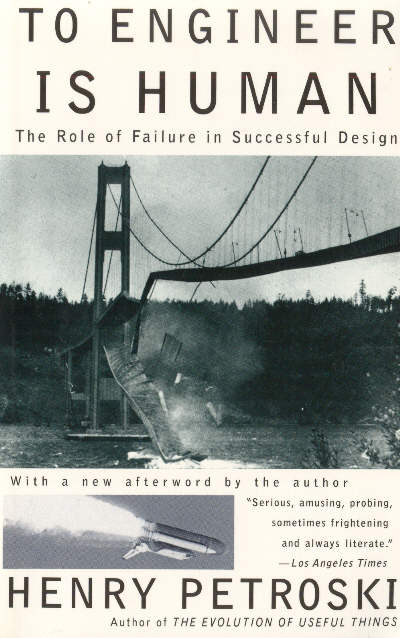
My first experience of Henry Petroski's work came through studying and reviewing his 2006 book, Success Through Failure, of which this current book is a predecessor and an early introduction to his theme. It came to my attention when I was searching for a book in my library and the name Petroski caught my eye on the binding edge. Here was my chance to read a precursor to a recent book and discover the underpinnings of Petroski's latest work. The cover of the book contains the famous photo of the Tacoma Narrows bridge collapse, a clear indication of his theme of investigating engineering failures to uncover their roots and to provide for safer designs for future projects. To engineer is human and to obviate the failure of designs is divine, one might say. Human designs fail because a successful design will challenge new engineers to tackle some improvement upon it and with that improvement comes a concomitant risk. "Make it lighter and less expensive while maintaining its function and safety", the customer might request. Or maybe "Place a walkway in mid-air over the hotel lobby in the Atrium," as Hyatt-Regency requested for a shortcut in its Kansas City location. The key to successful engineering is to "get the customer to relax their specifications", someone once told me. Certainly, telling the customer the walkway would be unsafe was an option, but the engineers chose to meet the customer's specs with a design which was safe, but one which neglected the difficulty of implementing it, and that led to a collapse of the walkway and 114 deaths.
To create a vehicle which never broke down was the subject of a poem by Oliver Wendell Holmes called The One Hoss Shay. By making every part as strong as the other, the designer assured its owner and users that there would be no weak link, that all parts would last equally long. But the logical conclusion to such a design is humorously played out when one day the entire shay falls completely apart. All the parts failed at the same time! In my work as a writer, my keyboards are subjected to constant wear, but this wear has a pattern which becomes obvious over time: the most frequently used letters in the English language tend to have their letters wear off the keys before the other ones.
As a typist who learned to type without looking at the keys, this is a minor inconvenience to me at times. For example, when I have to enter some special codes which require me to look at the keys, I find that the I-O, K-L, M-N keys are blank and I have to consciously choose which of the adjacent keys are the I and O, etc. Samuel Morse designed his Morse code by counting the amount letters in each bin of a manual typesetter's work station, the E being the most frequent was chosen to be a DOT and the T the next most became the DASH. Today he could have looked at a heavily typed upon keyboard to make his code.The Japanese recognized the dilemma posed by differential wear of components in a machine, and I remember hearing that the Japanese, when they performed a repair on a machine, replaced the broken part with a part that was stronger than the original part. I have used that same principle in repairing items around the house. My wife's hot roller hair curlers fit into a tray of metal cylinders which each heated up. One day she called me and said, "It's not working."
I found that the on-off switch was defective, and I searched my box of repair parts and found a sturdy metal toggle switch which I installed in the place of the cheap, mass-produced plastic part which had lasted only a year under normal use. Now, 20 years later my wife was still using those hair curlers when the heating coil broke, and she had to buy another set. If after the switch broke she had bought another set, it might have lasted 2 years and she would have gone through about ten sets of hair curlers! The cheap switches on modern small appliances are often the first parts to break. My one-cup coffee pot that I used for almost twenty years lasted so long because I put it on a power strip to turn it off and on instead using the cheap plastic switch. If you want to extend the life of a device, replace the weakest link with a stronger part or find a way to avoid using it before it breaks.Engineers are always trying new designs, and new designs are fraught with potential failures. No engineer can test a device for ten years to ensure it will last ten years. Ultimately the customer is the test bed for products engineered for consumers. We pay engineers to allow us to test their products. Recent experience of drivers of Toyotas (runaway accelerators) and GM's Volts (batteries catching fire) evince this modus operandi. I think of this process as the pioneers get the arrows and have learned to avoid the latest and greatest technology until other customers have tested it for me.
[page 62, 63] No one wants to learn by mistakes, but we cannot learn enough from successes to go beyond the state of the art. Contrary to their popular characterization as intellectual conservatives, engineers are really among the avant-garde. They are constantly seeking to employ new concepts to reduce the weight and thus the cost of their structures, and they are constantly striving to do more with less so the resulting structure represents an efficient use of materials. The engineer always believes he is trying something without error, but the truth of the matter is that each new structure can be a new trial. In the meantime the layman, whose spokesman is often the poet or the writer, can be threatened by both the failures and the successes. Such is the nature not only of science and engineering, but of all human endeavors.
Engineers who strive to design based on success also face two big problems which are not obvious, problems often uncovered only after a failure. The first is that the apparently successful structure could be in the process of failing without anyone knowing. The second is that the re-design to make the new bridge lighter and cheaper may cause the modified structure to fail.
[page 73] Thus a bridge that has stood for decades but has developed innocuous cracks in certain spots may serve as the basis for an improved design of a bridge of approximately the same dimensions and traffic requirements. Or an existing design that has suffered no apparent distress after years or decades of service may lead the engineer to look for ways to make it lighter and thus less expensive to build, for the trouble-free prototype appears to be over-designed.
Under the topic of design as revision, Petroski waxes eloquent when comparing engineering design to writing. Both fields are faced with the contradictory aims of leading people down a new road but following familiar landmarks all the way, the dilemma of producing the original using the familiar.
[page 75] There is a familiar image of the writer staring at a blank sheet of paper in his typewriter beside a wastebasket overflowing with crumpled false starts at his story. This image is true figuratively if not literally, and it represents the frustrations of the creative process in engineering as well as in art. The archetypal writer may be thought to be trying to put together a new arrangement of words to achieve a certain end . . . The writer wants the words to take the reader from here to there in a way that is both original and familiar so that the reader may be able to picture in his own mind the scenes and the action of the story or the examples and arguments of the essay. The crumpled pages in the wastebasket and on the floor represent attempts that either did not work or worked in a way unsatisfying to the writer's artistic or commercial sense. Sometimes the discarded attempts represent single sentences, sometimes whole chapters or even whole books.
Why the writer discards this and keeps that can often be attributed to his explicit or implicit judgment of what works and what does not. Judging what works is always trickier than what does not, and very often the writer fools himself into thinking this or that is brilliant because he does not subject it to objective criticism. Thus manuscripts full of flaws can be thought by their authors to be masterpieces.Engineering structures may be full of flaws, but it is the job of good engineering to flush out and remove the flaws during design and to provide for the structure to stand if any one piece were to fail. No one ever imagined that a 100-story skyscraper could collapse to the ground, much less two standing close by, before September 11, 2001. The intense heat of a jumbo airliner's full tank of jet fuel catching fire in an upper story was never calculated as a risk. The failure of one floor's support beams due to that heat caused the entire structure to collapse to the ground. Skyscrapers will be designed differently as a result of that dual catastrophe.
Paradoxically, designing from successes can also fail.
[page 98] While engineers can learn from structural mistakes what not to do, they do not necessarily learn from successes how to do anything but repeat the success without change. And even that can be fraught with danger, for the combination of good luck that might find one bridge built of flawless steel, well-maintained, and never overloaded could be absent in another bridge of identical design but made of inferior steel, poorly maintained or even neglected, and constantly overloaded. Thus each new engineering project, no matter how similar it might be to a past one, can be a potential failure.
Relax, however, because there is a margin of error which is built in to take care of the unk-unk's, the buzzword for the unknown-unknowns. This called the factor of safety, focusing on the positive aspects of the problem, safety instead of error.
[page 98] No one can live under conditions of such capriciousness, and the anxiety level of engineers would be high indeed if there were not rational means of dealing with all the uncertainties of design and construction. One of the most comforting of means, employed in virtually all engineering designs, has been the factor of safety.
The factor of safety is a number that has often been referred to as a "factor of ignorance," for its function is to provide a margin of error that allows for a considerable number of corollaries to Murphy's Law to compound without threatening the success of an engineering endeavor. Factors of safety are intended to allow for the bridge built of the weakest imaginable batch of steel to stand up under the heaviest imaginable truck going over the largest imaginable pothole and bouncing across the roadway in a storm.But some well-meaning engineers can come, over time, to see that factor of safety as unnecessarily large and they decide to pare it down as a means of saving money and improving the design. Therein lies another danger which comes from a step into the unknown.
[page 101] Confidence mounts among designers that there is no need for such a high factor of ignorance in structures they feel they know so well, and a consensus develops among designers and code writers that the factor of safety for similar designs should in the future be lowered. The dynamics of raising the factor of safety in the wake of accidents and lowering it in the absence of accidents clearly can lead to cyclic occurrences of structural failures. Indeed, such a cyclic behavior in the development of suspension bridges was noted following the failure of the Tacoma Narrows Bridge.
In his chapter "Interlude: The Success Story of the Crystal Palace" Petroski goes into great detail about the building of the mid-19th Century exhibition hall in London's Hyde Park. Skeptics railed against the project, saying it would be unsafe, couldn't be built in time, would not survive a storm, etc. Joseph Paxton designed the Palace based on the greenhouse he had built earlier, but building the huge Exhibition required innovation techniques for assembling and constructing buildings. His completed project was so successful that its methods were adopted by large exhibition halls and led to the construction techniques used today in modern iron and glass skyscrapers. It was the "first building constructed using prefabricated, standardized units that were shipped to the construction site for rapid assembly." (Page 151)
[page 149] Yet, although the true skyscraper did not really come into its own until the twentieth century, the Crystal Palace prefigured it in many important ways. The light, modular construction ingeniously stiffened against the wind is the essence of modern tall buildings. And the innovative means by which the walls of the Crystal Palace hung like curtains from discrete fastenings, rather than functioning as integral load-bearing parts of the structure, is the principle behind the so-called curtain wall of many modern facades.
Petroski takes up the problem with the de Havilland Comet 4 airplane which began to have unexplained crashes, seemingly falling apart in mid-air. Finally submerging a complete aircraft underwater and pumping air into it, the engineers began to simulate the compression and decompression of the aircraft over thousands of flights and the aircraft literally explode during one of the compressions. The trouble was then discovered to be associated with stresses on rivet holes near the window openings in the fuselage. The problem was fixed and the Comet 4 began to fly once more.
This aircraft engineering incident was prefigured by a novel written by Nevil Shute (author of "On the Beach") in his novel, "No Highway". By coincidence my wife and I had watched a movie of this novel named "No Highway in the Sky" just before I read about the Comet. An engineer named Theodore Honey was doing some structural analysis and the theoretical calculations of his equations showed that the Reindeer aircraft of his own company would lose a tail section after 1431 hours of flying stress and vibration. He had acquired a full-sized Reindeer for his laboratory and had devised hydraulic arms to create those flying stresses. Before his simulation had run up to the full 1400 hrs, a Reindeer crashed off Nova Scotia and he was quickly dispatched to the site. Unbeknownst to him at takeoff he was flying in a Reindeer which would exceed the 1400 hrs before they reached Nova Scotia and would apparently take Honey (Jimmy Stewart) and a famous actress (Marlene Dietrich) and all the passengers and crew to their deaths in the icy waters of the North Atlantic. Here's the climax of the story.[page 182] But the technocrats do not accept his theoretical calculations as relevant to the practical matter of real airplanes, even though fatigue problems accompanied the introduction of other new forms of transportation technology, such as the railroads. Thus Honey sets out to collect evidence from a Reindeer that had crashed in Canada after about the same number of flying hours as predicted by his calculations. That crash was attributed to simple pilot error, and hence an exhaustive investigation of the wreckage was not considered necessary to provide any essential evidence to the contrary. So Honey flies to Canada himself to collect the evidence of a fatigue failure that he is sure is lying there in the snow. While en route, Honey discovers that the plane he is traveling on is a Reindeer with about fourteen hundred hours of flying time, and thus he fears that its own tail plane will fall off at any moment due to metal fatigue. After his frustrated attempts to convince the crew to keep the plane on the ground at Gander, a refueling stop, until it can be properly inspected for dangerously large fatigue cracks, Honey keeps the Reindeer from taking off by sabotaging the landing gear. His uncommonly violent act convinces his superior to aid Honey in continuing his quest. When the wreckage in Canada is finally reached, the telltale signs of fatigue vindicate Theodore Honey, and a dangerous fatigue crack is also found in the grounded Reindeer at Gander.
Here we have a case of fiction preceding fact, so closely did the case histories of the Comet and the Reindeer parallel each other. Six years after the novel and three years after the movie, the Comet model suffered two fatal crashes due to metal fatigue. Thankfully, Shute was more prescient in that novel than in his doomsday novel "On the Beach".
When I entered college destined for a degree in physics I acquired my first slide rule. It was a small slide rule compared to the monstrosities which dangled from the side of engineers. I needed simple calculations in my endeavor to learn how the world worked and engineers needed complicated log-log and other scales to figure out how to make the technology and structures of the world work. I learned about significant digits, how slide rules can provide slightly over 3 digits of significant information, and how to remove excess and meaningless digits from my calculation results. When I worked on the early process computers in the 1960s, I found that significant digits were important again, this time due to the limitations of storing a floating point number in the computers' 24-bit word. The exponent was stored in 8 bits and the mantissa in 16 bits, giving 2 to 2 to the 8th power for the exponent, or 10 to the 8th power. More than enough exponent for chemical plant calculations. The mantissa, however, could only approximate 4.5 significant digits (2 to 16th power is 65,536, which provides 4 full digits, but not quite 5). That was better than the best slide rules could do at the time and engineers never complained about their calculations, taking the 4.5 digits as the best they could depend upon.
Later I worked in a mini-computer factory in 1970 and the eight binary digits of the exponent were treated as exponents of hexadecimal or base-16 digits which gave an exponent of astronomically large size, 16 to the 256th power or about 10 to the 306th power, an enormously larger exponent, using the same eight bits! The mantissa was also treated as hexadecimal digits and we never bothered any more with significant digits, especially with the availability of double-sized floating numbers which were optional for applications requiring extraordinary accuracy. If you weren't sure of how much accuracy you needed, you used double-floating point calculations.Today engineers have switched to hand-held calculators and PCs and most have never heard of significant digits. But for those of you who haven't, try this simple test which will only take seconds on your calculator: take a simple calculator and enter 2, hit the X (times) button, the = (Equals) button. That amounts to successive doubling or squaring of the result. Then hit the Square Root button the same number of times and you should get 2 again, right? Right, except if you exceed the significant digits of the machine! Then you will not get 2 exactly but only an approximation of 2, maybe 1.9999999995 if your machine has ten significant digits. My TI-1795 antique twentieth century calculator gives me an error if I try to square 65,536 because that exceeds the display width of eight digits which is likely coordinated with the number of significant digits the machine can contain. Machines with floating point capability will allow you go higher and when you take successive square roots will give you some approximation of 2, like 1.9999999995 due to exceeding the significant digits of the machine. In spreadsheets the number of significant digits is disguised because you decide on the size of digits to display, but a calculation like the above will reveal to you the actual significant digits.
Why bother with all this? Because if you pretend to have more significant digits than your computing device provides, your detailed engineering calculations may go askew without your knowing it, and the structure you designed may fall into ruin through the failure of some inadvertently under-designed part. With the loss of slide rules, we have lost the reason to train engineers about significant digits. We have lost the significance of significant digits!
[page 193] Engineering faculty members, like just about everyone else, got so distracted by the new electronic technology during the 1970s that more substantial issues than price, convenience, and speed of computation did not come to the fore. The vast majority of faculty members did not ask where all those digits the calculators could display were going to come from or go to; they did not ask if the students were going to continue to appreciate the approximate nature of engineering answers, and they did not ask whether students would lose their feel for the decimal point if the calculator handled it all the time. Now, a decade after the calculator displaced the slide rule, we are beginning to ask these questions, but we are asking them not about the calculator but about the personal computer.
And the reason these questions are being asked is that the assimilation of the calculator and the computer is virtually complete with the newer generations of engineers now leaving school, and the bad effects are beginning to surface. Some structural failures have been attributed to the use and misuse of the computer, and not only by recent graduates, and there is a real concern that its growing power and use will lead to other failures.How quickly did slide rules disappear from shelves of bookstores after calculators became popular? The company Keuffel & Esser should know as they were the primary manufacturer of slide rules, especially the complicated engineering pendants in their tooled leather sheaths. But when the company paid for a study of the future: they completely missed the abrupt disappearance of their own product! Engineering teaching and practice were changing under their K&E's feet and they never looked down.
[191] But it was not then widely known, and as late 1967 as Keuffel & Esser commissioned a study of the future that resulted in predictions of domed cities and three-dimensional television in the year 2067 — but did not predict the demise of the slide rule within five years.
During the time of slide rules, structures were often over-designed with large factors of safety. Engineers avoided complex structures because the calculations were so time-consuming and expensive. With complex computer modeling, these complicated structures can be built and their designs optimized, but that comes with a cost. The cost can be predicted if you know what I call, Matherne's Fundamental Theorem : With every advantage, there is an associated, and not obvious, disadvantage. The not-obvious disadvantage of the optimized design is clearly the reduction of the factor of safety — the margin of error becomes smaller and engineers may not be noticing the number of significant digits in their calculations and computer modeling programs. Disadvantage for the engineer translates into premature structural failure of a design which had passed all inspections, such as the Tacoma Narrows Bridge, the Hyatt Regency Skyway, and the DC-10's pylon flanges.
In this next passage, Petroski shows off his sense of humor several times as he makes important observations for the engineers faced with newer and more powerful computers every day.
[page 195] The electronic brain is sometimes promoted from computer or clerk at least to assistant engineer in the design office. Computer-aided design (known by its curiously uncomplimentary acronym CAD) is touted by many a computer manufacturer and many a computer scientist-engineer as the way of the future.
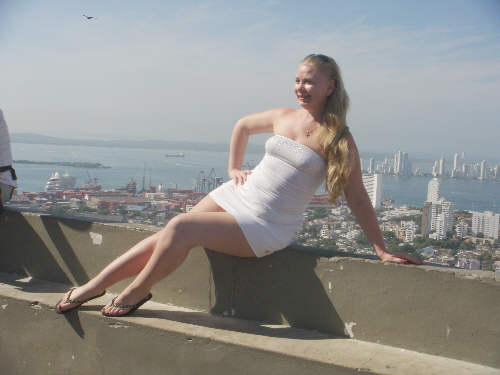 But thus far the computer has been as much an agent of unsafe design as it has been a super brain that can tackle problems heretofore too complicated for the pencil-and-paper calculations of a human engineer. The illusion of its power over complexity has led to more and more of a dependence on the computer to solve problems eschewed by engineers with a more realistic sense of their own limitations than the computer can have of its own.
Should we design more and more complex structures, given the plethora of new design aids engineers have at their disposal. Yes, but there is a serious caveat, as serious as the one Daedalus gave his son Icarus, "Don't fly too close to the Sun." Engineers should keep this epigram posted on their desktops. Engineers in early days had a feel for the structures they designed, they could walk around it during its construction and that gave them a close personal experience which one cannot receive from a computer printout or analysis of a proposed structure.
[page 200, 201] And as more complex structures are designed because it is believed that the computer can do what man cannot, then there is indeed an increased likelihood that structures will fail, for the further we stray from experience the less likely we are to think of all the right questions.
Petroski says that, "More than ever before, the challenge to the profession and to educators is to develop designers who will be able to stand up to and reject or modify the results of a computer aided analysis and design." Educators must ensure that their charges learn this process well enough to build structures which will endure for the lifetimes of use they predict. And they must teach new engineers to understand the implications of the paradox of design he outlines below.
[page 163] The paradox of engineering design is that successful structural concepts devolve into failures, while the colossal failures contribute to the evolution of innovative and inspiring structures.
When I chanced upon the idea of how dolphins and other cetaceans communicate with each other, I began a search through the literature. My first stop was with John Lilly, and I wrote about my idea in the review I did of his book, Lilly on Dolphins. Through my research, I envisioned a method of two-way communication with dolphins based on the way I understand them speaking and hearing through the receiving and transmitting of moving pictures. What Lilly and his crew attempted was to my mind as silly as trying to interpret television images dolphins were emitting using a radio receiver to change them into words! To communicate my vision for the first inter-species communication, I decided against a scientific treatise, and chose instead creative writing, a novel. The Spizznet File contains my expounding of the engineering design required for communicating with dolphins, and, in Petroski's book, I found an author recommending such an approach to bring an innovative idea to the technical community.
[page 21] No individual's list of the causes of failures or choices of case studies or of categories in which to put them or of lessons to be drawn from them is likely to satisfy everyone, and hence all such attempts are likely to be doomed to failure themselves. However, there is another, technologically unorthodox method of expounding on engineering design and structural failure that has the advantage of being at the same time less precise and more thought provoking. That is the method of creative writing, in which the plot of a novel or a narrative poem is constructed around a technical idea. Superficially the story can be entertaining while its message or moral can have profound implications. Furthermore, since fiction and poetry are open to interpretation, each reader can bring his own experiences and take away his own wisdom. And if the technological ideas are correct and consistent, the technical community will sit up and read.As long-standing designs are taken as a sign of success, engineers modify them, and the previous path that led to "success ultimately leads to failure: aesthetic failure, functional failure, and structural failure. The first can take away the zest for life, the second the quality of life, and the third life itself." (Page 222) I can think of no better way of ending this review than the way Petroski did his book, with a quotation by George Santayana, "We must welcome the future, remembering that soon it will be the past; and we must respect the past, knowing that once it was all that was humanly possible."
Read the Review at:
http://www.doyletics.com/arj/enghuman.htm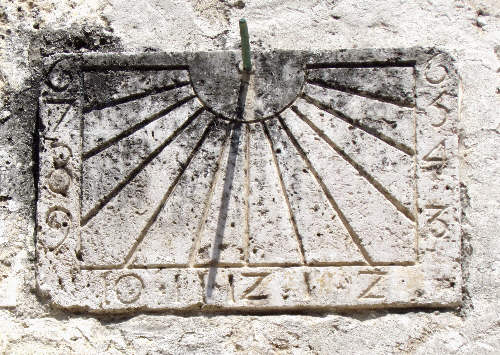
= == == == == == == == == == ==
I hear often from my Good Readers that they have bought books after reading my book reviews. Keep reading, folks! As I like to remind you, to obtain more information on what's in these books, buy and read the books — for less information, read the reviews.
== == == == == == == == == == == == == == == == == == == == ==
8. COMMENTARY:
= = = = = = = = = = = = = = = = = = = = = =In this section I like to comment on events in the world, in my life, and in my readings which have come up during the month. These are things I might have shared with you in person, if we had had the opportunity to converse during the month. If we did, then you may recognize my words. If I say some things here which upset you, rest assured that you may skip over these for the very reason that I would likely have not brought up the subject to spoil our time together in person.1. Padre Filius Discovers a New Bowl Game:
Padre Filius, the cartoon character created by your intrepid editor and would-be cartoonist, will appear from time to time in this Section of the Digest to share with us some amusing or enlightening aspect of the world he observes during his peregrinations. The month of December was filled with such ridiculous Bowl Games as the Insight Bowl, the Meineke Car Care Bowl, and the Fight Hunger Bowl that it's only a matter of time until we see such illuminary names as the Garbage Bowl, the Pinata Bowl, the Ten-Pins Bowl, the Rock-n-Bowl, and this one which the good Padre spied on a TV screen downtown.
This month the good Padre watches a Brand-New College Post-Season Bowl Game.
2. Comments from Readers:
- EMAIL from Charles Matherne:
Bobby,
Thank you for the January Honored Reader distinction.
A chance meeting at a funeral has opened up a chapter of my father's life I knew nothing about and for that I thank you.
Will continue to read with pleasure and interest.Happy New Year to you and your family
Charles Anthony Matherne- EMAIL from John Harris Beck in Michigan:
Dear Bobby, For some time I've wanted to point more people to your wonderful reviews — for which, by the way, thank you! Steiner and others, of course. I'm finally getting up to speed on our website www.anthroposophy.org and its "Articles" section. What a great many sites are doing now, apparently also without asking, is to pick up articles from elsewhere, give a few sentences,and link to the full article. Would you be comfortable if we started doing that with some of your postings? I think it's almost pure promotion for what you're posting, but I'd just be more comfortable having asked.
All the best to you,
John Beck~~~~~~~~~~~ REPLY ~~~~~~~~~~~~
Dear John,
You were just another name in my subscription list, up until now! Thanks for the words of praise and acknowledgment, they are much appreciated.To answer your question: YES. I would be delighted for you to quote pieces from my reviews/articles and provide links.
I read through the issue of Evolving News and was impressed by its beauty, content, and magazine format. I was amazed at how the webpages open like real magazine pages.
Warm regards,
BobbyEMAIL from son Rob and grandson Walden
Subject: flying videos from Walden's visit
Date: Sun, 29 Jan 2012 19:05:40 -0800Walden was in Sausalito, and I took a three day weekend for building and flying... some highlights below
Another Walden build, mini jet, flying slow and solid
Flying over the big sailboats, landing on the beach, getting close to a palm tree!
Bobby Note: Great views of Sausalito, California from the air!
3. Poem from Freedom on the Half Shell:
"Freedom on Half Shell"
 And now the eponymous poem from Freedom on the Half Shell:The oyster never leaves his shell,
And does, therein, exceeding well;
He does not have to sweat and brood
To know the joys of oysterhood;
He deems the treasured pearl a fault,
And takes his world with ample salt.
Samuel Hoffenstein from
The Complete Poetry of Samuel HoffensteinSamuel Hoffenstein said it for me in his poem written in the 1930s. As you enter this book of poems before you, keep your salt shaker handy. "Taking something with a grain of salt" is an old fashioned idiom for "not believing everything you hear." In the realm of freedom with its polar opposite of coercion, one should take things with "ample salt" as Sam suggests in his poem.
In the D. C. Mole Station, the Plantation Master's home on the hill, as I call Washington, D. C. in some of the included poems, one hears a lot about freedom and hardly anything about coercion. Remove the "salt" and you find in reality the exact opposite ratios being placed into practice: a lot of coercion is promulgated into law and the last bastion of freedom, the Bill of Rights, is being undermined, saboteged, and extirpated, clause by clause, with each new law passed by the Supreme Court in its finite wisdom. (Doesn't the Constitution charge them with interpreting the Constitution, not modifying it for the sake of some fashionable cause? Doesn't anybody keep track of these things?)
How can freedom ever prove itself if it is treated as a fault, an irritant, and removed by the Plantation Master before it can improve into a pearl?
Please pass the salt and let's open a few oysters, whatdya say?
Freedom on Half Shell
In South Louisiana
We eat our oysters raw
Using the half shell as a spoon.We take our freedom
In the open air
And consider it a boon.The oyster shell is dirty
and clamped shut so tight
It takes a lot of force and skill
to open up the shell just right.The oyster is opened live
it struggles against the knife
But when its muscle's severed
it gives up its gentle life.Freed by coercion of its spirit
the oyster's body lies
A delicacy to be consumed
by the scion of the skies.Oysters all we human beings
confront the coercive will
That would dispatch our spirit
leaving US freedom on the half shell.
4. BICYCLE RIDINGThis morning listening to Prof. Daniel Robinson, I realized that learning to ride a bicycle is a bootstrap process. One must already be riding a bike in order to ride one! If not, the bike will topple over, right? What keeps the bike in balance is its rolling, so it must start rolling before you can get enough balance to ride the bike. So something from outside the system of bike and rider must act as the bootstrap: the hands of one’s father pushing one along, a push of a stationery bike leaning against a porch by its new rider, e.g. Once we have grown comfortable with riding, we simply push ourselves off to begin riding as if it were natural, but watch beginning riders and you will see the bootstrap process at work. The bootstrap process is the way one overcomes the Bootstrap Paradox, namely, that you need to do something that must already have been done but you can use some process as you wish. True for bike riding and computers and whenever one learns something new: It helps to know all about it before you start! “Knowing-all-about-it is the bootstrap necessary to begin anything new.” In the world of the Waodani tribe (discussed in my Walking His Trail review), the bootstrap was learning to forgive and live in peace. Five missionary men gave their lives to demonstrate this to do the Waodani. These men provided the bootstrap from the outside which the Waodani needed to learn this lesson. Christ Jesus gave his life for humanity for a similar reason.
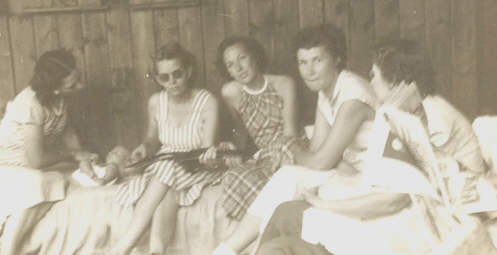
Myopia or Nearsightness is commonly corrected by negative-Diopter lenses (shown by -N D on prescriptions, e.g., -2.5 D). For simplicity, call these minus lenses. Farsightedness is usually corrected by positive-Diopter lenses, e.g. +2.0 D, and these are usually called reading glasses if you wish to buy them in Drugstores. This tutorial may help you if you were prescribed eyeglasses for nearsightedness at age 12 or higher.When you are fitted with minus lenses, they bring distant objects to the spot where you can see objects clearly without minus lenses. Your eye muscles must scrunch up to see close, therefore your eyeballs are compressed and stress is placed on your body as well causing migraines and various aches and muscle pains.
When you wear plus lenses, they move near objects to the distance where you can see them clearly. Your eye muscles are relaxed and no stress is put on your eyeballs and the rest of your body.
With minus lenses, your eye muscles exert a strong pressure on your eyeballs. This pressure can lead to macular degeneration and other associated eye problems which keep O. D.'s busy, like astigmatism, cylinder corrections, retinal detachment, migraines, and many other physical problems created by the eyes being held in the tight grip called an accommodation spasm.
With plus lenses, your eye muscles are relaxed when you are reading because the text appears at the distance of the horizon. When you remove these glasses to look at the distance, your eye muscles stay relaxed. By using plus lenses (reading glasses) you can avoid the many problems associated with minus lenses. Simply begin to wear reading glasses for all close work, and soon you can throw away your minus lenses and enjoy a lifetime free of the most common eye problems.
NOTE: This wearing of plus lenses by myopics is counter-intuitive, so you may be wondering, as I did: "Why should I wear glasses to do the one thing I can do well: read small text and do close work without glasses?" The answer is simply: your eyes will last longer and your health will be better. It's your life and your choice.
== == == == == == == == == == == == == == == == == == == == ==
9. CLOSING NOTES:
= = = = = = = = = = = = = = = = = = = = = =Thanks to all of you Good Readers for providing the Chemistry which has made this site a Glowing Success. — Especially those of you who have graciously allowed us to reprint your emails and show photos of you and by you on this website — you're looking good! As of June 1, 2019, it enters its 20th year of publication. The DIGESTWORLD Issues and the rest of the doyletics website pages have received over 21.6 MILLION VISITORS ! ! !
We have received over ONE MILLION VISITORS per Year to the Doyletics Website since its inception June 1, 2000, over twenty years ago. Almost 2 million in the past 12 months. We are currently averaging about 150,000 visitors a month. A Visitor is defined as a Reader who is new or returns after 20 minutes or more has passed. The average is about one visitor for every 10 Hits.
IMPORTANT NOTES about DIGESTWORLDtm Our DIGESTWORLD came into existence years before Facebook and all the other social media which interrupt people's schedules many times a day. All our photos, reviews, cartoons, stories, etc, come to you via a link inside of one short email Reminder at the beginning of each month. We hope you appreciate how we let YOU choose when to enjoy our DIGESTWORLD Issues. To Get a Monthly Reminder, Click Here .
We especially want to thank you, our Good Readers, in advance, for helping our readership to grow. NOTE our name is now: DIGESTWORLD. Continue to send comments to Bobby and please do create links to DIGESTWORLD issues and Reviews on LinkedIn, on your Facebook page, and on other Social Media. When you copy any portion of a webpage or review, please include this text: "Copyright 2018 by Bobby Matherne".
Email your friends about the reviews, the handy doyletics Speed Trace, the Household Hints, the cartoons, the Cajun jokes, the recipes, the poems, and the photos in all the DIGESTWORLD Issues archived on our website. Urge them to subscribe to the DIGESTWORLD Reminder so they won't miss a single issue!
The Subscription Process SIMPLE: no Reply Confirmation is required. An email to the Editor with your First and Last names is all that's required. There is never a charge for viewing any page on our website; nor for any of the guidance we offer to people using the FIRST AID KIT or asking for help with doyletics in any other areas.
For those who are able to contribute to the site we offer a year's subscription for receiving the DIGESTWORLD Monthly Reminders for $50.~~ NOTE: DIGESTWORLD is a Trademark of 21st Century Education, Inc. ~~ The cost of keeping this website on-line with its 300 Gbytes of bandwidth a month is about $50 a month. Thank you, our Good Readers, for continuing to patronize our advertisers when they provide products and services you are seeking as you visit any of our web pages. Remember the ads are dynamically displayed and every time you read even the same page a second time, you may find new products and services displayed for your review. Our reviews, digests, tidbits, etc, all our webpages act as Google magnets to bring folks to the website to learn about doyletics and frequent our advertisers, so they support one another in effect.
We wish to thank all Good Readers who have made a contribution to the doyletics.com website! Special thanks go to Chris and Carla Bryant in Corpus Christi and Gary Lee-Nova in Canada!We welcome your contributions to the support of the website and research into the science of doyletics. To obtain our street address, email Bobby at the address found on this page: http://www.doyletics.com/bobby.htm and we will send it to you. Every $50 subscription helps toward keeping this website on-line for another month. If you can't send money, at least show your support by sharing your favorite Issue of DIGESTWORLD and Reviews with a friend.
You can read a description of how to do a Speed Trace (either in English or Spanish):Learn to Do a Speed Trace Here

Or Watch Bobby extemporaneously explain How to Do a Speed Trace on Video:
To make a connection to the Doyletics website from your own website, here's what to do. You may wish to use the first set of code below to link to the site which includes a graphic photo, or to use the second set of code for a text-only link. Immediately below is how the graphic link will look on your website. Just place this .html in an appropriate place on your website.
<CENTER> < — with graphics link — >
<A HREF="http://www.doyletics.com/index.htm">Learn to Do a Speed Trace Here<BR>
<IMG SRC="http://www.doyletics.com/doylepb.gif" width="309" height="102" border="2" TITLE="Learn to Remove Doyles — all those Unwanted Physical Body states of fear, depression, migraine, etc." ALIGN=middle><A/></CENTER>
<CENTER> < — text only link — >
<A HREF="http://www.doyletics.com/introduc.htm">Learn to Do the Speed Trace at doyletics.com <A/>
</CENTER>Check out the new additions to the Famous and Interesting Quotations at:
http://www.doyletics.com/quotes.htm== == == == == == == == == == ==
My reviews are not intended to replace the purchasing and reading of the reviewed books, but rather to supplant a previous reading or to spur a new reading of your own copy. What I endeavor to do in most of my reviews is to impart a sufficient amount of information to get the reader comfortable with the book so that they will want to read it for themselves. My Rudolf Steiner reviews are more detailed and my intention is to bring his work to a new century of readers by converting his amazing insights into modern language and concepts.
== == == == == == == == == == ==A Short Email Reminder for the Newest DIGESTWORLD Issue is mailed monthly to:
Friends and associates
People who have expressed interest in Bobby's writing.
People who have Asked to Receive the DIGESTWORLD Reminder.Please Don't Bug Us 
Nothing BUGS US more than losing Hale-and-Hearty, Ready-to-Read Good Friends from the DIGESTWORLD Reminder List.
So we've made it easy for Good Readers who have changed their Email addresses and Friends who would like to begin receiving the DIGESTWORLD Reminder at the first of each Month:
IT'S EASY to RE-SUBSCRIBE or SUBSCRIBE:
CLICK HERE!
As of August, 2011 we have begun using a Contact Manager with an Email Merge feature which allows us to send personalized Emails to everyone in our Contact List. You can receive the colorful Email containing the DIGESTWORLD Reminder beginning with "Dear [Your First Name]". It is important that we have your First Name, so if the name you are addressed by in your Reminder is not your first name, please notify us of the name you wish us to use. For convenience you can send a quick email to give us your name by Clicking Here. To Contact Bobby, his Email address is visible on this page.
NOTE: As of 2018 the Topica.com List messages are NO LONGER READABLE!
Please do your part by letting us know of any email address change so that you may continue receiving the DIGESTWORLD Reminders. Most of our Readers come from folks who don't get these Reminders, but we offer the DIGESTWORLD Reminder as a service to our regular Good Readers. To send us your new email address, CLICK HERE! .
If you discovered this page by a Google Search and want to SUBSCRIBE NOW
If you have enjoyed a particular issue, let us know, especially around the first of each month when those "lost soul" messages are bugging us, Send us a quick email by Clicking Here!
Simply Click the Link at right to send an Email Request: SUBSCRIBEIf you have a friend or two that you think would enjoy reading the DIGESTWORLD, suggest they view the current DIGESTWORLD Issue and perhaps they'll decide to Subscribe.To unsubscribe from the DIGESTWORLD Reminder List:
Click Link at right to send a Blank email to: UNSUBSCRIBEIf the above links which provide canned emails don't work on your system, you can send a Subscribe/Unsubscribe request to the address found on this page: http://www.doyletics.com/bobby.htm Please include your first and last name when Subscribing.
== == == == == == == == == == == == == == == == == == == == ==
10. GRATITUDE - in Three Easy Steps:
= = = = = = = = = = = = = = = = = = = = = =
Maintaining a website requires time and money, and apart from sending a donation to the Doyletics Foundation, there are several ways you can show your gratitude and support our efforts to keep doyletics.com on-line.
One would be for you to buy a copy of my Dolphin Novel, The SPIZZNET File. Books May be ordered in hardback or paperback form from Xlbiris the Publisher here:
online: http://www.xlibris.com/TheSPIZZNETFILE.html
email: orders@xlibris.com
The best source at the best price is to order your copies on-line is from the publisher Random House/Xlibris's website above.
Two would be for you to use the Google Search Engine for your web searches or to find an item on doyletics.com website. New reviews will have a place to do a Google Search at the top and the bottom of the reviews. Just enter a search phrase in the box below to do a Search. Note you can check whether to Search just this site or all websites.
Three would be for you to let us know you like us by Subscribing to our monthly Reminder. One short email each month with a link to our Latest DIGESTWORLD Issue will keep you apprised of our latest reviews, photography, poetry, Cajun stories, recipes, Movie Blurbs, Travels, and even more! Simply Click Here: Subscribe Me!
Thank you in advance!
~~~~~~~~~~~~~~~~~~~~~~~~~~~^~~~~~~~~~~~~~~~~~~~~~~~~~~~
Like Us? Subscribe to Receive a Monthly Email
Reminder of New Reviews & New DIGESTWORLD Issues — CLICK
~^~== == == == == == == == == == == == == == == ==
22+ Million Good Readers have Liked Us
22,454,155 as of November 7, 2019
Mo-to-Date Daily Ave 5,528 Readers
For Monthly DIGESTWORLD Email Reminder:
Subscribe! You'll Like Us, Too!
== == == == == == == == == == == == == == == ==
Any questions about this DIGESTWORLD ISSUE, Contact: Bobby Matherne
CLICK HERE TO OPEN OUR FIRST-AID KIT. Does your Face sometimes resemble the Faces Below? If so, Click on the Faces or Flags to Dig into our First Aid Kit.
To follow Research in the science of doyletics, Read our Monthly DIGESTWORLD Issues.
Click Here to get Monthly Reminder.
For Copies of Reviewed Steiner Books, Click on SteinerBooks Logo below.
Visit Bobby's Other Reviews, Articles, and Essays
Books are Lighthouses Erected in the Sea of Time
Counselor?
Visit the Counselor's Corner for Suggestions
on Incorporating Doyletics in Your Work.
e-mediatelytm is a Trademark of 21st Century Education, Inc. Prototyped 2000.