Photo of bridge and moon by Seth M. Nehrbass, Patent Attorney. Used with permission.
LIKE US? To Receive a Monthly DIGESTWORLD Reminder, Click the Link to Send Email Request: SUBSCRIBE
NOTE: Place Cursor over a photo for a few seconds to read text description.
== == == == == == == == == == == == == == == == == == == == == == == == == 
All the tools you need for a simple Speed Trace
IN ONE PLACE.
Great Way to show Gratitude for this Digest is to use the above Google Search Engine to Search this Site or the entire Web wherever you find it in the Digest pages.
== == == == == == == == == == == == == == == == == == == == == == == == ==
~~~~~~~~~~~~~~
~~~~~~~~ In Memoriam ~~~~~~~~
Gary Bruce Bryant
(1934 - 2008)
~~~~~~~~~~~~
Father of Good Reader
and Doyletics User
Chris Bryant of Corpus Christi, Texas
~~~~~
~~~~~~~~~~~~~~
~~~ GOOD MOUNTAIN PRESS DIGEST #114 Published April 1, 2011 ~~~ == == == == == == == == == == == == == == == == == == == == == == == == == Quote for the Spring Month of April:
Let Life happen to me,
Life is in the right always.
— Rainer Maria Rilke , German Poet== == == == == == == == == == == == == == == == == == == == == ==
By Subscription only.== == == == == == == == == == == == == == == == == == == == == ==
Editor: Bobby Matherne, Asst. Editor: Del Matherne
[To Contact Editor Click Here!]
To Subscribe, Click Here or copy into your Browser
this URL: http://www.doyletics.com/subscrib.htm
To Unsubscribe, see bottom of Digest.
©2011 by 21st Century Education, Inc, Published Monthly.
To Read All of Bobby's Writings Click Here!
~~ Click on Heading to go to that Section (Allow Page First To Fully Load). ~~THE GOOD MOUNTAIN PRESS DIGEST #114, April 2011 Archived Digests
Table of Contents1. April's Violet-n-Joey Cartoon
2. Honored Readers for April
3. On a Personal Note
Featured Reviews
Movie Blurbs
4. Cajun Story
5. Recipe of the Month from Bobby Jeaux’s Kitchen: Crab Salad with Avocado&Egg
6. Poem from Friday, June 29, 2007:"Buds and Blooms in Timberlane Rooms"
7. Reviews and Articles Added for April:8. Commentary on the World
- ARJ2: Please, Mr. Einstein — A Novel by Jean-Claude Carrière
- ARJ2: Healing — The Sufi Message by Hazrat Inayat Khan
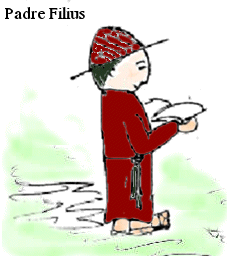
1. Padre Filius Cartoon
2. Comments from Readers
3. Freedom on the Half Shell Poem
4. Who are those other people?
5. Easy Removal of Phantom Leg Pain
9. Closing Notes — our mailing list, locating books, unsubscribing to Digest
10. Gratitude== == == == == == == == == == == == == == == == == == == == == ==
THE GOOD MOUNTAIN PRESS DIGEST #114 == == == == == == == == == == == == == == == == == == == == == ==ARCHIVED DIGESTWORLD ISSUES ON THE WEB ~ ARCHIVED DIGESTWORLD ISSUES ~ 2000: INAUGURAL YEAR: Jun #1 Jul #2, Aug #3, Sept #4, Oct #5, Nov #6, Dec #7
2001: Jan #8, Feb #9, Mar #10, Apr #11, May #12, Jun #13, Jul #14, Aug #15, Sep #16, Oct #17, Nov #18, Dec #19
2002: Jan #20, Feb #21, Mar #22, Apr #23, May #24, Jun #25, Jul #26, Aug #27, Sep #28, Oct #29, Nov #30, Dec #31
2003: Jan #32, Feb #33, Mar #34, Apr #35, May #36, Jun #37, Jul #38, Aug #39, Sep #40, Oct #41, Nov #42, Dec #43
2004: Jan #44, Feb #45, Mar #46, Apr #47, May #48, Jun #49, Jul #50, Aug #51, Sep #52, Oct #53, Nov #54, Dec #55
2005: Jan#051,Feb#052,Mar#053,Apr#054,May#055,Jun#056,Jul#057,Aug#058,Sep#059,Oct#05a,Nov#05b,Dec#05c
2006: Jan#061,Feb#062,Mar#063,Apr#064,May#065,Jun#066,Jul#067,Aug#068,Sep#069,Oct#06a,Nov#06b,Dec#06c
2007: Jan#071,Feb#072,Mar#073,Apr#074,May#075,Jun#076,Jul#077,Aug#078,Sep#079,Oct#07a,Nov#07b,Dec#07c
2008: Jan#081,Feb#082,Mar#083,Apr#084,May#085,Jun#086,Jul#087,Aug#088,Sep#089,Oct#08a,Nov#08b,Dec#08c
2009: Jan#091,Feb#092,Mar#093,Apr#094,May#095,Jun#096,Jul#097,Aug#098,Sep#099,Oct#09a,Nov#09b,Dec#09c
2010: Jan#101,Feb#102,Mar#103,Apr#104,May#105,Jun#106,Jul#107,Aug#108,Sep#109,Oct#10a,Nov#10b,Dec#10c
2011: Jan#111,Feb#112,Mar#113,Apr#114,May#115,Jun#116,Jul#117,Aug#118,Sep#119,Oct#11a,Nov#11b,Dec#11c
2012: Jan#121,Feb#122,Mar#123,Apr#124,May#125,Jun#126,Jul#127,Aug#128,Sep#129,Oct#12a,Nov#12b,Dec#12c
2013: Jan#131,Feb#132,Mar#133,Apr#134,May#135,Jun#136,Jul#137,Aug#138,Sep#139,Oct#13a,Nov#13b,Dec#13c
2014: Jan#141,Feb#142,Mar#143,Apr#144,May#145,Jun#146,Jul#147,Aug#148,Sep#149,Oct#14a,Nov#14b,Dec#14c
2015: Jan#151,Feb#152,Mar#153,Apr#154,May#155,Jun#156,Jul#157,Aug#158,Sep#159,Oct#15a,Nov#15b,Dec#15c
2016: Jan#161,Feb#162,Mar#163,Apr#164,May#165,Jun#166,Jul#167,Aug#168,Sep#169,Oct#16a,Nov#16b,Dec#16c
2017: Jan#171,Feb#172,Mar#173,Apr#174,May#175,Jun#176,Jul#177,Aug#178,Sep#179,Oct#17a,Nov#17b,Dec#17c
2018: Jan#181,Feb#182,Mar#183,Apr#184,May#185,Jun#186,Jul#187,Aug#188,Sep#189,Oct#18a,Nov#18b,Dec#18c
2019: Jan#191,Feb#192,Mar#193,Apr#194,May#195,Jun#196,Jul#197,Aug#198,Sep#199,Oct#19a
To Receive a Monthly DIGESTWORLD Reminder — Click Here.
== == == == == == == == == == == == == == == == == == == == == ==
1. April Violet-n-Joey CARTOON:
== == == == == == == == == == == == == == == == == == == == == ==For newcomers to the Digest, we have created a webpage of all the Violet-n-Joey cartoons! Check it out at: http://www.doyletics.com/vjtoons.htm Also note the rotating calendar and clock that follows just to the right of your mouse pointer as you scroll down the page. You'll also see the clock on the 404 Error page if you make a mistake typing a URL while on the doyletics.com website.
The Violet-n-Joey Cartoon page is been divided into two pages: one low-speed and one high-speed access. If you have Do NOT Have High-Speed Access, you may try this Link which will load much faster and will allow you to load one cartoon at a time. Use this one for High-Speed Access.
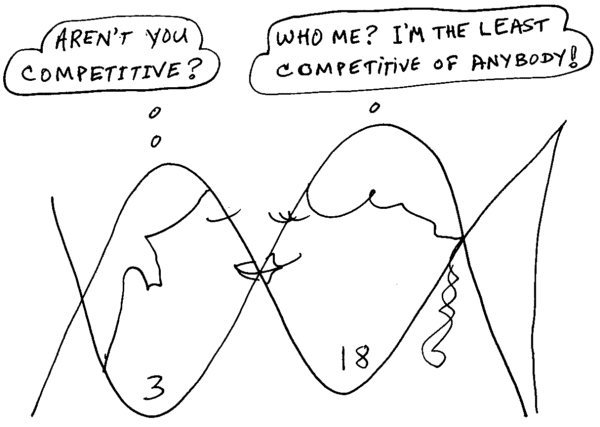
This month Violet and Joey learn about Competition.
#1 "Competition" at http://www.doyletics.com/images/031811jv.gif

== == == == == == == == == == == == == == == ==
2. HONORED READERS FOR April:
== == == == == == == == == == == == == == == ==Each month we choose to honor two Good Readers of our Good Mountain Press Digest from those all over the World. Here are the two worthy Honored Readers for April, 2011:
Walter Alexander in New York
Al & Betty Boysen in Florida
Congratulations, Walter and Al & Betty!
== == == == == == == == == == == == == == == == == == == == == == == == == == == == == == == == == == == == ==
3. ON A PERSONAL NOTE:
== == == == == == == == == == == == == == == == == == == == == == == == == == == == == == == == == == == == ==
Out Our Way:MARCH BLEW IN LIKE A LION
Didn't notice if the wind was blowing, but everything else was blowing up or breaking. Started off the first day of March buying a headlight bulb for my Maxima which has had an intermittent low beam for about a year after my front bumper had to be replaced due to someone's carelessness in a parking lot. I took back to the Collision place and they pushed on the plug and said, "See, it's back on." Then when I got home, it wasn't. Took it back twice to them and same thing. Later I had major work on Maxima, the dealer replacing the starter and some seals and CV joints, so I asked them to fix it. Same story and same ending. I gave up. Six months or so later the low beam went off permanently. Since the dealer's repair gang didn't find anything, I assumed it must have been a bad bulb all along. The guy at the Auto Parts place refused to try to replace the bulb as "something might break" so I took it home to do it myself. The plug came off in several pieces with one wire completely broken off, obviously the low beam wire which had been hanging by a thread for a year! No wonder it was intermittent! No wonder it broke off eventually! No one in the four sets of people I asked to fix the problem, ever took the connector off! ! ! Unbelievable. The simple troubleshooting expedient of inspecting the bulb would have noted the problem!
A new connector and harness costing all of $70 would have permanently fixed the headlight good as new. I took the shattered connector to the dealer with the bill from the previous repair of 12 months earlier where it said, Fix Headlights, showed the fractured, melted connector to the Service Associate, and he got it fixed for $70, charging me only for the parts, no labor. Took about three days to acquire the parts, but I had my 1990 Ford F150 pickup available for wheels in the interim.On the way back home from dropping off the Maxima at the dealer, as I went into the Laundry Room, the door handle broke off! I inspected the solid brass handle and noticed that it was actually a two-part brass handle with an iron headless bolt which held the two pieces together. Easy enough to fix: simple remove the two broken pieces and put a new bolt in them. Easy enough to specify, but not so easy to do. On one piece the broken end of the bolt was sunken into the brass and there was no way to extract it. No way easily. Later in the month I bought an "Easy-Out" of the right size from Chris at Ullo's Ace Hardware. It's a drill looking tool with a left-hand thread and tapered. You drill a hole in the bolt you wish to remove, set the "Easy-Out" into the hole in the bolt, and turn the "Easy-Out" in the direction to remove the bolt. The tool will dig into the walls of the bolt and then the bolt will give up its purchase on the walls of the brass handle and slide out. Again "easy" to specify, not so easy to do. The "Easy-Out", with Truth-in-Packaging should be named: the "Extremely-Difficult-Out"! I made one hole, but the "Easy-Out"slipped out. It came out easily without the stuck bolt moving. It kept coming "Easy-Out" by itself. I made the hole larger, I hit it with a hammer while turning the "Easy-Out", and time and again, it came out easy without doing its job.
There are no manuals which specify how many times you try and re-try when something fails. There were no second options in this case: either the "Easy-Out" takes out the bolt, or I have to find replacement handle for a thirty year old lockset. An hour flew by with one "Easy-Out" after another. Finally I had made the hole as big as I dared to make it, I banged on the Vise-Grips holding the "Easy-Out" as hard as I dared as I turned the pliers and slowly the pesky little bugger came out. Then I hacksawed off the head on the replacement bolt, filed the cut edge so it was thread properly and the door handle, which had come off broken so easily, went back on in seconds.Finally I headed back to my PC and it had to be rebooted and Reset twice after some driver got stuck using up 93% of the CPU time. Norton had earlier reported warding off an attack on my PC, so I was concerned that a problem might have slid through the Internet Security feature. Nothing did, the PC finally came up running normally.
That night our son-in-law Greg, a lawyer from Houston, came to stay with us for the night. He came in to take care of a deposition in Marrero the next day. He told us he had tried video-conferencing before, but you cannot really see the reactions to people during a deposition over a computer screen. Nothing beats being there. The next week he came over for two days for more depositions and we went out to dinner one night to the Bon Ton Restaurant in downtown New Orleans.
MARDI GRAS, THE BALL, AND ALL
Thursday before Mardi Gras is the day we decorate our clubhouse for the Carnival Ball. This year, my friend Guntis, who has come to several Balls with us, volunteered to help with the decorations. Putting up the greenery and the strings of tiny lights is a major job, and three of the key people who are usually there were missing this year. I gathered the Japanese yew branches for the greenery and got that started. Then we strung up the lights with a whole new crew and got it all done in short order.
The next day was the luncheon at Galatoire's and it was another marvelous event, followed by a quick ride home to relax for an hour or so, then get dressed in my white tie and tails for the evening's festivities. Our long-time friend Cindy needed help getting uptown from Kenner, so Del dropped me off at the streetcar barn while she drove to get Cynthia. By the time our streetcar parade had stopped in front of the Winter Palace, everyone was waiting: Guntis & Annie, Burke & Cynthia, and Del.
The day after the ball, we had planned to go to Mid-City for a party at Sharon and Dave's house for the Endymion Parade, but a huge rainstorm postponed that parade until the next night after Bacchus. I worked on my Digest while Del went to the abbreviated party and she was able to finally schedule a time for Sharon and Dave to come over to our new house for dinner, which happened about a week later. The night they were due to come, Del had bought about 12 lbs of boiled crawfish at the grocery, so we spread the newspaper over the patio table and enjoyed eating the tasty crustaceans al fresco!
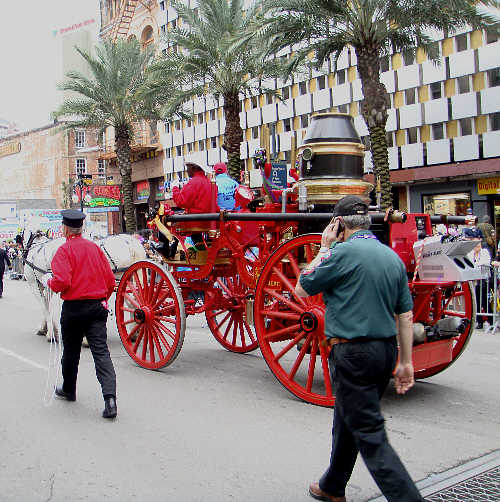
Lundi Gras came without us having gone to a parade yet, so we decided to eat at our favorite restaurant which is on the parade route and then walk across the street to watch the Proteus and Orpheus parades. We found a great spot to watch the parade. At one point, the I-610 Stompers, an all-male dancing crew, was stalled in front of where we were standing and had time to go through all their routines.
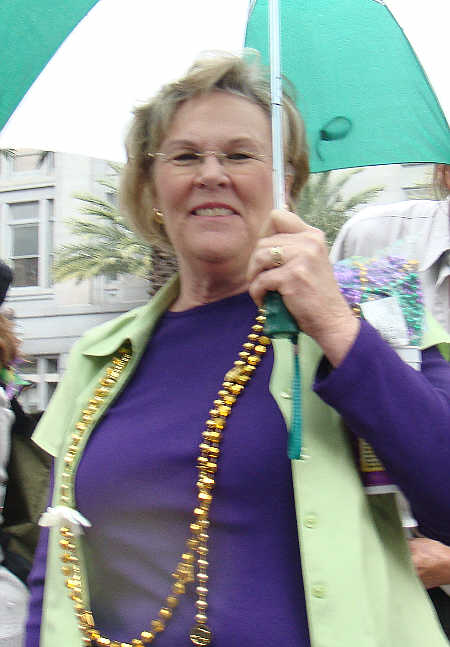
At the end of their canned routines, they invited parade watchers to join in, and one of them came and pulled Del into the middle of the street for an animated dance. Imagine a bunch of guys from a construction gang, just getting off work, donning orange tops and blue shorts, wearing sneakers, and dancing in the streets for seven miles! That's the I-610 Stompers. A real hoot! Only in New Orleans!When Orpheus came by, I noticed Steve Zahn on the Treme float and yelled, "Hey Dude!" and I caught his eye and he threw me a black and gold chain necklace, suitable for any Black & Gold Saints fan. We left halfway through Orpheus and went home with lots od beads, doubloons, and happy memories. All this activity and the first week of the month was not over yet! Mardi Gras filled day 7 of March.
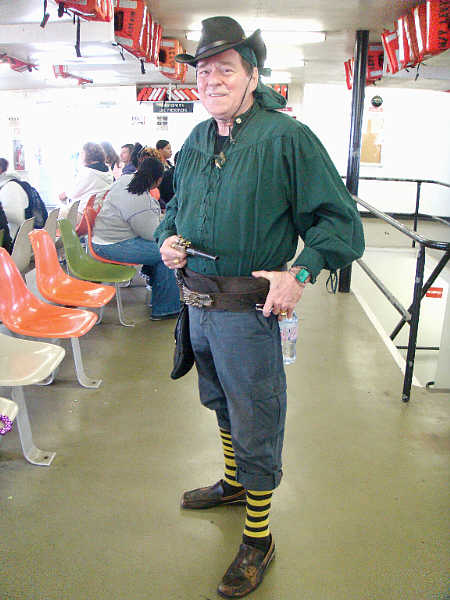
We were up early and I donned my pirate gear for the day. We parked by the Algiers-Canal Street ferry as usual and in minutes we were walking through Harrah's Casino, the new ferry landing, so to speak. It makes for a pleasant walk-through on the way from ferry to Canal Street, with restrooms and Starbucks and lots of places to empty your pockets of coins.
We walked to Bourbon Street and then down it till we got to Toulouse and headed toward Pontalba Café for lunch. Oyster Po-boys were good and we sat at a french-window table which we could see, hear, and smell the flavors of Mardi Gras in the French Quarter as we dined.
Then we walked past Jackson Square to Café du Monde. Del looked for table inside (flaps were down because of high wind) and I talked to two couples from Oregon, one who lives in Shreveport now. Their friends from Oregon had called and said, "We're coming for Mardi Gras to visit you in New Orleans." He told them, "Shreveport is a long way from New Orleans."
But, somehow they found a way to join them down here. Then I saw Del or thought it was her standing at a table for us, but it was another tall gal in a green vest. Found Del at a table on the edge of the flaps and we had coffee and beignets. She'd been talking to three Duke students working on MBAs. We left there and walked back to Royal Street to make our annual stop at the Monteleone Hotel. I spotted Edwin Fleischmann with Ruby, both heavily costumed and hard to spot and took a photo of them.We rested at the Monteleone Hotel and then found a spot on Canal Street in a park bench to wait about an hour for Rex to pass. When it did, we were once again lined up directly on the parade route with no one in front of us which allowed us to catch a lot of beads, cups, and doubloons. The flip side of the Rex doubloon coin thrown from the parade this year was St. George defeating the Dragon — the design as taken from one of the prettiest Rex floats of this year. I took a lot of photos!
We stopped for café latte's at Harrah's Casino and a bit of a rest and then got on the ferry to come home. While other folks elsewhere in the country were bemoaning the long string of cold, empty days of February and early March, New Orleans was buzzing away with three weeks of solid Carnival fun.
FIVE TV SCREENS HUMMING THIS MONTH
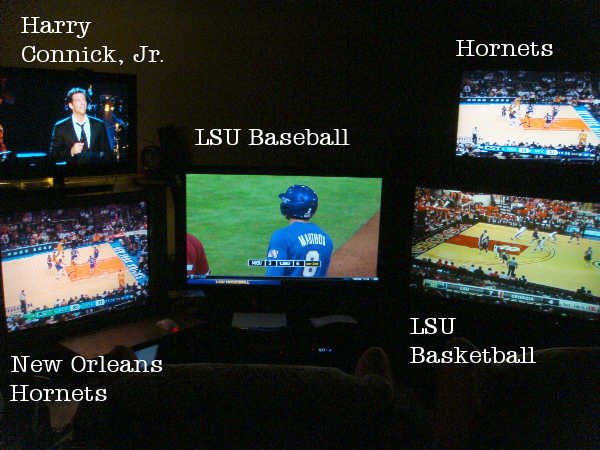
Friends who see my Screening Room for the first time invariably ask me, "Why Five TV's?" In a month in which Basketball and Baseball overlap each other, the five screens have seen a lot of air time. One night Del went to a meeting and I watched Harry Connick, Jr on 712, LSU Basketball team on 702, and Hornets game on 737, plus LSU Baseball team beat Miss Valley State on Geaux Zone on the large center screen. Left me only the upper-right screen to monitor the news. Here's a photo showing the five screens that night in the Screening Room. LSU's Baseball team is making another run for Omaha and a seventh National Championship and the New Orleans Hornets are making a run for the NBA playoffs.
Then as March progressed, the news channels were buzzing with news of the earthquake, tsumani, nuclear disasters in Japan, and riots in nearly every Middle East country, with a UN-sanctioned No-Fly Zone and attacks on Libya to free it from Qaddafi's villainous grasp.
DIGGING IN THE DIRT FOR FLOWERS & VEGGIES
Our vegetable garden needed some help, so I began digging out the black mulch from underneath the winter crop of cypress needles and loaded about a dozen garden carts of this black gold on top of the veggie plot, having first pulled out the remaining broccoli and Brussels sprouts plants. Also about 2 dozen bunches of green onions, cutting off and saving the white tips for planting later in the year.
With the black mulch in place I hauled out Tillie (my Echo Tiller) and she and I tilled the soil, mixing in the black mulch with the sandy veggie plot. With the mulch bed a little lower, it was time to add some more green mulch on top of it.
So I cranked up my Snapper Riding Mower with its brand-new Briggs& Stratton 11.5 HP engine and cut the grass at Timberlane for the first time since the Fall. The grass was not quite tall enough to cut, but the lanky spring weeds needed to be taken down a notch, and the lawn looked marvelous after the trimming. I added about ten bags of green mulch over the mulch bed. I never worry about Spring weeds, because Summer's coming, and they can't survive the heat and vigorous growth of St. Augustine grass which will snuff them all out by June! No weed-n-feed application for me: simply trim and wait for Nature to do its course in New Orleans. The ground will nurture the St. Augustine, the sky will water it, and I will mow it — makes for an unbeatable Triumvirate!
With the mulch bed all ready, it was time for our annual Bio-Dynamic treatments. We dug up our first Preparation 500, Manure in Cow Horn buried over the Winter months. We added it to our barrel compost mixture. Barrel Compost is a Bio-Dynamic preparation mixture which incorporates the Steiner Preparations 502 through 507. That requires some rain water, which we begged off of our neighbors, Connie & Don, who have a rain barrel. I told them that I planned to have my own rain barrel before the summer set in, and I managed to get it installed by the end of the month. We put a handful of the barrel compost into a large bucket of rainwater and stirred it 40 minutes in a clockwise direction, then 40 minutes in a counter-clockwise direction, doing so at dusk, so that when we were done stirring we could immediately begin the application after dark set in. I apply with a long-handled car washing brush, by dipping the brush in the treated water, then lifting and sprinkling it over the mulch bed and various plants. A sprinkler can would get clogged by the compost which does not completely dissolve in the water, but merely stays suspended in it.
Then came the decision on what to plant and how to arrange the plants in the veggie plot. The mulch bed was easy to decide: cucumbers would be planted along the East and North edges of the mulch bed where they produced so abundantly last year. In addition we planted four more Loquat trees along the South edge to create a shady area over the mulch bed in future years, re-creating here what had worked so marvelously at our previous home. In addition we bought two large artichoke plants for the SW and NW corners of the mulch bed. They will grow well there and have all the room they need to expand as they are perennials and we should get a nice crop of artichokes from them each year from now on.
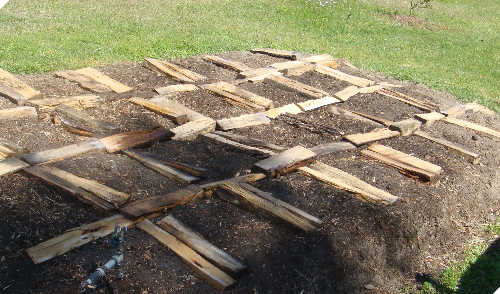
As for the veggie plot itself, I decided not to create rows this year, but rather to lay down some leftover firewood to mark off separate square areas to plant within. I marked on the bare wood with a permanent marker what was planted within. With the firewood acting as a walkway, I can walk to any plot, weed it, tend it, harvest it without stepping on any seeds which haven't come up yet. We have okra already sprouting from the bushes from last year, two cotton plants, some radishes, some chamomile, some green beans, some Creole tomatoes, some bell peppers, some eggplants, sunflowers, and maybe a couple of other plants which will show up later. Now it's time to let warm sun and water do its job.
MAXIMA GETS A TWIN, A NEW ALTERNATOR, AND SHOCKS
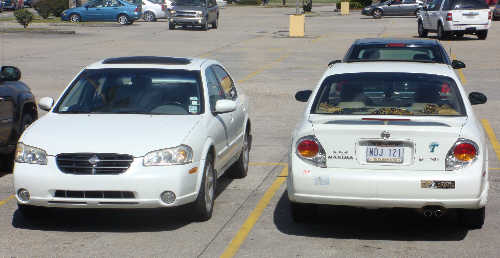
One day at PJ's an interesting thing happened in the parking lot. As I pulled into a parking space, I noticed a White Maxima almost identical to mine to my immediate left. It was parked in the opposite direction, but it was a Sports model SE, sun roof, tail spoil, fancy hubcaps, etc.
I walked to check out front and then on the back I noticed Saints colors and a Tulane sticker. I had to meet the owner, but how? Should I walk into PJ's and ask, "Who owns a white Maxima?" I considered it, but while I paused a good-looking black woman, about my age, maybe ten years or so younger, came towards the car. "Is this your car?" I asked. She smiled and we began talking about our identical cars. She loves her Maxima as I do, owns a 1994 Jaguar, British-made, but complained about how expensive it was to repair, when I asked her what she liked most, she said the prestige of driving it. She didn't mention any better ride or handling. So here's the scoreboard:Mine: White, Male, White Maxima, 2000, Sports SE, LSU, Saints Fan
Hers: Black, Female, White Maxima, 2002, Sports SE, Tulane, Saints Fan
I had wanted a Jaguar for many years, but after driving several Maximas, I decided that the only difference would be the prestige and I didn't need any artificial, money-bought and maintained prestige.
A week or two later, I noticed that the Maxima had been kind of slow accelerating from a stop and wondered about that. One day coming home from PJ's down Timberlane Drive which is due for a new roadbed, I was thinking about getting a quote from dealer to replace the shocks, and in that instant the motor died, about 150 feet away from our driveway. The next morning, it started up fine, but about 50 feet away it ran slow and I quickly backed it into driveway and called for it to be towed to the Dealer for repair. Turned out it was an air sensor for the engine, explaining the slow pickup, and a bad alternator. While at it, I had them put in a new battery and replace the struts (shock absorbers) for the rear axle. Now the white Maxima is purring and accelerating like a champ and taking those bumps on the drive home from PJ's.
NEW CAMERA WITH TELEPHOTO LENS
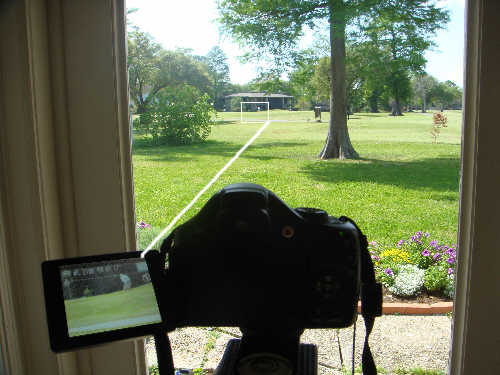
My vademecum (go everywhere) camera is a SONY T300 and I am so happy with it, that I had bought a new one last year when the other began acting up. But my friend and fellow physicist Seth Nehrbass told me about a new CANON SX30 with a built-in 35X optical zoom lens which sounded too good to be true, especially at the price of $380! (See photo down below.) It's only about the size of an old fashioned film 35mm camera, but the Zoom lenses is nested deep into the camera body and only comes out as it is needed. With 14 mpixels, the digital resolution is about 50% more than the T300. It's got flip-up view screen and flash attachment. After testing it, I decided to get a new tripod and external flash attachment for group photos indoors, something my T300 strained to do properly. The big test came on a trip to Audubon Park on the last Saturday of March. Bird Island there is full of nesting Great Egrets this time of year and it was bright sunny day with lots of people walking on the trail which goes past the rookery.
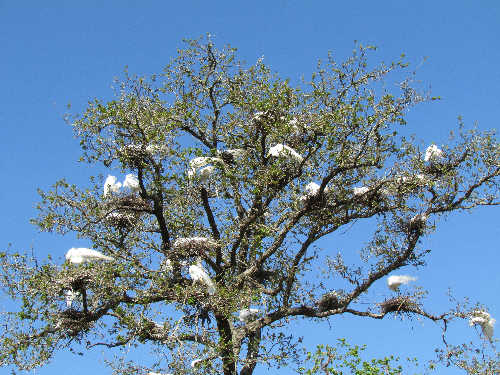
There must have been a hundred or so nesting Great Egrets and miscellaneous other birds and turtles around. I saw French Ducks, Wood Ducks, a Red Duck standing on one leg, an Anhingus Snake Runner, red-eared slider turtles, two large white swans a'swimming, several geese and white ducks in addition the bevy of egrets. My biggest challenge was to capture the flying egrets. Hard to find them in the telephoto lens at close range setting, and too small to get a good shot if at wide range. The three best flying shots I got are shown below in this Digest.
MISCELLANIA
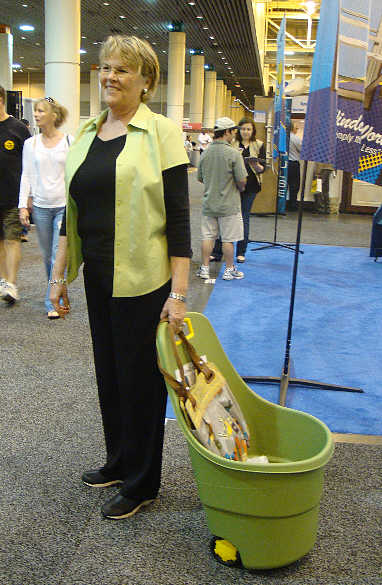
During this month Del and I went to the Home and Garden Show at the Convention Center. I didn't know which of the Halls the show was in, and should have checked, because we hit the worst case scenario. We parked in the Riverwalk parking lot and the show was at the far end of the very long building. We walked forever to get to the show passing about six conventions along the way, passed up a chance to drive a new Chevrolet VOLT at the Auto Show, and finally arrived at the show we wanted. Unfortunately, the gal taking tickets couldn't tell where to get tickets. We walked back the way we came several hundred feet and no sign of ticket booth. It was outside! One hand-scribbled sign was the only notice of location of ticket booth. It's a no-brainer to say that when you're going to a show where you will be walking around for a long time, you should park as close as possible. Next time we'll do that. We talked to several contractors who could help us with fixing the concrete on our brick patio and build a covered porch or pegola for us to get some much-needed shade from the evening Sun.
After the show we were both tired and hungry and decided to come home. It was St. Joseph's Day, and the altars full of food were scattered around the city. We parked to attend the St. Joseph's altar at St. Joseph's Church in Gretna. Unfortunately the line was around the corner and not moving so we left. It was just past 1 pm and I figured most people had eaten, but the opposite seemed to be the case, so we drove to another Italian eating place, DiMartino's Deli for some oyster poboys.
I had ordered a 65-gallon rainbarrel from NOLAGreenRoots.com and drove down to their offices on Tulane and Salcedo to meet Joe Brock to pick it up. Spent an hour and a half sharing with him how the Plant as Doctor works which I wrote about in a recent Digest commentary. Also quickly covered the Plants as they affect the various parts of the body, and a thumbnail sketch of how Bio-Dynamic Gardening works. At one point he told me, "As I listen to you, light is filling my mind." He was delighted to learn these things, and took copious notes of everything I shared with him. My fondest hope was get Brock to tweak slightly the way the harvests of their community gardens are distributed. People who toil in a certain garden plot should be given preference in receiving the produce from their plot. Why? Because the toxins (chemicals) from their body in the breath and sweat are absorbed by the plants they tend and these same plants adjust their genetic structure, transposing genes from one spot in their DNA to another spot.
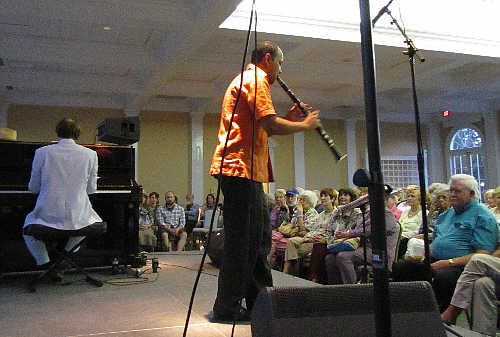
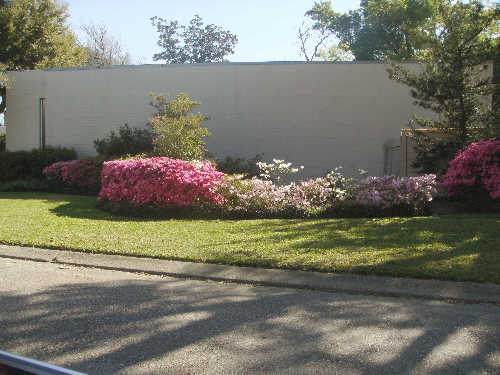
This action creates different proteins which are designed specifically to fill some need in the body of the human being whose chemicals the plants had previously ingested from the air and soil. Thus, those who tend a plot should be given the harvest from that plot. After our talk, Brock asked me to speak to some of his high schoolers who are in training in gardening and I agreed.Normally we attend lectures at my club on Thursday nights which continue through May and only begin attending the Twilight Concerts in City Park from June until October. But this first concert starred Tom McDermott and Evan Christopher, and we wanted to be in that number. And we were so glad we did, and were there, hearing the tones from Evan's mellow clarinet as he did his Creole Melody and other jazz specials along with Tom whose fingers flew over the piano keyboard. Our view was of Tom's back as he did a continual sitting-down dance while spinning out incredible melodies into the twilight air. Plus we arrived early so I could get some photos of the newly blooming flowers.
This next item was rather incredible. I still don't have the full story about what happened so I can only report what I heard. My cousin Deanna, who has never called me before, reached me on my cell phone. As her voice had a low tone, I figured it was bad news and surely about her mother, my Aunt Hilda, my dad's oldest sister who is over 95. Deanna has been taking care of her, sleeping at her house every other night or so for years. No, it was about my younger cousin, Roxanne, in her low sixties, whose ex-husband had shot two men in a casino in Houma where Roxanne and my Aunt Carolyn (Dad's youngest sibling) were. Apparently he was upset at his ex-wife and confronted her and then he shot two men, one of whom has died and the other in critical condition. The man then shot himself in the body, then in the head, then walked outside, still alive, and shot himself in the head again. He was rushed into surgery where he died on the operating table.
Deanna told me at one point, "You usually call me when there's news, so I thought I would call you." I told her, "I thought sure it was your mom when I heard your voice." "Hah!" she said, "she'll probably outlive me!" I said, "Deanna, if your mom outlives you, she can add to her resume that she spent the last years of her life sleeping with her daughter every other night!" She laughed. After we got off the phone, I looked up the Houma Courier on-line and the Casino incident was front page news. Didn't mention the name of the ex-wife, so I wouldn't have known it was Roxanne if Deanna hadn't called.
A RUN FOR THE ROSIE
Yesterday a jockey named Rosie won a million dollar purse at the New Orleans Fairgrounds and a ticket to ride in the Kentucky Derby. She rode a horse named "Pants on Fire". This morning at PJ's Coffeeshop I saw a friend of mine who works at the Fairgrounds Racetrack in New Orleans and this thought went through my mind, "What if Rosie's horse had come in second in the race yesterday behind a horse named, Liar, Liar?" Imagine the track announcer calling the race having to yell repeatedly, "Down to the stretch, it's Liar, Liar, Pants on Fire!" Doubt anyone could do that without breaking up!
LAST MINUTE ADDITIONS
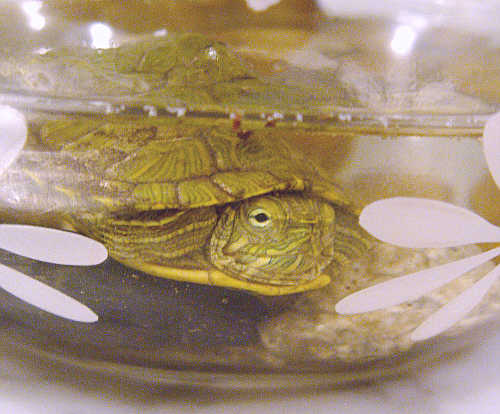
YURDLE: Del found a small red-eared slider turtle sitting alone on the driveway in front of our northside entryway. We found a small glass bowl, added water for it to stay under and rocks for it to climb atop. She named it, "Yurdle" so we have an addition to our family, Yurdle the Turtle.
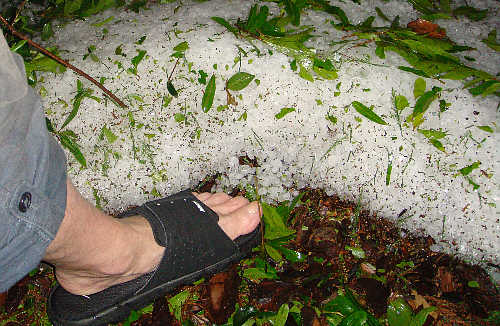
HAILSTORM: On the night of March 28, Del and I had dinner at a restaurant on Manhattan Blvd and the rain started with thunder and lightning, so we rushed home. As we neared our driveway I saw the sky in the south light up a constant blue color everywhere. As we stared at it, the lights on the poles went out. I turned to enter the garage and pressed quickly on the opener remote when the street lights came back on, but they went off in a couple of seconds and the garage door was only able to raise about a foot. So I quickly told Del to take over and drive the car immediately in to the garage after I raised it by hand. The hail had already begun to fall and I wanted to protect the new Maxima from dents. Luckily, in the dark, I was able to guess right as to how to release the garage door from the motor gears, and raised it by hand.
For the next hour we were subjected to over 100 mph winds and intense hail which built up in drifts of four inches in the garden. Over 7 inches of rain fell on us. The next day our roofing contractor came to do the post-storm inspection we had signed up for and found that we had some minor damage to the ridge tiles of our year-old roof, which will be shortly replaced. A couple of small panes in the dormers had cracked and need replacement. The main damage was our lovely flowers which have graced the pages of this Digest. As I told Del, as she was almost in tears, the hail did not damage the roots of the plants. They will grow back, and quickly with all the life-giving rain which has soaked the ground. We had been praying for rain and think perhaps we overdid it! But life goes on.R.I.P. : Julie Hatchett Stewart, our daughter Kim's aunt who was only five days older than she was, passed away in Dallas after a long illness on March 30, 2011. May she find peace and comfort in the new place she has entered.
EVERY GOOD THING MUST COME TO A NEW BEGINNING, SO UNTIL NEXT MONTH . . .
The past month brought us Sunny Skies and Warm Breezes, plus flowering everything: azaleas, redbud trees, peach trees, and beginning irises. Everyone in New Orleans is enjoying the early Spring Fiesta, Garden Tours, Crawfish Festival, etc, and working in their gardens. April will see us in the full swing of Spring Festivals and Jazz Fest time in good ole New Orleans, God Willing and the River Don't Rise! Whatever you do, wherever in the world you and yours reside, be it chilly or hot, cloudy or sunny, Spring or Fall, remember our slogan: Enjoy this present moment, we live in the middle of eternity, and it's given to us for free!
~~~~~~~~~~~~~~~~~~~~~~~~~~~~~~~~~~~~~~~~~~~~~~~~~~~~~~~~~~~~~~
IMPORTANT MESSAGE:
To those Good Readers who are puzzled by How the Moon could be Rising In Front of a Mountain, Click on Photo. To see 161021 photo, Click Here. ALSO: if you are puzzled because you No Longer get our Monthly Reminder, you may have Changed Your Email Address without notifying us. NOTIFY US NOW by a simple Click Here!
Here's the Sting:
You will NOT receive a Monthly Reminder unless you have Re-subscribed under your new address to DIGESTWORLD.If you've already receiving DIGESTWORLD Reminders, ignore this message.
If you're not subscribed, and would like to Subscribe to DIGESTWORLD Reminders to receive one short email a month to inform you of the latest ISSUE, now's a good time. SUBSCRIBE NOW
by Clicking Here.Yes, this message does no good to those who changed their email address without notifying me — but it can alert those of you who are going to change your address.
If you've changed or are planning to change your email address, Click Here to SEND NEW ADDRESS. (Alternate way is to copy into your Browser this URL: http://www.doyletics.com/subscrib.htm )
EASE OF VIEWING NOTES:
NOTE: For Internet Explorer Browsers, DIGESTWORLD is best viewed at 100% Zoom and the Window's width sized so that Digest Archives lines are single-spaced, just barely. Adjust Window width so that Mountains almost touch the Archive Numbers, especially if you find some Photos overlapping text.PHOTO CAPTIONS (CURSOR FLYOVER ISSUE RESOLVED):If you have been enjoying the photos in DIGESTWORLD, but have wondered who or what you were looking at, you will now be able to hold your cursor still over the photo and the photo's description will appear. (Test on Butterfly-Crab Image at Right.) We spend a lot of time writing these photo captions and hope you will read them. All the Archived Issues have been updated to provide descriptions when your cursor rests for a second on a photo. Note that older Reviews have not been updated. If you haven't finished reading text when description disappears, move cursor away and back on photo to finish. We thank you for your patience and hope this pleases you.
- If some great idea takes hold of us from outside, we must understand that it takes hold of us only because something in us responds to it, and goes out to meet it.
Carl Gustav Jung ( 20th-century psychologist and philosopher )New Stuff about Website: Five Featured Reviews:
1. Owen Barfield's
Romanticism Comes of Age .
At last the scales have fallen from my eyes and I no longer see as through a glass darkly, but bright and fresh, the reason: I have been drawn to Rudolf Steiner's writings. I have been hitherto stumbling in a graveyard, trying to create some semblance of life from epitaphs and dates on dusty stones and herein I find a quick companion, a pub brother, who over our dark beers, tells me the secret. Not right up front, but only after a long prologue, a tale of man and nature, of unity, splitting apart, and reunion. A tale of many tales, of scientists and poets, positivists and romantics, all narrated in detail, but without an end in sight, until the last five pages of this book when Barfield tells us the essence of Steiner's contribution to knowledge — his discovery of the starting place of acquiring knowledge itself: in the activity of thinking.
In one fell stroke, Steiner illuminates the bridge between James' "blooming, buzzing confusion" of the sensory world and our primordial perception of the sensory world mediated by our previous experiences. That bridge is the activity, the process, of thinking. Beginning as we must, with the results of thousands of years of thinking insinuated in our specious present ("specious Given" in Barfield's terms), we can never experience the net Given (the specious Given stripped of the results of our long protocol of thinking) but we can think of its necessary existence. And, having done so, we can know that any science of thought that ignores this distinction of the specious Given and net Given does so at its own peril and creates strawmen that will not survive the heat of closer scrutiny.The search for one's eyeglasses is made difficult because the instrument of discernment is lacking during the search. One invariably requires the assistance of someone of acute sight in the search. If one's eyeglasses are perched on one's own nose during the search, the search will be fruitless, even though the eyesight is flawless. No amount of help from clear seeing companions will be of any help either, unless the companion has the perspicacity of Rudolf Steiner, and looking directly at you, says, "Your eyeglasses, dear friend, were in place all along." We can discover that the activity of thinking is not a local phenomenon limited to our skulls, but a living process that fills the universe if we only heed Steiner's admonition to notice the object of our long search has the instrument of our search all along.
2. Rudolf Steiner's Sermon on the Mount

In many of his writings Steiner calls the "sensible" world one that is perceived via our ordinary five senses and he calls the "super-sensible" world one that requires the use of super-sensible perception to perceive it. Moving forward from the advent of the "I AM" or ego body in the time of Moses to the Sermon on the Mount, Steiner describes the dramatic change that took place in humankind in the time of Jesus. Humankind, by then blessed with ego consciousness since Moses's time, had lost its ability to raise themselves up to the realm of spiritual beings. The spiritual beings had to descend into the human realm before the new ego consciousness could recognize them. Thus the meaning of the Christmas story of "angels bending near the earth." The new message to humans at the time of Christ was to "find his connection with God within, and this by means of his ego." Thus came John the Baptist proclaiming "The Kingdom of Heaven is at hand." Heaven could not be interpreted rightly as an earthly location (physical body), nor as a political kingdom (ether body), nor as a philosophical kingdom (astral body), but only as the living ego body entering a relationship with the descended Christ in power and harmony.
The eight beatitudes progress from the lowest human body to the highest spiritual body as the following summary of Steiner's words illustrate. Even a casual glance at the parallelism may be enough to soften the heart of the most calloused skeptic as it shows that Jesus, as the descended Christ, was aware of the progression of the multiplexed bodies of humankind. I will cite the verse of Matthew, the pertinent human body, followed by a brief quote or re-statement of Steiner's view of the beatitude.
Beatitude 1 (5:3, physical body): Those living in their physical body (i. e. poor in spirit) "if they develop their ego-ruled bodies in the right way, they will find the Kingdom of Heaven."
Beatitude 2 (5:4, etheric body): Those who mourn can find the source of comfort within themselves.
Beatitude 3 (5:5, astral body): The meek, by "fostering calmness and equanimity within themselves; all comfort and well-being on earth shall be their reward."
Beatitude 4 (5:6, soul or ego body): Seek a higher development in your soul body and your ego will "become sufficient unto itself." (Steiner calls this the slumbering of the ego.)
Beatitude 5 (5:7, rational soul): "He who develops compassion and mercy shall find compassion in others." (Steiner calls this the awakening of the ego.)
Beatitude 6 (5:8, consciousness soul): Through the consciousness soul "the ego comes into being as pure ego and becomes capable of receiving God into itself." This is expressed poetically as "Blessed are the pure of heart, for they shall see God." "The heart," Steiner says, "is the expression of the ego, the divine in man."
Beatitude 7 (5:9, spirit self): This is what I would call the Holy Grail of the Beatitudes. Steiner calls us vessels that are gradually receiving the spirit. Thus with the deed of Christ bringing down to earth "the power of love and harmony" we listen as Christ tells us "Blessed are those who draw the spirit self down into themselves, for they shall become the Children of God." Children of God is a poetical reference to our ultimate destiny as we progress in our human and spiritual evolution.
Beatitude 8 (5:10, life spirit, spirit man): Steiner sees this as a direct message about the mission of Christ (spirit man) and his disciples.
3. Jean-Paul Sarte's The Emotions — Outline of a Theory
How appropriate that I 'd be reviewing this book on the fiftieth anniversary of Sartre's writing it! In all those fifty years scientists haven't learned much more about a theory of emotions than Sartre knew in 1948. [See ARJ: Passion and Reason, Emotional Intelligence, and The Emotional Brain] But Doyle P. Henderson came up with a theory of emotions some twenty ago [ARJ: PANACEA!] in the light of which I wish to examine Sartre's view of emotions. Henderson's theory may be said to form the basis for the science of doyletics — the science of the acquisition and transmission of emotional traits.
Sartre says on page 7, "Thus, emotion is first of all and in principle an accident." He says it is useless for a psychologist to ask how "the very structure of human reality makes emotions possible." Yet, rightly understood, the theory of doyletics does exactly that: it says that a human being begins developing cognitive memory capability at three years of age and switches over entirely to cognitive memory at age five.
Before age five, all bodily experiences (those physical body states called by the names, emotions, feelings, moods, and motor skills) are stored directly in a form that permits later stimuli to trigger an exact recapitulation of any stored physical body state as though it were actually happening at the time.
Thus, if we are presented with a bouquet of flowers, we attribute the feeling to the flowers and say, "Those flowers give me a thrill!" We don't say, e.g., what would be more accurate, "The sight and smell of those flowers triggers a physical body state that was stored in me when I was two years old!"
We cannot say the latter because only the thrill was stored, not the cognitive memory of the event. We don't remember the when, the where, the what, the why of the event; we only remember the how we did it and the how we felt. If it had been possible for us at age two to store the event as a cognitive memory, the thrill would not have been stored. If as an adult we do a doyle trace we may recover the event as a cognitive memory, but in doing so, we will lose the possibility of ever experiencing the thrill of the event as soon as the event gets stored in cognitive or conceptual memory. This pre-eminence of cognitive memory over physical body states was very early recognized by Doyle Henderson and formed the basis of his theory. It is the key factor which permitted his software program to remove unwanted physical body states.
If someone were so foolish as to trace their thrill experience upon receiving flowers, they would be able to say, the next time someone surprised them with flowers on a special occasion, "These flowers remind me of flowers that I saw and smelled when I was two years old." — but they would no longer be able to feel the thrill that they had felt before! Thus it is always necessary to remind new doyle-tracers, "Only trace physical body states that you do not want to have ever again."
Our experience of emotions allows us to classify them, and, once classified, to think that we understand them. Doyletics allows us to understand that the origin of our emotions is in our idiosyncratic set of childhood experiences before five years old and that our use of a classification word like thrill is simply a convenient pointer to some childhood experience that we have no other way of describing.
[page 16] If, in the manner of the phenomenologist, we wish to make of emotion a true phenomenon of consciousness, it will, on the contrary, be necessary to consider it as significative from the first.
Sartre says that "To signify is to indicate another thing." and that physiological facts signify almost nothing — they just are — yet, through doyletics we understand that the physiological facts are the physical body states that comprise emotions and that they point to events of personal history. Since we are always creating new personal history with each emotion that arises from an important event, we are easily led to believe that the current event is creating the emotion.
The experience of over twenty years of doyle tracing to remove unwanted emotions permanently, however, proves the existence of an original event of personal history before the age of five. And during that original event only the physiological components of the emotion were stored.To a materialistic scientist, the feeling of joy is the physical body state recapitulated from the original event before five years old. To a spiritual scientist, the feeling of joy is the spiritual concomitant of the physiological states or doyles that we call joy. The spiritual scientist sees the world as a chariot that is pulled by two horses: the black horse of the material world and the white horse of the spiritual world.
[page 43] A woman has a phobia of bay-trees. As soon as she sees a cluster of bay-trees, she faints. The psychoanalyst discovers in her childhood a painful sexual incident connected with a laurel bush.
Sartre claims the fainting is a phenomenon of refusal to re-live the memory connected with the bay-tree. If we consider that the painful adjective is a word used by the analyst to refer to the woman's reluctance to tell what really happened, the more likely description is that the young girl swooned or passed out, overcome by the flood of sexual energy, and the current fainting as an adult woman in the presence of a bay-tree is a re-triggering of the physical body state of unconsciousness stored during the original event.
[page 55] The words which my neighbor is writing makes no demands; I contemplate them in their order of successive appearance as I would look at a table or clotheshanger. On the other hand, the words which I write are exigencies.
As I pass now from copying the above quote, I enter a new phase of writing in which the very next word has an urgency, a potential newness that I cannot guess beforehand. Watching someone in the throes of an emotional display has the same quality as that of watching someone else writing — we observe the facts in progression. But when we are the one emoting, we feel the urgency of the emotion as an exigency that we do not feel when we observe someone else. What I am wanting to claim is that, "writing is born out of the same substrate of human capability as emotion," and I feel the impulse to write those words, even though I can pause, reflect, and consider what they mean, and not be sure what I mean by them, up until now.
[page 67] The emotion of active sadness in this case is therefore a magical comedy of impotence; the sick person resembles servants who, having brought thieves into their master's home, have themselves tied up so that it can be clearly seen that they could not have prevented the theft. Only, here, the sick person is tied up by himself and by a thousand tenuous bonds.
Seen rightly, sickness, a magical comedy of impotence, is a comedy that we are expected to take seriously if we are caregivers. This is a beautiful insight by Sartre into the reason why a sick person will rebuff anyone who suggests to them that it's all in their minds — the sick person, like the servants above, must insist that it was the thieves, not themselves, that tied them up. This reminds me of the lifelong hypochondriac who had the following engraved on her tombstone, "See! I told you I was sick!"
[page 72] The actor mimics joy and sadness, but he is neither joyful nor sad because this kind of behavior is directed to a fictitious universe. He mimics behavior, but he is not behaving.
This I must disagree with — though Sartre was a writer, not an actor, and so must be forgiven. One need only observe the sterling performances that are highlighted during Academy Awards presentations to realize that these performers are behaving in a real universe that includes real people in the audience, people who will only remain engrossed in a performance if it is startlingly real. The essence of the acting art is to produce experiences in oneself that are so congruent with the scene that the audience believes that the performer and the person portrayed are one and the same.
[page 93] The study of emotions has quite verified this principle: an emotion refers back to what it signifies.
And what it signifies, or points to, is the set of physical body states experienced by that person before the age of five. To build a theory of emotions is easy if one begins on this premise. And the theory, if it is to be accepted, must have useful consequences. In the case of doyletics, the useful consequences are the ability to remove unwanted emotions, feelings, or moods in the privacy of one's home. The listing of the possible set of uses is beyond the scope of this essay. Sartre's book is a useful outline of his theory of emotions, and it has helped this author to outline Doyle Henderson's theory of emotions.
Comments on my Review by Doyle P. Henderson, May 30, 1998:
Oh, what fun I have had reading your reviews, and even printing out, in color your photo and the well-formatted Sartre's book review... Your observations, as always, are instructive, even to me, regarding PANACEA! and Sartre's work... Your remarkable capability to relate things, to see and explain their relevance and meaningful relationships, continues — enhanced by your own exposure to more things.... It will never become stale or obsolete.
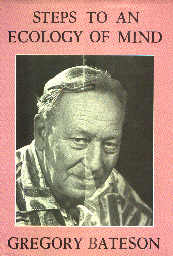
4. Gregory Bateson's Steps To An Ecology of Mind
Writing a review of this book is like doing the Encyclopedia Brittanica — where do you start? What do you leave out? It would require a review of each lecture and article contained to do justice the encyclopedic content of the book. Instead I will discuss my reaction to the book in my second reading of it after a 10 year hiatus.
The only way I can think that I could understand the book as well as I do is to have read it ten years before. During that first reading there were large segments of the book that were virgin ground to be plowed — and my plow skimmed the surface of that ground. The new areas of double-bind, schizophrenia, and Russell's Theory of Types certainly attracted my attention back then and have held it since, in no small part as a result of this book. Reading the book again was for me a voyage of discovery — discovering how indebted I am to Gregory Bateson for pointing me to the study of Korzybski, Bandler&Grinder, Milton Erickson, Carl Jung, and others. A section near the end of the book refers to Jung's Seven Sermons to the Dead which I had failed to look up on my first reading and had forgotten even the reference in Steps — even when I had occasion to read Sermons a year or two ago in a study group. Re-reading Bateson's comments on the creatura and pleroma added a cybernetics understanding of the concepts missing in Jung. Bateson added a similar understanding of Jung's concepts of archetypes and the collective unconscious. Bateson's cybernetic story of the Eden myth is worth the price of the book. He identifies the Fall with a Leap into the use of planning by human beings. With planning comes the good of getting what you want and the evil of getting all the unexpected and unwanted side-effects. By all means get the newly printed hardcover copy. My first reading of the mass paperback edition was sheer torture. Just keeping the book from falling apart while you wade through the complexities of thought in small print is a supreme challenge. And well worth it.
5. C. S. Lewis's Studies in Words

In the older books one knows what one does not understand but in the later one discovers, often after years of contented misreading, that one has been interpolating senses later than those the author intended and all the while one seems to be learning not only about words." [italics mine]
Not only about words, but about the evolution of consciousness as it appears in our changing of the usages of words over the centuries. Finding evidence of the evolution of consciousness in word usages is a game I learned from my readings of Owen Barfield's works. So it is not surprising to find that Lewis, Barfield's personal friend, would say, "...the slightest semantic discomfort in one's reading rouses one, like a terrier, to the game."
Early in this philological masterpiece, Lewis warns us of verbicide, or the murder of a word. He lists the deceased: awfully, tremendous, sadism, unthinkable, and significant, as words that have been killed by overuse.
He notes the "tendency of words to become less descriptive and more evaluative." Examples are: bourgeois, noble, and generous. the move from descriptive to evaluative occurs when the word's meaning (all meanings from the past) gets replaced by the speaker's meaning (meanings in the present). Soon the evaluative speaker's meaning becomes the primary meaning of the word. Cool, bad, boss, radical and hot are modern examples of words whose speaker's meanings have changed several times in recent years.
The charm of this book comes in discovering the roots of common words like kind and villain. Kind is the same root word as kin and villain means a person attached to a villa. This helps me to understand how my godfather's name, Bonvillain, came to seem oxymoronic. Originally it would have meant a "good" "villager". How these words got from their roots to their present meanings makes for delightful discoveries between the covers of this book.
Lewis likes to "drive words of different languages abreast" and this makes for an interesting chariot ride all the way to THE END.
~~~~~~~~~~~~~~~~~~~~~~~~~~~~~~~~~~~~~~~~~~~~~~~~~~~~~~~~~~~~~~
Movies we watched this past month:
 Notes about our movies: Many of the movies we watch are foreign movies with subtitles. After years of watching movies in foreign languages, Arabic, French, Swedish, German, British English, Russian, Spanish, Italian, Japanese, Chinese, and many other languages, sometimes two or three languages in the same movie, the subtitles have disappeared for us. If the movie is dubbed in English we go for the subtitles instead because we enjoy the live action and sounds of the real voices so much more than the dubbed. If you wonder where we get all these foreign movies from, the answer is simple: NetFlix. For a fixed price a month they mail us DVD movies from our on-line Queue, we watch them, pop them into a pre-paid mailer, and the postman effectively replaces all our gas-consuming and time-consuming trips to Blockbuster. To sign up for NetFlix, simply go to http://www.netflix.com/ and start adding all your requests for movies into your personal queue. If you've seen some in these movie blurbs, simply copy the name, click open your queue, and paste the name in the Search box on NetFlix and Select Add. Buy some popcorn and you're ready to Go to the Movies, 21st Century Style. You get to see your movies as the Director created them — NOT-edited for TV, in full-screen width, your own choice of subtitles, no commercial interruptions, and all of the original dialogue. Often you get the Director's Cut Edition which adds back excellent footage that was cut from the theater releases. With a plasma TV and Blu-Ray DVD's and a great sound system, you have theater experience without someone next to you talking on a cell phone during a movie plus a Pause button for rest room trips.Hits (Watch as soon as you can. A Don't Miss Hit is one you might otherwise ignore.):
P. S. Ask for Blu-Ray DVD movies from NetFlix.“Yellow Handkerchief” (2008) Will Hurt, hurt and newly out of prison, stars as he teams up with a young odd couple driving to New Orleans, an Uneasy Rider. Gradually his story unfolds and the two teens drive him too see if his estranged wife will revile or welcome him. A DON’T MISS HIT! ! !
“The Sicilian Girl” (2009) true story of young girl who watched her dad get shot in the streets of her home and vowed to get the men who killed him. She kept a diary from then on about the activities in her home town which later allowed the court in Rome to break up the mafia clan for good. A DON’T MISS HIT !!!
“The Oxford Murders” (2008) starring Elijah Wood and John Hurt as the young meets old mathematician/philosopher and vie to solve serial and surreal murders on Campus while they are among the prime suspects or sleeping with them. Truth proves to be stranger than fiction and harder to figure out than the Idiot’s Series. A DON’T MISS HIT !!
"The Magnificent Ambersons (2000)" remake by A&E using Welles’ 1942 original script. Should be called the Malignant Amberson after the son without which everyone would have lived happily ever after and there would have been no movie! Can he ever find redemption for being so mean to his mother’s first love? Hit
“Cheeky” (2000) is a cheeky film, no ifs and plenty butts, about Venetian gal, Carla Borin, who moves to London but leaves her boy friend and panties behind, and such a nice behind it was. Does the Marilyn Monroe stunt many times, flashes a flasher, and pines for her Mateo till he brings the wood.
“Cranes Are Flying” (1957) Russian made film about a couple in love during WWII when the man volunteers for Army duty. They see the cranes flying in a V-formation and he sings a song about them. Beautiful B&W film of the war period in rural Russia, of love found, lost, and remembered.
“A Midsummer Night's Sex Comedy” (1982) Woody is married to Mary Steenbergen, but he, Tony Roberts, and José Ferrer all fall in love Mia Farrow in a comedy of errors and pratfalls on a summer’s night with Felix Mendelssohn serenading the movie audience. A lush experience in every way but sexual.
“Leaving Barstow” (2008) Andrew is out of high school, bored, and his single mom is dating a musician just 4 years old than he is. Can he leave her to this latest of many bed companions and go off to college. His teacher (Webb from JAG) dresses him down, his friend sends off his application behind his back, and he meets a girl. Can anything good come out of Barstow?
“Kings Row” (1942) Amazing story in which double-amputee Ronald Reagan asked “Where’s the Rest of Me?” and goes on from that thought gradually from actor to governor to president of the United States. He saw that the so-called government was criminally taking the legs away from Americans and vowed to fix that problem. A DON’T MISS HIT ! ! !
“Ballad of a Soldier” (1959) A young Russian soldier is a forward observer when four tanks overrun his position. He destroys two of the tanks with his grenade launcher and is allowed to go home for a couple of days to visit his mother and fix her leaking roof. This is the story of his travels home in the middle of WWII. This is a heart-warming story of the people and the kindness he is shown on the way home. A DON’T MISS HIT !
“Lantana” (2001) is a quirky, down-under, driving on the wrong side of the road mystery in which five and a half couples collide in random ways and the dialogue is delicious as each person talking is inadvertently saying things which the listener is going through! Can this be resolved with only one person dying of a doylic memory attack? Can I hear a G’day Mate on that?
“An American Affair” (2008) A teenager watching his comely neighbor (Gretchen Mol) discovers her to be a JFK mistress. Will the warning from the CIA reach JFK in time that his life is in danger? A view from a window and through the bushes through the eyes of a teenager at the seamy underbelly of D. C. pols.
“Big Trouble” (2002) is Big Fun for the viewers: pratfalls, comic collisions of multiple forces like an assassin’s sniper rifle fires a hole in a TV at the same time a teenager is try make a “kill” with a water gun! No heads rolled, no dead bodies, one Russian shot in the toe, three TVs were killed, and one little naked Piggie ran all the way home! A DON’T MISS LAUGHER! ! !
“Intersection” (1994) Gere, married to Sharon Stone has affair with Lolita Davidovich, and his architectural design for his life comes tumbling down. Movie finds a way for both women to think he loved them best at the end.
“127 Hours” (2010) James Franco plays the man who got his right arm caught between two rocks at the bottom of a chasm and had to choose between dying or amputating his own arm. Gut-wrenching and arm-wrenching drama to the end. A DON’T MISS HIT! !
“Town” (2010) Ben Affleck played a Charlestown bank robber. Can love break out during a bank robbery? Can a bank robber break out of Charlestown? These and other questions are answered by this gripping movie. A DON’T MISS HIT ! ! !
“The Next Three Days” (2010) is all the time Russell Crowe has to retrieve his wife from a life in prison for a crime she probably did not commit. Can he do it? A DON’T MISS HIT ! ! ! ! “The Magnificent Ambersons” (2001) remake by A&E using Welles’ 1942 original script. Should be called the Malignant Amberson after the son without which everyone would have lived happily ever after and there would have been no movie! Can he ever find redemption for being so mean to his mother’s first love?Misses (Avoid At All Costs): We attempted to watch these this month, but didn't make it all the way through on most of them. Awhile back when three AAAC horrors hit us in one night, I decided to add a sub-category to "Avoid at All Costs", namely, A DVD STOMPER. These are movies so bad, you don't want anyone else to get stuck watching them, so you want to stomp on the disks. That way, if everyone else who gets burnt by the movie does the same, soon no copies of the awful movie will be extant and the world will be better off.
“Middletown” (2006) is dark Scottish town where the sun never shines and nothing is blacker than the heart of the son returned as a minister destined to tear apart the family he left behind. Not a thriller, but depressing.
“Marmaduke” (2010) has one minute of fun things and 87 minutes of inanities. Waste of Luke Wilson’s voice and several reels of prime movie film. A baby-sitting movie to keep the pre-teens amused perhaps. Or torture prisoners with, probably would violate Geneva Convention.Your call on these — your taste in movies may differ, but I liked them:
“Just Married” (2003) and just plain stupid and klutzy! “I know this honeymoon hasn’t been perfect.” is the understatement of the year. Savaging cars, hotel rooms, and each other across Europe must have made Europe cross. Even the ending is unbelievable.
“Echelon” (2009) is a Bourne Conspiracy Wannabee, but the script is discontinuous and the explanation of what Echelon is sucks, very murky. It’s the Macguffin, so we don’t have to know. At best a Your Call.
“Quid Pro Quo” (2008) Isaac, legs crippled in auto accident at 9, is given assignment to report on wannabe cripples, some who amputate their own legs. He falls in love with a such a woman and finds magic shoes which allow him to walk. Then things gets stranger. This movie dramatically illustrates this outré problem on the edges of society.
“Forever Mine” (1999) in which Josephine Fiennes and Ray Liotta attempt to keep Gretchen Mol as their sweetheart/wife forever, and one of them has to go. Will it be the cabana towel boy or the councilman-thug?
“Lulu on the Bridge” (1998) a lugubrious story of a jazz saxophonist whose life as a musician is cut short by a madman’s bullet. He meets Lulu who becomes the love of his life, miracles happen, and then Lulu faces the bridge. Will she jump? Will Izzy survive her jump?
“Jack Goes Boating” (2010) he might as well, he can’t do anything else, even swim. But a woman comes into his life, and he learns to cook, to swim, and boating is next, if she stays with Jack through the rough parts.
== == == == == == == == == == == == == == == == == == == == == ==
4.STORY:
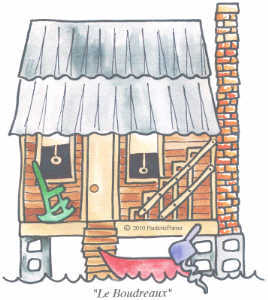
Boudreaux Cajun Cottage, drawn by and Copyright 2010 by Paulette Purser, Used by Permission
== == == == == == == == == == == == == == == == == == == == == ==Boudreaux came home to Opelousas from the oilfield a few days earlier than expected and was awakened about midnight by the phone ringing. Marie was sound asleep so he picked up the phone and immediately heard this man's voice speaking softly.
Boudreaux shouted indignantly, "Mais, how should Ah know?! Dat's a hundred miles away!"
Marie woke up and said, "Boudreaux, what's wrong, Cher?"
Boudreaux replied, still huffing and puffing, "Some maudit idiot woke me up to ax me if the coast was clear! Ah jes' got back from dere, let him go find out fo' hisself!"
== == == == == == == == == == == == == == == == == == == == == ==
5. RECIPE of the MONTH for April, 2011 from Bobby Jeaux’s Kitchen:
(click links to see photo of ingredients, preparation steps)
= = = = = = = = = = = = = = = = = = = = = =Crab Salad with Avocado&Egg
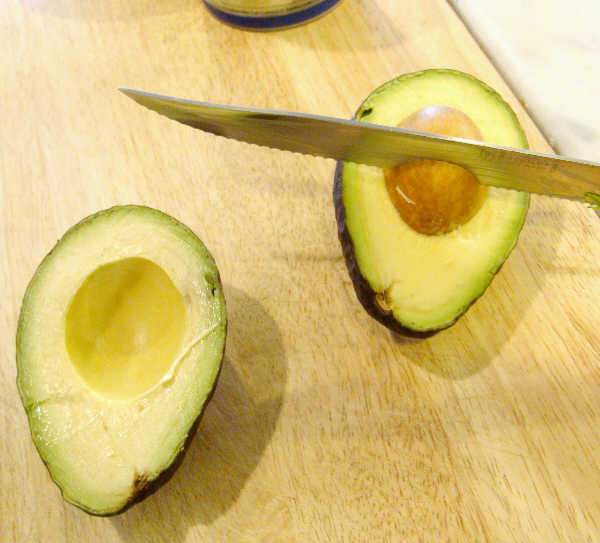
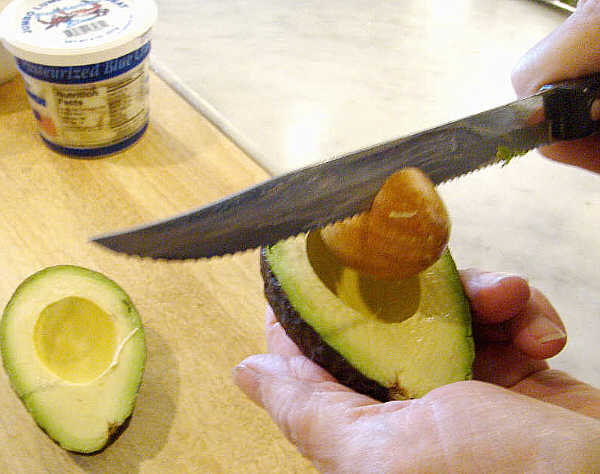
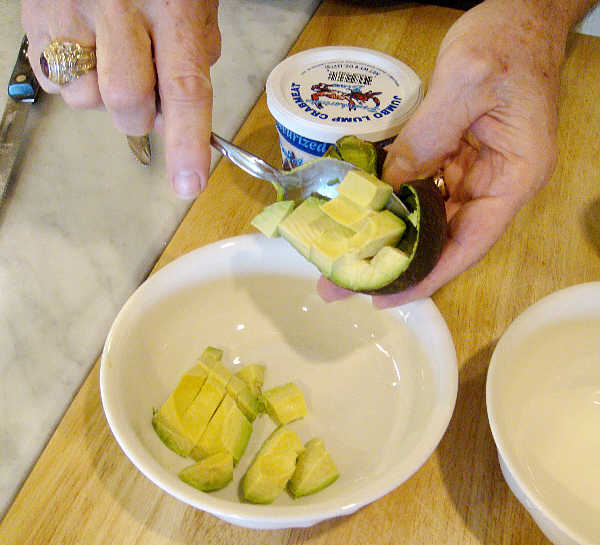
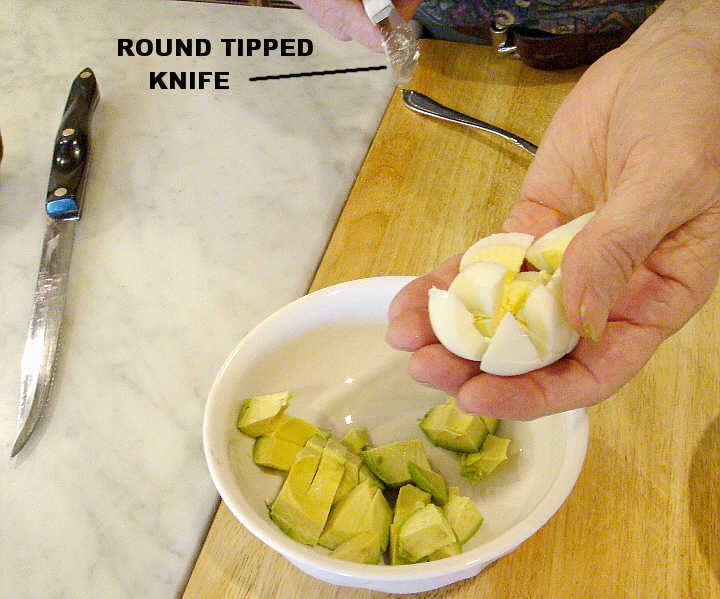
Background on Crab Salad with Avocado&Egg: This is a quick and easy Crab Salad with minimal clean-up required afterward. The key to this salad is the use of Jumbo Lump Crabmeat. The "jumbo" in the name nearly doubles the price, but it is well worth it. Naturally Fresh Ranch dressing is the best available. Make sure the avocado is barely soft to the touch so that it will be ripe and soft for best flavor and texture. The egg should be boiled about 18 minutes for easy peeling. This method of preparation makes no mess on the counter top or in one's hands. See photos of how to dice avocado while still in its shell by using a rounded tip knife. The boiled egg can be diced the same way.
Ingredients
Jumbo Lump Crabmeat (4 oz)
Naturally Fresh Ranch dressing, as needed
Hardboiled egg (1 or 2)
Green onion tips, fresh basil and parsley if available
Preparation
Chop the greens finely to use as garnish.
Cooking Instructions
Slice avocado in half and remove stone as shown. Cut into stone. Rotate stone, remove, and discard stone. Using rounded tip knife, make Rotate stone, remove, and discard stone.lengthwise cuts then crosswise cuts in each half of avocado. Then the chopped avocado can be removed by a spoon without ever having to peel the avocado. With care the peeled boiled egg can be sliced directly in one's hand and dumped into the bowl.Put one half of the avocado directly into one bowl followed by the egg. Add about half the lump crabmeat into each bowl, saving a few choice lumps to top off each bowl. Pour the Naturally Fresh Ranch dressing over these ingredients, and then top with the remaining crabmeat and sprinkle the chopped greens as a final garnish.
Serving Suggestion
Can be served and eaten immediately. Make a great appetizer or a light summer meal.
Other options
A bit of chopped green onion tips add some savor. Sprinkle Tony's Cajun Seasoning for extra flavor.
== == == == == == == == == == == == == == == == == == == == == ==
6. POETRY by BOBBY from Friday, June 29, 2007:
= = = = = = = = = = = = = = = = = = = = = =
Buds and Blooms in Timberlane Rooms
Who can hear the voices of the flowers?
Can you hear the warning of the rose?
“If my blooms you dare to pick,
My thorns will your finger prick.”Can you hear the viola solos wafting from the evergreen Magnolia?
“High above the ground we sing
our interludes in white.”Can you hear the harmony of your gardens?
“Together we harmonize in our buds and blooms
And a choral feast provide for our Gardener’s rooms.”Can you hear the aria of the aspidistra’s articulated tongues?
“Listen while we sing this ditty,
You will find us dirt and pretty.”== == == == == == == == == == == == == == == == == == == == == ==
7. REVIEWS and ARTICLES for April:
= = = = = = = = = = = = = = = = = = = = = =And for my Good Readers, here’s the new reviews and articles for this month. The ARJ2 ones are new additions to the top of A Reader’s Journal, Volume 2, Chronological List, and the ART ones to A Reader’s Treasury. NOTE: these Blurbs are condensations of the Full Reviews sans footnotes and many quoted passages.
1.) ARJ2: Please, Mr. Einstein — A Novel by Jean-Claude Carrière
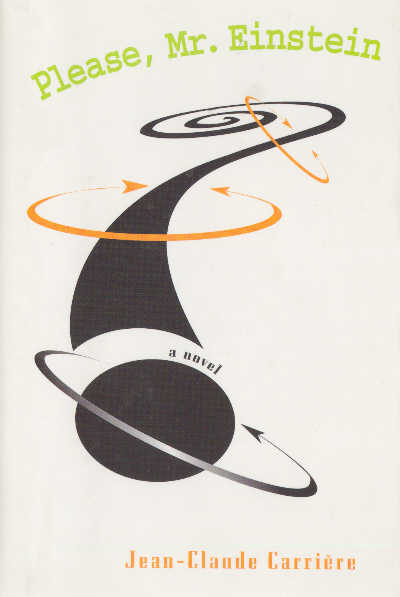
A girl enters an office filled with men with briefcases in some European city and is led into an inner office where she comes face-to-face with Albert Einstein, a curious occurrence because he has been dead for fifty years. He tells her, "I'm very glad to see you." Why, because he says, "It proves to me that the human race hasn't disappeared." Seems as if he thinks he will be blamed if nuclear weapons were to wipe out humanity, but the girl brings him up short, "If humanity had disappeared, who would be left to blame you for it?" (Page 12, 13) Thus begins their conversation about Einstein's life and theories which fills the pages of this book.
She asks him what he means when he says that "thought is like light: it's continuous and discontinuous." The old gentleman spreads out his hands in a gesture and then lets them fall.
[page 16] "Explain, explain. . . People are so demanding, they always want to understand everything. I'll be glad to try to explain. I often have. In any event, I've endeavored to do so all over the place. You can't assert things without attempting to give the reasons for them, but explanations aren't always enough.
"Meaning what? Please explain."
"Come, come, young lady, don't pretend not to understand, because this is the essential point. If one is to explain something to people, they must intend and want to understand. If not, one might as well be addressing a brick wall."
"I do intend and want to understand — to learn something, even, that's why I came straight to you, to your home. I'm not here to ask you to sign a petition, I'm not campaigning for anything and I have no plans to make money off of you. I just want to know a little more. However, from what people have told me and what I've read here and there, the things you say aren't simple."Light, for example, has hiccups, if you examine it very closely, he explains. A long string of hiccups can be thought of as continuous and discontinuous, and that is how light operates. It seems to be continuous until we examine it closely and then we notice the tiny hiccups we call "quanta". She asks him, "What happened in 1905?"
[page 65,66] "Three or four brief articles in a physics journal whose editor was keen to publish me. People have written about them so often. Why bring them up again?"
"I tried to read those articles. I failed."
"You aren't the only one. Anyway, don't bother. Scientific terminology has completely changed since then. Even I might have trouble rereading them, and I'm sure I'd be tempted to correct them if I did — to insert question marks in the margins."
"So reading them wouldn't be worth my while?"
"No, I told you. What you've just seen here in this room — all those interminable calculations, all those assumptions, manipulations and verifications, all that — is just a dark cloud through which we have to pass in order to convince our colleagues of the truth of our conclusions by means of our procedure itself. It's the jargon of our club. We have to conform to it or our membership isn't renewed and we're refused admission. No need for you to venture into it, you'd risk getting lost. After all, you don't refer to the original text when you read something translated from Chinese, you trust the translator. Don't bother!"
"Much obliged," she says.Our ideas are born in light, but must pass through the darkness of calculations so that others may come to believe and understand them.
As for his theory of relativity, Einstein gives a rather droll explanation based on the validity of his theory, something he must have mulled over personally while others waded through the darkness of his equations.
[page 73] Einstein gives another example of what he calls "basic relativity," the everyday kind. In those days he used to like to say of himself, "If the theory of relativity proves valid, Germany will claim me as a German and France will proclaim that I'm a citizen of the world. If my theory is disproved, France will say I'm a German and Germany will proclaim that I'm a Jew."
When Rooster Cogburn in the movie, True Grit, said he moved backwards from the man he had shot, he was asked by the judge to explain exactly which direction he moved. Rooster replied, "When I say I moved backwards, the direction I moved was backwards!" The universe is like that for us. We can pretend it has coordinates in our mind, like the judge did, but to a human being, it's all relative. Einstein was a Rooster Cogburn in the history of science because he saw everything relative to himself.
[page 73] The universe isn't constructed like a house based on architectural drawings and elevations. Top, bottom, near, far — none of those words possess other than a relative meaning, if you give the matter two minutes' thought."
"Is that why you spoke of space-time?"
"In part. So as to coordinate events, to situate them both in space and in time. . . . To put it another way, I situated matter in space-time, which curved in consequence. It bowed to me, so to speak."We seem to need a way to understand the incomprehensible, but Einstein tells us that is futile. "As if," he begins derisively, "the stars were hung in the sky to answer our long-standing questions." He gives us the mantra of the materialistic scientist, which if we hum it long enough, will convince us that the stars which are unreachable during our daytime being must likewise be unreachable to our nighttime being, which seems to me to be the abderian route to absurdity. And, yet, he admits to experiencing feelings — feelings which are the scant daytime bleed-through of our nighttime perception of the spiritual world in which the stars are our intimate companions. But, Einstein avers, he doesn't believe in God.
[page 85, 86, italics added] "Certainly not. In the light of this boundless magnificence, the notion of a divine creator and ferocious chastiser of the only human race strikes me as wholly absurd. Why should such a genius, who encompasses all things in a cosmic dream of unattainable dimensions, pore over our tiny peccadilloes like some persnickety schoolmaster? Besides, as you're doubtless aware, to a scientist all our actions are predetermined, or nearly all. Our free will is extremely limited.
I would say rather, to a dummkopf all human actions are predetermined. To use one's thought to probe the universe and to explain only the physical aspects of the universe all the while ignoring thought itself is a true abderian fiasco. But the physical aspects of the universe are explained and accepted by the dark equations of the members of the club, whose clubhouse entrance is topped by the warning, "Abandon All Free Will Before Entering."
Rightly understood, science pours the material world into the realm of spirit by formulating its laws, while art pours the realm of the spirit into the material world by creating its works of art. To me that is a far better way of understanding science and art than what the girl says in this next passage.
[page 106] "But the arts obscure the mysterious," she says, "whereas the sciences seem to make it their mission to dispel it."
The girl's Einstein disagrees, but only throws more confusion into the mix of obfuscation which at times chunks up in this novel around the ideas of Einstein.
[page 107] Einstein disagrees. It's true, he says, that the arts tend to seek obscurity — that's what they're there for — but they can also arrive at resounding truths that are personally experienced and felt by a very large number of people, whereas scientists are forever roaming from one mystery to another. And, when they think they've discovered some kind of new light, they don't know how to make it acknowledge that discovery. Darkness resists, digs its heels in, builds itself new lairs. Hence the liking scientists cherish for the inexplicable, and hence their attraction to the unknown. (A perverted taste? Who knows?) It's as if vast territories of a potentially hostile, lethal nature have only been awaiting their arrival to reveal themselves ever since the world began.
The next passage contains a wonderful reference to the disappearance of magic contained in Shakespeare's final work.
This metaphor presages the move of science from alchemy to chemistry which was accompanied by human beings turning their view from the spiritual realities to the hard physical realities.[page 107] And to think that there are still some who feel a nostalgia for magic, for the great, encoded secret preserved by initiates, for signs that conceal things, for symbols and numbers! They have forgotten that in The Tempest, at Shakespeare's behest, Prospero consigns his magic book to the ocean bed forevermore. His charms and spells are "O'erthrown," tossed overboard. He abandons them and goes home. A huge page turned at the beginning of the seventeenth century. Copernicus was dead and Galileo hard at work, Descartes had already been born. A brave new world was in the offing. Elves and goblins were disappearing who knows where, fairies were in hiding. The last witches were being burned at the stake by frenzied fanatics.
Soon, the everyday experience of elves and fairies disappeared from adult eyes, remaining only in the eyes of the newborn until they reached about three years old. What remained were the dregs of the coffee whose aromas filled the nostrils of humans for ages. Scientists today claim that the humans who smelled the aromas and saw directly such visions of the spiritual world as elves and fairies were hallucinating.
Einstein at one point in the novel refers to himself as a "model" because at every place he went to speak, he was photographed. Once he stuck his tongue in disdain for the photographer with the camera and that became one of his most famous images, as though he did it often instead of only once. When the renown scientist Arthur Eddington confirmed Einstein's prediction of the curvature of space in 1919, curiously it was the golf correspondent for the New York Times which reported the scientific breakthrough.
[page 134] He is photographed on each of this public outings, so much so that he once declared that his true profession was that of a photographer's model. In 1948, on emerging from the hospital after a brief admission for surgery, he sticks out his tongue at one of the photographers who are pestering him, and this impish image remains a twentieth-century icon, even today.
When people suggested that his theories could produce a bomb that could destroy the world, Einstein thought it was idiotic and impossible.
[page 136] "I didn't believe that one of my equations could unleash the Apocalypse. They hadn't been conceived with that in mind, of course. They were research, pure and simple."
When his fellow scientists came to plead with him to write the letter to President Roosevelt suggesting a way to end World War II, Einstein was taken aback. How could he suggest such a thing be created from his own ideas?
[page 138, 139] "I was in an exceptionally dramatic position. Can you imagine? There was a possibility that the fate of the planet was being decided in this little seaside house, which a doctor friend had lent me. We knew that the fission of uranium had been achieved and that several teams were on the way to producing a chain reaction."
Back then, no one imagined the atomic bomb could be made small enough to be carried on an airplane, so it was thought that only port cities were endangered by a large ship carrying the bomb into a harbor. That was what he wrote in the short letter to Roosevelt which he signed on August 2, 1939. When the bomb was finally used for the first time, on Japan instead of Germany, he listened to the event on the radio like everyone else. He reportedly called it a "calamity." (Page 152)
But his biggest calamity was the thought experiment he teamed up with two graduate students, Poldosky and Rosen, to show that quantum mechanics had a fatal flaw, a paradox, which their thought experiment revealed. The girl wants to know about the EPR Paradox.
[page 168] The girl now alludes to the old EPR paradox to which Einstein lent his initial (the others being those of Poldosky and Rosen), the crucial — more recent — experiment conducted by the physicist Aspect and the research carried out by other experts of whom she has heard. What about these particles that receive information instantaneously, wherever they happen to be in the universe, as if space and time had no hold over them. As if they ignored and dominated them — or constituted them? — and as if non-localized influences faster than light were at work? What about them?
The unthinkable has been proved possible! And necessary! It revealed Einstein's biggest difficulty — he had to give up thinking. Perhaps that T-shirt with his tongue sticking out is the crux of his message to the world in which he found unthinkable things happening.
[page 169] I can't bring myself to admit defeat and say: Beyond a certain point the world is genuinely inexplicable, prodigiously incoherent and fundamentally paradoxical, and I will never know how or why. I will never be able to say that. You asked me the question on arrival, remember? You asked me to explain, and I told you that explaining is the hardest thing in the world. Now do you see why? Because I'd have to explain that we must give up explaining. And I never would! It would mean going against all that made up my life. Was I lionized, feted, decorated, celebrated, showered with awards and praised to the skies, only to take my leave, sticking out my tongue for the last time and saying: Ladies and gentlemen, I've been no earthly use, I've floundered around in ignorance, I don't know what to say to you and I'm making for the exit bereft of ideas?"
The girl, whose name is never revealed in the novel, leaves us with a delightful metaphor which I call the Puddle's Kern, a deep element of truth about the minds of some people.
[page 171] Just for fun, the girl speaks of a puddle formed in a potholed road after a shower of rain. Suddenly endowed with reason, the puddle explores the ground around it and cries, "What a miraculous coincidence! My shape and dimensions exactly match those of this hole in the road! That means I was meant to be at this particular road! There's no doubt about it, so what other purpose could I serve?"
Some minds, she says, are shaped like puddles.Einstein's mind was not such a mind, it did not fit into the puddle of science or even into the puddle we call the universe. He managed to extract some meaning from the world that no one else ever imagined and the result was, as he saw it, a cataclysm. Instead of a puddle, perhaps the world is a muddle. "It's an everlasting muddle. The world is our muddle. And yet, whatever the object of our work, it's always the world of which we're thinking. It's all we have." As the girl leaves, he waves to her, and picks up his violin to play it. Will he perhaps play Schoenberg for the first time?
Read the Review with its two Footnotes at:
http://www.doyletics.com/arj/pleasemr.htm2.) ARJ2: Healing — The Sufi Message by Hazrat Inayat Khan

The first part of this book, Healing, was published as a separate volume in 1931, and its content is so valuable and needed in today's time when Japan has just endured a great earthquake, tsunami, and nuclear disaster. When spirits and hopes of the world are the lowest the need arises for powerful spiritual forces of the kind Hazrat Inayat Khan gives us in his writings. Over a period of ten years, I acquired all 12 volumes of his Sufi Message, of which this is Volume 4. I read and studied all of them, some of them more than once. This volume I read during a two month period in 1985 shortly after I bought it and I read it again during a two-month period in 1987. It was as if I had to re-confirm the powerful insights from my first reading that forced me to read it again. Nearly every page is filled with important ideas and concepts which are clearly marked by my marginalia which stare up from the pages to me as if pleading to be shared with the waiting world. For them, I interrupt my already full schedule of books to read, study, and review in order to share Hazrat Inayat Khan's thoughts with you as I first encountered them 26 years ago. In addition I will share with you how those thoughts have infused into me and my life during the same time period.
[PREFACE] When Health, the first book of this volume, was published in 1931 it met with great interest, for it is just as rare to find a book on spiritual healing in which the advance of modern medical science is appreciated, as to find acknowledgment of spiritual healing in a medical textbook. Hazrat Inayat Khan, the Sufi mystic, has set forth in the lectures and other papers included in Health, which were originally intended only for his pupils, the basic laws governing the divine healing power as well as several methods for its application. As with all mystical knowledge, the printed word alone can never confer the power and knowledge of healing upon anyone; a guide, a teacher is essential; but the reader will find in Inayat Khan's sober but profound words a wealth of material for further thought and meditation.
"Illness is an inharmony, either physical inharmony or mental inharmony, the one acts upon the other." The Cambridge educated mystic Hazrat Inayat Khan begins his book on Health by coining the word inharmony to speak about the origin of illness. Note how similar in construction is the word in-harmony to the more familiar word dis-ease. The word disease stems from the metaphoric expression dis-ease, meaning a loss of ease, comfort, or harmony in a human being. Every word begins as a metaphor, but over time and long familiarity the new word becomes just another word and most people lose sight of the power of its metaphoric roots. What is the power of harmony which brings us sustained health?
[page 15] If one continues to think harmonious thoughts it is just like regular beating of the pulse and proper circulation of the blood; if the harmony of thought is broken, then the mind becomes congested. Then a person loses memory; depression comes as the result, and what one sees is nothing but darkness. Doubt, suspicion, distrust, and all manner of distress and despair come when the mind is congested in this way.
Thinking back to that first reading of mine in 1985, I recall that I was surrounded by inharmony in so many ways in my life. I didn't like the work I was doing, I didn't like the people I was working with, and I was searching for answers out there in the world as to why this was the case. I remember noticing some folks in my world who suddenly sprouted curly hair, women and men both with previously straight hair, got permanent waves and their hair suddenly became kinky.
Since water hoses with kinks in them have restricted flow, I imagined that their lives had kinks which restricted their flow, so I began to avoid such people, not based on their hair style, but rather their restricted life style, which superficially might be represented in their mode of hairdo.[page 16] Besides . . . the harmony of the body and the mind depends upon one's external life, the food one eats, the way one lives, the people one meets, the work one does, the climate in which one lives. There is no doubt that under the same conditions one person may be ill and another may be well. The reason is that one is in harmony with the food he eats, with the weather he lives in, with the people whom he meets, with the conditions around him. Another person revolts against the food he eats, against the people he meets, against the conditions that surround him, against the weather he must live in. This is because he is not in harmony; and he perceives and experiences similar results in all things in his life; disorder and illness are the result.
In 1976 I had moved back to the New Orleans area because I had decided that the weather, the food, and the people suited me better than any other place I had lived from the West Coast to the East Coast of the USA. I had to create a new set of friends, and among this new set were some who qualified as the kinks that I needed to weed out. They were all interesting people, especially the kinks, so it took some prodding from my study of Inayat Khan to begin the weeding out process. If you simply stop seeing or talking to a person over a long enough time, they disappear gently from your world, so this process can be done without hurting others. How was I to deal with a job which turned into one I no longer enjoyed doing? This was a big challenge. In my previous job history, I changed jobs every three to five years and by 1987, I had been in this one job already six years, and it provided me job security along with unfulfilling assignments. Note the similarity of unfulfilling and inharmony. Instead of getting upset, which brings with it inharmony, I worked on figuring out how to survive and thrive in an otherwise deadening environment.
In addition to inharmony in my work assignments, I had to work long hours, often 60 to 84 hours a week, six and seven days a week. Plus there was my hour plus drive each way to and from work. With fulfilling work, I could work earnestly and gladly for long hours as I did many times before in other jobs. But how to deal with long hours and unfulfilling work added to a long commute time? So I worked on these conditions as I do on other problems. The solution came when I realized that I could train myself to read while driving. That would give me a minimum of two hours a day during which I could study the many subjects I was interested in. Was it safe? I had read twenty or so years earlier a short study in Scientific American that if your eyes glimpsed the road ahead at least once every four seconds, you could drive safely at about 60 mph. That was usually the top speed I drove on my commutes. I trained myself to naturally interrupt whatever I was reading and glimpse at the road for curves, blockages, slow vehicles, etc.
On straight roads, especially Interstate highways, it was a snap. With my rack-and-pinion steering automobiles, I hardly had to move the steering but once every four seconds. There was another fact I had accumulated over the years: our peripheral vision, even though it lies outside of our sharp foveal vision region, picks up objects-in-motion better than foveal vision. So while I was reading and driving, I would notice important details such as a car approaching an intersection from the right or left, even though my eyes were focused on the reading material on my steering wheel. In addition, I learned to drive about five miles per hour slower than the prevailing traffic in the area. That kept me from sliding over the speed limit and also allowed for traffic to have to pass me up instead of vice versa. If I encountered a slow moving vehicle in front of me on an open highway, I had to decide either to pass it and slow down. Since I was reading, I was rarely in a hurry to get where I was going, so going slower was usually the better option as it got me there on time and maximized the amount of time spent reading.Was I driving safely? Figure it out for yourself. I drove 80 miles a day for 300 days a year for 14 years or 336000 miles, and that's only commuting miles, without a single accident or speeding ticket. My insurance company which pays more attention to safety than paranoia calls me a very safe driver. The only moving accident I had came after I left the unfulfilling job and was driving on an Interstate one afternoon while not reading. If I had been reading the 18-wheeler Dump Truck would not have escaped my noticed as it barreled up behind me from a down ramp and caught my left rear wheel bringing it to a stop and causing my small Geo Metro LSI to slue 90 degrees left so I found myself being pushed down the center of the highway at 50 mph sideways! The truck stopped and I drove the car off the highway and home later. No injuries, except for the driver's side door was slightly collapsed.
The weather in New Orleans I learned to cope with by simply removing as much clothes as necessary until I was comfortable outside.
Avoid the middle of the day outside in summer, but enjoy the early morning newspaper moment (when I retrieve the Times-Picayune from the yard) and the mild, dry twilights after the heat of the Sun has squeezed much of the relativity humidity from the humid Gulf of Mexico air.After fourteen years, I had to resist a shout of Hooray! when I found that I was being forced to retire at age 55. I wanted to yell like B'rer Rabbit, "Please, Massah! Don't throw me in that briar patch!" I had managed to fill my otherwise unproductive time by writing and now I was going to be able to spend full-time working at my reading and writing. I must say that I rarely reach the two hours a day of good concentrated reading that I did when I was commuting two hours every day.
Not everyone is a reader, but each person can find something productive to do with their unfilfilling hours of each day that will lead them to a fulfilling life — a life filled with harmony instead of disharmony, with ease instead of disease. If one doesn't manage to do this, the result can be revolting.
[page 16, italics added] There is no doubt that under the same conditions one person may be ill and another may be well. The reason is that one is in harmony with the food he eats, with the weather he lives in, with the people whom he meets, with the conditions around him. Another person revolts against the food he eats, against the people he meets, against the conditions that surround him, against the weather he must live in. This is because he is not in harmony; and he perceives and experiences similar results in all things in his life; disorder and illness are the result.
Everyone knows that arsenic is a poison and should be avoided at all costs. The US bureaucracy went so far as to make the slightest traces of arsenic a violation of an environmental standard. While they were doing that, I was reading in Rudolf Steiner about how a slight trace of arsenic can bring a pale, weak person back to robust health! Hard to believe that one chemical could have such dramatically different effects on a human being. Many of the medications prescribed by Steiner are homeopathic medications versus the allopathic medications we are familiar with from our large drug companies. Instead of fighting a disease like allopathic drugs strive to do, homeopathic remedies cause the symptoms of the very disease one is trying to eliminate and thereby triggers the body into creating the healing desired.
This is similar to what happens during an inoculation. To combat smallpox, a cow pox virus is entered into the blood stream and the antibodies form to prevent one from ever having a full-blown case of smallpox.[page 16] This idea can be very well demonstrated by the method that present-day physicians have adopted, of inoculating a person with the same element which makes him ill. There is no better demonstration of this idea than the practice of inoculation. This puts a person in harmony with the thing that is opposed to his nature. If one understands this principle one can inoculate oneself with all that does not agree with one, and with that to which one is continually exposed and from which there is no means of getting away. Woodcutters do not as a rule get sunstroke: seamen do not catch cold easily. The reason is the former have made themselves sunproof while the latter have made themselves waterproof. In short, the first lesson in health is the understanding of this principle, that illness is nothing but inharmony and that the secret of health lies in harmony.
Man has all of creation within him: earth, water, air, and spirit. As Inayat Khan says on page 17, "he is the fruit of the whole creation, he ought to be able to show his evolution in his balance." This advice mirrors that of Rudolf Steiner, an Austrian mystic and philosopher, who urged that we remove both the lows and the highs from our physical existence so as to maintain our balance as a full human being.
[page 17] When a person becomes sensitive to every little thing that he comes across, it changes the note of the tone; it becomes a different note to which his body is not accustomed; and that causes an illness. Too much despair or too much joy, everything that is too much should be avoided, although there are natures who always seek extremes; they must have so much joy and amusement that they get tired of it, and then they have a collapse with sorrow and despair. It is among these people that you will find continual illness.
Our body both philosophers Khan and Steiner tell us is a delicate instrument which must be kept in tune and not allowed to be knocked by everyone who comes by or it will get out of tune and out of order and out of harmony. How do we keep our divine instrument in order, in tune? By the food we eat and the air we breathe. If we imbibe alcohol, we are ingesting a substance which our body makes internally from the food we eat and this gets our body out of tune because it has too much alcohol. If we ingest tobacco in any form, our heart rate speeds up in relationship to our breathing causing the effect we misname, "shortness of breath". Our breathing gets out of kilter and we do not get enough air and our body goes out of tune, subjecting us to repeated infections of various kinds. We must keep our divine instrument in tune and clean.
[page 18] And how should we clean them? By carefulness in diet, by sobriety, and by breathing properly and correctly; because it is not only water and earth that are used for cleansing, the best means of cleansing is the air and the property that is in the air, the property that we breathe in; and if we knew how by the help of breathing to keep these channels clean, then we should know how to secure health.
We mentioned earlier how nicotine can cause a rise in the pulsation of the heart, but among those who never use tobacco, there is a very common way of increasing the pulse rate, and that is watching the news. What qualifies as news seems to be whatever is the latest catastrophe. We have seen the Iceland volcano spew ash over Northern Europe, BP spew oil over the Gulf of Mexico's waters, earthquakes in Haiti, and the latest combination of earthquakes, tsunamis, and nuclear catastrophes in Japan. These catastrophes are objective events existing out in the world but we let them inside of our body through the process of fear. They disrupt our rhythm and throw our body out of tune, out of harmony.
[page 18] If a person suddenly hears of something causing fear the rhythm is broken, the pulsation changes. Every shock given to a person breaks this rhythm. We very often notice that, however successful an operation, it leaves a mark, even for the rest of one's life. Once the rhythm is broken, it is most difficult to get it right.
Our rhythm when it is disrupted must be returned slowly and gently to its proper state. The best method is "regularity in habits, in action, in repose, in eating, in drinking, in sitting, in walking, in everything, gives one that rhythm which necessary and which completes the music of life." (Page 19) A child does not know how to do this but needs a mother's love and soft caress to restore the child to a balanced rhythm, after a fall, bruise, or any hurt. Each time the mother does this for her child, the child is enabled to grow into a adult who will know how to do this on one's own.
[page 19] When a child's rhythm and tone are disordered, the healing that a mother can give, often unconsciously, the physicians cannot give in a thousand years. The song she sings, however insignificant, comes from the profound depths of her being and brings with it the healing power. It cures the child in a moment. The caressing, the patting of the mother does more good to the child than any medicine when its rhythm is disturbed and its tone is not good. The mother, even without knowing it distinctly, feels like patting the child when it is out of rhythm, singing to the child when it is out of tune.
Church bells seem to ring much longer than would be necessary to simply mark the hours of the day, don't they? I never thought about the importance they play in healing, up until now. The ringing of the bells for the Angelus at 6 am and 6 pm in country churches signaled a time for the farm folk to bow their heads in silent prayer. This healing pause to begin and end each day has passed into desuetude unfortunately. I know when Del was born on April 12, 1945, the church bells were chiming all throughout the city for a long time, and across America also, because of the death of our beloved president Franklin Roosevelt. Undoubtedly it did much to help her achieve the good health she has sustained over her lifetime. The extensive chiming of the church bells for mourning a loved one also has the effect of helping the mourners to restore their body's natural rhythm and maintain their health. It is a wisdom of the ages that is lost on so-called modern people of today.
[page 20] There used to be a custom in ancient times, that instead of using an organ in churches four or five persons with the lips closed used to keep one tone, humming that one tone together. I was most impressed by this, hearing it again in a church in Russia after coming from India. The secret of the continual ringing of the bell practiced by the churches at all times and even up till now, is that it was not only a bell to call people; it was to tune them up to their tone, it was to suggest, 'There is a tone going on in you, get yourself tuned to it!!' But if that tuning is not done, even if a person has recovered from his illness, weakness still remains. An external cure is no cure if a person is not cured mentally. If his spirit is not cured the mark of illness remains there and the rhythm of mind is broken.
When one walked with Hazrat Inayat Khan, it was not a simple walk. After reading some 15 volumes of his writings, I can say that I have walked through many pages with this Sufi mystic and philosopher and experienced his manner of talking and walking.
[page 20] Once a pupil who accompanied me on my walk, in spite of all his kindness and pleasure in accompanying me, felt a great discomfort at times because he could not walk as slowly as I did. Being simple and frank, he expressed this to me. And in answer I said, 'It is a majestic walk.'
Our body is like a car's battery which will run-down if it is not recharged on a regular basis. When it runs down long enough, the battery will die. All the things which maintain the body's rhythm help to recharge it and keep it running. In this next passage, it seems as though Inayat Khan is saying, "A stitch in time saves nine lives!"
[page 22] Death is a change that comes through the inability of the body to hold what we call the soul. The body has a certain amount of magnetism, which is the sign of its perfect running order. When, owing to illness, the body, either suddenly or gradually, loses that magnetism by the power of which it holds the soul, it so to speak helplessly loses its grip upon something that it was holding; and it is this losing the grip that is known to us as death. . . . If there is a something a little wrong with it, one neglects it, absorbed in life as it is, and so allows it to become worse every day, drawing closer thereby the death which otherwise could have been avoided.
We are drawing nearer in the book to where my acronym for health comes into play frequently, EAT-O-TWIST. It means simply, Everything Allways Turns Out The Way It's Supposed To. In all things and in all ways, what we suppose to happen in the world will happen if we keep supposing it long enough. Taking care of oneself after an illness is not enough — one must also change the supposing that goes, "My illness may return." Inayat Khan says it this way, "It is as necessary to take care of oneself as it is to forget about one's illness." (Page 24) It is not easy to do. Try to forget about a pink elephant, for example. Now what color was it? See. But with practice one can learn to think of health returning and staying around, and by supposing that reality, i. e., believing in it, the specter of the recent illness will dry up and blow away.
To do otherwise is to keep the disease around or bring it back. The supposing of health within, and supposing is something which each of us has control over, will show itself in the form of health without, that is, in the outside world of our body.[page 25, 26] As long as the patient believes that he is ill he is giving sustenance to that part of the disease which is in the subjective world. Even if the germs of the disease were destroyed, not once but a thousand times in his body, they would be created there again; because the source from which the germs spring is in his belief, not in his body, as the source of the whole creation is within, not without.
To seek first the Kingdom of God, rightly understood, means: 'Rise above the facts first, and by the light that you gain from there, thrown upon facts, you will see the facts in a clear light.' Simply put, EAT-O-TWIST!
[page 27] There is no lack of honesty if you deny the fact of illness; it is no hypocrisy if you deny it to yourself first. It is only a help, for there are many things in life that exist because they are sustained by your acknowledging their existence. Deluded by outwardly appearing facts you hold them in your thought as a belief; but by denying them you root them out, for they cannot exist when starved of the sustenance for which they depend upon you.
If you suppose your disease to be in control of your body, EAT-O-TWIST! EAT-O-TWIST never breaks. Why fight it? If it always works, why not put it to work in your favor, in the favor of your health and well-being right now? Do you need some money-back guarantee for something which is offered to you freely without price? Given that it always works, you have a choice when you see a friend has caught a cold: you can think either, "I will catch cold." or "I am healthy and will remain so." Which supposing do you naturally do? What would keep you from making the healthy choice? Do you suppose that you cannot change your own supposing? EAT-O-TWIST!
[page 28] We often see that the more a person is afraid of a thing, the more he is pursued by it, for unconsciously he concentrates upon it.
If you have a fear, it's time to change your supposing. First remove the fear by a Speed Trace so you will no longer have bodily states from the fear stimulus, then change your supposing about the fear, suppose it to have been an artifact of your early pre-five life that has been returning given the right trigger every time, up until now. Then create new supposings for yourself about the same situation from now on. I could not recommend this procedure to you if I had not used it many times over the past twenty-five years.
Here is one example. About ten years ago we had planned an auto trip to the far north in the winter time. I woke up the morning we were due to leave, stood up and experienced a huge wave of vertigo which sent me falling back into bed and for minutes later the room continued to swim around above my head. Fears about this being a permanent condition came into my head and I invited them to leave immediately. I remembered the only other time I felt the room dance around my head. I was 17 and had been drinking a lot of beer that night. It was horrible. I decided immediately to do a Speed Trace on the vertigo and dizziness, which was easy because the symptoms were still raging. They disappeared as I completed the trace, and I immediately began to suppose that the vertigo was triggered by some sinus condition which called up some severe dizziness from my childhood. I completed my supposing that this vertigo had now played itself out completely and any future episodes would be merely minor ones caused by rising out of bed too quickly. For over a decade now, that has been exactly the case and I suppose it will continue to the case.
The other option is for someone to ponder their illness for so long that the very pondering fuels the illness. This is not a practice to be commended to anyone, but considering it will allow many to recognize the syndrome and thereby avoid it before it gains control over their own life.
[page 29] Then there are others who become too careful, they think of nothing else except their illness. The first question before them is, 'How shall I get well?' Pondering upon their illness they give a kind of fuel to that fire of illness from their thoughts, keeping it burning; they do not know that by their unconscious effort the illness is kept alive. In order to keep the health in perfect order one must keep a balance between body and mind, between activity and repose; and it is the psychological outlook on one's health which helps more than any medicines.
Khan visited a patient who had been treated for an illness for twenty years and was still unable to move. He gave her a simple thing to do in the morning and evening. To the surprise of everyone she became able to move her arms and legs. Yet, the patient had been so inured to her illness that she couldn't believe it was gone. The doctors said, "This illness has made such an impression upon her that she thinks that it is nature for her, and that to be well is a dream, an unreality." Instead of the disease holding her, she was holding onto to the disease!
Doctors often create diseases by giving them a name, which allows patients to hold onto the disease. Dr. Axel Munthe reported that his cases of appendicitis began falling off when it was reported that American doctors were cutting away appendices. His patients wanted a disease that was safe from the surgeon's knife and colitis came along to solve their problem, or rather to give another name to it. Soon his office was filled again, this time with colitis patients. One can laugh at this folly, but consider this, the most frequent complaint which gastroenterologists have to deal with today is irritable bowel syndrome, the latest in a long series of names for the same symptom.
[page 30, 31] As medical science has advanced in modern times the different diseases and complaints have become more classified. Each separate complaint has been given a name, and in this way even if a person has only a slight complaint, after the examination by a physician he is told its name. His complaint may be only as big as a molehill, but it is turned into a mountain. There is no greater misfortune than hearing from a doctor that one has contracted an illness which is dangerous, the name of which is frightening. What then happens? That name being impressed on the heart of the man, creates the same element and in the end the man sees the thing come true about which he was told by the physician. In the same way the impression that the words of a fortune-teller make upon one in many cases brings about the realization of his fortune-telling in the end.
If the doctor is a wise doctor, as Dr. Ellenbroeck was in the 1970s, he might take the name of the disease and turn it into a verb. Consider what happens if you change from saying, "I have acne!" to saying "I am acne-ing!" The first is a solid condition you have, and the second is something you are doing. When the good doctor used this approach on the teenagers who came to see him, all of whom were suffering from severe acne, their acne condition began to clear up after a short period of going around thinking, saying, and therefore supposing, "I am acne-ing." Most of them decided that if it was something they were doing, they could just as easily stop doing it, and their acne went away. EAT-O-TWIST!
Our doctors are less wise in many ways than ancient doctors who refused to give their patients a name for their condition. A modern doctor might suppose, "Well, they just didn't have a name for many diseases." A truly modern thinker might suppose, "Well, they knew better than to create a permanent name for some otherwise temporary condition their patient is going through."
[page 31] Among ancient people only the physicians knew the names of diseases; but the physician was not allowed to tell the patient what complaint he had, because from a psychological point of view he would be doing wrong. This was not only a medical science, there was a psychological idea attached to it.
Wise doctors do not project their own supposings upon their weakened and susceptible patients, after all, doctors are bound by their oath to first of all, do no harm. Yet, it happens.
[page 34] I knew a person whom a physician had examined and had told that he would die within three months. No doubt if that person had been imaginative he would have taken that impression. But he came to me and he said, 'What nonsense! Die in three months! I am not going to die even in three hundred years from now.' And to our great surprise within three months the doctor died and this man brought me the news! We must learn to respect the human being and realize that a human soul is beyond birth and death, that a human soul has a divine spirit in it, and that all illnesses and pains and sufferings are only his tests and trials. He is above them, and we must try to raise him above the illnesses.
You may have heard of a famous physician called Avicenna, but perhaps you didn't know he was a Sufi or that he operated completely using his intuition.
[page 35] Avicenna, the great physician of ancient times, on whose discoveries medieval science was based, was a Sufi who used to sit in meditation, and by intuition he used to write prescriptions. Just lately a physician has discovered the great treasure that this man had given to medical science and has written a book to interpret the ideas of Avicenna in modern language.
Instead freeing patients from their disease, many doctors insist on locking up their patients because of the disease, as if trying make sure the patient continually ponders the disease which has them captured. An interesting example of this rush to confinement happened within a few miles of where I live.
A young girl of about 14 in a junior high school gave birth in the Girls' Restroom (WC) at the school, completely unattended. The baby went home later, perfectly fine. But the EMT's noticed that the girl was still bleeding and seemed have another baby inside so they rushed her to the hospital where doctors successfully delivered the second baby. She had twins. The first one born in an unsanitary girl's toilet, the second one born in a modern sanitary hospital, delivered by a doctor. The first one went home healthy, the second one developed a serious bacterial infection and had to kept in the hospital for a week before recovering.[page 37] The system that we know today of keeping patients shut up in hospitals, in asylums, is just like making them captives to the disease. The atmosphere of the place and the very thought of being in the hospital make them feel ill; and so it is with the life in asylums. . . . They could be helped better than by putting them in places where they can think of nothing but their illness. I have myself seen many cases whom relations or friends have looked after, and they have been helped much more than by what they would have received in a hospital.
What is this power of supposing? It is a free will choice of a human being to exert one's own power of spirit over some matter in the world. One might say, "Okay, this only happens in insignificant things, its power is surely limited." And one would be wrong in saying that, as the evidence is great to the contrary.
[page 39] One often wonders to what extent the spirit has power over matter; and the answer is that, as matter is the outcome of spirit, spirit has all power over matter.
"Every miracle is a change of attitude." That, in essence, is the meaning of "The Course in Miracles". A popular Earl Nightingale course in the 1970s stressed the importance of attitude to success in life. Inayat Khan stresses the importance of attitude in one's return to health.
[page 40] The mystics have always known and practiced in a most perfect way the idea which is generally talked about in its most elementary form — the idea that by repeating to oneself, 'I am well, I am better, I am better,' one becomes better. There are many who do not see any reason in it, but you will see that in time the most materialistic people will come to realize the truth that it is the attitude of mind, the willingness to be cured, the desire to get above one's illness, the inclination to fight against disorder, which help one to health.
In addition to the above, Inayat Khan offers a prayer to be said every day, with every thought. With it one focuses on healing, purifying, and perfect health.
[page 48] One should think, 'Every ray of the sun cures me, the air heals me, the food I take has an effect upon me; with every breath I inhale something which is healing, purifying, bringing me to perfect health.'
Inayat Khan says that there is one illness for which there is no remedy, the imagination.
[page 48, 50] In every illness the imagination plays its role. The greater the imagination, the greater becomes that illness. . . . With children pain increases with imagination, and therefore the one who understands this can stop the pain of a child more quickly than by medicine, for the child is responsive to suggestion. A grown-up person who holds his imagination in hand and does not let it loose, is difficult to help, but a child can be helped in a moment. A child may be crying in pain, and in a moment's time, if you can get its imagination away from it, you can cure it.
But, if there is no remedy for the imagination's power, that selfsame power can be redirected to healing.
[page 50] But at the same time imagination plays a great role, and it is better for a person to analyze to what extent imagination plays a part in his complaint. And he may analyze it by trying to forget his pain, to forget it entirely, by trying to deny facts which stand before him as evidence of illness. When a person is able to do so to that extent, then he will be able to realize how much of it is illness and how much imagination. He will also observe this phenomenon: that as soon as he withdraws his imagination from his illness, he starves his illness of the food which maintains it; and it is possible that by this starvation illness will die.
This all sounds rather far-fetched, I'm sure, to those who have not watched this process in operation, but Inayat Khan has done so on apparently many occasions. Take this next example.
[page 51] I have often made an experiment with a person who said he had got a very bad headache. I have asked him to sing, and in the end he found that he was cured. Anything that take the mind away from the imagination of the illness cuts down the props that support the illness; then the illness cannot stand on its feet. There must be something to hold it, and that is the imagination.
When I was thirty-five, I came down with red measles. I didn't know I had red measles, after all, I had already had them as a child, and my mother who raised four boys when I was a child, knew what red measles looked like. My local doctor couldn't diagnose my symptoms, so he sent me to an internist. I sat in the office after the doctor interviewed and probed me, and through an open door I noticed the doctor with a fellow doctor poring through a large medical reference book! My imagination ran wild. What horrible disease could I have to cause such consultation to take place? The doctor came in shortly and said, "Don't worry. It's rare we get an adult case of red measles. We simply wanted to be sure of the symptoms." I was relieved to know the cause of the red spots on my body and why I couldn't stand to have any light on in the room. What I didn't understand at the time was why my body decided to give me a second case of red measles at exactly this time. Looking back years later I realized that the shenanigans of my wife to which I became privy during that week I stayed at home in bed were instrumental in my leaving her and returning to New Orleans. My illnesses gave me permission to stay home inactive all week. That is one of the prime benefit from an illness: permission to do something you wouldn't do under any other circumstance. The other prime benefit on an illness: protection from something that would have happened to you if you had not been ill.
Another example of the permission benefit: a young man, who was in a psychotherapy group I ran back in the 1970s, was very active and an animated speaker. He basically talked all the time, filling the air time so few others got to speak. He had been sick for a week and I asked him the protection/permission questions. First: what would have happened to you if you had not been sick? "Just more work," he answered. Then: what did not happen as a result of you being sick? "Nothing," he said. So I questioned him further about what he actually did while he was at home. Some friends had visited him and during those visits, and because he was ill and didn't feel like talking, he had some intimate conversations with his friends that would not have happened but for his illness. This is the type of analysis which one can apply in one's own life in regard to some illness and determine for oneself whether it was a permission or protection benefit which arose from the illness. Every behavior of the body has a good intention, but the body is mute as to its intention, and it is up to the owner of the body to translate the mute gestures of the body into meaning.
Supposing something to be the case over a long period of time turns into belief and belief grows into faith. And, as Inayat Khan says, "Without faith even medicine cannot help."
[page 53] No treatment can give good results where faith is lacking. Faith is the first remedy; everything else comes afterwards. All our failure, sorrows, disappointments, difficulties in life are caused by our lack of belief. Illness means lack of belief. Beyond and above all other evidences illness is the sign of the lack of belief; if one believed, there would certainly be no place for illness. But illness takes the place of belief. One cannot disbelieve in what one believes. Illness becomes one's belief; that is where the difficulty come in. When a person says, 'I am fighting against my illness', that means, 'My imagination is fighting against my belief.' He affirms, 'I am fighting against my illness', which means he establishes illness in himself. He fights against something which he affirms to be existing. In his belief he gives the first place to the illness; the second place in his belief he gives to the imagination of curing it. thus the power with which he wishes to remove his illness is much smaller than the power which is already establish in him by illness. He fights something which he affirms to be existing.
What is the power of belief? That reminds Inayat Khan of a story, a story about the power of belief. If you see this story as silly, you are giving evidence that you, unlike Bayazid in the story, believe strongly that the power of belief is silly, and you are thereby exercising the most powerful part of your human ability to trivialize itself. When you meet the living Ka'ba, you will walk by without a second thought, continuing on a long pilgrimage to find something which doesn't exist in you because of your lack of belief.
[page 54] It is people like Bayazid, whom many consider 'in the clouds' (silly), who prove in their lives what belief means. Bayazid was going on a pilgrimage to Mecca. A dervish was sitting by the way on his journey. Wanting to pay homage to a spiritual man, he went to that dervish and sat down to receive his blessing. The dervish asked him, "Where are you going?" He said, 'I am going to Mecca.' 'On a pilgrimage? what do they do on a pilgrimage?' Bayazid replied, 'They walk around the holy stone of Ka'ba.' The dervish said, 'You do not need to go so far for that pilgrimage. if you will make circles round me and go back your pilgrimage is done.' Bayazid sad, 'Yes, I believe this.' He circled around the man and went back home; and when people asked, "did you make a pilgrimage to the Ka'ba?' he said, 'Yes, I made a pilgrimage to a living Ka'ba.'
The importance of a theory is the belief it generates. One can look at history and see when the dramatic increase of importance happened with Einstein's theory of relativity. No one but him believed his theory — until Sir Arthur Eddington made a pilgrimage halfway around the Earth to view a total eclipse of the Sun and proved that the apparent position of a distant star moved due to a curvature of space in the region of the Sun, exactly as Einstein's theory had predicted.
[page 54] If one believes in what does not exist, the belief will make it exist; if there is a condition that one believes in, even if that condition does not exist, it will be produced.
"Do not hide your light under a bushel basket," Jesus admonished us in the Bible. Likewise Inayat Khan says:
[page 54] The difference between the mind of the believer and the mind of the unbeliever is this, that the mind of the believer is like a torch and the mind of the unbeliever is like a light which is covered by something which does not allow it to spread its light.
Inayat Khan talks about many aspects of healing: balance, breath, tracing of disease, reason for disease, reason for tiredness, pain, healing by medicine, and healing with the finger-tips. The last one I would like to focus on because I am familiar with its manifestations through my own massage study and work. A good masseuse heals with his finger-tips. He keeps his hands clean, his fingernails trimmed, and always shakes off his hands after doing an important piece of massage work. Why the hand shaking?
[page 58] Hygiene is the first subject to consider in healing with the tips of the fingers. Hands that have been engaged in any work or that are stained with an liquid must be washed for healing. The healer must first observe the hygienic rules of keeping his body, as well as his clothes pure and clean; especially at the time of healing he must be absolutely free from all that is unhygienic. The sleeves, at the time of healing, must be rolled back, and the finger-nails must be clean and properly trimmed. After healing one should wave the hand, as it were shaking it, to shake off any fine atoms, or even vibrations, so that a poison taken from the painful part of the patient may not be given to the patient again.
The next advice is important and contains a recommendation that I had encountered before: when to apply deep pressure and when not to.
[page 55] There are cases in which the sensation of the body is deadened by the pain, and the pain has gone into the depth of the affected part of the body. In such cases waving the hand or touching is not enough, rubbing is necessary. When dealing with the effects of poison from the sting of a bee or scorpion, or from snake-bite or the bite of any other poisonous animal, a simple soft touch or stroking of the affected part is indicated; if the pain is more intense touch is not necessary, simply the waving of the hand close to the affected part.
Even the breath of the healer plays an important part, and like the hands, often the presence of the breath is enough — direct breathing upon the affected part is not necessary.
[page 67] When the breath is developed and purified it is not necessary for the healer even to make an effort to throw his breath upon the patient, but the atmosphere that his breath creates, the very presence of the healer brings about a cure, for the whole atmosphere becomes charged with magnetism.
This magnetism Inayat Khan refers to is not what we called electromagnetism, but a healing spirit infused in the air around the healer.
[page 69] By the mastery of this spirit diseases are cured, age is mastered, even death is conquered. When this spirit is lacking, energy is lacking, intelligence, joy, and rest are lacking, and when there is this spirit there is hope, there is joy, there is rest; because the nature of this spirit is to hold intact the body of atoms and vibrations. Comfort lies in its being held, discomfort when that spirit is not sufficient to hold the body intact. Thus it is the lack of this spirit that is the cause of a great many diseases. By the development of this spirit in himself the healer can give a part of his spirit to another, and that be comes the best source of healing.
What one supposes to be case, becomes the case. This is a most important aspect of healing. If one concentrates one's imagination on a wound, the wound remains; if one concentrates on the suffering, the suffering gets worse. The energy of one's supposing cannot be used to fight some disease since fighting something makes it stronger. One should concentrate one's attention on the healing of the wound, on comfort replacing the suffering and pain.
In 1977 when I was busy moving from one house to another, my brother Paul and I were carrying a glass which had covered a large wooden desk of mine for 14 years. It had been moved from New Orleans to California, to New England, and back to New Orleans, but on this move, as I raised my end of the large sheet of glass, the lower corner hit the small U-Haul trailer and a large triangular shard of glass fell to ground slicing across my left arm an inch or two above my wrist. It was bleeding and I immediately sat down and concentrated intensely, in my imagination seeing the wound closing up and healing quickly. Within minutes without any other first aid, my arm had stopped bleeding and that was scant sign of any wound. I never even put a bandage on it. Del and her son who was helping were amazed at what happened. I had never done anything like that before, but as I reflect upon what happened I was exactly following the process that Inayat Khan recommends for healing in the next passage.
[page 78] Before a person attempts to heal another he must develop in himself the power of concentration. The concentration of a healer should be so developed that not only when sitting in meditation and closing his eyes can he visualize the desired object, but that even with his eyes open he should be able to hold fast the picture that his mind has created in spite of anything that may be before his eyes. In healing it is necessary to know what picture one should hold in one's mind. If the healer should happen to hold the picture of a wound, he would help the wound to continue instead of begin healed; and so if he thought of pain it might perhaps be continued more intensely by the help of his thought. It is the cure that should hold in mind; it is the desired thing that he must think about, not the condition. In all aspects of life this rule must be remembered; that even in trouble one must not think of the trouble and in illness one must forget about illness. Man often continues life's miseries by giving thought to them. The healer must from beginning to end hold the thought of cure and of nothing else.
On New Year's Eve on 1981, a friend of mine was saying goodbye as she left the party at my house. She had recently returned from a tour to China with a symphony orchestra. I asked her about the silver rondel she had hanging on a chain around her neck. It seemed to be some Chinese ideogram. She explained that some old man in China had given it to her, explaining that it was composed of three characters, the Sun (box), a tree-shape, and C-shaped symbol meaning East. He said, "In ancient China it was thought to be very good fortune for one to see the Sun rising in the East from the trees." As she said those words, my eyes widened, and seeing the expression on my face, she immediately took the necklace off and placed it around my neck, where it has remained to this day.
It seemed to me to be a good luck charm, so I have continued to wear it 24/7 and have replaced the chain several times in the ensuing three plus decades. I learned later that the word meant "good fortune" or "happiness" and is pronounced "foo". What the old Chinese man said made me think of this symbol as an ancient Christ symbol, as Christ rose in the East from a Tree. That thought made this a sacred word to me. Reading this next passage some four years later made me think of this good luck charm. Here was a word which means "happiness" in thought, created a special feeling in me, can be spoken as "foo", and is written in sterling silver and hangs around my neck.
[page 80] There is a great power hidden in the mystery of the repetition of a sacred word, but there is a still greater power in writing a sacred word; because the time taken to write a sacred word carefully is perhaps five times or ten times as long as the time taken to repeat a sacred word. Besides, action completes the thought-power better than speech. In writing a sacred name it is the completing of a thought which is even more powerful than uttering the word. But when a person thinks, feels, speaks, and writes, he has developed the thought through four stages and made it powerful. Sufis, therefore, give a charm to the faithful who they think believe in the healing power of the charm. They call it Taviz. The patient keeps it with him night and day, and links his thought with thought of the healer, and feels at every movement that he is being healed.
In India they put a charm in silver or gold plate, or keep a charm engraved upon stone or metal; and the very fact of realizing that he possesses something in the form of a charm that has a healing influence upon him becomes such a help to the believer that he feels that every moment of the day and night he has the healer with him, and that he is being healed.Where do our healing practices come from? Where do our various healing medicines come from? Let me tell you a story. Our beloved Schnauzer named Steiner got sick once when he was about nine years old, which is almost a full life span for a miniature Schnauzer. We noted no symptoms of this illness, but it seemed to be a sickness onto death because Steiner suddenly began hiding in the bamboo in the yard and sleeping there overnight. His usual habit was to come into the house via his doggy door and sleep in his soft bed on the floor of the utility room. He stopped eating also. This went on for about a week, and then suddenly we saw him walking around the yard and his appetite had returned. He lived another three years after that episode. Clearly he knew intuitively how to heal himself and did so very capably. We saw no impairment in his health afterward. We may not be aware that each of us have such intuitive healing processes because we seldom allow ourselves the need to exercise them, so quickly do we go to some medical doctor and charge them with finding out what is wrong with us.
[page 88] Consciously or unconsciously every being is capable of healing himself or others. This instinct is inborn in insects, birds, and beasts, as well as in man. All these find their own medicine and heal themselves and each other in various ways. In ancient days the doctors and healers learned much from animals about the treatment of disease. This shows that natural intuition has manifested in the lower creation as well as in the higher. The scientists of today should not, therefore, claim with pride that they are the inventors of chemical remedies, but should humbly bow their heads in prayer, seeing that each atom of this universe, conscious of its sickness, procures for itself from within or without a means for its restoration. In other words, medicines were not discovered by physicians, but were intuitively found in creation as the necessity for them arose.
Which strengthens a person more: self-healing or being healed by someone else?
[page 89] Self-healing is more desirable than healing by others; the former strengthens the will, the latter weakens it.
If a person has been in therapy with a psychotherapist for a long time and finally tells the therapist, "I'm leaving you," the person will feel an increase of personal will power by the decision. Freudian psychoanalysts called the process breaking of the counter-transference, breaking of the close-knit bond with the analyst, and consider the patient as cured. What Inayat Khan takes note of, which most therapists would not, is that a patient who has been deemed to be cured by a therapist has left therapy with a weakened will, no matter what proclaimed benefits the therapist may say the patient received. People would do well to say, like Groucho Marx did, "I would not want to be treated by any therapist who would have me as a patient!"
That reminds me of a story, a story which I first read in this book, about a boy who was addicted to eating dates and spent all of his money and his mother's money on dates, leaving her penniless. She petitioned the Holy Prophet to speak to her son. The holy man agreed to talk to her son after five weeks. He explained the situation to the young boy and the young boy seeing the pain he was causing his mother, gave up his date addiction. This was a happy ending for everyone except the holy man's disciples who quizzed him as why he waited five weeks to give this advice to the woman's son.
[page 92] The Holy Prophet explained, saying, "I myself am fond of dates, and I felt that I had no right to advise the lad to abstain from them until I had myself refrained from eating them for five weeks." The healer of character should never for a single moment try to heal another of weaknesses to which he is himself addicted.
This is a short synopsis of some of the healing practices laid out in this book by Hazrat Inayat Khan. Some are practical, some are deeply spiritual, some are given in Sufi stories, some in common sense instructions. From whatever walk of life you come to Inayat Khan, you will find him opening up to you and giving you a charm which will lead you through a life of good eating, good thinking, and healthy living.
Read the Review with its Footnotes at:
http://www.doyletics.com/arj/hmptmw4v.htm= == == == == == == == == == ==
I hear often from my Good Readers that they have bought books after reading my book reviews. Keep reading, folks! As I like to remind you, to obtain more information on what's in these books, buy and read the books — for less information, read the reviews.
== == == == == == == == == == == == == == == == == == == == ==
8. COMMENTARY:
= = = = = = = = = = = = = = = = = = = = = =In this section I like to comment on events in the world, in my life, and in my readings which have come up during the month. These are things I might have shared with you in person, if we had had the opportunity to converse during the month. If we did, then you may recognize my words. If I say some things here which upset you, rest assured that you may skip over these for the very reason that I would likely have not brought up the subject to spoil our time together in person.1. Padre Filius Listens to R-U-SIRIUS-XM Radio this Month:
Padre Filius, the cartoon character created by your intrepid editor and would-be cartoonist, will appear from time to time in this Section of the Digest to share us on some amusing or enlightening aspect of the world he observes during his peregrinations.
This month the good Padre hears Italian Nancy Sinatra introduce a John Gary Irish favorite song on St. Patrick's Day on the Frank Sinatra Channel of R-U-Sirius-XM Radio.
2.Comments from Readers:
- EMAIL from Yvette, our daughter in Bellaire, TX, after her husband Greg stayed with us during the month of February:
I am glad that Greg is off galavanting in New Orleans with MY family, while I am back home holding down the fort! :-)Enjoy Mardi Gras! We will have to bring the kids in to see some parades next year I guess. Unfortunately, they are both so busy with schoolwork, sports, academic competitions, etc. Aidan is a part of an "Odyssey of the Mind" competition where a group of 4th graders have to solve a Rube Goldberg problem and create a skit about it . . . so creative and fun! They created an egg slicer by making a guitar out of wood and wire and then making it work with a marble run, dominoes, a balloon that pops, etc. The competition is next weekend so he is working on it almost everyday! I will have to send you a picture of their craziness.
Love to you both!
Yvette Clark
- EMAIL from Betty in KY:
Hi Bobby All looks good there, with so much goings on. . . I love my Mardi Gras memories so much when working there in New Orleans. I did get to see the shuttle take off and thought that was a miracle to witness.
Take good care and keep in touch, hugs, Betty
- EMAIL from Chris Bryant in Corpus Chrisi, TX:
Bobby,
I was just doing my meditation time and I thanked Jesus for the change doyletics has brought. He said thank Bobby. Thanks that I'm not racked with jealousy and driven by rage or smothered by grief any more. Thanks that even really bad stuff is not as bad and doesn't go on ad infinitum any more.
Thank you friend,
Chris
- EMAIL from Vesa Loikas, photographer in Finland:
Hei  Bobby - I finally got around editing my Lapland, Northern Finland photos from a couple of weeks ago. Here are a few to enjoy. Feel free to include any of them in your journal and if you have any specific questions about a specific photo let me know.Vesa
- EMAIL from Cynthia Waters, Metairie, LA:
Bobby & Del,
Thank you for inviting me to the ball. It was so special to be in my Grandfather's club spending quality time with you! I really had a lovely evening! I love you both! Happy Mardi Gras!!!!
Love,
Cynthia- EMAIL from Seth Nehrbass, New Orleans, LA:
Dear Bobby:Here is a photo I took Saturday with my new camera (Canon PowerShot SX30 IS, 14 MP, 35X optical zoom) that I bought on Lundi Gras.
Best regards,
SethBOBBY NOTE: after seeing this photo and discussing the camera with Seth, I did buy one for myself. It's the size of a standard film 35MM camera, but its built-in telephoto lens extends out as long as my previous add-on telephoto lens which were too bulky to carry on on most outings. Photo of Great Egret by Seth M. Nehrbass, Patent Attorney. Used with permission.
- EMAIL from our daughter Maureen, Metairie, LA:
Dad,Here I am with the first fish I ever caught! A large Redfish on Lake Pontchartrain.
MaureenBobby Note: See Maureen and her proud catch just below the poem which follows.
3. Poem from Freedom on the Half Shell:
"Mowers and Growers"

Give me your poor, huddled masses yearning to breathe free and I will give them taxes, regulations, restrictions, and every manner of unfairness ever created by persons saddled with the illusion that they can decide what is best for someone else's welfare. The individual, like the business professional, knows what's best in a given situation and, given the freedom, will take that action. The forces of coercion are prying open the shell that contains the living muscle and spirit of the American people — will we resist those forces and keep our muscles and spirit alive, free to open at will, or will we give up like the oyster and settle for "freedom on the half shell?" Here is another poem from Freedom on the Half Shell:
Mowers and GrowersThere are two groups I know
that have diverse opinions
The Pro-Growers and Pro-Mowers,
filled with marching battalions.
Pro-Growers picket lawnmower shops
holding pictures of new mown hay
They taunt and tease and traffic stops
to take in what they have to say,"Grass is a natural product
and must be allowed to live
For that is God's code of conduct
and none of us escape that sieve."Pro-Mowers want their grass
cut as low as the mower can,
No blade of grass will they let pass,
left uncut by the Scyther's hand."The right belongs to us, you see,
and ne'er will we let you forget,
This land is bathed in liberty,
so on we mow without regret."When on the horns of a dilemma
it's best to overthrow the bull,
Each side has a half-truth lemma
that doesn't satisfy us at all.I let my grass grow long's I want
and thus escape the grower's taunt,
And let mowers mow as they will
deprive their life of living's fill.
4. Who are those other people?
During a lecture on Chinese literature, the speaker mentioned this story told by Lao Tze:
A man came to see a revered teacher to ask for help. The teacher asked him, "What are all these other people doing here?"This is a simple story with a profound meaning. The man had brought inside him many other people and the teacher told him if he wanted help, these other people would have to go. We are all "carefully taught" about so many things by so many people that they follow us around everywhere, and if we wish to change or improve our condition, we must first of all let these people disappear from our lives.
The man turned around and looked and saw no one.Those people who appearred in our lives before we were five years old left behind doylic memories which can plague us to the end of our lives. The people who affected us after we were five years old left behind memory traces, cognitive memories which we can recall and dispute when the memory arises, saying what that person told me wasn't true, for example.
But what help can we get for those people who left behind doylic memories in us which appear as real-time feelings and bodily states in the present? We cannot remember how they left behind those bodily states in us, and so we can suffer indefinitely from what those people left behind in us, up until now. When we do a speed trace, we can convert those unpleasant and undesirable bodily states into cognitives memories thereby removing forever afterward the re-appearance of those bodily states.
If we do a speed trace, we have, in effect, stood before the wise teacher inside of us and chased away those other people who had been accompanying us through life, up until now. When we do that, we can know that those people will be gone from now on.
How to know about these before-five people in your life? The answer is simply: When in Doubt, Trace it Out!
5. Easy Removal of Phantom Leg Pain
One of the common problems suffered by amputees is phantom leg pain. As Principal Researcher in the science of doyletics, I have had long conversations with Doyle Henderson on this subject and we have hypothesized that phantom leg pain must have a similar etiology to other doylicly-based pains and discomforts. One problem was how to explain amputations which occurred after the age of five, as doyletics theory formerly postulated five as the Memory Transition Age and stated that post-MTA all events are stored as cognitive memory (plain memory) and not as doylic memory (bodily memory). With the recent revelation that, under intense pain, the hippocampus is flooded with glutocorticoids which effectively stop memory storage, our modified hypothesis is that under those conditions, the amgydaline limbic structures open up temporarily to their pre-MTA state and are able to store doylic or bodily memories. Previous I wrote about this in reference to PTSD or Post-Traumatic Stress Disorders in general. Certainly an amputation, whether under battlefield conditions or in a city hospital, can be considered a traumatic stress situation, and a temporary condition arises in the limbic system where bodily states are stored permanently as a doylic memory. When that happens during an amputation, one would expect that any pain felt in the leg before amputation would arise as real felt pain after the amputationj. or until removed by later being converted into a plain memory by a Speed Trace. One should note the theory of doyletics predicts that a person would experience that the leg was still there after an amputation due to the stored doylic memory of the leg pre-MTA, pre-five years old.
In this 1974 book, Disorders of the Autonomic Nervous System, the authors R. J. Johnson and J. M. K. Spalding write on Phantom Leg Pain. They begin by saying that amputation "is not a satisfactory means of relieving pain (in a limb) because the preamputation pain persists in the phantom limb and it may then be more difficult to treat than before the amputation." (Page 282)
[page 282] It is often implied that a phantom limb is necessarily painful. After an amputation it is normal for the patient to feel that the amputated part is still there but only a few complain of pain. In amputees who were previously healthy, such as wounded soldiers, the feeling is not uncomfortable and disappears gradually, the phantom shortening as it becomes less distinct. (Henderson & Smyth 1948; Sunderland 1968). In some patients, however, and in particular those whose limb was painful before amputation, pain may be felt in the phantom or in the stump. The pain is difficult to treat, and the many treatments which have been tried include chemical and surgical sympathetic disruption. In a few cases the response is dramatic (Livingston 1944), but in most it is disappointing (Kallio 1950; Noordenbos 1959; Bonica 1968).With the advent of the science of doyletics in the 21st Century, there is a new treatment available, a memory technique that converts a doylic memory into a cognitive memory, a bodily state into a memory, the Speed Trace. Within minutes it can be used by a sufferer to eliminate phantom leg pain. No chemicals, no surgery, no electrical stimulation, no disappointments, no doctors, no surgeons, just a simple memory trace which is available on the doyletics website without charge. Here's the link: http://www.doyletics.com/introduc.htm. Remember: When in Doubt, Trace it Out!
== == == == == == == == == == == == == == == == == == == == ==
9. CLOSING NOTES:
= = = = = = = = = = = = = = = = = = = = = =Thanks to all of you Good Readers for providing the Chemistry which has made this site a Glowing Success. — Especially those of you who have graciously allowed us to reprint your emails and show photos of you and by you on this website — you're looking good! As of June 1, 2019, it enters its 20th year of publication. The DIGESTWORLD Issues and the rest of the doyletics website pages have received over 21.6 MILLION VISITORS ! ! !
We have received over ONE MILLION VISITORS per Year to the Doyletics Website since its inception June 1, 2000, over twenty years ago. Almost 2 million in the past 12 months. We are currently averaging about 150,000 visitors a month. A Visitor is defined as a Reader who is new or returns after 20 minutes or more has passed. The average is about one visitor for every 10 Hits.
IMPORTANT NOTES about DIGESTWORLDtm Our DIGESTWORLD came into existence years before Facebook and all the other social media which interrupt people's schedules many times a day. All our photos, reviews, cartoons, stories, etc, come to you via a link inside of one short email Reminder at the beginning of each month. We hope you appreciate how we let YOU choose when to enjoy our DIGESTWORLD Issues. To Get a Monthly Reminder, Click Here .
We especially want to thank you, our Good Readers, in advance, for helping our readership to grow. NOTE our name is now: DIGESTWORLD. Continue to send comments to Bobby and please do create links to DIGESTWORLD issues and Reviews on LinkedIn, on your Facebook page, and on other Social Media. When you copy any portion of a webpage or review, please include this text: "Copyright 2018 by Bobby Matherne".
Email your friends about the reviews, the handy doyletics Speed Trace, the Household Hints, the cartoons, the Cajun jokes, the recipes, the poems, and the photos in all the DIGESTWORLD Issues archived on our website. Urge them to subscribe to the DIGESTWORLD Reminder so they won't miss a single issue!
The Subscription Process SIMPLE: no Reply Confirmation is required. An email to the Editor with your First and Last names is all that's required. There is never a charge for viewing any page on our website; nor for any of the guidance we offer to people using the FIRST AID KIT or asking for help with doyletics in any other areas.
For those who are able to contribute to the site we offer a year's subscription for receiving the DIGESTWORLD Monthly Reminders for $50.~~ NOTE: DIGESTWORLD is a Trademark of 21st Century Education, Inc. ~~ The cost of keeping this website on-line with its 300 Gbytes of bandwidth a month is about $50 a month. Thank you, our Good Readers, for continuing to patronize our advertisers when they provide products and services you are seeking as you visit any of our web pages. Remember the ads are dynamically displayed and every time you read even the same page a second time, you may find new products and services displayed for your review. Our reviews, digests, tidbits, etc, all our webpages act as Google magnets to bring folks to the website to learn about doyletics and frequent our advertisers, so they support one another in effect.
We wish to thank all Good Readers who have made a contribution to the doyletics.com website! Special thanks go to Chris and Carla Bryant in Corpus Christi and Gary Lee-Nova in Canada!We welcome your contributions to the support of the website and research into the science of doyletics. To obtain our street address, email Bobby at the address found on this page: http://www.doyletics.com/bobby.htm and we will send it to you. Every $50 subscription helps toward keeping this website on-line for another month. If you can't send money, at least show your support by sharing your favorite Issue of DIGESTWORLD and Reviews with a friend.
You can read a description of how to do a Speed Trace (either in English or Spanish):Learn to Do a Speed Trace Here

Or Watch Bobby extemporaneously explain How to Do a Speed Trace on Video:
To make a connection to the Doyletics website from your own website, here's what to do. You may wish to use the first set of code below to link to the site which includes a graphic photo, or to use the second set of code for a text-only link. Immediately below is how the graphic link will look on your website. Just place this .html in an appropriate place on your website.
<CENTER> < — with graphics link — >
<A HREF="http://www.doyletics.com/index.htm">Learn to Do a Speed Trace Here<BR>
<IMG SRC="http://www.doyletics.com/doylepb.gif" width="309" height="102" border="2" TITLE="Learn to Remove Doyles — all those Unwanted Physical Body states of fear, depression, migraine, etc." ALIGN=middle><A/></CENTER>
<CENTER> < — text only link — >
<A HREF="http://www.doyletics.com/introduc.htm">Learn to Do the Speed Trace at doyletics.com <A/>
</CENTER>Check out the new additions to the Famous and Interesting Quotations at:
http://www.doyletics.com/quotes.htm== == == == == == == == == == ==
My reviews are not intended to replace the purchasing and reading of the reviewed books, but rather to supplant a previous reading or to spur a new reading of your own copy. What I endeavor to do in most of my reviews is to impart a sufficient amount of information to get the reader comfortable with the book so that they will want to read it for themselves. My Rudolf Steiner reviews are more detailed and my intention is bring his work to a new century of readers by converting his amazing insights into modern language and concepts.
== == == == == == == == == == ==The Good Mountain Press Digest is mailed monthly to:
Friends and associates
Individuals who have expressed interest in the Digest
Persons who have subscribed at the Digest Subscription Page.Please Don't Bug Us 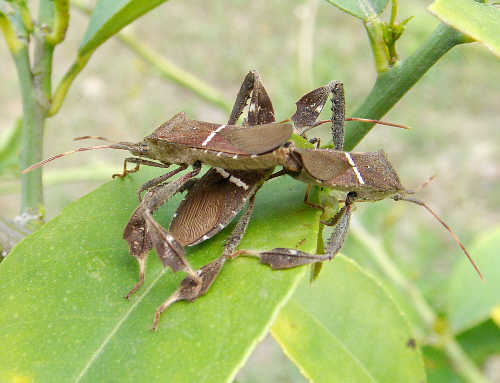
Nothing BUGS US more than losing Hale-and-Hearty, Ready-to-Read Good Friends from the DIGESTWORLD Reminder List.
So we've made it easy for Good Readers who have changed their Email addresses and Friends who would like to begin receiving the DIGESTWORLD Reminder at the first of each Month:
IT'S EASY to RE-SUBSCRIBE or SUBSCRIBE:
CLICK HERE!
As of August, 2011 we have begun using a Contact Manager with an Email Merge feature which allows us to send personalized Emails to everyone in our Contact List. You can receive the colorful Email containing the DIGESTWORLD Reminder beginning with "Dear [Your First Name]". It is important that we have your First Name, so if the name you are addressed by in your Reminder is not your first name, please notify us of the name you wish us to use. For convenience you can send a quick email to give us your name by Clicking Here. To Contact Bobby, his Email address is visible on this page.
NOTE: As of 2018 the Topica.com List messages are NO LONGER READABLE!
Please do your part by letting us know of any email address change so that you may continue receiving the DIGESTWORLD Reminders. Most of our Readers come from folks who don't get these Reminders, but we offer the DIGESTWORLD Reminder as a service to our regular Good Readers. To send us your new email address, CLICK HERE! .
If you discovered this page by a Google Search and want to SUBSCRIBE NOW
If you have enjoyed a particular issue, let us know, especially around the first of each month when those "lost soul" messages are bugging us, Send us a quick email by Clicking Here!
Simply Click the Link at right to send an Email Request: SUBSCRIBEIf you have a friend or two that you think would enjoy reading the DIGESTWORLD, suggest they view the current DIGESTWORLD Issue and perhaps they'll decide to Subscribe.To unsubscribe from the DIGESTWORLD Reminder List:
Click Link at right to send a Blank email to: UNSUBSCRIBEIf the above links which provide canned emails don't work on your system, you can send a Subscribe/Unsubscribe request to the address found on this page: http://www.doyletics.com/bobby.htm Please include your first and last name when Subscribing.
== == == == == == == == == == == == == == == == == == == == ==
10. GRATITUDE - in Three Easy Steps:
= = = = = = = = = = = = = = = = = = = = = =
Maintaining a website requires time and money, and apart from sending a donation to the Doyletics Foundation, there are several ways you can show your gratitude and support our efforts to keep doyletics.com on-line.
One would be for you to buy a copy of my Dolphin Novel, The SPIZZNET File. Books May be ordered in hardback or paperback form from Xlbiris the Publisher here:
online: http://www.xlibris.com/TheSPIZZNETFILE.html
email: orders@xlibris.com
The best source at the best price is to order your copies on-line is from the publisher Random House/Xlibris's website above.
Two would be for you to use the Google Search Engine for your web searches or to find an item on doyletics.com website. New reviews will have a place to do a Google Search at the top and the bottom of the reviews. Just enter a search phrase in the box below to do a Search. Note you can check whether to Search just this site or all websites.
Three would be for you to let us know you like us by Subscribing to our monthly Reminder. One short email each month with a link to our Latest DIGESTWORLD Issue will keep you apprised of our latest reviews, photography, poetry, Cajun stories, recipes, Movie Blurbs, Travels, and even more! Simply Click Here: Subscribe Me!
Thank you in advance!
~~~~~~~~~~~~~~~~~~~~~~~~~~~^~~~~~~~~~~~~~~~~~~~~~~~~~~~
Like Us? Subscribe to Receive a Monthly Email
Reminder of New Reviews & New DIGESTWORLD Issues — CLICK
~^~== == == == == == == == == == == == == == == == == == == == == ==
== == == == == == == == == == == == == == == ==
22+ Million Good Readers have Liked Us
22,454,155 as of November 7, 2019
Mo-to-Date Daily Ave 5,528 Readers
For Monthly DIGESTWORLD Email Reminder:
Subscribe! You'll Like Us, Too!
== == == == == == == == == == == == == == == ==
Any questions about this DIGESTWORLD ISSUE, Contact: Bobby Matherne
CLICK HERE TO OPEN OUR FIRST-AID KIT. Does your Face sometimes resemble the Faces Below? If so, Click on the Faces or Flags to Dig into our First Aid Kit.
To follow Research in the science of doyletics, Read our Monthly DIGESTWORLD Issues.
Click Here to get Monthly Reminder.
For Copies of Reviewed Steiner Books, Click on SteinerBooks Logo below.
Visit Bobby's Other Reviews, Articles, and Essays
Books are Lighthouses Erected in the Sea of Time
Counselor?
Visit the Counselor's Corner for Suggestions
on Incorporating Doyletics in Your Work.
e-mediatelytm is a Trademark of 21st Century Education, Inc. Prototyped 2000.