LIKE US? To Receive a Monthly DIGESTWORLD Reminder, Click the Link to Send Email Request: SUBSCRIBE
NOTE: Place Cursor over a photo for a few seconds to read text description.
== == == == == == == == == == == == == == == == == == == == == == == == == 
All the tools you need for a simple Speed Trace
IN ONE PLACE.
Great Way to show Gratitude for this Digest is to use the above Google Search Engine to Search this Site or the entire Web wherever you find it in the Digest pages.
== == == == == == == == == == == == == == == == == == == == == == == == ==
~~~~~~~~~~~~~~
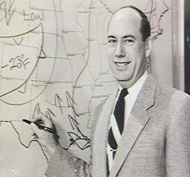
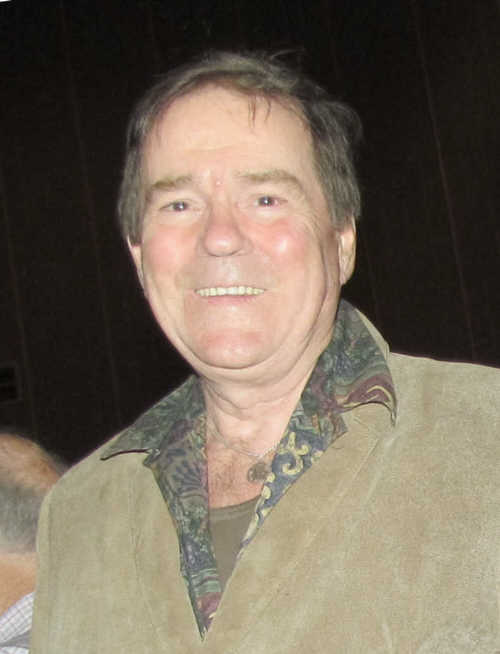
~~~~~~~~ In Memoriam: Nash Roberts (1918-2010) ~~~~
~~~~~~~~ Beloved Weatherman of New Orleans, as we knew him,~~~~~
~~~~~~~~ marking Weather map with his grease pencil in the 1950s ~~~~~
~~~~~~~~~~~~~~
~~~ GOOD MOUNTAIN PRESS DIGEST #116 Published June 1, 2011 ~~~ == == == == == == == == == == == == == == == == == == == == == == == == == Quote for the Busting Out All Over Month of June:
If modern art is sometimes shrill, it is not the fault of the artist alone. We all tend to raise our voices when we speak to persons who are getting deaf.
— Edgar Wind, Art Historian== == == == == == == == == == == == == == == == == == == == == ==
By Subscription only.== == == == == == == == == == == == == == == == == == == == == ==
Editor: Bobby Matherne, Asst. Editor: Del Matherne
[To Contact Editor Click Here!]
To Subscribe, Click Here or copy into your Browser
this URL: http://www.doyletics.com/subscrib.htm
To Unsubscribe, see bottom of Digest.
©2011 by 21st Century Education, Inc, Published Monthly.
To Read All of Bobby's Writings Click Here!
~~ Click on Heading to go to that Section (Allow Page First To Fully Load). ~~THE GOOD MOUNTAIN PRESS DIGEST #116, June 2011 Archived Digests
Table of Contents1. June's Violet-n-Joey Cartoon
2. Honored Readers for June
3. On a Personal Note
Featured Reviews
Movie Blurbs
4. Cajun Story
5. Recipe of the Month from Bobby Jeaux’s Kitchen: Sunshine Cake
6. Poem from April, 2011:"Gladden Your Heart Today"
7. Reviews and Articles Added for June:8. Commentary on the World
- ARJ2: Guidance in Esoteric Training, GA#245 by Rudolf Steiner
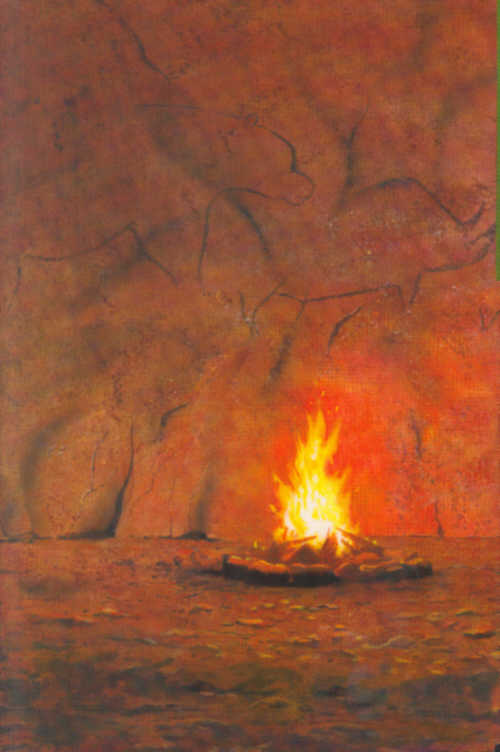
- ARJ2: The Land of Painted Caves by Jean M. Auel
- ARJ2: Reality Is Broken — Why Games Make Us Better and How They Can Change the World by Jane McGonigal
1. Padre Filius Cartoon
2. Comments from Readers
3. Freedom on the Half Shell Poem
4. On My Becoming A Writer
5. The Pelican, Cajuns, and Free Crawfish
9. Closing Notes — our mailing list, locating books, unsubscribing to Digest
10. Gratitude== == == == == == == == == == == == == == == == == == == == == ==
THE GOOD MOUNTAIN PRESS DIGEST #116 == == == == == == == == == == == == == == == == == == == == == ==ARCHIVED DIGESTWORLD ISSUES ON THE WEB ~ ARCHIVED DIGESTWORLD ISSUES ~ 2000: INAUGURAL YEAR: Jun #1 Jul #2, Aug #3, Sept #4, Oct #5, Nov #6, Dec #7
2001: Jan #8, Feb #9, Mar #10, Apr #11, May #12, Jun #13, Jul #14, Aug #15, Sep #16, Oct #17, Nov #18, Dec #19
2002: Jan #20, Feb #21, Mar #22, Apr #23, May #24, Jun #25, Jul #26, Aug #27, Sep #28, Oct #29, Nov #30, Dec #31
2003: Jan #32, Feb #33, Mar #34, Apr #35, May #36, Jun #37, Jul #38, Aug #39, Sep #40, Oct #41, Nov #42, Dec #43
2004: Jan #44, Feb #45, Mar #46, Apr #47, May #48, Jun #49, Jul #50, Aug #51, Sep #52, Oct #53, Nov #54, Dec #55
2005: Jan#051,Feb#052,Mar#053,Apr#054,May#055,Jun#056,Jul#057,Aug#058,Sep#059,Oct#05a,Nov#05b,Dec#05c
2006: Jan#061,Feb#062,Mar#063,Apr#064,May#065,Jun#066,Jul#067,Aug#068,Sep#069,Oct#06a,Nov#06b,Dec#06c
2007: Jan#071,Feb#072,Mar#073,Apr#074,May#075,Jun#076,Jul#077,Aug#078,Sep#079,Oct#07a,Nov#07b,Dec#07c
2008: Jan#081,Feb#082,Mar#083,Apr#084,May#085,Jun#086,Jul#087,Aug#088,Sep#089,Oct#08a,Nov#08b,Dec#08c
2009: Jan#091,Feb#092,Mar#093,Apr#094,May#095,Jun#096,Jul#097,Aug#098,Sep#099,Oct#09a,Nov#09b,Dec#09c
2010: Jan#101,Feb#102,Mar#103,Apr#104,May#105,Jun#106,Jul#107,Aug#108,Sep#109,Oct#10a,Nov#10b,Dec#10c
2011: Jan#111,Feb#112,Mar#113,Apr#114,May#115,Jun#116,Jul#117,Aug#118,Sep#119,Oct#11a,Nov#11b,Dec#11c
2012: Jan#121,Feb#122,Mar#123,Apr#124,May#125,Jun#126,Jul#127,Aug#128,Sep#129,Oct#12a,Nov#12b,Dec#12c
2013: Jan#131,Feb#132,Mar#133,Apr#134,May#135,Jun#136,Jul#137,Aug#138,Sep#139,Oct#13a,Nov#13b,Dec#13c
2014: Jan#141,Feb#142,Mar#143,Apr#144,May#145,Jun#146,Jul#147,Aug#148,Sep#149,Oct#14a,Nov#14b,Dec#14c
2015: Jan#151,Feb#152,Mar#153,Apr#154,May#155,Jun#156,Jul#157,Aug#158,Sep#159,Oct#15a,Nov#15b,Dec#15c
2016: Jan#161,Feb#162,Mar#163,Apr#164,May#165,Jun#166,Jul#167,Aug#168,Sep#169,Oct#16a,Nov#16b,Dec#16c
2017: Jan#171,Feb#172,Mar#173,Apr#174,May#175,Jun#176,Jul#177,Aug#178,Sep#179,Oct#17a,Nov#17b,Dec#17c
2018: Jan#181,Feb#182,Mar#183,Apr#184,May#185,Jun#186,Jul#187,Aug#188,Sep#189,Oct#18a,Nov#18b,Dec#18c
2019: Jan#191,Feb#192,Mar#193,Apr#194,May#195,Jun#196,Jul#197,Aug#198,Sep#199,Oct#19a
To Receive a Monthly DIGESTWORLD Reminder — Click Here.
== == == == == == == == == == == == == == == == == == == == == ==
1. June Violet-n-Joey CARTOON:
== == == == == == == == == == == == == == == == == == == == == ==For newcomers to the Digest, we have created a webpage of all the Violet-n-Joey cartoons! Check it out at: http://www.doyletics.com/vjtoons.htm Also note the rotating calendar and clock that follows just to the right of your mouse pointer as you scroll down the page. You'll also see the clock on the 404 Error page if you make a mistake typing a URL while on the doyletics.com website.
The Violet-n-Joey Cartoon page is been divided into two pages: one low-speed and one high-speed access. If you have Do NOT Have High-Speed Access, you may try this Link which will load much faster and will allow you to load one cartoon at a time. Use this one for High-Speed Access.
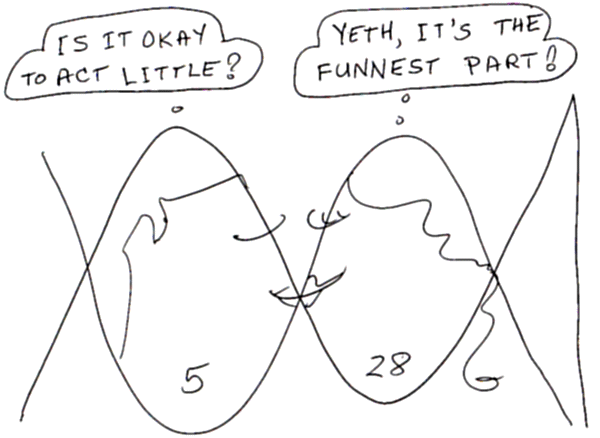
This month Violet and Joey learn about Being Little.
#1 "Being Little" at http://www.doyletics.com/images/052811jv.gif

== == == == == == == == == == == == == == == ==
2. HONORED READERS FOR June:
== == == == == == == == == == == == == == == ==Each month we choose to honor two Good Readers of our Good Mountain Press Digest from those all over the World. Here are the two worthy Honored Readers for June, 2011:
John Calender in New Orleans
Mabel Schumacher in Wisconsin
Congratulations, John and Mabel !
== == == == == == == == == == == == == == == == == == == == == == == == == == == == == == == == == == == == ==
3. ON A PERSONAL NOTE:
== == == == == == == == == == == == == == == == == == == == == == == == == == == == == == == == == == == == ==
Out Our Way:MAY WE HAVE SOME RAIN, PLEASE
We hardly ever get so dry a May as this one. It was dry and clear most of the month, feeling ever so much like California weather. We had a half inch rain early in May and on the 26th another even smaller rain. Our automatic sprinkler system, Del, had been outside nearly every day moving the garden hoses around to supplant the fixed sprinklers. This is only the second year for most of our St. Augustine sod, so it needs some help until it gets its deep roots implanted in the soil. My veggie garden also has need of a lot of watering. With the dry spell and the hailstorm (late April), my okra and cucumbers required three plantings before they took, the tomatoes, eggplants, and bell peppers only two plantings. As of the end of May our cucumbers are flourishing, producing 5 to 10 cucumbers daily. Anyone who comes to Timberlane gets to take away a handful of cucumbers. The first tomatoes, bell peppers, eggplants, and okra pods are beginning to appear. My large artichoke plants are also growing profusely and give me hope of dozens of artichokes to be picked in the Fall. Our citrus orchard is stunted due to the dry weather and the slashing of its leaves by the hailstorm. All the citrus flowers were decimated, no signs of replacements, leaving us without a citrus crop this Fall, a sad prospect, but as always, a temporary one. The daily summer showers are right around the corner into June and the citrus will experience a full year's growth and will be ready to fruit in November of 2012. Normally new citrus plants require about three years to begin fruiting in earnest anyway.
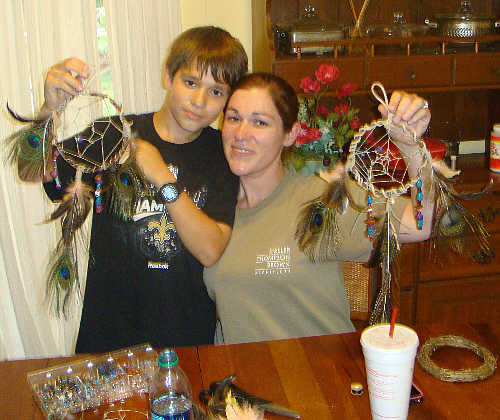
DREAMCATCHERS FOR BEN
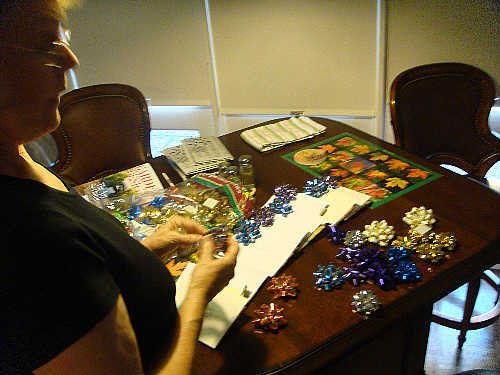
Our greatgrandson had a recurrent scary dream which caused him some problems, so we visited him at his grandmother Maureen's house where she and Ben's mother were making two dream catchers for him. One to be hung over his bed at his mom's house and the other at his dad's house. These circular designs are based on the Native American tradition of hanging a symbolic web over a sleeping person to protect him or her from bad dreams. My contribution to Ben's dream catcher was a silver earring in the shape of a sand dollar, dime-sized, which my daughter Carla found a few years ago during our lunch with her and Pat in Galveston, Texas. One earring is not much use, so I had placed it on my black fedora below the feather and have worn it daily for several years. We also assisted Ben in some Senoi dreamwork during which he confronted the dream spirit, pursued it when it walked away, made friends with it, and received a gift from it. A photo of Ben with his new dream catchers is posted in this Digest.
BLUE ANGELS, MOTHER'S DAY, AND MILK BOTTLES
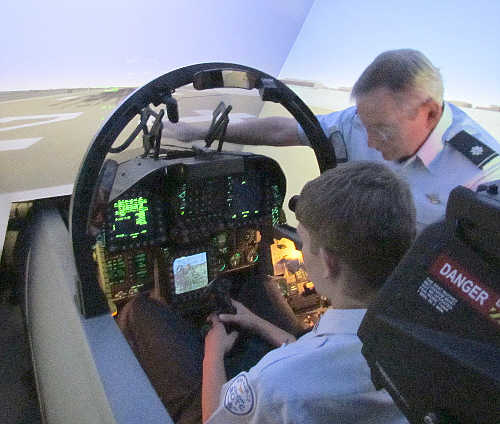
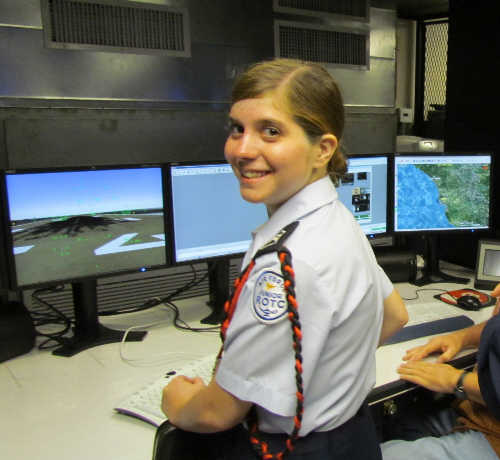
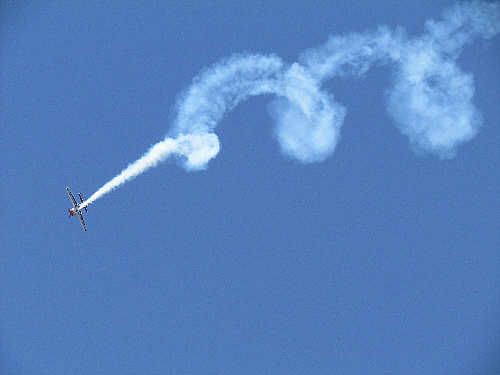
On the Friday before Mother's Day, I was invited to go along with Colonel Jim Webb as a sponsor for his Jr. ROTC troop at Riverdale High School. It gave me a great chance to break in my new CANON SX30 camera with its 35X built-in telephoto lens. Also to use it under varying conditions. I discovered the Sports setting which allows for continuous shooting of very fast objects, and the Blue Angels certainly qualify as very fast. During our time at the base, Col. Webb brought several kids to the F-16 simulator and he asked if I would like a short turn in the simulator, and I jumped at the chance. After spending long hours in jet fighter simulator video games during the time of the first Desert Storm, it was a thrill to step into the full-size F-16 cockpit, take off from Miramar Air Base (home of Top Gun school), circle around Southern California, and land safely back on the base. I was the only one in the cockpit, but Col. Webb was my co-pilot leaning into the open cockpit to answer any quick questions I had like, "Is my air speed for landing okay?" Okay, I ran off the apron slightly while trying to figure out how to apply the brakes, but still a great run for a first timer in the F-16. Too busy flying to fire any missiles, etc, during this run.
Our problems with Del's mom, Doris, continued into May, but a solution was found and seems to be working. Interestingly, the solution came from a Lady of Wisdom. Doris is safely in her new home at Our Lady of Wisdom nursing home. Del visited eight different facilities in the New Orleans area, before selecting this one for her mom. Del and I visited her there one night and to my mind it is nicer than her previous place and costs less than the former place would, even with complete nursing care and no more 24/7 sitters required. They have doctors on duty, and they will take care of transporting Doris to an off-site doctors or hospitals and Del can meet her mom there — no more hassle of getting in and out to the car and into the doctor's office. Doris is cheerful in her new place and the people are very nice. It's been a good move. Her back seems to be healing and she can walk a bit if she wants to. By the end of the month, Doris was re-united with Margaret, a friend from Woldenberg. This looks very much like a better situation all-around for Doris.
This was the first year where Doris did not join us for Mother's Day, so Del got to be the highest ranking mother when we got together with John, Stoney, Sue, and Sam at the Timberlane Country Club for the special Mother's Day luncheon.
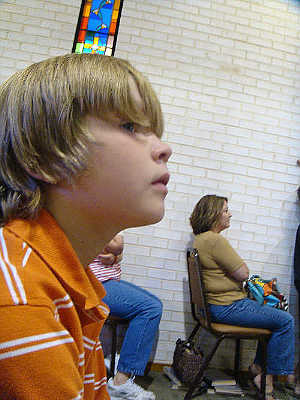
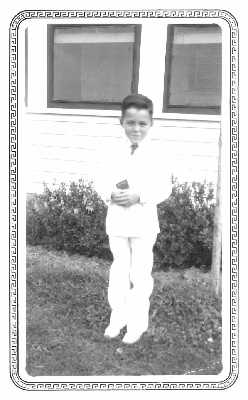
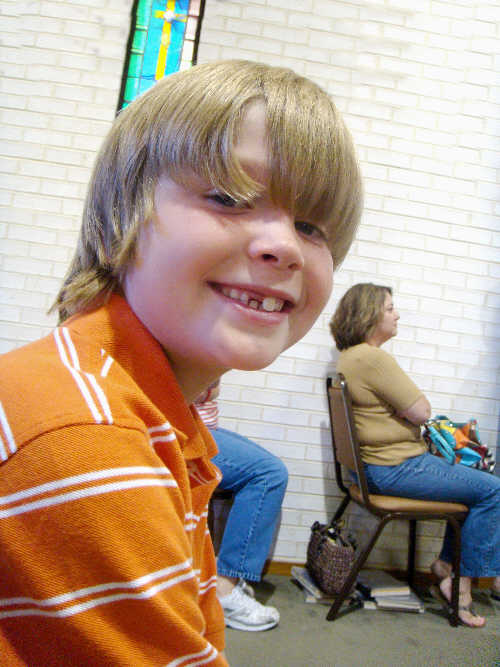
A couple of weeks after Mother's Day, Del and I drove up to Prairieville near Baton Rouge to watch John's son Kyle make his First Communion. When I had my First Communion in 1948, all the boys had to wear white suits, white shoes and a tie. Apparently children are no longer the all-white milk bottles of the Baltimore Catechism these days, and the white suits have been replaced with come-as-you are outfits, i.e., no outfits at all. See my photo and Kyle's photo for comparison of 1948 and 2011.
THREE GRANDSONS GRADUATE FROM HIGH SCHOOL
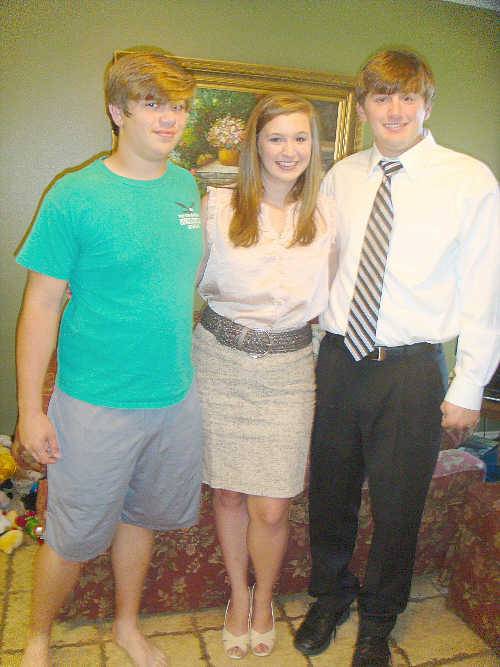
Luckily Sam, Weslee, and Gabe all graduated from schools in Louisiana, all on a different date, and different cities. As we dressed to go Sam Hatchett's graduation in Mandeville, I was congratulating myself for the luck of having conflicts of graduation dates this year. After dressing, I went through the day's mail to find a Graduation Card for my brother David's only grand-daughter, Mindy Matherne. Gabe's ceremony was in Kenner at 4 PM and Mindy's in Westwego at 6 PM, same day. As much as I wanted to represent my deceased brother at Mindy's graduation, I did not get an Admit Ticket and the timing would have been brutal to make both.
SAM HATCHETT
Both Sam and Weslee had post-graduation sponsored activities planned for them, so we needed to get there before graduation to spend time with each of them. For Sam, that meant an early afternoon trip across the Causeway to the Beach House in Mandeville, a block off the North Shore's seawall. From the restaurant you could barely see the middle high rise of the Causeway, twelve miles away. I used my 35X telephoto to capture an image of the bridge. Sam's three sets of grandparents were there: his father's father Bill and wife Carol, his father's mother Del, and his mother's parents, Foster and Phyllis Budd. In addition there were Toney Scholl from Miami and Robbie Todd from Mandeville, two of Sam's dad Stoney's friends from Marcie Street who were at our house so often, they called Del, Mom. In addition, Sam's Aunt Sharon — his mom Sue's sister from Dallas also joined us for a sunset dinner on the lakeshore.
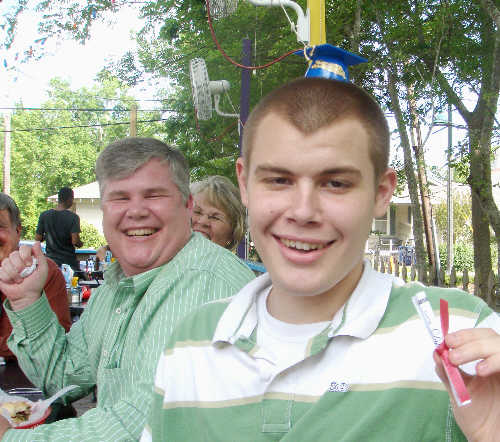
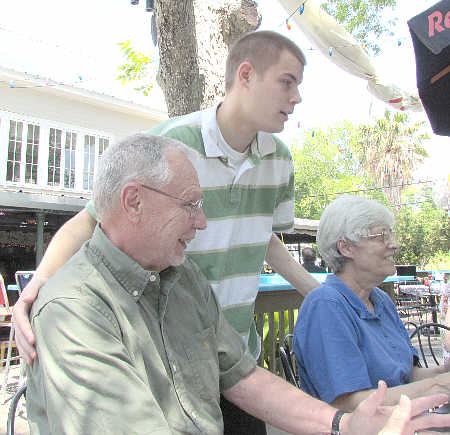
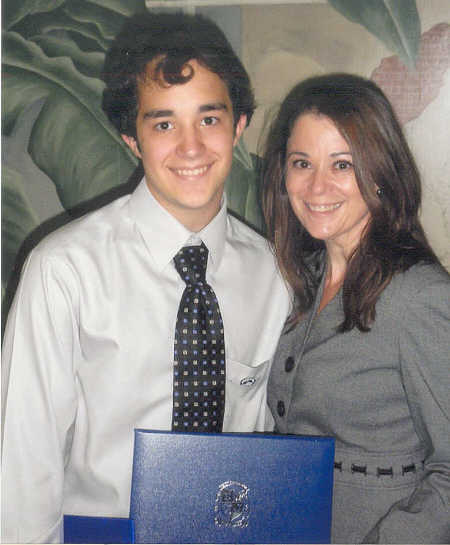
Sam's graduation cake had a small mortarboard and diploma on its top as decorations. Sam took the mortarboard, placed it on his head, and showed off his diploma for a photo op for Grandpa.
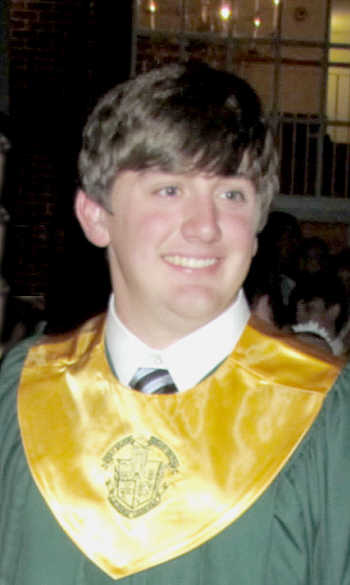
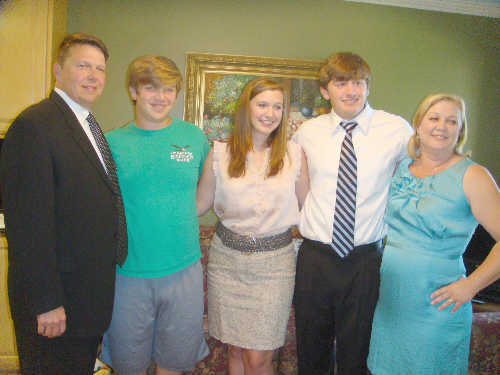
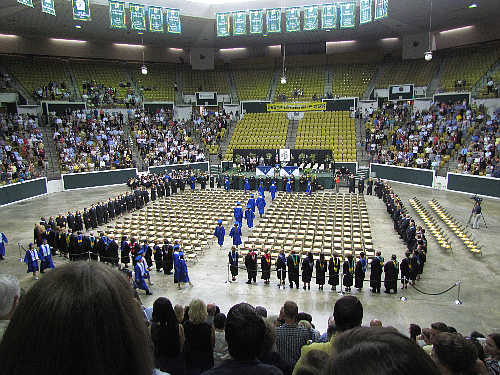
Foster and Phyllis left for their Opelousas home as the rest of us headed for Hammond to the large auditorium on the Southeastern campus where the graduation was be held for over 400 students from Mandeville High. Add that number to the 200 for Gabe East Jefferson class and you get the 600 that graduated in 1960 in his grandmother's EJ Senior Class, which was held in the Muncipal Auditorium, the only venue big enough for it back then.
After following the easy directions Del got from a hairdresser to the "Dome" on campus, we got lost three times, but finally found the Dome was really a truncated cone. We got good seats, good for someone with a 35X telephoto lens. But the light levels were so low that a good shot from that distance required complete stillness of the graduates, something no graduate did except when they were seated, facing the stage, and away from me. Our daughter Kim and her daughter Katie joined us from Baton Rouge for the graduation and we got good photos of Sam after the graduation before he was spirited away to parts unknown, instead parting to unknown spirits as we did in our graduation time. Del and I drove home late at night, thankful that Part I of the Graduation Trilogy had been successfully completed.
WESLEE GRALAPP
Sam's graduation was on a Tuesday and the following Tuesday was Weslee's, about three hours further away, in Alexandria, Louisiana, or Central Louisiana. He was graduating from Menard, a Catholic High School with about 60 fellow graduates. Del and I drove up a day earlier than the evening graduation so that we could leave for home directly after Weslee got his diploma and was spirited away on one last parent-telic fling.
Wes, his father, met us after he got home for work and suggested a sunset at his camp on the Red River, right downstream from a dam, where the water is placid, and no TV's, iProds, or teenage hi-jinks could disturb our meditations on life. I had not been to his and Oday's camp for two years, and was surprised by all the additions. A new building had arisen a hundred yards away from the wooden camp looking more like a modern steel industrial building. Its purpose was to provide a Mud Room for duck hunters after a long day in the cypress swamp. A large safe seemed more suited to a Wellls-Fargo bank, but I found out it held the shooting arsenal and ammo for the hunters. The new building slept six upstairs, with indoor and outdoor kitchens, and place for off-road and on-road 4-wheelers, the latter being electric golf carts. Wes took me to the edge of the property to show me the new gate with two locks on it: one lock for the property owners on each side of the gate. Why build a gate in the fence if you're going to lock it? Wes and Oday asked the owners. Well, we don't want you coming into our cow pasture. So Wes and Oday put up a lock on their side as well, and there is now a Gate-to-Nowhere.
And apparently some lawsuit over the boundary line. Having once spent three hours listening to boundary disputes at my son's home in Indiana, where such disputes seem to fill the empty time between basketball seasons, I asked Wes to spare me the details of the suit. Perhaps the gate could be called a Go-to-Hell Gate.Our golf cart tour next took me to what I call the Instant Dock. It's a long pier extending well into the cypress tree line ending in a boat dock that is the size of large den with a roof and comfortable chairs. Great place to escape the afternoon sun or just to remove heavy hunting clothes for the walk to the Mud Room. Why do I call it an Instant Dock? Well, what do you need to make coffee with if you have Instant Coffee? Water! And that's all this Instant Dock needs to dock a boat there. Till the rains come, which they haven't for several months, the pier is a long, high board walk to the Instant Dock.
The grill on the porch of the original camp was heating up when I came out after playing myself a game of 8-ball on the pool table inside. Wes had some green beans, potatoes, and Cod to grill up for our supper. I relieved him as the chef and soon we were enjoying a tasty supper overlooking the placid waters of the Red River. After supper, we walked down the steps to the platform close to the water where we sat in comfort, talked, and solved all the problems of the world. Weslee's graduation hubbub was 24-hours and a 1,000 miles away.
As we rode the golf cart back to its garage next to the Mud Room, a yellow Full Moon was rising dramatically over the trees lining the eastern edge of the Red River camp. Here was my chance to capture the Moon with my new telephoto camera. I set it on a post for stability and took a shot: — the Moon was washed out. What was it that Seth had told me he did? Ah, Manual setting and ISO of 1600. I quickly dialed in the settings and took three perfect shots with a detail of a good amateur telescope and camera! All on my CANON SX30 with its built-in 35X Optical Zoom and 14 Megapixels of resolution. A perfect ending to a perfect evening, good food, good friend, and a Full Moon over the Red River.
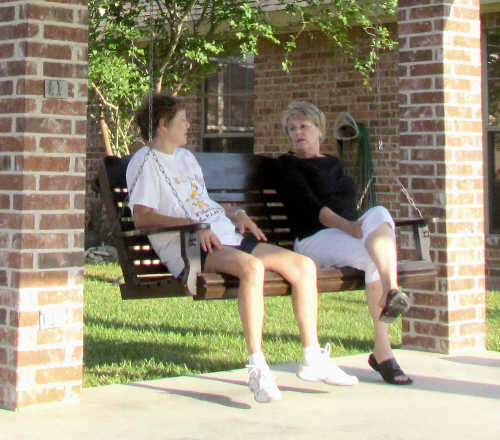
The next morning I missed Wes as he quickly headed off to work. With TV's on in three rooms, I went to an outside swing hanging from the tree if I was going to get any work done. Okay, it was reading actually, but reading is an essential part of my research work and what's a book review without a book?
While I was sitting and reading an elderly gentleman was walking his two large poodles on the sidewalk a few feet away. He stopped and said, "Been walking past here for many year and never saw anyone sitting on that swing." That made me smile. No TV, no computer terminal, no cushiony sofas to lie half asleep on, just a wooden slatted swing for sitting outside alone and reading. Not much to interest teenagers. Dr. Bill Brown introduced himself as a neighbor who lives around the block, and suddenly his two poodles noticed the Siamese cat making evil eyes at them, and Dr. Bill had to excuse himself and continue the walk. I returned to my reading about how reality is broken, after having seen a display of its breaking in action.Just then a worst case scenario hit! Two trucks full of garden laborers and plants pulled alongside the swing and began unloading things. I walked inside to find all TV's still on, so I decided to sit on the patio enclosed by the house. My peace there lasted about five minutes because I was sitting where the plants were being transplanted along the patio wall away from the house. I went inside to a somewhat quiet library area until the front yard activity quietened and I could return to my swing and reading exercise regimen.
I took a break from work to accompany Del and Katie to take John Gary Hines, a cute 3-year-old boy to a chicken fast food restaurant so he could climb and slide in the playroom (no shoes allowed) while we ate in chaotic peace. Del brought me a salad and herself a chicken salad sandwich. Only chicken items on menu, except for salad. We then went later to Atwood's Bakery where I got a creditable latte with extra foam. Atwood's cakes and other bakery products are excellent.
Food and folks began to arrive for the pre-graduation meal about 5:30 pm with Wes's brother Cole and his family, Uncle William and his wife, his mother Barbara Gralapp, etal. Dinner consisted of chicken and shrimp pasta followed by Weslee's graduation cake from Atwood's for dessert.
Del cut Weslee's cake and I ate a small piece. I told Weslee he was lucky because his mortarboard was made of icing, so he would escape his cousin Sam's fate. Sam's cake had a plastic trinket mortarboard on top and we took a photo of Sam with the tiny cap on top his head.
We left early to follow Kim to the Louisiana College at Pineville auditorium, but she sped off in the opposite direction we were facing, so I had make a speedy U-turn on S. Hampton to catch up with her. We grabbed seats on an aisle and Del wanted to sit with family, so we bargained for aisle seats with family where I could take photos from the aisle mostly unobstructed, except for the huge football player in front of me. Graduation for only 60 Seniors would have been short, except that Menard had a practice of reading every scholarship a student was offered, whether the student would take it or not. The Valedictorian had about 23 scholarships, some to places at disparate parts of the country which she obviously could not use, but they were dutifully read, every single name and description of every scholarship. If Menard had the 400 graduates that Mandeville had, we might still be waiting for the list of scholarships to end. But end it did, and we got the obligatory cap and gown photos of Weslee before he was scooped away to Chucky Cheese, a rope course, and a sock hop, among other things.
About 9 pm we headed south on I-49 for Paul's house in Opelousas with Del driving. Got there about 10 pm and we talked with Paul and Joyce for an hour or so before we hit the sack.
Up about 7 am and walked outside in the garden with Paul. Ate some blueberries off his bush that he didn't know were ripe yet. He picked some for Joyce and Del. Also ate some of the blackberries from the bush that grew from one I gave him from our 217 Timberlane Road house which originally came from David's bush in Des Allemands. Need to get a sprout back from him, now that I have room for another blackberry bush, and would also like a Confederate Rose (its deep red color is beautiful). Stopped at Mel's Diner for breakfast, forgetting that Bubba II's lay ahead of us on our trip home via Hwy 90. Traffic stacked up due to an overturned dump truck just south of Lafayette, the rest of the trip was a breeze. Had an oyster po-boy at Bubba-II's, even though I was still full from the eggs, grits and muffin at Mel's. Del took photos as I drove over the Atchafalaya River in Morgan City.
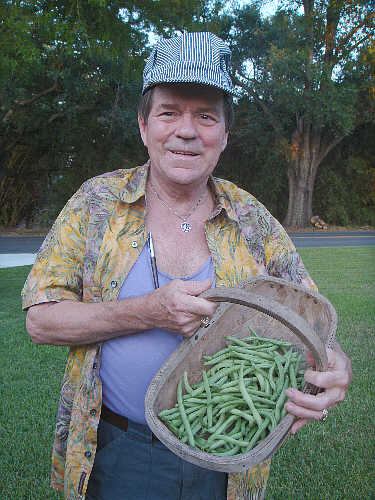
Had a start when FOX news reporter on Sirius/XM said, "Flood is up to I-10!" and I envisioned the water reaching up to the I-10 raised freeway level, but quickly realized he only meant a flood bump from the Morganza Spillway's opening was heading south and nearing the foundations of I-10 raised highway. Big difference in meaning using same words, means the reporter let a rampant ambiguity loose on the airways. Got home and picked my second large cucumber for supper. Del was spreading mulch and watering lawn and gardens again. I picked green beans to go with our salad for supper. It looked like the right amount of beans to try a reprise of the meal Wes grilled at the Red River camp, so I sauteed chopped potatoes with green beans. It was delicious and will make that next month's Recipe after I do it with grilled flounder or tilapia filets.I spent the afternoon selecting, printing, and placing in a notebook my poems to read for my club the next night. Del timed me at 12 minutes, so I can slow down a bit, pause, add a few comments, etc. She laughed at several points, which is always a good sign. She's Everyman when it comes to my writing. If she likes something, then both the hairdressers and the college professors will like it.
GABRIEL PETER BAYHI
Gabe graduated from East Jefferson High School, the same school his grandmother graduated from in 1960 in a Senior class of over 600. EJ was the only High School in East Jefferson at the time, having been created from several smaller high schools on the East Bank of the river in Jefferson Parish. The ceremony was scheduled for 4 PM in the Punchdrunk Center, oops, excuse me, Pontchartrain Center in Kenner, making it both the shortest and longest drive of the three graduations. There's no way to get to Kenner which doesn't involve intense traffic, back ups, and delays.
Set in the far western corner of the parish, which is ridiculous for the East Bank, just as ridiculous as for West Jefferson to be miles east of East Jefferson, the Civic Center has only one entrance and exit with the parish line at one edge and Lake Pontchartrain at another edge, and an apartment complex at the third edge. We got there on time, right at 4 PM, but had to walk fifteen minutes across a steamingly hot asphalt parking lot to reach the doorway. Once inside we maneuvered and got seats perfect seats in the upper deck: we could see everything, but hear nothing but the raucous crowd around us, talking incessantly, and we could see nobody on the stage. The only thing lucky for us on this day is there were no family and friends to find and sit with, no activities planned before the ceremony, and none afterwards. If we thought we might be able to find Maureen and Gabe afterwards, we would have suffered through the whole ceremony, but lacking that we played our grandparents card and left shortly after Gabe's name was called, thankfully with his "Bayhi" last name, he was only the 16th name to be called. His mother, the Assistant Principal of East Jefferson came forward to present the diploma to her son. Gabe is her baby, the last of four children to graduate High School, and is headed for College.On the same day as Gabe graduated, Del graduated from her first term as Timberlane Garden Club President, and was then inducted as the new President for another year. She went over her speeches with me, saying she would use the hail story today. After the hail had knocked down and wiped out all the color of her flower beds, she went into a minor depression, which is unusual for Del. It reminded of a postpartum depression after a miscarriage I had lived through with someone else many years ago. I told her, "Del, remember, the hail did not reach the roots of the flowering plants." She smiled a bit, and that seemed to start her back on the road to perking up again. Within a week, most of the plants she had thought were dead were alive and in a few more weeks blooming again, and she was all full of smiles and plans for plants.
LSU BASEBALL TEAM, OMAHA-BOUND OR -RELEASED
My alma mater's baseball team, designed for a run for the World Series Championship in Omaha this year, by all accounts, suffered through a continuous series of bad breaks, bad hitting, and bad pitching, a triumvirate of catastrophic consequences. As a result, the LSU team which has won three consecutive SEC Conference Tournament titles the past three years, is sitting out the last two weeks of May and won't know until June 1 if they will be in a regional anywhere. Their RPI, whatever that is, is high enough to warrant the Tigers a place in a regional, but warranting is not getting in, so we have to wait and see. With strong winning record overall, but not in the SEC, whose Western Division is so strong there were five teams who finished first. LSU bloomed in the final three weeks of the season, needing to sweep the last series with MSU to miraculously get into SEC Tourney. They only won two out of three, but by a huge margin. One game was 17-1 win for LSU.
The breaks were going the Tigers way, bats alive, and the freshmen pitchers were pitching like the seasoned sophomores they almost are. The jury is still out, but if they make a run for Omaha, Katie-bar-the-door. This year is looking like another SEC winner of the College World Series, and for LSU to win it, they'll have to beat several SEC teams which swept LSU early in the season, a miracle for sure, but hey, just getting to Omaha will take a miracle and you can only stack so many miracles in series before the impossible is needed. Let's just say right out that "It's impossible for LSU to win the College World Series." Now there's a challenge that can motivate an injured Tiger and start him clawing away at everything in sight. (May 31 update: No Omaha for LSU this year.)LIFE GOES ON . . .
Our daughter Yvette came into town in the last week of May to get on a cruise to Cozumel, Mexico with her daughter Evelyn. We had lunch with them at the Bon Ton Restaurant and then dropped them off at the Erato Cruise terminal. The last week was also the pot luck supper at my club and we had a great time with everyone there. It was like an annual family reunion is the days when our kids were young, but now with about half of our 19 grandkids graduated from high school, those reunions are few and far between, relegated most to Christmas time. My Aunt Nancy was born in England and married my dad's brother, Ray, and she is turning 90 the first week in June and we will have our first Matherne reunion since 2000, eleven years ago, down in Bourg, Louisiana. Her children grew up knowing mostly the Matherne side of their family, so for them, a Matherne Reunion covers all of their close relatives. There will be some gaps in the family, large gaps since the last reunion, prominently, David Matherne, Annette Matherne, Elaine Matherne, Francis Matherne, and Hilman Matherne, and undoubtedly others I will hear of when I get to the reunion. There will also be new Mathernes with various last names who will have grown up or been born since 2000 for whom this will be their first ever Matherne Reunion. Life goes on. . . .
EVERY GOOD THING MUST COME TO
A NEW BEGINNING, SO UNTIL NEXT MONTH . . .The past month brought us Sunny Skies and Balmy Breezes, plus re-flowering of everything: smashed by the big hailstorm! Plus huge flooding of the Mississippi and Atchafalaya flood plain, but only minimal flood stage in New Orleans. We graduated three grandsons from High School who will be entering three different colleges in the Fall. June will see us attending the 2011 Matherne Reunion, Twilight Concerts in City Park (our Jazz Fest), and harvesting, cooking, eating the bounty of cucumbers, eggplants, bell peppers, okra, and Creole tomatoes from our Veggie Garden. Till July we head west to Sean Matherne's wedding followed by our Orange Beach cabin on the Gulf Shore, God Willing and the spillways keep the River within the levees ! Whatever you do, wherever in the world you and yours reside, be it chilly or hot, cloudy or sunny, nearing mid-Summer or mid-Winter, remember our slogan: Enjoy the present moment, it's the only Eternity there is and it's given to you for Free!
~~~~~~~~~~~~~~~~~~~~~~~~~~~~~~~~~~~~~~~~~~~~~~~~~~~~~~~~~~~~~~
IMPORTANT MESSAGE:
To those Good Readers who are puzzled by How the Moon could be Rising In Front of a Mountain, Click on Photo. To see 161021 photo, Click Here. ALSO: if you are puzzled because you No Longer get our Monthly Reminder, you may have Changed Your Email Address without notifying us. NOTIFY US NOW by a simple Click Here!
Here's the Sting:
You will NOT receive a Monthly Reminder unless you have Re-subscribed under your new address to DIGESTWORLD.If you've already receiving DIGESTWORLD Reminders, ignore this message.
If you're not subscribed, and would like to Subscribe to DIGESTWORLD Reminders to receive one short email a month to inform you of the latest ISSUE, now's a good time. SUBSCRIBE NOW
by Clicking Here.Yes, this message does no good to those who changed their email address without notifying me — but it can alert those of you who are going to change your address.
If you've changed or are planning to change your email address, Click Here to SEND NEW ADDRESS. (Alternate way is to copy into your Browser this URL: http://www.doyletics.com/subscrib.htm )
EASE OF VIEWING NOTES:
NOTE: For Internet Explorer Browsers, DIGESTWORLD is best viewed at 100% Zoom and the Window's width sized so that Digest Archives lines are single-spaced, just barely. Adjust Window width so that Mountains almost touch the Archive Numbers, especially if you find some Photos overlapping text.PHOTO CAPTIONS (CURSOR FLYOVER ISSUE RESOLVED):If you have been enjoying the photos in DIGESTWORLD, but have wondered who or what you were looking at, you will now be able to hold your cursor still over the photo and the photo's description will appear. (Test on Butterfly-Crab Image at Right.) We spend a lot of time writing these photo captions and hope you will read them. All the Archived Issues have been updated to provide descriptions when your cursor rests for a second on a photo. Note that older Reviews have not been updated. If you haven't finished reading text when description disappears, move cursor away and back on photo to finish. We thank you for your patience and hope this pleases you.
New Quotes Added to quotes.htm this month:
- Always give without remembering,
always receive without forgetting.
Nino Qubein (Author)Five Featured Reviews:
1. Milan Kundera's
Testaments Betrayed
To interpreters of the works of Rabelais, Kafka, Stravinsky, Hemingway, Nietzsche, and others, Kundera offers the following words of chastisement from Stravinsky, "But you're not in your own house, my dear fellow" (This phrase is also the title of the last chapter.) As a meta-critic of music and literature Kundera blows away the fog of confusion so that the reader may see how the well-meaning epigones, lost in the fog of cultural expectations, have strayed from the path laid out in the works of the original composers and authors.
In A Sentence Kundera presents three different translations of a Kafka sentence, followed by the original German, and finally an exact translation by Kundera. The foibles of translators are laid bare on Kundera's dissecting table. One must read translations with a fresh eye for literary foolishness after this chapter.
In Works and Spiders he quotes Nietzsche, "an act put on by system-makers: in their desire to fill in their system and round off the horizon that encloses it, they must try to present their weak points in the same style as their strong points." This filling in of the system, Kundera refers to as "a collaboration between an eagle and hundreds of heroic spiders spinning webs to cover all the crannies." This reminds of the Levee Board system in place which led to the Federal Flood in New Orleans in 2005, often called Hurricane Katrina ( a minor event compared to the widespread flood from a failed levee system).
In The Unloved Child of the Family Kundera says "Thus in the big family that is a small country, the artist is bound in multiple ways, by multiple cords." Someone from a small country such as Greece or Italy would be called a traitor for disparaging his homeland's character, but someone from a large country would be mostly ignored for the same offense.
In Paths in the Fog Kundera reminds us that man proceeds in the present always in a fog, unsure of what the next moment may bring. He says, "But when he looks back to judge people of the past, he sees no fog on their path," thus reminding us that when we judge the actions of others we should re-create their fog as a part of our creative act of imagination. If "all history is the history of thought" as R. G. Collingwood said, then the future history of thought, the evolution of consciousness from that time, must be a necessary part of the fog that accompanies us in our meditations on that time. This is the fog that Kundera lifts for us momentarily in this book, thereby betraying for all to see the many "Testaments Betrayed."
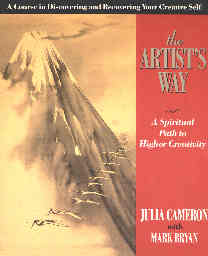
2. Julia Cameron's The Artist's Way
Got writer's block? Take one of these and call me in the morning — after you've finished the twelve week course that Cameron and Bryan have laid out for you in this book. I will then ask you, "How many days did you do your morning pages the past week?" If the answer comes back less than seven, I will suggest a cloistered order because the life of writer is not for you. I will place you in the same category as the wanna-be Miss Abs of 1996 in the Dilbert cartoon who said, "I bought the exercise machine you suggested, but I'm still lazy."
This book is not for lazy people. Instead it is for industrious people who have poisonous friends who have thrown wet blankets on their every artistic endeavor, be it painting, sculpture, writing, or whatever. The authors put you on the exercycle of morning pages (free writing) for ten minutes every morning and urge you to use your newly developed will-power and discipline to take yourself on an artist date every week. Here is the plan in all its simplicity: 1) write freely, without editing or stopping for three pages every morning to clear the garbage from your psyche, and 2) spend time alone with yourself studying life and art once a week. These are the two fine themes around which this fine book has been woven by Julia Cameron and her friend Mark Bryan.
Since giving someone a suggestion (like "Buy yourself an exercise machine") is usually not enough to turn them into an athlete, Julie and Mark have given their course to many people in seminars and developed this book from it. If you've bought self-help books before, read them, tried some of their suggestions, and then forgotten about the whole thing, save your money. This book won't work for you either.
If you are serious about freeing your artist within, buy this book, and use it as a workbook. Do all or most of the exercises at the end of each chapter. Do your morning pages and artists dates. Soon the latent artist within will pay you a surprise visit now and then.
I read this book straight through during a weekend trip to Houston — I loved the quotations sprinkled in the margins. I had discovered morning pages or free writing years ago from Peter Elbow (Writing Without Teachers) and I had been taking myself on artists dates for years, but The Artist's Way re-invigorated my resolve and I began my morning pages again. My book A Reader's Journal was the direct result of my first attempt at morning pages some ten years ago. While writing full-time for the past year, I'd dropped them until this book reminded of their importance.
This book is loaded with ideas and suggestions. Here's an example. The authors are talking about the swimming of Eva Babitz — a novelist and swimmer:
That rhythmic, repetitive action transfers the locus of the brain's energies from the logic to the artist hemisphere. It is there that inspiration bubbles up untrammeled by the constraints of logic.
This is the process I call "collating time" — it is the process of weeding a garden, sewing stitches on a quilt, of shelling peas, of loading shotgun shells, of shucking corn, of peeling shrimp, of doing something as mundane as collating pages from a printer — if one does the operation carefully with full intention, inspiration will bubble up, freeing the artist within.
3. Rudolf Steiner's The Arts and their Mission
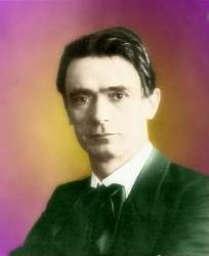
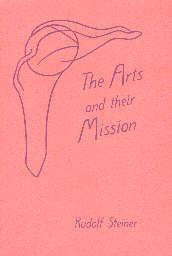
In the Introduction, Virginia Moore says, "Clearly Rudolf Steiner belongs to an age-old stream flowing sometimes above ground, sometimes below, but never, since the beginning, dry." Never one to be bound to "the aridity of matter-bound thinking"[VM] Steiner is rather the marathon swimmer who swims the length and breadth of this ageless stream, stopping at points along the way to describe the scenery, enticing us to explore the stream ourselves.
At one early stop he shows to us some men who instinctively remember the experiences of their fathers and grandfathers. At another place in the stream we meet men who experience ideas flowing into their minds as water flows into our bodies — a bounty from the large mass of the earth. (The concept of ideas and thoughts arising within our minds would have to wait for a paradigm hop of consciousness farther down the stream.)
At another resting place we observe spirits of the recently deceased finding their way upwards by following the architectural lines of pyramids and spires. At another we see a man whose trunk and limbs in one life transform into his head in the next life. In the stream, we observe everywhere colorful soul-spirits and follow them into their earthly incarnations as they garment themselves in the splendid colors of their being in the spirit world. From our tutelary sessions in the stream with Steiner, we ken the spiritual essence of the various arts: how the entrance of the soul-spirit into the world creates costuming, how the focus on the present time freezes a human body into sculpture, how the exit of soul-spirits from the material world creates the need for architecture, how the soul-events in paintings occur in two-dimensions with color as the third perspective, how the lower earth gods (e. g., Dionysus) appeared as actors on the dramatic stage before man did, how the upper gods (e. g., the Muses) infused man with poetry and song. As we drift in the stream, we hear from the banks, Homer pleading to the gods that their will be done, not his, as he opens the Iliad: "Sing, oh Muse, the wrath of Achilles, son of Peleus." And, lastly, we pause in the stream of today, "when man is in the process of becoming free, daimonic man, that is, man under the influence of tutelary spirits is an anachronism." [RS, italics mine] Looking back over our trip in the stream, we realize that we have seen man evolve in consciousness, from Homer, who required the tutelary advice of his Muse, to Modern Man, who shuns parental injunctions in favor of the complete freedom that only autonomy can bring."Once upon a time," or as we may now say it: Many paradigm hops ago, "the daimonic led to tragedy."[RS] Today, in complete autonomy, we can say, "There are no innocent victims"[BM] — that each one, partly in consciousness, partly out of consciousness, has complete control over the events of one's life.
Finally we pause in the stream to consider Goethe's triad, "Wisdom, Semblance, and Power." Wisdom, Steiner sees as "formless knowledge," Power as virtue, or "the power to carry out worthwhile things effectively," and Semblance, as art, "the beautiful." I see Goethe's triad as a four-part process that mirrors Don Robinson's Habit Formation steps: 1. Unconscious Incompetence (Power, will, virtue), 2. Conscious Incompetence (Action Semblance — performance arts), 3. Conscious Competence (Word Semblance — literary arts), and 4. Unconscious Competence (Wisdom, formless knowledge). In the progression through each of these four steps humankind makes a paradigm hop and consciousness evolves. The stream is actually a cascade of falls, each one marking a jump in the evolution of consciousness for the salmon-like human race heading for its spawning grounds upstream.
4. James Michener's The Novel — A Novel

"The Novel is a work of fiction. The characters in it have been invented by the author, and any resemblance to actual persons, living or dead, is coincidental. The story is also fictitious." Going to such lengths to ensure the reader that the book is fiction causes one to wonder if Michener "protesteth too much" and if much of the content of the book actually happened to him. On page seventy-five the fictitious Yoder tells us that the endpapers were done by the artist, Jean-Paul Tremblay. On the flip of the title page, credit is given to Jean Paul Tremblay. Such propinquity in one area makes one wonder about the rest of the book.
Readers are cautioned not to miss the CONTENTS page or they may wonder in Chapter Two how Yoder could have been a tomboy. The first chapter deals with The Writer, and the rest deal with The Editor, The Critic, and The Reader.
The Writer, Lukas Yoder has just finished his eighth book in his Grenzler series. We follow him through the well-practices motions he goes through after the completion of his novel. As he visits his friend who checks his book for Pennsylvania Dutch authenticity, we enjoy a fresh-baked German rice pudding with him.
When he visits his editor, Ms. Marmelle in New York, we sit in on the conferences about the subsidiary rights and international rights of his earlier books. When he returns home, we look over his shoulder in his workshop as he converts old hex signs hacked from collapsing barns into finished art works.The Editor, Ms. Marmelle, tells us how she came to be an editor, starting as a go-fer in the secretarial pool, then being assigned to Mount Dreck, the over the transom submissions pile. Her biggest difficulty in that job was holding to the one in nine hundred goal. She was severely reprimanded and told to hold her recommendations to the editors to a maximum of three in nine hundred. One of her submittals was Yoder's first novel and she was assigned to be the editor for its publication.
The Critic, Karl Streibert, we also follow as he grows into a full professor of English at Yoder's alma mater, Mecklenberg College, a tale complete with a raffish summer affair in Athens. Streibert loves great writing and detests Yoder's plodding style. In spite of that, Ms. Marmelle becomes his editor. Streibert grows several writing proteges, the two most prominent being Jenny Sorkin and Timothy Tull.
The Reader, Jane Garland, turns out to be the grandmother of Timothy Tull in the fourth and last chapter, during which a murder occurs and is solved in short order by the writer Yoder and his Dutch friend.
Each chapter shows the book process from a different angle and reflects light in the hidden recesses of the other chapters, till in the final chapter all the action is brought together by murder. Michener tells a masterful tale about a writer and his milieu, which we must suspect closely parallels Michener's own.
5. Dudley Lynch and Paul L. Kordis's Strategy of the Dolphin

Ablaze with self-indulgent and self-congratulatory fluff — this masterpiece of hyperbole hardly ever finishes a sentence or a complete thought. E.g., "The strategy of the carp. And the strategy of the shark." or later "It's the road less traveled, but if you begin, in the discovery sense, you are already there." This is future shock in mega-doses, "open wide" they say (in effect), "we have you pegged and here is your curriculum vitae for future success. You only have to jump into the pool and dophinize your shark and carp brain to swim circles around others to succeed in creating a flow that overwhelms you with abundance everywhere: of money, love, friends, success, and, of course, money! By the way, here's our address to send us money at Brain Technologies Corporation."
I read this book through in one session (about 2 hours) since there was little material that was new to me and because the hyper-onceover the book gives the subjects encourages that kind of express train mentality.
Read this book if you are a carp or a shark and have fallen so far behind in your field that you cannot catch up in one simple lifetime. It will at least give you an explanation of why. Or at best plot a blueprint for a springboard to a revolutionary way of thinking/being that will make your former shark/carp/pseudo-enlightened-carp thinking irrelevant to your future self.
Dolphins: save your money and skim it at amazon.com or a library.
~~~~~~~~~~~~~~~~~~~~~~~~~~~~~~~~~~~~~~~~~~~~~~~~~~~~~~~~~~~~~~
Movies we watched this past month:
Notes about our movies: Many of the movies we watch are foreign movies with subtitles. After years of watching movies in foreign languages, Arabic, French, Swedish, German, British English, Russian, Spanish, Italian, Japanese, Chinese, and many other languages, sometimes two or three languages in the same movie, the subtitles have disappeared for us. If the movie is dubbed in English we go for the subtitles instead because we enjoy the live action and sounds of the real voices so much more than the dubbed. If you wonder where we get all these foreign movies from, the answer is simple: NetFlix. For a fixed price a month they mail us DVD movies from our on-line Queue, we watch them, pop them into a pre-paid mailer, and the postman effectively replaces all our gas-consuming and time-consuming trips to Blockbuster. To sign up for NetFlix, simply go to http://www.netflix.com/ and start adding all your requests for movies into your personal queue. If you've seen some in these movie blurbs, simply copy the name, click open your queue, and paste the name in the Search box on NetFlix and Select Add. Buy some popcorn and you're ready to Go to the Movies, 21st Century Style. You get to see your movies as the Director created them — NOT-edited for TV, in full-screen width, your own choice of subtitles, no commercial interruptions, and all of the original dialogue. Often you get the Director's Cut Edition which adds back excellent footage that was cut from the theater releases. With a plasma TV and Blu-Ray DVD's and a great sound system, you have theater experience without someone next to you talking on a cell phone during a movie plus a Pause button for rest room trips.Hits (Watch as soon as you can. A Don't Miss Hit is one you might otherwise ignore.):
P. S. Ask for Blu-Ray DVD movies from NetFlix.“Robin Hood” (2010) with Russell Crowe and Cate Blanchett, two Aussies which get each other in the end. Wonderfully realistic presentation of the events leading up to the Magna Carta and to the creation of Robin Hood. A DON’T MISS HIT ! ! !
“Valentine's Day” (2010) marvelous movie about the most romantic day of the year for ages from 10 to 90 and in-between. Romance in the Hollywood Cemetery one of the many Don’t Miss Moments of this great feel-good movie. A DON’T MISS HIT ! ! !
“Finding Home” (2003) is what Amanda does when she reluctantly visits the Bed & Breakfast on an isle off coast of Maine after her Grandmother who owned it died. Suddenly repressed memories pour into her as she deals with all the aspects of her life past and present converging upon her. “Love is the ultimate forgiveness.”
“Cherish” (2002) After Zoe’s car kills a policeman by a stalker who controlled her car while she was drunk, she has an ankle monitor locked onto her while she awaits trial in a rundown warehouse. She manages to do what her therapist had suggested, she stops talking, she listens, she develops real friends while she plots her way out.
“Cinema Verite” (2011) is a look behind the cameras of the first (1973) reality show and the family it defamed. Can life survive TV? Jury still out. Coming soon to a DVD near you.
“10 Items or Less” (2006) ( 2nd Viewing, see digest092) is a gem of a movie. Morgan Freeman plays a version of himself as an aging actor unable to find work (the fictional part of movie) and having to scout a seedy supermarket to learn how to play a store manager for an independent film. Watching a movie a second time allows one freedom to focus on the individual actions without trying to figure out where the plot is going, and often leads to laughter where none was found in earlier viewing, e.g., when Morgan apes the aging store manager’s staring and shuffle walk, hilarious! Saw it once? Watch it again with new eyes! A DON’T MISS HIT! ! !
“Ayn Rand: In Her Own Words” (2011) arrives in Hollywood wanted to be a screen writer and hardly spoke English, but on her first trip to studio stares at Cecil B. DeMille in his convertible and he invites her for a drive and soon she is working as an extra where she meets her ideal man, Frank O’Connor, working on a set. She tells her love story with Frank and her early life in Hollywood working on Fountainhead and Atlas Shrugged. A DON’T MISS HIT ! !
“Interpreter” (2005) Nicole Kidman stars as the girl raised in Africa speaking the Ku language and working as interpreter at UN when one late night she overhead a plot to assassinate the President of the Ku country when he gave a speech to UN. Her life is in danger, the UN is in danger, and pieces of her life and the plot begin unraveling until the very end where it ravels up a bit in a knockout surprise ending. A DON’T MISS HIT ! ! ! (NOTE: 2nd viewing, see also digest066; better the second time!)
“How Do You Know” (2010) this will be a great movie? Witherspoon, Owen Wilson, Nicholson, Rudd plus great script and directing. Some scenes so funny you have pause the DVD just to finish laughing! Owen says, “Okay if I read a note I wrote to you?” “Okay” “I went nuts when you left. I broke a lamp.” Suddenly you realize that that was the note! Plus useless-cleaner-becomes-Play-Doh morale: “We’re all just one small adjustment away from making our lives work.” No popcorn for this one, you’ll be laughing too much! A DON’T MISS HIT ! ! ! ! !
“Maze” (2000) an Amazing movie with Lyle Maze, an amazing artist with Tourette’s Syndrome, explosive tics which pop unexpectedly everywhere, in bed or in NYC crowds. Director takes us inside of Maze’s head during this explosions, so we see the world he sees, which includes Laura Linney nude. Prepare to be surprised early and often and leave calling this A DON’T MISS HIT ! !
"15 Amore" (2000) or 15 Love in a tennis game, one of the few past-times for mother of two waiting for her husband to return from WWII with two Italian POWs and two German Jews for company. A lovely fun and peaceful movie of war-time in rural Australia, and trouble only begins when peace breaks out. A DON’T MISS HIT ! !
“Harry Potter and the Deathly Hallows, Pt 1: (2010) Our three heroes take time off from the opening of their eponymous Disney theme park to make a movie: Harry, Hermione, and Ron skip their Year 7 of Hogwarts because Harry’s protection disappears when he turns 18 and they must hide from You Know Who while seeking Horcruxes which enable YKW to remain alive. A seemingly impossible task gets a bit easier when Harry locates the sword of Gryfindor, but much work remains to be done as they hear the story of the three deathly hallows. A DON’T MISS HIT ! ! !
“South Riding” (2011) centers on hovels in a swampy area where a young girl has to be taken out of school to tend six kids after her mom dies. Can Sarah, short and strong, save the girl for Oxford and can she win the heart of Robert, tall and strong?
“King of Kings” (1927) I saw this movie in 1970 in Hollywood where it was screened during Holy Week every year. This is my first reviewing since then and the movie is amazing, the story of Christ Jesus portrayed using only the words from the Bible woven into a masterful cinematic experience by Cecil B. deMille and a cast of thousands.
“Broken Hill” (2009) begins with a ranch hand in Outback planting a fence post and then listening to a concert of the sounds of the world around him, then to leading a prison band, and turning those sounds into a concert. One learns to listen to the world as a musician does during this fine movie. A DON’T MISS HIT ! ! !
“Social Network” (2010)an amazing justification for Galambos’ volitional science, all the wasted time and effort because Mark did not recognize his primary theft. He stole the ideas of the Harvard boys, but in this society, stealing ideas is not illegal, and a lot of money got thrown at lawyers until the theft was compensated, but only partially as is the forte of American coercive justice. This movie is a matched set to “Atlas Shrugged” in revealing defects in this society.
“A Mother's Courage: Talking Back to Autism” (2009) A story of a mother of an autistic boy who flew to USA and other places to talk and learn about autism. She found Temple Grandin who told her how to identify a case of sensitive hearing (boy covers his ears), or sight problems (constantly looking from side to side), etc. Temple description of what caused autism in the brain was garbled bafflegab. The mother met a therapist who cured her of her inability to help her son and son the boy was able to communicate with his mother. What makes autism so difficult is that it is an advancement of human beings which is being treated as a defect by the retards who constitute the majority of the human race, up until now.
“Wedding Crashers” (2005) 3rd viewing and still a lot of fun. Vince and Owen have a blast but love grabs them by the ass and brings them down to Earth as real love arrives. A DON’T MISS HIT ! ! ! See digests 59 and 87.
“Thor” (2011) hammers down all opposition and eschews love to remain a God, but that is Brad Pitt’s lot also, is it not? Comic Book film pretends that Norse Gods are physical humans in remote part of universe.Misses (Avoid At All Costs):
We attempted to watch these this month, but didn't make it all the way through on most of them. Awhile back when three AAAC horrors hit us in one night, I decided to add a sub-category to "Avoid at All Costs", namely, A DVD STOMPER. These are movies so bad, you don't want anyone else to get stuck watching them, so you want to stomp on the disks. That way, if everyone else who gets burnt by the movie does the same, soon no copies of the awful movie will be extant and the world will be better off.“No Strings Attached” (2010) is a hokey, dirty-mouthed movie full of gratuitous sexual alliances which have little to do with the main story and garners it an Avoid at All Costs.
“Pitcher and the Pin-up” (2004) lacks script, acting, and plot and overcomes no obstacles on way to becoming a great flop.Your call on these — your taste in movies may differ, but I liked them:
“Theater of War” (2008) a documentary of Meryl Streep doing Brecht’s “Mother Courage” along with Kevin Kline. By amazing coincidence, I was in the middle of a Teaching Co. lecture on Bertolt Brecht’s Marxist plays. The movie proceeds as if it were a play by Brecht instead of by him, dragging his face and politics across the screen like Mother’s war wagon has been dragged across the stages of the world.
“Ayn Rand: A Sense of Life” (1998) Gave up on this documentary halfway through as the one we had watched earlier this month,“Ayn Rand: In Her Own Words”, covered much of the same ground, but more interestingly and engagingly.
== == == == == == == == == == == == == == == == == == == == == ==
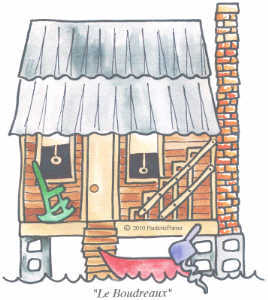
Le Boudreaux Cajun Cottage, drawn by and Copyright 2011 by Paulette Purser, Used by Permission
4.STORY:
== == == == == == == == == == == == == == == == == == == == == ==Boudreaux is attending his 20-year Reunion at his high school in Gueydan, a small Cajun town in rural Louisiana. A man comes up to him and asks, "Boudreaux! Don't you recognize me, Sha?"
"Mais, non, Ah don' t'ink so, me. Do Ah know you?"
"Of course, Ah'm Broussard, yo ole buddy from high school!"
"Bien sur, Broussard! Comment sais va, Sha?"
"Mais, everthing's fine, Boudreaux!"
"What you doing wit yo'self dese days?"
Broussard says, "Ah own a three-story Cathouse."
"Oh, dat sounds interesting! How dat's working for you?"
"Terrific! Ah got lots of business. You see, we got everything covered: We got the first floor for the heterosexual, second floor for the homosexual, and third floor for the pedophile."
Boudreaux is a little taken aback by his old school buddy's line of work, so he asks an innocent question hoping to move to another topic soon, "Told me sumpin' Broussard, how you done get started in dis business?"
Broussard said, "Mais, you know, Ah started small. At first, it was just me, de wife, and de kids."
== == == == == == == == == == == == == == == == == == == == == ==
Sunshine Cake (Dessert)
5. RECIPE of the MONTH for June, 2011 from Bobby Jeaux’s Kitchen:
(click links to see photo of ingredients, preparation steps)
= = = = = = = = = = = = = = = = = = = = = =
Background on Sunshine Cake: This is a recipe from the Old Country which I got from Anna Dorn Oren (Click to see her photo) who lived in Milwaukee, Wisconsin area and was a good friend of the family. She made this often for family gatherings in Englewood, Florida where she retired to. This is the recipe she gave me. It is a cake baked from scratch, using only flour, eggs, and sugar, but it is light and fluffy and tastes great. If you've never baked a cake except from a mix, try this one and you'll be delighted with the results, both in taste and compliments. (You will require a sifter and an angel's food or bundt cake pan for this recipe.)
Ingredients
1 Cup of All-Purpose Flour
7 eggs
1 1/4 Cups of Sugar
1 tsp Cream of Tartar
1 tsp Almond Extract
 Preparation Steps
1. Sift the flour 5 times. (For sifting, use a sheet of wax paper to do sifting and put aside)
2. Sift the sugar 3 times. (hardly necessary with modern granulated sugar)
3. Separate whites and yolks. (Crack eggs with a serrated-edge knife for uniform splitting of egg for ease of separation)
4. Add the Almond Extract to and Beat the yolks. (Put aside)
5. Add the Cream of Tartar to and Beat the whites of the eggs, adding sugar gradually to form a meringue type mixture.
6. Add the beaten yolks slowly to the meringue while mixing.
7. Gradually add flour to mixture while mixing.
8. Pour mixture into angel food or bundt cake pan. (Do not grease the pan! After mixture is in pan, lift pan and drop several times to exhaust any air bubbles.)
Cooking Instructions
1. Preheat oven to 350 degF.
2. Bake 20 (twenty) minutes
3. Raise oven to 375 degF and Bake for 15 more minutes to brown the cake.
4. Remove and run pointed knife around cake to remove.
5. Click Here to see how cake looks in the pan after baking.
Serving Suggestion
Let cool.
Slice and serve.
Place under a cake cover and it will keep fresh for a week or so.
Other options
Can be sliced horizontally and fille with with white icing or whipped cream and slices of strawberries or other fruit.
== == == == == == == == == == == == == == == == == == == == == ==
6. POETRY by BOBBY from April, 2011:
= = = = = = = = = = = = = = = = = = = = = =Gladden Your Heart Today
The secret of happiness is easy to say:
Let go of sorrow to gladden your heart today.Surely there will be sorrow tomorrow, you say.
Yes, that may be so, sorry to say.
But to ponder the sorrow of tomorrow
Brings sorrow into today.So, I press my case this way:
Let go of the sorrows of tomorrow
To gladden your heart today.The future may be full of sorrow —
one will only know tomorrow.
To ponder on such future sorrow
brings the sorrow into today.Let go of the sorrows of tomorrow
To gladden your heart today.If you live in the sorrows of tomorrow
you will find the present full of strife,
You may have to beg, steal, or borrow
to find happiness today in life.Let go of the sorrows of tomorrow
To gladden your heart today.== == == == == == == == == == == == == == == == == == == == == ==
7. REVIEWS and ARTICLES for June:
= = = = = = = = = = = = = = = = = = = = = =And for my Good Readers, here’s the new reviews and articles for this month. The ARJ2 ones are new additions to the top of A Reader’s Journal, Volume 2, Chronological List, and the ART ones to A Reader’s Treasury. NOTE: these Blurbs are condensations of the Full Reviews sans footnotes and many quoted passages.
1.) ARJ2: Guidance in Esoteric Training, GA#245 by Rudolf Steiner

This book marks the 195th book by Rudolf Steiner that I have read and reviewed. My goal is to read, study, and report on my study in all of the books by him available in English translation. How I first began reading Rudolf Steiner's works is written up in several places such as Rudolf Steiner Comes Into my Life by Friedrich Rittlemeyer. It was a process that began with small books of his lectures which I found on the bottom shelf of Golden Leaves Bookstore operated by Donna France in Metairie, Louisiana in 1977. I was seeking books on metaphysics and she had the widest collections of books I knew about. Each time someone did a course on some author, Donna would buy extra books for the course, and put the leftover ones up for sale in her book store. Over the next 10 years, I had bought about 10 books and read one or two and wrote short reviews of them, but I still didn't know why I kept buying these books by an obscure Austrian mystic and philosopher. When the Internet became operational about 1995, what seems like a century ago, the first question I asked was, "Who is Rudolf Steiner?" and the second question was, "What books of his should I read first?" Soon I was reading his basic books and the more I learned about these basics of Occult Science, Theosophy, and the Philosophy of Freedom, the more I realized that he was revealing the key information I was seeking to help me understand the two big enigmas of life.
What enigmas? Someone, perhaps it was I, once wrote that "life is like a puzzle with an enigma on both ends." Those are the two enigmas I sought answers to: what happens before life and what happens after life, meaning life in a body on Earth. With those answers came an avalanche of information about how the human being and the cosmos in which we find ourselves developed together, and how what we do in our lifetime can have dramatic effects on the future generations of this world. This understanding came to me long before I read this next passage in the Foreword to the Second Edition of this book by Virginia Sease.
[page 1, Foreword] Since the year 1972 when this book was first available in English, the demand for esoteric training has increased to an overwhelming degree. Just at the time of the first printing, a whole generation of younger people world-wide had begun to experience that the mechanistic, utilitarian, materialistic attitude and relationship to life no longer could provide a basis for their own entrance into twentieth-century civilization. They began to search in a far more intensive — sometimes even frantic — way for means towards self-discovery than had been the case for their parents or grandparents, who were absorbed and burdened through war and the immense technological challenges which accompany war and its aftermath. Now, in retrospect, at the end of the century it is apparent that the last third of this century bears witness to countless human beings who know with inner certainty that their own development in the skills of modern life, in social relationships and in spiritual dimensions is not limited in effect to them only but simultaneously affects the earth, the universe and humanity in general. Thus they have become earnest seekers imbued with the will to find various means for self-development.
My reading of subsidiary or derivative works of Rudolf Steiner I have limited to those authors who wrote about his life such as Rittelmeyer (above) and those who have expanded on some particular aspect of his works, such as Edward Reaugh Smith in his Burning Bush etal series of books. With a few exceptions I have stayed away from those writers trying to popularize Steiner, because their broad brush and interpretive approach would distract me from my focus on what Steiner wrote directly. Each book I read of Steiner's introduces me to new and mind-boggling concepts — this remains true after 195 books!
Naturally there are repetitions of themes from time to time in Steiner's lectures, but each I re-read a familiar theme, it is a new me reading it, and Steiner handles the material from a new perspective to fit the particular audience in the lecture hall. Rudolf Steiner explains about how he creates the various points of view.[page 2, 3, Foreword, from Munich, August, 1913] "I try to present spiritual facts again and again from fresh points of view, in spite of my having described them fro other points of view in other works. Such accounts are complementary to each other, like photographs of a person or an event taken from various points. In every such description, made from a certain standpoint, there is an opportunity for communicating knowledge which is not attainable from the other points of view."
The topic of Occult Science had nothing to do with Black Magic, but was a way of understanding the spiritual underpinnings of the physical world, especially the two enigmas of life before birth and after death. Theosophy was not a religion but rather a way of understanding all religions (Page 7), and thus a true theosophy is a spiritual science itself, which is why Steiner abandoned the term theosophy early in his teaching, changing it to the more descriptive term, anthroposophy, which breaks down into anthropos the full human being of body, soul, and spirit -- and sophy a knowledge of. In the first lecture of this book, he likens theosophy to mathematics.
[page 7] A man can understand mathematics through his own spiritual faculties and comprehend the laws of space without having to refer to any such early text. But if he has really absorbed the truths of geometry, he will value all the more highly the original texts through which these laws were first presented. So it is with theosophy. Its sources are not in ancient documents, nor do they rest upon tradition; they lie in the reality of the spiritual worlds. It is there that they must be found and grasped by the development of man's own spiritual powers, just as he grasps mathematics by endeavoring to develop the faculties of his intellect.
Just as we require organs to perceive the physical world, so do we require organs to perceive the spiritual world. The difference is our sensory organs were operated on by the forces of Sun and sound and thus came fully developed and ready to use during this epoch in human evolution, whereas our spiritual organs are in a quiescent condition and must be exercised to bring them into operation.
[page 7, 8] Our intellect, by means of which we are enabled to comprehend the laws of the world of sense, is supported by an organ, the brain. Similarly, in order to grasp the laws of spiritual worlds, we need appropriate organs.
How have our physical organs developed? Because forces from outside have worked upon them: the forces of the sun, the forces of sound. Thus did eyes and ears come into being out of neutral, sluggish organs into which, at first, the sense-world could not penetrate, and which opened only by degrees. If our spiritual organs are worked upon by the right forces, they too will open.In ancient times, we possessed spiritual sight. One can confirm this by reading the earliest writings of humankind, in which reports of gods, spirits, and elemental beings of many kinds were described. These writings, such as Beowulf, Gilgamesh, the Iliad and Odyssey, were written versions of oral traditions going back centuries before writing. Likely the oral tradition was made possible by spiritual viewing of the events of these epics and did not require a written document nor rote memorization as scholars suppose today. Instead, with the loss of spiritual sight, writing was necessitated! Writing replaced the direct perception, which explains these amazing statements about the invention of writing by Plato who lived in the early centuries after its invention.
For this invention will produce forgetfulness in the minds of those who learn to use it, because they will not practice their memory. Their trust in writing, produced by external characters which are no part of themselves, will discourage the use of their own memory within them. You have invented an elixir not of memory, but of reminding; and you offer your pupils the appearance of truth, not truth, for they will read many things without instruction and will therefore seem to know many things, when they are for the most part ignorant and hard to get along with, since they are not wise, but only appear wise.
One cannot read these immortal words of Plato without being reminded of the politicians and news anchors on television who are reading from their teleprompters and giving the appearance of being wise.
What happened to our spiritual sight? It had to be sacrificed in order for our "I" to be awakened. As our human body gradually gained solidity, the spiritual sight became replaced by sensory perceptions of the physical light reflected from the surface of objects. Man's ability for spiritual sight was gradually relegated to his night consciousness as his day consciousness and physical sight took over.
[page 8, 9] But the forces working upon him were no longer plastic, weaving forces akin to the nature of his own being; they were forces that fed upon him, destroyed him, in order to awaken the 'I'-consciousness. Only in the night, when he sank down into the rhythmic spiritual world homogeneous with him, did he acquire new strength and become able once more to feed forces into his physical and etheric bodies. Out of this conflict of impressions, out of the deadening of the astral organs formerly working unconsciously in man, the life of the individual 'I', the 'I' -consciousness, arose. Out of life — death, out of death — life. The ring of the serpent was complete. And now from the wakened 'I' -consciousness there had to arise forces that would kindle life again in the defunct vestiges of earlier astral organs, shaping and moulding them.
To modern humans, who are accustomed to instant solutions to everything, the thought surely arises, "Why did we have to wait so long for our spiritual sight to arise once more?" The answer is similar to what Plato said, "We would not have freedom, but would only appear to have freedom." There is no shortcut on the road to freedom. An education in freedom requires the development of the Will, whose initiation must come freely from within the individual; it cannot be imposed from without.
[page 9] The great Initiates could have made the task easier, for themselves and for man, if they had worked upon his astral body during the night, when it is free, in such a way as to impress the astral organs into it from outside. But such an act would have operated in man's dream-consciousness; it would have trespassed on his sphere of freedom. The highest principle in man, the will, would never have unfolded.
But on one day, a salient day in the history of the Earth, rightly understood, one great Spirit united in the body of a man shed His life's blood into Earth which thenceforth took on a golden glow as seen from outer space. What He did was to bring the Initiation Mysteries into the light of day and make them available to every human being as His legacy. John 12, 14: "the Word became flesh and dwelt among us, full of grace and truth" and "to all who received him, who believed in his name, he gave power to become children of God".
[page 10] Then initiation came forth from the darkness enshrouding the Mysteries into the clearest light of day. In a great and mighty Personality, the Bearer of the highest unifying Principle, of the Word-of Him who is the expression and manifestation of the hidden Father, and who taking on human form became the Son of Man and thereby the Representative of all Mankind, the bond uniting all 'I' s — in Christos, the Life-Spirit, the Eternal Unifier, the initiation of mankind as a whole was accomplished as historical fact and at the same time as symbol, on the plane of feeling. So potent was this Event that in every individual who modeled his life on it its power could continue to work right into the physical, expressing itself even in the appearance of the stigmata and in the most piercing pains. Feelings were shaken to their innermost depths. An intensity of emotion, the like of which has never surged through the world before or since, arose in mighty waves. In the initiation on the Cross of Divine Love, the sacrifice of the 'I' for All had taken place. The blood, the physical expression of the 'I', had flowed in love for mankind, and the effect was such that thousands pressed forward to this initiation, to this Death, letting their blood flow in love and devotion for mankind. That blood untold was poured out in this way has never been sufficiently emphasized; the thought no longer enters the consciousness of people, not even in theosophical circles. Yet the waves of ardor which in this streaming blood flowed down, and then ascended, have fulfilled their task. They have become the wellsprings of powerful impulses. They have made mankind ripe for the initiation of the will.
And this is the legacy of Christ.This the legacy we have received from what Steiner calls the Mystery of Golgotha, the Deed which we commonly refer to as the death of Christ Jesus on the Cross.
The remainder of this book consists of General Requirements, Exercises, Mantras, and Explanations for students developing their organs of spiritual sight, most of these were given around the period of 1905 to 1907.
Steiner gives six goals which every aspirant for occult development strives to achieve. Each of these activities should be focused on for a complete month before proceeding to the next activity.
1. Cultivation of absolutely clear thinking. [page 13]
During a period of 5 minutes a day, one must become the ruler of one's own thought independent of one's outer circumstances, occupation, social network, and various circadian activities. One must empty all these thoughts and focus on one single thought at the center of one's soul.2. Begin a New Daily Action [page 14]
Pick some activity that in the ordinary course of life you have not performed. Then make it a duty to perform this action every day. As time goes on, add other activities.3. Development of equanimity towards fluctuations of Joy and Sorrow. [page 15]
Replace height of jubilation and depths of despair by an equable mood. "Care is taken that no pleasure shall carry us away, no sorrow plunge us into the depths, no experience lead to immoderate anger or vexation, no expectation give rise to anxiety or fear, no situation disconcert us, and so on. . . . Once every day, at least, this inner tranquillity should be called up before the soul and then the exercise of pouring it out from the heart should proceed."4. Positive Attitude which Always Looks for the Best in Everything [page 16]
"It consists in seeking always for the good, the praiseworthy, the beautiful and the like, in all beings, all experiences, all things. This quality is best characterized by a Persian legend concerning Christ Jesus. One day, as He was walking with His disciples, they saw a dead dog lying by the roadside in a state of decomposition. All the disciples turned away from the disgusting sight; Christ Jesus alone did not move but looked thoughtfully at the corpse and said, "What beautiful teeth the animal has!"5. Confronting all Experiences with Complete Open-Mindedness [page 17]
To accomplish this, one must be willing to drop all the in-grained maps in one's mind, and be wiling for each new experience to operate completely out of those maps. One avoids ever saying such things as, "I knew that" or "I know how that will be" or "Isn't that always the case." These are merely examples of the pervasive way one can encounter reality out of one's own expectations and suppositions about the way the world is. "At every moment [the esoteric student] must be ready to encounter and accept absolutely new experiences." And this is regardless of what he deems as natural law or what is possible. One must become ready for anything to happen.6. Repeat All Five Activities Systematically and in Regular Alternation [page 18]
"In the sixth month, endeavors should be made to repeat all the five exercises again, systematically and in regular alternation. In this way a beautiful equilibrium of soul will gradually develop. It will be noticed, especially, that previous dissatisfactions with certain phenomena and beings in the world completely disappear. A mood reconciling all experiences takes possession of the soul, a mood that is by no means one of indifference but, on the contrary, enables one for the first time to work in the world for its genuine progress and improvement. One comes to a tranquil understanding of things that were formerly quite closed to the soul."Through the attention one gives to these exercises, one becomes an agent for good, which means advancing the evolution of humanity. The alternative is to continue with everyday morality, doing good in order that others will think of one as good, which is a path easily filled with evil, and evil hinders the evolution of humanity towards the good.
[page 19] . . . two things must be stressed. First, the six exercises described paralyze the harmful influence other occult exercises can have, so that only what is beneficial remains. Secondly, these exercises alone ensure that efforts in meditation and concentration will have a positive result. The esotericist must not rest content with fulfilling, however conscientiously, the demands of conventional morality, for that kind of morality can be extremely egotistical, if a man says: I will be good in order that I may be thought good. The esotericist does not do what is good because he wants to be thought good, but because little by little he recognizes that the good alone brings evolution forward, and that evil, stupidity and ugliness place hindrances along its path.
In an Association for Humanistic Psychology (AHP) Conference at Berkeley about 1979, I sat next to a young woman who began talking about words and how if you reversed a word, you found a word with its opposite meaning. It was she who first brought to my attention that EVIL is LIVE written backwards. One can see in the above paragraph that EVIL hinders Evolution, while to LIVE according to the six exercises above brings Evolution forward. Thinking on these matters, I wrote the following poem, "No I Tu Love."
No I Tu Love
What would life be like
If we had no I tu love?
Could we live if we had no evil?
If we had no I tu love?Madam, I'm Adam is a palindrome,
Which reads and means the same
From back to front to back.
What shall we call a word, a phrase
Which reveals its outer meaning
Front to Back
And reveals its inner meaning
Back to Front?"Take evolution . . . Please," Henny Youngman might have said,
If he wished to monkey with the human race
As Charlie Darwin did."Please pass me a banana" — no monkey has ever spoken that line,
Having no concept of I, or me, or Thou.
No how.What Charlie did was turn the idea of humanity
into a game of chance, naturally,
with selection happenstance,
Treating I am God
As antiquated Dogma, I think,
Reminding us what would life be like
If we had no I tu love.Steiner adds three additional rules to the general requirements for one on the esoteric path. These rules are laid down to allow one to avoid the confusion which might otherwise lead one into calamity as one advances on the path. The first rule is: "No idea which has not first been examined shall be allowed to enter my consciousness." This examination should lead to an independence and strength of soul which will reveal itself as follows:
[page 21] The strength of one's own soul will then shed light upon all one's thoughts and conduct; one's consciousness will grow correspondingly broader and one will be able, above all, to form the habit of allowing the spiritual laws which reveal themselves in the soul to express themselves, thus emancipating oneself from a blind obedience to the surrounding world.
The second rules states: "My soul should be vividly aware of the obligation to increase constantly the sum of my concepts and ideas." One should constantly increase one's conceptual life and expand one's expectations or one might encounter higher experiences on the esoteric path without realizing it.
[page 22] Nothing is worse for the esoteric pupil than staying fixed with a certain number of concepts and trying to understand everything by means of them. It is infinitely important to be constantly appropriating one new idea after another. If this should not happen, the pupil would be ill-prepared to meet any sense-free perceptions he might develop, and would be overpowered by them either to his disadvantage or at least to his dissatisfaction. To his dissatisfaction, because under, such circumstances he could well be having higher experiences already without even noticing it. There are many pupils for whom this is the case, who do not recognize higher experiences because of incorrect expectations due to a paucity of concepts. Many people are not in the least indolent in their outward lives, but are nevertheless quite reluctant to enrich their conceptual life with new ways of understanding.
The third rule states: I will only gain knowledge about those things to which I am not attached in sympathy or antipathy. Here the importance of developing equanimity in all things, so that one does not zoom from the depths of despair to the heights of exultant from one moment to the next, but maintains a steady demeanor whether things are going good or bad. One must remove all wishes or have these inner wishes lead to self-deception.
[page 2, 23] An old initiate repeatedly drove home this point to his pupils by saying: 'You will only learn something about the soul's immortality when you are as equable about the possibility of its annihilation after death as about the possibility of eternal life. As long as you wish to live eternally you can learn nothing about life after death.' It is the same with all truths. As long as the human being still harbors the slightest wish that things might be one way or another, the pure bright light of truth will not shine for him. Whoever, for example, retains even the most hidden wish that his good qualities might outweigh his bad will not be able to achieve real self-knowledge, for this wish will pull the wool over his inner eyes and deceive him.
The fourth rule is easier to state than to achieve: I am obliged to overcome my reservations towards what seems 'abstract'. If one discounts abstract ideas, saying they are not real, one will have great difficulty developing sense-free concepts. The perfect triangle cannot exist as a chalk marking on a blackboard, but only in the mind of the person making or viewing the triangle. Our centuries of experience of finding an abstract mathematical concept which later proves to be useful in the sensory world has happened many times and should prove to us the reality of abstract ideas. At the same time, one can only understand truth in the higher worlds if one frees oneself from the sensory-based concepts so prevalent in our time.
[page 23] As long as an esoteric pupil clings on to ideas whose substance is derived from the sense-world, he cannot attain to any truth about higher worlds. He must strive to develop sense-free concepts. This is the hardest rule of all four, particularly in the circumstances of our day and age. Materialistic thinking has to a large extent deprived human beings of the capacity to think in sense-free concepts. One must do one of two things: either strive to think concepts that are never perfectly, but only approximately, present in sensory reality — for example, the concept of a circle. A perfect circle can be nowhere found, but only conceived of; such a conceived circle is the underlying law out of which all circular formations arise. Alternatively, one can think of a high moral ideal; this also cannot be wholly realized by any human being, but it is nevertheless the foundation or law underlying many human deeds. No one can make any progress in their esoteric development if they do not recognize the fundamental importance for life of such so-called abstractions, and enrich their soul with the relevant concepts.
In the lecture "Main Exercise" the pupil is required to abstain from breathing while immersing oneself in one of the following images, in successive exercises: IT THINKS, SHE FEELS, and HE WILLS. The reasons for these exercises are tied up with the evolution of the Cosmos which proceeded from Old Saturn, to Old Sun, to Old Moon conditions during which the human being evolved in parallel with the Cosmos. Thus each condition led the human being through another stage of transformation until we arrived at the current Earth stage of evolution, during which these three earlier conditions returned at a higher level.
[page 42] Thus the Saturn, Sun and Moon conditions were recapitulated during the Earth-evolution, and in such a way that the Saturn repetition corresponds to the creative work of the 'He wills' on the outer sheath of the human being. The Sun recapitulation corresponds to the creative work of the 'She feels' on the arms and hands, and the Moon recapitulation to the creative work of the 'It thinks' on the organs of speech. The idea of the human body as a mere product of the sense-world is abandoned, and the esotericist finds his way to vision of those higher worlds whence come the forces that work creatively upon man. So, too, the bare concepts which have been acquired of such matters as Saturn, Sun and Moon become actual perceptions and experiences. And so indeed it must be if the way is to be found more and more from the exoteric to the esoteric.
How are these three images related to the higher world?
[page 42 IT THINKS ] 'It' is the Word of Power for the Cosmic Thinking, that is, for those Beings in the higher world to whom creative thinking belongs in just the same measure as sense-perception belongs to the human beings below them.
[page 42, 43 SHE FEELS ] 'She' is the Word of Power for the Cosmic Soul which originates the Feeling that streams out from it, whereas human feeling streams in, being stimulated from outside. This Feeling of the World Soul is the Creative Cosmic Love, which brings all things into existence.
[page 43 HE WILLS ] 'He' is the Word of Power for the Cosmic Will, the Cosmic Spirit whose will acts from out of Himself, whereas the human will is brought into action through the outer world. This 'He' is the creative, archetypal Power of the World.
If we go back to the Great Epoch (Fourth Root Race) preceding the our current Atlantean Epoch (Fifth Root Race), we are in the Lemurian Epoch during which human beings were prepared to enter their first physical incarnation as hard Man or Adam-Man. The preparation was performed etheric streams which first closed Man off from his environment by a boundary layer we call skin, then Man began to stand upright, along with the upright posture came operational breathing apparatuses we call lungs and their associated larynx which together made speech possible, and finally Man primitive feeling of self was replaced by a clear consciousness of self, an I am.
[page 95, 96] At that time an important event took place in the process of human evolution — man developed a skin and thereby shut himself off from the rest of the world as an independent being. Until then he had not been separate from his environment; the streaming currents of the whole world penetrated into him. Now he shut himself off behind his skin. The process of separation from the environment was brought about by a particular ether-stream.
After a certain time there was a further significant event. Man assumed the upright posture, thereby giving a definite direction to his whole striving and development. Before that time the position of his body was like that of the animal today. Only now could he develop his forelimbs into arms and hands as they now are, i.e. fit for work in the real sense. Only now did he begin to work as an independent being; only now was it possible for him to develop individual karma. No animal can do this. Only a being who walks and stands upright creates individual karma. A second, definite ether-stream brought about this transformation.
A third ether-stream resulted in a third important transformation. Only when man had assumed an upright posture could lungs develop in the form to be found only in man, and in connection with them the larynx formed itself out of delicate etheric substances. The gradual development of human speech was now possible.
Through a fourth ether-stream the organ lying between the eyebrows at the root of the nose was formed, and thereby man awoke for the first time to self-consciousness — to consciousness of self. Before then he had only a feeling of self.Everyone has seen Leonardo da Vinci great drawing of Man with his arms and legs spread out. What few understand is the spiritual realities which underlie this drawing. Consider the drawing's arms spread horizontally and the legs spread out. If you draw a line from the tip of the head to the Man's right foot, then a line to the left hand, then to the right hand, then to the left foot and finally back to the tip of the head, you will have drawn a pentacle or five-pointed star, also called a pentagram. There is a stream of ether which flows into the human body taking this exact path.
[page 97] Streams of ether are always circulating out of the cosmos through the human body. One such stream enters through the head, passes from there into the right foot, then into the left hand, then into the right hand, then into the left foot, and from there back to the head. If we think of a man standing in the position just described, with outstretched arms, then the streaming has the form of a pentagram.
These streams of ether must come into the body from the head. If one were to take the pentagram and invert, one will see a drawing which one finds often associated with Black Magic, often seen drawn upon the head of man with goat-like horns and features. The inverted pentagram goes from the chin to the each horn and ear in succession. This association of the inverted pentagram with evil reveals the negative effects that would enter Man if the etheric forces entered from his feet.
[page 97] It would be bad for man if the stream did not enter into him through the head but through the feet. All evil influences enter the human body through the feet. The black magicians make use of this.
This may sound far-fetched and one might wonder how this could be proven to be true, but I encountered exactly such a case of evil spirits entering and leaving through a man's foot. A long time friend of the family, call him Hank, was on his death bed when a priest was called to administer Last Rites, the Sacrament of Christian Healing as it is called today. Some background on Hank: after his wife of many years died, he continued to live in the small family home and met a gal at a nearby bar who moved in with him. Soon she invited her boy friend to join her in the house and relatives received reports that they were stealing from Hank and even beating him up.
Eventually the relatives moved Hank to a nursing home in a nearby state where he never really seemed to get better. He was abusive to everyone around him, never had a nice word to say, and was a mere shadow of the loving father and friend he used to be when his wife had been alive. Hank utterly refused to have the Last Rites performed on him, but his daughter insisted that the priest perform them and attendants were called in to hold Hank down. He screamed as the Rites were performed and after the Holy Sacrament was over, he quieted down and went to sleep. From reports of the violent scene, it sounded to me like an exorcism, and that impression might have remained a hunch, but for what happened the next morning after the Rites. His daughter had been changing his garments and bed linen for several weeks, and when she came to do so the next morning, she noticed a prominent burnt spot on the sole of he left foot which she was positive was not there the previous morning! She was also convinced that an evil spirit that possessed her father had left during the Rites the night before. Even this physical evidence could be called into question by skeptics, but for the dramatic changes in Hank's personality which appeared immediately the next morning and lasted until his death a couple of weeks later.Hank was polite and caring to everyone who came to see him, often talking for a long time about favorite times he had with visitors. He got to spend the last few weeks of his life reminiscing with his friends and relatives, all thanks to the insistence of his daughter that the Last Rites be administered. No one could doubt that Hank had been possessed by evil spirits and that these had left during the sacred ceremony performed by the Catholic priest on that fateful night.
Hanks experiences certainly confirmed for me that evil spirits enter and leave from the feet of the human being as Steiner indicates above. We are woven out of spirit and if we deny that as a reality, we will be confronted with proof to the contrary at some time in our lives.
[page 97, 98] These streams circulate all the time in man and bring him into connection with the entire cosmos.
The being of man is woven out of the spirit, we are born from out of the spirit, we have descended into matter, and flow back again to the spirit. The streams which were active in us during our descent into matter should now become conscious to us. We go back along the same path by which we have come, but consciously. There is no other true evolution. What we now kindle in ourselves through these exercises will be developed by humanity at large only in the Sixth Root Race. In spiritual science, a Root Race is called a Day of Creation. We are at the point where the Sixth Day of Creation is being prepared; we are in the dawn of the Sixth Day of Creation. The descent from the spirit, the life in matter and the return to the spirit are presented in three letters:AUM . . .
The next lecture gives us six subsidiary exercises, some of which we have encountered before:
1. Control of one's thoughts
2. Initiative in one's actions.
3. Mastering joy and sorrow.
4. Positivity.
5. Lack of prejudice.
6. Equilibrium.Let's look in detail at No. 5 and what lack of prejudice might mean.
[page 103] 5. Lack of prejudice. We should remain flexible, always capable of taking in new information. If someone relates something to us which we think sounds improbable, we must nevertheless always keep a tiny corner of our heart open, in which we say: 'He could be right after all.' This does not need to make us completely uncritical, for we can always examine and test such statements. When we practice this, a feeling comes over us as if something was streaming into us from outside. We draw this in through the eyes, ears and the whole skin.
Are you really ready to say to someone, "I do believe you are right." even in the face of what you believe to be evidence to the contrary? Few people would and yet this is exactly one of the things Steiner is asking us to practice in these exercises. There is a wonderful Sufi story which illustrates this deep spiritual reality. The story relates how Nasruddin was made judge for a day. He sat in his prestigious robes and looked down on the courtroom as an accused man brought before him to be judged. The Prosecutor told the court of the many crimes that the defendant was accused of committing. As soon as he was finished his pleading for a conviction, Nasruddin looked at the Prosecutor and said earnestly, "I do believe you are right!" The Bailiff quickly came over and whispered into Nasruddin's ear, "Your Honor, the Defense had not been heard from." So Nasruddin called for the Defense Attorney to come forward. The Defense plead his case for his client's innocence. He explained what an exemplary life his client had lived, how he was somewhere else at the time of the crime, and possessed an air-tight alibi. When he finished presenting the case for his client's innocence, Nasruddin looked at the Defense Attorney and said, "I do believe you are right!" The Bailiff rushed over to whisper in Nasruddin's ear, "But Judge, they can't both be right!" Nasruddin looked at the Bailiff and said, "I do believe you are right!" Can you bring yourself to this level of lack of prejudice?
There is another important exercise that everyone can avail themselves of, whether on an esoteric path of training or not, and that is the Rückschau, Back-Look of the day's activities each night before going to sleep. This exercise is similar to the process one goes through upon entering the life between death and a new birth called Kamaloca during which all the events of one's lifetime on Earth just ended are reviewed in backward order.
[page 105] The evening review of the day is also important. It must be undertaken backwards, from the end of the day to the beginning, since we ought to accustom ourselves to the mode of perception of the astral plane. During this review one should visualize everything as vividly as possible. To begin with, of course, if one has 80 important experiences to review, one cannot visualize each one of them vividly. One must then choose a considered selection, until the whole day unfurls before one like a tableau. Once again, it is the little insignificant occurrences which matter, for what awakens the powers of the soul is the effort which one makes.
There can be no EVIL without the letter I in it, and there can be no evil in the world unless performed by someone with an I — an animal has no "I" and as such is incapable of evil. This analysis leads me to think that perhaps why so many people love animals is because they are assured of the time they spend with animals will be free from evil, but cannot be sure of the same amount time spent with human beings. In the one prayer which Christ Jesus gave to us, the last line refers to our "I" thus: "And deliver us from evil." The Our Father proceeds through the various bodies of the human being from the physical (daily bread), to etheric (trespasses), to astral (temptation), to I (evil). Without evil, we have harmony in the world, but let the I get involved and the possibility for dIsharmony (sic) appears — there's the I, the Ego again, and the possibility for evil.
[page 110] Whoever has supersensible hearing hears the universe resounding in a mighty harmony; when he compares this with the tones reaching him from individual human beings, he hears a discord — greater in some cases, less in others, but still a discord. It is your task to resolve and dissolve this discord into harmony through your continued evolution. This discord has arisen through the 'I'; yet it came about through the wisdom of the spiritual powers which rule and guide the universe. If human beings had remained in harmony, they would never have come to independence. Discord was introduced so that the human being could freely regain harmony out of his own strength. For this reason it was necessary that the 'I' -feeling, conscious of itself, should develop at the cost of inner harmony.
How does this inner disharmony show itself in our time? In increasing fear and anxiety. One need only turn on any news channel to bombarded with the latest disharmony inducing news items. For every harmony-inducing item, about 37 disharmony-inducing items will be broadcast over the airwaves and cyberspace. Our development of our "I" will culminate when we reach the Jupiter condition of consciousness. This will allow humans for the first time to be an independent "I" and remain in harmony with the universe. (Page 111)
What is evil? Steiner said on several occasions that "evil is a good out of its time". Can you think of an example of a "good out of its time"? Forcing a plant to flower prematurely in a greenhouse is one. What is the evil which attends such an endeavor?
[page 111] A flower which should bloom in August can be 'forced' in a hothouse so that it flowers already in May. In August, the time of its proper flowering, no further blossom can unfold; its strength is exhausted and it can no longer find its right place within the conditions to which it belongs. In May, also, it will die the moment it is taken out of the hothouse, since it does not belong in the context of that season.
Okay, how does that apply to human beings like us, you ask. Consider what happens inside us when we experience anxiety. Steiner stately clearly that anxiety is optional today, but the way of overcoming will only come in the future. "It is the same with feelings of anxiety. They have no place today, and will have one still less in the future." So what exactly is anxiety?
[page 111] What occurs when we feel anxious? The blood is driven back into the center of the human being, into the heart, in order to form a firm central point and make the human being strong in opposition to the outer world. It is the inmost power of the 'I' which does this. This power of the 'I', which affects the blood, must become ever stronger and more conscious; on Jupiter the human being will then be able to direct the blood to his central point quite consciously, so as to make himself strong. What is harmful and unnatural today, however, is the feeling of fear which is connected with this flow of the blood.
With the advent of the science of doyletics, removing anxiety and fear is a simple trace away. A one-minute Speed Trace can quickly remove the throbbing doylic memory which when it arises, we call it fear! Or the vague antsy feeling we call anxiety. A doylic memory trace is a quick and easy way to "set your inner strength against this outer world that presses upon you." Similarly one can remove anxiety "which is especially necessary for anyone who proceeds with an esoteric training." (Page 111, 112) What if one thinks, "I am not interested in esoteric training, so why bother to remove my anxiety and fears?" Is that a valid objection? Perhaps for this lifetime, but eventually each of us will face the onset of Jupiter-consciousness and its powerful accouterments.
[page 112] What would happen if the human being should still have feelings of fear and anxiety at the onset of Jupiter-consciousness? The outer world at that stage will be far, far more antagonistic and terrible for the human being than is so today. Anyone who does not rid himself here of the habit of anxiety will there fall into one dreadful terror after another.
If one learns to cope with terror and anxiety in this lifetime, one will be well-prepared for Jupiter-consciousness. We are currently in the reign of the Archangel Michael which will be succeeded by the reign of Archangel Oriphiel around 2229 A. D. This next age will bring horrific challenges to humans who have not already prepared themselves to cope with terror and anxiety. Ask yourself if you can imagine the cybernetic machines we are already building today arising in the future to oppose the evolution of humankind. Artificial Intelligence will never replace nor achieve human intelligence, but it will sure give it a yeoman try. What is a robot or an android, but a computerized machine which tries to assume life and then oppose its creator as Dr. Frankenstein's monster did in Mary Shelley's prophetic horror story.
[page 112, italics added] This condition is already now preparing itself in the outer world. That will show itself still clearer to the human being during the terrible epoch which will come upon us during Oriphiel's rulership, which I spoke to you about last time. When that time comes the human being will need to have learnt to stand firm! Our contemporary culture is itself creating those horrifying monsters which will threaten the human being on Jupiter. You need only look at the huge machines which human technology is today constructing so ingeniously. The human being is creating demons for himself which in the future will rage against him. Everything that he builds today in the way of technical appliances and machines will assume life in the future and oppose him in terrible enmity. Everything that is created for mere utility, to satisfy individual or collective egoism, will be the human being's enemy in the future. We are today far too concerned with gaining useful advantage from what we do. If we really wish to help advance evolution, we should not be concerned with the usefulness of something but with whether it is beautiful and noble.
What can we begin to do about this situation today? Place our children in schools, such as Waldorf Schools, in which children are exposed to beauty and artworks and create such works to surround themselves with. Too long we have experimented with mechanical and material utility in our schools. One can read the inspiration for Waldorf Schools fermenting in Steiner's mind a full decade before the idea came to fruition at the Waldorf-Astoria Cigarette Factory in Stuttgart, Germany.
[page 113] Our actions should not be guided only by utility but by our pure delight in what is beautiful. Everything created by the human being to satisfy his artistic needs, in pure love of beauty, will also assume life in the future and contribute to his higher evolution. It is terrible to see today how many thousands of human beings are forced, from earliest childhood on, to engage only in activities founded upon material utility; they are cut off all their lives from everything that is beautiful and artistic. In the poorest primary school there should hang the finest works of art; that would be an endless blessing for human evolution. The human being is today building his future. One can gain an idea of how things will be on Jupiter if one is clear that today there is no absolute good or absolute evil. In every human being is mixed both good and bad. Whoever is good must recognize that he only has a little more good than bad in himself and is certainly not wholly good. But on Jupiter, good and bad will no longer be combined. Human beings will divide into those who are wholly good and those who are wholly bad. Everything beautiful and noble that we cultivate today leads to a strengthening of the good on Jupiter; everything that occurs as a result of egoism and utility leads to a strengthening of the bad.
Clearly we will have more complicated computerized machinery, including robots and androids in coming decades and centuries, so what we can do about them? Take the Luddite approach and destroy them with sledgehammers and computer hackers? Or find a way to create beauty and morality with them? The time is now — the choice is ours. We can not help but choosing by commission or omission — the mission is ours.
[page 115] Everything that serves only to advance the principle of utility will one day come into its own as such awful powers. This process can be paralyzed if we transform instruments of utility into those which, besides their usefulness, above all also communicate beauty and godliness. It is very good for us to know this. Otherwise such powers would one day tear the earth asunder. We can also see how enormously important it is in education to surround the child with artistic creations and impressions. Art frees one. Even the locomotive must one day be transformed into a beautiful machine. Our feelings of fear and anxiety nourish other evil beings. We must not allow ourselves to fall prey to such thoughts. On Jupiter such beings will surround us in far greater numbers than they do now. But there is no need for anyone to be alarmed who maintains a clear aura, so that no flies can swarm around the dirt.
In an essay written in 1903, Rudolf Steiner offers his exegesis of the opening sentences of Light on the Path by Mabel Collins, a Theosophist. Here are the sentences:
[page 131]
Before the eyes can see they must be incapable of tears.
Before the ear can hear it must have lost its sensitiveness.
Before the voice can speak in the presence of the Masters,
it must have lost the power to wound.
Before the soul can stand in the presence of the Masters,
its feet must be washed in the blood of the heart.These words were not written for those who are steeped in "scientific truth." What is scientific truth? It is being, i.e., what "has become" — what already exists, what has being currently and as such can be examined scientifically. Science makes maps of what exists, and these maps can represent all the territory of what exists, but undaunted, scientists so believe in their maps that they call their maps reality! This leap of faith by the very scientists who would scowl others' faith is glossed over and rarely mentioned. But Steiner points out that there is something equally important as being and that is becoming. Being is a finite truth which must be given life by a truth that is becoming.
[page 131] Every object in our surroundings is at once product (i.e. become, manifested) and seed (unmanifested, becoming). And only when one thinks of an object as both 'become' and 'becoming' does one realize that it is a member of the one life, the life where time is not outside, but within it. Thus finite truth is only something that has become; it must be called to life by a truth that is becoming. The former one grasps, the latter one 'heeds'. All merely scientific truth belongs to the former kind. Light on the Path has not been written for those who seek only this kind of truth. It is written for those who seek the truth which today is seed, in order tomorrow to be product, and who do not grasp the 'become' but heed the 'becoming'.
THE EYES: When one cries over a situation, it is always the situation of being. Turn one's focus to becoming and notice how dramatically the situation can change. One begins to think of ways in which one can help and the tears are pressed into service to water the seeds of change for the better.
[page 132] Anyone who still abhors the criminal in the customary sense, and still idolizes the saint in that sense, has not rendered his eyes incapable of tears. Consume all thy tears in the will to help. Do not weep over someone stricken with poverty; get to know his situation and help him! Do not grumble about what is bad; understand it and change it into good. Thy tears only dim the pure clarity of the light.
THE EARS: Being sensitive means to allow our feelings to merge with and modify our perception of sound. Steiner points out that more delicate sensations can only be perceived if our feelings do not interfere with our hearing.
[page 133] Thy sensations are all the more delicate, the less sensitive thou art. Sound becomes clear to the ear if its clarity is not disturbed by encountering rapture or sympathetic feeling as it enters the ear. . . . Put it another way, this means: let the heartbeats of the other resound in you, and do not disturb them with the beating of your own heart. Open your ear and not your nerve-endings. For these will tell you whether the tone is agreeable or not, while your open ear will tell you the tone's true nature. When you go to someone who is ill, let every fibre of his body speak to you, and deaden the impression he makes on you. . . .
Bestow your words on dumb things so that they may speak through you. For they are not a summons to your pleasure, these dumb things, but a summons to your activity. It is not what they have become without you that is there for you, but what they are to become through you.THE VOICE: A phonograph needle rests in a groove laid down when the recording was made, and the variations in that groove as the needle moves along re-creates the sound present when the needle of the recording machine engraved the groove in the record. Our lower self is like the needle of the recording machine in that it wishes to engrave itself upon the record of the world. But, as Steiner says on page 133, "As long as it wants to do that, no Master will wish to hear its voice."
[page 134] As long as the sharp needles of the 'I will' project from man's words, so long are his words the emissaries of his lower self. If these needles are removed and the voice becomes soft and pliant, so that it lays itself round the mysteries of all things as a veiling garment, then it weaves itself into Spirit-raiment, and the Master's delicate tone takes it as vesture. With every thought which in the true sense of the word a man dedicates to the inner truth of things, he weaves a thread of the garment in which the Master who appears to him may wrap himself.
THE FEET: Our feet must carry us to where there is work to be done, if we are to become an emissary to the world, that is, "an organ through whom the depths of the world-riddle speaks". The Master will not stand in our presence when we, in our lower self, are enjoying pleasant things, only when our feet have taken us to where our work is to be done will the Master be present. (Page 134)
[page 134] He who remains in himself cannot find the Master; he who would find him must let the strength of his soul — his heart's blood — flow into all he does, into his active feet.
This book is full of guidance in esoteric training, but one would be ill-advised to expect that merely doing the exercises suggested will be enough. This book is not like the Betty Crocker Cake Mix box which proclaimed, "Be Creative!" and "Here's how to do it!" If one follows instructions, one can mix the ingredients and bake, but one will have been compliant and not creative. One likewise cannot excel in esoteric training by merely adding these exercises to their daily routine. One must strive to incorporate every aspect of one's current life, one's being, into the becoming which will result as one mixes the ingredients together and bakes over time.
[page 166, 167] It is possible so to regard the esoteric life that one looks on the exercises which one receives as an adjunct to one's ordinary life. One would find then, however, that the progress made was not very considerable. The aim of the esoteric pupil should far rather consist in resolving to bring into connection with his esoteric life all that meets him in everyday existence. In this way he creates a center in himself from which he directs the whole conduct of his life.
The words of the exercises only form the garment which we wear as an antenna, ever ready to receive the beams from the spiritual world when our "thought is filled with the power of the Christ". (Page 179)
Close the book now and let the blood of your heart wash the soles of your feet as they carry you into the world where the needle of your lower self becomes dedicated only to reading being and not to engraving becoming, where your ears will hear your voice with such sensitivity that your voice will flow as a garment over those who hear it, warming their hearts and attracting the beams of the spiritual world to them, where the tears in your eyes will dissolve and add brilliance to the rays which streams into them. Let your current being serve as a launching pad into the becoming which is approaching you even now.
Read the Full Review with its 9 Footnotes here:
http://www.doyletics.com/arj/guidance.htm2.) ARJ2: The Land of Painted Caves by Jean M. Auel

Six years after reading the fifth book in the Earth's Children Series, I had given up on hearing about Jondalar and Ayla again. So, when I learned of a sixth novel, I quickly ordered the book before it was released and began reading as soon as it arrived. Our two heroes were older now with a daughter, Jonayla, who was just barely old enough to ride the smallest of their horses. The book opens with a group approaching a friendly cave hanging above the plain, only to find their way blocked by a group of Cave Lions. Ayla had the greatest respect for her totem animal whose claw marks on her leg were like a badge of honor and an indelible reminder of the ferocious lion's attack on her as a child. What worried Joharran, Jondalar's brother, most was that the lions were not worried by the approach of a group of humans. The huge lions probably saw the humans as an afternoon snack. Which told Ayla that they had not been around humans much or they would be concerned. She urged an attack to prevent the lions from staying around, which might happen if they simply bypassed the lions. She prepared her spear thrower.
[page 13] The cave lions became still and seemed tense as they watched the approach of the strange herd that didn't behave like prey animals.
Then, suddenly, everything happened at once.
The big male lion roared, a staggering, deafening sound, especially from such close range. He started toward them at a run. As he closed in, poised to spring, Jondalar hurled his spear at him.
Ayla had been watching the female on his right. About the time that Jondalar made his cast, the lioness bounded forward running, then vaulted to pounce.
Ayla pulled back and took aim. She felt the back of the spear-thrower with the spear mounted on it rise up almost without her knowing it as she hurled her spear. It was so natural for her, it didn't feel like a deliberate move. She and Jondalar had used the weapon during their entire year-long Journey back to the Zelandonii and she was so skilled, it was second nature.
The lioness soared into her leap, but Ayla's spear met her more than halfway. It found its mark from beneath the big cat, and lodged firmly in her throat in a sudden fatal slash. Blood spurted out as the lioness collapsed to the ground.Soon the remaining Cave Lions were crawling away through the bush, some of them wounded. This hunting adventure started off the long saga of Ayla and Jondalar on their visit to the region filled with caves decorated by artists who lived long before them. Caves filled with images of rhinoceroses, mammoths, cave bears, hyena, aurochs, and various creatures who roamed the region. These caves can be visited today, as the author Jean Auel did in preparation for this book. One can expect that the caves described in this book were actual caves visited by the author.
Someone told me recently that some author she was reading wrote about the daily things that women did around the house. I was reading this book at the time, and thought, yes, that's what Jean Auel is doing, only it's around a cave instead of a house. Riding on horses instead of cars, pulling a travois instead of a trailer. She describes to the reader how Ayla cooks supper, makes tea, carries around her provisions for making tea in a pouch she always has with her. Without metal containers, Ayla and her contemporaries used water-tight leather bowls filled with water to cook in and make tea, etc. These bowls had hot rocks placed into them to heat up the water, soup, or stew. The rocks were placed in the campfire and were taken from the fire with wooden tongs and dropped into the liquid.
We are told how Ayla field-dresses large game such as aurochs and dries strips over a smoking fire which she notes, not only preserves the meat, but makes it take on the taste of the smoke and wood. Also, Auel describes something that is rarely mentioned in literature, certainly not in Jane Austen's novels: how and when a woman goes to urinate or replaces her menstrual padding. How their daughter was taught to pee as a baby when she was taken outside and held up away from the cave entrance. Auel describes all the daily activities of a woman and the materials she for cooking, cleaning, padding, clothing, riding, or hunting, using only materials that would have been available in the region of the land of the painted caves — what today we call France — during the early Stone Age times of Ayla and Jondalar. This book is like a written travelogue into the earliest human times of the Ice Ages.
In addition, Auel describes how annual meetings were held and who attended. How vacations would be taken. How visits to old friends would happen, sometimes on a long trip. How baby-sitters were engaged, e.g., when Jondalar and Ayla went on a trip to a nearby museum — such as to one of the magnificent painted caves.
The summer lodges were described with scrupulous detail, including how the inside walls of the lodges were kept dry from overnight moisture.
[page 76] The ground cloth only went a short distance up the inside wall, but it was enough to keep out drafts. Any moisture that condensed in the cool of the evenings would form on the inside of the outer wall, leaving the inside of the inner wall dry.
What constituted sex education for the young female virgins? A special ceremony called the Rites of First Pleasures.
[page 85, 86] Ayla and Jondalar said their farewells and headed toward the camps to which they had been directed. When they neared the camp of the Third Cave, Ayla recognized the large zelandonia lodge with its ancillary lodges close by. Right now, she thought, recalling the Summer Meeting of the year before, the young women who were being prepared for their Rites of First Pleasures were cloistered in one of the special dwellings, while appropriate men were being selected for them. In the other lodge were the women who had decided to wear the red fringe, to be donii-women this season. They had chosen to make themselves available to the young men who were wearing puberty belts, to teach them how to understand a woman's needs.
Pleasures were a Gift from the Mother, and the zelandonia considered it a sacred duty to make sure the first experience of young adults was appropriate and educational.By her liberal and consistent use of the word "pleasures" to refer to sexual activities, Auel is able to avoid using modern words for activities which certainly happened during Stone Age time. She does so in a very delicate way so that even modern prepubescent youngsters might learn something about sex, but no librarian would pull Auel's books from even her most Puritanical collections.
Have you ever met someone who was so shallow that you thought their brains were useless? After reading this next passage, you might have to alter that opinion. Their brains would be useful for tanning hides.
[page 208] Many of the internal organs of herbivorous animals like bison or aurochs or any of the various deer, or mammoth or rhinoceros, were edible and quite tasty — the liver, the heart, the kidneys — and some parts were usable. The brains were almost always used for tanning the hides.
Auel states that the people of that region didn't have a concept of private property. That they didn't consider that land could be owned. Yet, rightly understood, land cannot be owned, only the right to use the land can be owned. In the definition of property as "all non-procreative derivatives of one's life" land cannot be included because the land was there before the person acquired the rights to use it and will be there after the person is gone or the rights have been sold. This is the most robust and useful definition of property and I recommend to everyone. In her creative imagination of the Cave people, Jean Auel formulated a version of such a definition of property.
[page 20, 21] "It is in the territory of the Fourth Cave of South Land Zelandonii, and they consider it theirs to use and show," the First said. "They are also the ones who would add any new paintings, usually. If Jonokol felt moved to paint on the walls, they would probably welcome it, but it would be best if he made his wishes known to them first. One of their own might have been feeling the need to paint something in the same place. It's unlikely, but if that were true, it might mean that the spirit world is reaching out to the zelandonia for some reason."
She went on to explain that it was always fitting to recognize the territory that any Cave thought of as theirs. They didn't have a concept of private property; the notion that land could be owned did not occur to anyone. The earth was the embodiment of the Great Mother, given to Her children for all to use, but the inhabitants of a region thought of their territory as their home. Other people were free to travel anywhere, through any region, even distant ones, as long as they used consideration and generally accepted courtesies.Jean Auel does a great job describing the walls of the painted caves, undoubtedly recorded during her visits to them. One can have the feeling of walking through these caves without having to bend down in low spaces, walk over slippery paths, re-light tallow candles to see in the dark, and without having crane one's neck over to inspect the ceilings. Ayla didn't know how to sing in the caves, but she could whistle and it worked as well to ken the size of each dark space they entered.
[page 30] "Why don't you use your bird whistles to speak to the Mother, Ayla," the First said.
Ayla had heard the woman humming, not loudly but very melodically, and hadn't expected to be asked. "If you would like me to," she said, and began a series of bird calls, the ones she thought of as softer evening sounds.
About four hundred feet from the entrance, halfway in, the cave narrowed and the sounds resonated differently. That was where the drawings started. From this point on, the walls were covered with drawings of every kind. The two walls of the winding subterranean passage were marked with almost uncountable, often undecipherably superimposed and intermingled engravings. Some were isolated and many that could be interpreted were very well made. Adult women frequented the cave most often and, consequently, the more accomplished, refined engravings were usually made by them.
Horses predominated, shown at rest and with lively movement, even galloping. Bison were also very prevalent, but there were many other animals: reindeer, mammoths, ibex, bears, cats, wild asses, deer, woolly rhinoceroses, wolves, foxes, and at least one saiga antelope, hundreds of engravings in all. Some were very unusual, like the mammoth with its trunk curled back; the head of a lion that utilized a naturally embedded stone for the eye was strikingly rendered; and a reindeer bending down to drink was outstanding for its beauty and realism, as were the two reindeer facing each other. The walls were fragile and didn't lend themselves well to painting, but were easy to mark and engrave, even with fingers.
There were also many parts of human figures, including masks, hands, and various silhouettes, but always distorted, never as clearly and beautifully drawn as the animals, such as the disproportionately large limbs on the seated figure, shown in profile. Many engravings were incomplete and buried in a network of lines, various geometric symbols, tectiform signs, and undefined marks and scribbles that could be interpreted many ways, sometimes depending on how the light was held. The caves were originally formed by underground rivers, and at the end of the gallery there was still a karstic area of active cave formation.When Ayla gets attacked, she and Jondalar subdue the four men led by Balderan, and take them to the nearest cave shelter with them. Everyone recognized them as the perpetrators of multiple sexual assaults, murders, and thefts in their own caves. The four were placed under arrest and the cave dwellers met to discuss the fate of the four murderous thieves. A decision was made to kill them by poison and Ayla reluctantly prepared the hemlock potion required, which could be disguised as part of the water parsnip soup of the evening, but the four led another attack on Ayla and this time, the cave dwellers took their own revenge on the four, leaving only one alive.
The last 200 pages of the 700 page novel were filled with excitement enough to keep pages flipping until late into the night. Ayla remained behind from the Summer Meeting until after the Summer Solstice (Summer Long Day) which marked the end of her year-long recording of the positions of the Sun and the Moon on her chart, a necessary study for her as an acolyte of the First Zelandonii. When she finally reaches the Summer Meeting already in progress, she stumbles upon Jondalar in a sexual liaison with his former girl and in the place in the river which was special to Jondalar and Ayla. She was heart-broken and for the first time since they first met in The Plains of Passage, she and Jondalar were separated and their beautiful daughter Joyayla was confused as why her parents were not sleeping together.
Enjoy the long trips through the Painted Caves and get ready for the long passage through the deepest psyches of Jondalar and Ayla which will end only the Mother knows where.
Read the Review at:
http://www.doyletics.com/arj/paintedc.htm3.) ARJ2: Reality Is Broken — Why Games Make Us Better and How They Can Change the World by Jane McGonigal

In the time before the Industrial Revolution brought division of labor, most all human activity was autotelic, that is, activity which is self-motivated and self-rewarding, done for its own sake. As people migrated to jobs with wages and salaries, suddenly their daily work was motivated by a paycheck and the rewards of the money which could be spent on life's necessities. What little time remained for autotelic activities was greatly reduced and thus became more valuable. With repetitive activities at work becoming increasingly boring, we are led inexorably to the need for activities which provide intrinsic rewards of positive emotions, increasing personal strengths, and improving social connections — all of which "we build by engaging intensely with the world around us" outside of work. (Page 45)
In my own career I had little time for games as I worked my way up the learning curve for one job after another, each one drastically different from the other. When I homed in on a computer career (which was a do-it-yourself job in the 1960s), each project was like a completely new job. I learned how to program and debug the first real-time computers in 1966 and a couple of years later I was debugging the scientific math package for a Fortran compiler, writing simulator a brand new 16-bit minicomputer, then writing a complete data collection and reporting system for large process control computers. I progressed to bootstrapping a PASCAL compiler which is written in PASCAL code, and then into assembling, debugging, and writing code for large supervisory pipeline control systems. Each challenge built on my previous challenges, and I continued up the learning curve. When I topped the learning curve, things became increasingly boring and I was faced with long hours of work in repetitive tasks which offered me little challenge. Luckily home computers and computer games showed up at exactly the right time to relieve my boredom and send me on new paths of autotelic activities, gaming and writing.
The point-and-shoot game of DOOM arrived at exactly the same time as an intranet was installed in the plant where I worked. During our lunch break, three buddies and I would tackle the demons in DOOM and each other. The score we kept was the number of frags we made. A frag was basically a removal of the other player from the game, requiring him to start over somewhere else. And when a player got removed, what was his first response? To sulk and mope? Nope, maybe a short cry or moan which could be heard over his work cubicle, but then he jumped right back into the action to seek out and frag the player who had just fragged him, or any other player who stumbled across his path. The game could be played solo against the demons, but the human players were at another level of skill and unpredictability! We all had immense fun for 30 minutes and then returned to work. For me, it was as if I were 11 instead 51 years old — I was back running around at night in my yard, climbing over fences, laying in wait for, and catching one of my three brothers by surprise in our improvised games of Cops and Robbers. At age twelve we were already expert game designers and testers. The fun games lasted, the non-fun games were quickly forgotten, or they were modified until they became fun. A few props like a cowboy pistol was all we needed, and a few hours of night-time. In the 1940s and early 1950s we had no air-conditioning or TV and our parents sat on their front porches and talked with neighbors for hours, which allowed us kids to play as much as we wanted. It was a game heaven for kids. We knew autotelic activities because we were constantly seeking new ones, improving on old ones, and if nothing else was available, inventing new ones on the spot. The thirty minute games of DOOM forty years later during lunch at work got my heart pumping and adrenalin flowing just like those games of Cops & Robbers when I was twelve years old. When I retired from that plant, my DOOM buddies honored me with a DOOM MASTER plaque which they had created especially for me. That plaque has a special place in the Dustbin of Time and in my Hall of Fame for cherished memories.
Isn't this supposed to be a review of a book, you may be thinking? Yes, and when I review a book, I share the thoughts which the book conjures up in me, and I allow the book to become a focal point for sharing my thoughts and memories, and they will undoubtedly conjure up some equivalent thoughts in you, we both get ready for autotelic theme of this book to unfold.
What autotelic games did you participate in your early life? Here are mine to help you get started, not all of them, but the ones I recall the best. I will omit the so-called kiddie games like Ring-Around-the-Rosie which well-intended teachers led us through. These were barely fun and definitely not autotelic, but teacher-telic. Thankfully these teacher-telic games disappeared by the time I reached High School. Graduation night, for example, was a night to practice having the kind of freedom I would have from teacher-driven activities when I attended college just a couple of months later.
In elementary school at recess and after school we had waves of activity which spread across the schoolyard. One day we would be playing marbles in the dirt under the perennially shady live oak trees, and then suddenly everyone showed up with tops. We would wind the string about the top's base, pull the string quickly away as we released the wooden top, and it would fall spinning to the ground. Games evolved around trying to land your spinning top on othe top of another top. Then yo-yo's would appear and we would practice our moves (called tricks) like walking-the-dog or baby-in-the-cradle, or around-the-world. Then pocket knives would appear and some version of Mumbly-Peg would arise. Some time in February, kites would suddenly appear in the schoolyard after school was over. If Dad had some old weather boards around, a quick pass of the pocket knife would create the spars for a kite, and some tissue paper from Mom, together with some paste of flour and water and some kite string would create all the fun of many days of kite-flying. Buying a kite was as unknown as buying crawfish during my pre-teen years. We had lots of both, but only through our own efforts. Dad knitted crawfish nets and we saved guts from chickens my mom plucked and gutted to use as bait. For kites we also needed some rags, which Mom always had plenty of. We tore the rags into strips, tied the ends together, and made the long tails which stabilized our handmade kites in strong winds. We stuck our nose up at the lazy or rich kids whose store-bought kites didn't have tails. Keeping our kites in the air and letting out big rolls of No. 50 cotton thread to the end of the hand-made spool were our goals. We heard of people flying with razor blades on the tail of their kites to bring down other kites, but we would never purposely do anything to endanger our hand-made beauties. We never lost a kite that I can recall, so careful were we with our flying techniques. My brother Paul and I once endeavored to build a box kite. It long and tedious work and when we flew it the first time, it crashed and broke into pieces. Back to the three-stick hexagonal kite design which we had mastered already.
One autotelic activity I enjoyed was building balsa stick and tissue paper models of airplanes. It was a joy to take a 10 cent box of balsa sticks and sheets, cut out the wing and fuselages formers from a printed flat of balsa wood, pin the pieces to the layout sheet, glue it together with fast-drying cement, and then cover it with tissue paper and decals to make an flying model of an airplane. In practice we rarely flew these models because they invariably crashed and that part was no fun at all.
Comic books were readily available. We didn't have money to buy them, but our Uncle Frank bought and read a lot of them, so when we visited our Grandma's house, we'd go immediately to the closet where he would place his already read comic books, and we'd spend the day under the pecan trees reading copies of Henry, Lulu, Nancy, Heckle & Jeckle, Batman, Superman, Plastic Man, Captain Marvel, Blackhawks, and a seemingly endless stream of other comic books. Friends would loan us their comic books, we would read them and return them. Many of my early moral judgments were formed by comic books. People may look down on comic books, but lacking a library of classical literature, I was reading comic books, the 5¢ Superman may not have been a classic, but it's worth a fortune today for anyone lucky enough to have saved one. What kid who was derided by adults for reading comic books would have ever decided to actually save one? My parents never said anything negative about them, they were delighted when I was delighted. They only scolded my brothers and me if we did anything to break something around the house or dared to do anything the least bit illegal. There was a kid across the street who had been to Reform School and they made it clear that where we were headed if we did anything bad. In addition to morality, they gave me the most precious gift any parent can give to a child, freedom. It is becoming an increasingly rare commodity among kids today, unfortunately.
I recall vividly the day that signaled the end of my childhood. It was a warm summer day somewhere in the middle of Avenue E when a couple of my thirteen-year-old peers showed me the inside of the first Mad comic book. It seemed like they whispered as they spoke, as if they didn't want any parents to know what they had in their hands. Naturally I wanted to see it and read it, and suddenly a vast expanse of terra incognito opened up for me: for the first time in my life, I was reading satire! The world would never be the same for me again! I doubt that I ever read Lulu or Henry again after that day, childish comic books fell away from my life and I began reading Mad comics, and buying my first comic books in the process. My world exploded with new possibilities and meaning with each Mad comic book I read. They were an excellent training course for another magazine which would make its appearance in a couple of years, Playboy.
Back to my earlier years, at the age of eleven or twelve got my first BB gun, a Red Ryder model with a telescope on the top of it. I soon discovered the arc of the spring-propelled BB's made the use of a telescope ridiculous, and I removed it. With my rifle, I could shoot, with careful aim and estimation of that deep arc of the BB's flight, small birds such as sparrows, goldfinches, and even some bigger cardinals and Blue Jays. It was as hard as lobbing a dime into a plate as the Penny Arcade, so I enjoyed long hours of stalking and fun for ever bird I shot. One or two birds killed in a long afternoon was deemed a great success. No human, old or young, ever got their eyes put out, as my BB gun was too precious to me to chance losing it. My dad shot birds, ducks, rabbit, and deer with his shotgun and I figured this was my basic training in learning to do the same when I grew up.
As I grew in my mid-teens, I discovered card games which I played with my friends. Seven-and-a-Half was a Blackjack type game we played for money, nickels and dimes. Knuckles was a game we played when there were no adults around because it involved payment, not in money, but in pain. If you lost a game of Knuckles, you were hit on your knuckles by the other players for as many times as number of cards you were left with. With my cousins, it was a mild tap, but with the tough guys of Westwego, these were hard slams that could leave my knuckles red for an hour or so afterward. I didn't like the pain, but the motivation so high to win, that my adrenalin was flowing at every point during the game.
Skipping forward past college and raising four children, I arrived at the very first computer games. About 1966 a primitive version of Blackjack appeared which one could play on a Teletype terminal. Then about 1972, interactive CRT displays made Pong possible (video simulation of Ping Pong), and a few years later, I had a chance to play a Lunar Lander program on a monochromatic CRT which used vector graphics to draw the lunar surface and my job was to set the Lunar Lander safely on the Moon's surface by varying the pitch and yaw and the retro-rocket thrust. A game player could have the Apollo 11 experience on a computer! Next stop was the 1980s with Wolfenstein, the first point-and-shoot game which rose to popularity. So far as I know, Wolfenstein innovated the idea of Boss Levels, which if you succeeded in fragging the bad guys and reached the top level, a Super-Bad Guy was waiting for you and this top level often took as long to solve as all the lower levels. From the flat single-level world of Wolfenstein, DOOM meant a huge quantum leap into a reality in which you could jump over objects, climb up stairs, etc, while exploring the rooms and open spaces looking for bad creatures to frag. When DOOM morphed into QUAKE, suddenly there were artificial goals added, which reminded me of the teacher-telic activities of my youth which I disliked so much, and I quickly tired of video games after that evolution.
During the 1980s Video Game Rooms flourished all around the country, and I spent many a quarter on my favorite video games. PAC MAN was not my favorite, too teacher-telic like, probably. The ones involving space travel and Star Wars like shooting were my favorite. I recall the thrill of the first time I sped through the hurdles to let off a shot which destroyed the Death Star! Soon home computers reached and topped the level of the arcade games, and a new decade of computer games appeared on home computers like DOOM and QUAKE in the 1990s.
When I retired from the plant where I worked for 14 years, it was with the goal of spending the rest of my time writing and once I set out on that autotelic goal, I left behind the video game playing for good. The work I began was more interesting to me because I was deciding on the activity, it was rewarding, it was the most fun thing I had done in my life, and there was little time or inclination to play video games. My grandkids loved some of the new video games, however, and I received "Call to Duty - World at War" one Christmas and soon had a PS-3 Play-Station on which to play it. My PC was my full-time typewriter and data base and I could not let it be used to play games on, so the PS-3 allowed me to check some of the newer point-and-shoot games. One incredible event happened to me a couple of years after I completed the World at War game. In the last episode of the game, I had to fight my way through barricades, barbed wire fences, and machine gun nests to reach the entrance to the Reichstag, and then battle troops inside the huge auditorium until I reached the top and could hoist a victory flag. On a Baltic Sea cruise later, I took a day trip to Berlin and when I walked up to the huge green lawn in front of the Reichstag, I could see the barricades, the barbed-wire fences, and the machine gun nests, and look up at the real building towering over me. I felt no need to stand in a long line to enter the building because I had already spent hours of time exploring every inch of the building inside a video game.
Today, my monthly Good Mountain Press Digest, which will feature this review in its June, 2011 issue, is my autotelic activity. In each month's issue, I compile my writings during the month, my photographs (another autotelic activity I love), my cartoons (2 a month), emails from my Good Readers, and my Personal Notes on our activities for the preceding month. Someone asked me how long did it take me to create a Digest, and I answered simply, "A month". All of my activities of a month feed entries to the Digest. For example, my wife and I typically watch a movie on any night we don't have an outside activity, on good nights, we enjoy a Double Feature with popcorn during intermission. I make quick notes on each movie after it's over and from that, pen a short blurb about the movie. Currently there are 2257 movies we have watched. I keep a relationship data base to keep track of movies we've seen before. In fact, each separate item in the Digest that repeats requires an entry in a data base list to ensure that I do not repeat certain items, such Recipes, Cajun Stories, Cartoons, Quotations, Poems, etc. This requires almost daily updating and adding items to the Digest, so the writing of a single Digest can be said to take a month.
I mention all things because on page 3, McGonigal asks a good question.
[page 3] Gamers want to know: Where, in the real world, is that gamer sense of being fully alive, focused, and engaged in every moment? Where is the gamer feeling of power, heroic purpose, and community? Where are the bursts of exhilarating and creative game accomplishment? Where is the heart-expanding thrill of success and team victory? While gamers may experience these pleasures occasionally in their real lives, they experience them almost constantly when they're playing their favorite games.
Where is it? You must create it for yourself. Lacking the ability, the knowledge, the time to do that, games are a convenient substitute, but game activity should always point towards a time when the real game of life itself begins, namely, when the gamer creates that kind stimulation and satisfaction in their everyday existence. At that point, the gamer will find little time for games. As the Sufi saying goes, "The existence of counterfeit gold tells us that real gold exists." Until that time arrives for a gamer, it will seem that "Reality, compared to games, is broken."
The author states a goal, a personal mission, to see a "game developer win a Nobel Prize in the next twenty-five years." (Page 10) She makes no mention of John Nash who received a Nobel Prize in 1994 for his game theory work as a Princeton graduate student. Yes, I know that is not the kind of games she was talking about, but game theory existed for a long time as thought experiments before the digital computers came along to provide simulations of the thought experiments. Another innovator in the field of game theory, Robert Axelrod, used computer simulations of the Prisoner's Dilemma and showed the robustness of cooperation in the face of defection. His work, when fully developed and understood, may well deserve a Nobel Peace Prize, in my opinion, because it can lead to peaceful cooperation with in every aspect of human existence.
This next passage by the author seems to be equally true if the word "game" were to be replaced by the word "sport". A sports coach could be saying those words to the team's players. Perhaps it is her intent to get video games moved up to the level of importance accorded to football, baseball, hockey, or other sports in our society. Such sports can also be seen to build virtual experience on the sports fields which will prove useful in later life.
[page 12] If you are a gamer, it's time to get over any regret you might feel about spending so much time playing games. You have not been wasting your time. You have been building up a wealth of virtual experience that, as the first half of this book will show you, can teach you about your true self: what you core strengths are, what really motivates you, and what makes you happiest. As you'll see, you have also developed world-changing ways of thinking, organizing and acting. And, as this book reveals, there are already plenty of opportunities for you to start using them for real-world good.
Near the end of this book, McGonigal lists all the things she claims that reality is, compared to games. Paradoxically, after giving details in each of the preceding chapters about why this is so, this list appears in the final chapter whose title is "Reality Is Better".
[page 348] Reality is too easy. Reality is depressing. It's unproductive, and hopeless. It's disconnected, and trivial. It's hard to get into. It's pointless, unrewarding, lonely, and isolating. It's hard to swallow. It's unsustainable. It's unambitious. It's disorganized and divided. It's stuck in the present.
If you feel this way about reality, or if you are stuck in some unproductive job which depresses you, the exit from which seems hopeless, the aim of which seems pointless, and if you also feel unrewarded, lonely, and isolated, well, the author has a solution for you: Games. If this describes you, then this book will be a revelation to you. And it's only about games, something you probably disdained as trivial and worthles, up until now, computer games in particular. This book can literally kick-start your life, allow you rev it up at will.
If, like me, you grew up in a target-rich environment for games of all kinds (as I listed above), then you will have already discovered that video games, computerized reality games, can be a wonderful past time.
McGonigal's four defining traits of a game were known to me by the age of five as my three brothers and I began making up games to play. One, the game had a goal. For "Cowboys & Indians" it might have been as simple as "Shoot the other guy first". Two, rules. Given that our guns didn't shoot any bullets or pellets, our rules were about what constituted a shot to remove the other guy from the game. Three: feedback system. How did we know the game was over? All the Indians were shot perhaps. And fourth: voluntary participation. The one aspect of our kid games, which none of the parent- or teacher-telic games possessed: each game was voluntary! If you had a cap pistol, e.g., and wanted to play "Cowboys & Indians", you could play. No one forced you to join. The game went on to fill all the time available so long as everyone was having fun. Any suggestions for new goals or rules were quickly evaluated by trying them out. If they added to the fun, they were kept. The ultimate goal was fun, and everyone had a vote. If someone disagreed with a new rule, they could voluntarily drop out, and the game went on without them. There were no unhappy players in our childhood games. By definition if there was one unhappy player who tried to force his rule on us, it became a fight, but rarely led to fisticuffs, more like a brief recess from the fun, an animated discussion on how to get back to the fun as quickly as possible. If recalcitrant Joey didn't agree, he could leave. If girls wanted to play, and had a pistol, they could and did. Our Aunt Carolyn, only three years older than I, would always had a set of cowboy pistols and joined us in playing.
Computer games that became wildly popular have traits similar to our childhood games. No one kept score in our shoot 'em up games. The goal was to have fun and the game continued as long as we were having fun. In the early computer game Tetris, which played under some different name, the fun was not so much in the scoring, but in the playing, due to its exquisite feedback system:
[page 24] As you successfully lock in Tetris puzzle pieces, you get three kinds of feedback: visual — you can see row after row of pieces disappearing with a satisfying poof; quantitative — a prominently displayed score constantly ticks upward; and qualitative — you experience a steady increase in how challenging the game feels.
As you got better the game became more challenging. It was like riding a horse who kept going faster and you strove to keep seated as you rode it faster and faster. The next game I knew to captivate people was the Free Cell Solitaire game which appeared in the early Windows operating systems as a free game. It was like Solitaire card games, but with four cells where you could park cards which prevented you from making Solitaire. Those four free cells opened up moves which allowed you to complete the Solitaire on every game. A list of the dozen or so very difficult games appeared and I completed them first.
There was one solution, which was proven likely impossible by computer-testing, whose number was 11982 or something close to that. The computer had tried over 65,000 solutions and failed, and I tried several thousand before I convinced myself further attempts were fruitless. Many people began at number 1 and went up one game at a time into the 10,000s, skipping over the insoluble one. When the game was increased from 32,000 to 1,000,000, I began systematically coming down from the top. I was still using as a past-time when I became a writer, but as my activity on my Digest picked up to near full-time fun, I set myself Free Cell free.I got a bit of a laugh just now as I tried to place my cursor over the text on page 26 of the Reality Is Broken book in order to swipe it, copy it, and paste below. Of course, it would be nice if that worked, but I prefer reading actual hard bound books, and that requires an extra step of typing or OCR scanning to input text. This time, I'm choosing the typing, which is possible for me because of that typing class in Hahnville High School where I learned to type at 60 wpm. The author is talking about the type of games on computers which I intensely disliked, such as Quake, which I played, but eventually gave up on because of the time I had to spend looking for that dumb clipboard on the desk, for example. BORING ! ! !
[page 26] If you poke around the room enough, you might think to pick up a clipboard lying on the desk. This movement triggers an artificial intelligence system to wake up and start speaking to you. The AI informs you that you are about to undertake a series of laboratory tests. The AI does not tell you what are being tested on. Again, it's up to you, the player, to figure it out.
I avoid games with such obstacles to fun. I was content with games in which I discovered the rules in the process of playing, and that led me to point-and-shoot games. When Call to Duty: World at War came to me as a Christmas present from my grandson, I enjoyed being able to choose my weapons and learn the rules as I went along on a team of Americans capturing Pelilu island in the Pacific or a team of Russians counter-attacking Germany. The first time I got to control an army tank was a thrill. What few hints I needed were flashed on the screen as I drove the tanks looking for targets to shoot, mostly enemy soldiers on the ground or inside other tanks, who, like in my childhood "Cowboy & Indians" games, shot back at me. It was me or them and them got as much back as they put out on me! There was some time looking around for the right weapon, and one had to learn how replenish ammo and grenades by walking or running over the dead enemy, but there were no long handbooks to read. I liked the one Call to Duty game which began with a training session with various weapons. The parts I disliked were the cul-de-sacs in games where there seemed to be no targets left to eliminate and no way to get on to the next level or episodes. These seemed to be bugs, and the other resort was to start the current level completely over.
But for the most part, I was happy re-living WWII for the first time, a war that was over before my cognitive memory ever set in at five years old. I was firing weapons I only held for a short time when I was in the Army ROTC at LSU for my freshman and sophomore years, the M-1 Garand and the Carbine rifle. Never was called on to fire them at real people, just on the target range. I dropped out of ROTC when it became voluntary for my Junior and Senior years and I was spared the ignominious fate of becoming Second-Lieutenant cannon-fodder in Vietnam later. Call to Duty was hard work, but constant fun, fighting in the field of War without getting your boots muddy, sleeping on rocks, or eating K-rations. I was simultaneously a Private with boots on the ground and a General who decided whether I would fight this next battle or not. I was happy. Call to Duty, unlike WWII or Vietnam was voluntary.[page 28] Games make us happy because they are hard work that we choose for ourselves, and it turns out that almost nothing makes us happier than good, hard work.
We don't normally think of games as hard work. After all, we play games, and we've been taught to think of playas the very opposite of work. But nothing could be further from the truth. In fact, as Brian Sutton-Smith, a leading psychologist of play, once said, "The opposite of play isn't work. It's depression."
When we're depressed, according to the clinical definition, we suffer from two things: a pessimistic sense of inadequacy and a despondent lack of activity. If we were to reverse these two traits, we'd get something like this: an optimistic sense of our own capabilities and an invigorating rush of activity. There's no clinical psychological term that describes this positive condition. But it's a perfect description of the emotional state of gameplay. A game is an opportunity to focus our energy, with relentless optimism, at something we're good at (or getting better at) and enjoy. In other words, gameplay is the direct emotional opposite of depression.
When we're playing a good game — when we're tackling unnecessary obstacles — we are actively moving ourselves toward the positive end of the emotional spectrum. We are intensely engaged, and this puts us in precisely the right frame of mind and physical condition to generate all kinds of positive emotions and experiences. All of the neurological and physiological systems that underlie happiness — our attention systems, our reward center, our motivation systems, our emotion and memory centers — are fully activated by gameplay.
This extreme emotional activation is the primary reason why today's most successful computer and video games are so addictive and mood-boosting. When we're in a concentrated state of optimistic engagement, it suddenly becomes biologically more possible for us to think positive thoughts, to make social connections, and to build personal strengths. We are actively conditioning our minds and bodies to be happier.In my real life today, hard work is what I choose to do every day because I consider it valuable to the world and fun to myself. But I worked the other way for the first 55 years of life, mostly doing work assigned to me by others. Often it was hard work that I loved doing, but a lot of time it was unsatisfying work which I had to do until I could figure out how to move to the next level, which in reality, is the next project or a new company. That is why I moved from job to job every few years — when I reached the top of the learning curve at one job, I jumped to another job with a new learning curve and new challenges. But we live in a time in human evolution where, at the age of 27 humans do not mature further automatically. Someone once said that, "Nowadays an 18-year-old is barely qualified to flip hamburgers and 9 years later is running the world." The result of this evolution shows up in so many retirements at the age of 55 and the difficulty of out-of-work 40-somethings finding a new job. Also, consider this: the judge in a robe is probably only as mature as any 27-seven-year-old adult, no matter how austere the gray hairs may make the aged magistrate appear.
The influx of inexperienced youth in companies, new college graduates in engineering and marketing especially, also shows up in needless new varieties of everything. Every week when I shop for groceries at the local supermarket, I see some new product designed by some new graduate in market management. A new set of variations of Rotel, e.g., shows up on the shelf where only one existed the week before and suddenly I have to read labels to try to locate the original can of tomatoes and chili peppers. Fifteen new varieties of Newman's Own salad dressing appear, and I only want the original. Sometimes there are no bottles of the original on the shelf! These new graduates have to do something, so they make change for the sake of justifying their jobs, and cause ripples through the entire consumer product chain, which are often more confusing than useful. By the time the errors of these new graduates are discovered, they have moved to a new job elsewhere, and those errors have become status quo for the new set of graduates just coming in. A new engineer replaces a metal part with plastic and the failure mode only shows up years after the engineer is working elsewhere. I mention these new graduates because they are the ones given minor modification work to do which is often unfulfilling and boring. No wonder they are more interested in games than in their employer-telic work.
[page 28, 29] If only hard work in the real world had the same effect. In our real lives, hard work is too often something we do because we have to do it-to make a living, to get ahead, to meet someone else's expectations, or simply because someone else gave us a job to do. We resent that kind of work. It stresses us out. It takes time away from our friends and family. It comes with too much criticism. We're afraid of failing. We often don't get to see the direct impact of our efforts, so we rarely feel satisfied.
That's what happens to the new graduates. Now look at the other end of the spectrum, to the 45 to 55 year olds. They have reached the top of their learning curve and are not given challenging jobs, but grunt work to pass the time to retirement and pensions.
[Page 29] Or, worse, our real-world work isn't hard enough. We're bored out of our minds. We feel completely underutilized. We feel unappreciated. We are wasting our lives.
At all ages, what we really want is work to do which is novel, exciting, and uses all of our skills, stretching us constantly until the day we die. That kind of work often appears in our favorite games more than in our everyday lives, thus the attraction of these games. Until one creates the right kind of work for oneself, fun will always seem more fun than work.
[page 31] High-stakes work, busywork, mental work, physical work, discovery work, teamwork, and creative work — with all this hard work going on in our favorite game, I'm reminded of something the playwright Noël Coward once said: "Work is more fun than fun."
When Del and I are at home, we have a Screening Room with five large TV screens to view movies and other topical events. When we go to our mountain cabin with its limited TV selections, we usually take along a Scrabble game with us. One of the gotcha's in Scrabble, the Challenge of a word laid by another player always seemed distasteful to me. Finally I suggested an alternative: allow players to look up the word ahead of time, before they lay it down. Then if someone else asks what the word means, the player can simply tell them. It had another salubrious effect: Del had admitted to me once that she never looked up words in a dictionary. Suddenly upon implementation of this rule, she began spending several hours in almost continuous thumbing of a dictionary looking for a word which fit her letters and positions on the board. One simple modification to Scrabble rules, and a tedious task previously avoided became a productive activity to win a Scrabble game. This new rule requires us to bring two large dictionaries with us on trips now, because each of us are looking up words most of the time. We also had to remove the dumb time-limit for making a word. Without a time limit, the other player may take 15 minutes to form one word, so we may turn on the TV and watch a re-run of a series of old James Bond movies to past the time while the other player is earnestly searching for the one right word. We also allow for repetitive usages of the Blank Tiles and of the Double and Triple Word scores. These changes lead to long satisfying, high-scoring games, with lots of fiero moments. What is fiero? It might be a thrill for you to find out. Stick around to read the next passage.
[page 33] Scientists have recently documented that fiero is one of the most powerful neurochemical highs we can experience. It involves three different structures of the reward circuitry of the brain, including the mesocorticocolimbic center, which is the most typically associated with reward and addiction. Fiero is a rush unlike any other rush, and the more challenging the obstacle we overcome the more intense the fiero.
With multi-person interactive games, people are creating bonds with other people of like interests all over the globe, from World of Warcraft guilds to nascent Rock bands.
[page 76] It may have once been true that computer games encouraged us to interact more with machines than with each other. But if you still think of gamers as loners, then you're not playing games.
My wife, Del, and I play a lot Chore games which we designed for ourselves over the course of 35 years together. I mentioned earlier that I did the grocery shopping. Del bought the groceries until the last of her four kids moved out to college, and then continued that practice until I retired at 55 to work as a writer out of our home. I had been doing most of the cooking for the two of us on the weekends before and soon, working at home everyday, I began cooking for Del each night when she came home tired from a long day selling and managing Healthcare plans, often working 80 hours a week, at the office and at home.
By taking over the grocery shopping, I made things easier for her, and it allowed me to buy exactly the things I wanted to cook for the coming week. After fifteen years of this, it is still working, and, even though Del is home much more since she retired, she seldom accompanies me to the grocery. Over the years we found fun ways to take care of the other repetitive chores around the house and Chapter 7's "Chore Wars" section inspired me to share these.One of the least fun aspects of sharing living quarters with someone is walking into the kitchen first thing in the morning to find pots, pans, and dinnerware scattered all over the place, yelling, "Who left this mess?" only to hear back, "Not me!". So we decided to make Not Me the good guy. We began to that cleanup, one or the other of us, at night when the other one had already gone to sleep. The next morning, the kitchen would be spic and span and the other would ask who did this? The one who did it would smile and say, "I guess it was the Midnite Elves." Here is a poem I wrote about 1990 to explain the process.
The midnite elves were on the shelves
and counters of the kitchen
They made them sparkle in the dark
and even loaded dishes in
The dishwasher to start it running
well into the winter's evening.LO! upon the morning's early light
everywhere the eyes could see
The house was right — a lovely sight —
and who'd take the credit? Not Me.The midnite elves enjoyed themselves
and didn't look for credit
They tended to their task without being asked
and would only answer, "Not Me did it."From that humble beginning, we created the Honey Bunny and the Coffeemate Fairy. We drink a lot of coffee and we use Coffeemate Creamer and Honey. The small convenient dispensers we use every day need to be refilled about once a week or so. When one of us comes to make coffee and sees the honey refilled, for example, we'll say, "I see the Honey Bunny has been here!" Note how much more fun this is to say instead of the marriage-killing equivalent, "You used up all the honey without refilling it!" Another two chores turned into fun. Sometimes the Honey Bunny and Coffeemate Fairy made visits at the same time.
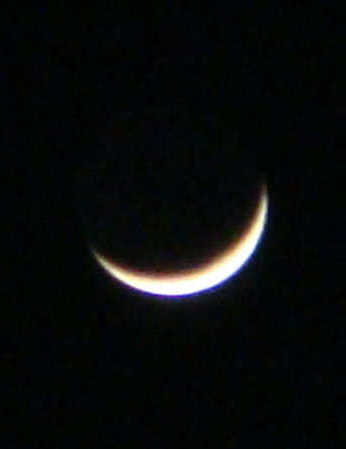
From the wonderful "Rose Is Rose" comic strip in our Times-Picayune daily newspaper, we discovered the "Garbage Moment" from Jimbo, who loves to go outside under the stars and look up at them after he takes out the garbage. No one has to remind him to do so or denigrate him for not doing so, he volunteers in the game of "Garbage Moment" and enjoys his time under the starlit sky. Later, we added the Newspaper Moment as our morning equivalent game. I usually go outside to retrieve the newspaper, and I always enjoy listening to the roosters crowing across the bayou on the other side of the bamboo thicket. We have a couple of quiet games we play, one is called Koala Bear. Do you recall when Qantas Airlines had the TV commercials with cute little cuddly bear saying the tag line, "I hate Qantas"? In our version of the game, if one of us is upset, the other comes over gives a gentle hug and says, do you hate Qantas, which is a signal for the sad one to place one's head on the shoulder of the other and say quietly and poignantly, "I hate Qantas." The other one is Waterfall. In this one, we get in the shower, hug as closely together as possible so that the water is dammed up to our shoulders, then we suddenly separate and feel as though we had suddenly stepped under a waterfall. We have lots of these moments of fun, whose primary requisite for playing is that both people have a lively child still living inside of them. One day Del was copy-editing my work and wanted to change a quote from the author Christopher Fry. I told her, "You're editing Christopher Fry and the man doesn't even know you." She replied, using her child voice, "Yeth, but if he did, he'd wuv me." It's never to late be a kid!
Sometimes things occasionally happen which are not fun, and one of us is doing something to make the current situation unbearable, so the other one invokes the Pissing in the Soup game, which means to accuse the spoil sport of "Pissing in the Soup." What does that mean? Well, it's the name-equivalent activity in life to pissing in the soup: "It may create more soup, but it doesn't necessarily improve the flavor!" Most of the negative interactions married couples get into which end in divorce could be reckoned to pissing in the soup. By calling attention to the negative activity, one of a couple is able to break up the unpleasant game of Pissing in the Soup and get on with the fun of being together again.
Sometime one of us does something so wonderful that when the other asks "How can I to repay you?" the answer comes back, "Put it in the Book." The Book is an imaginary book in which we log these special treats and treatments. It is creative accounting in the best sense of the word.
McGonigal's Chore Wars is a modified version of World of Warcraft where all the online quests correspond with real-world cleaning tasks and you play it with your spouses or room-mates.
[page 120] It's meant to help you track how much housework people are doing — and to inspire everyone to do more housework, more cheerfully, than they would do otherwise.
A Fix is McGonigal's answer to repairing some way in which she sees that "reality is broken." Fix #7 is titled "Wholehearted Participation" and its theme is stated this way, "Compared with games, reality is hard to get into. Games motivate us to participate more fully in whatever we're doing." I couldn't help but reframe the penultimate sentence this way, "Contrasted to idiocy, reality is harder to get into."
Under Fix #7 is the statement "If we're forced to do something, or if we do it halfheartedly, we're not really participating." Clearly someone who is doing something halfheartedly is doing so under some imagined if not obvious compulsion. And compulsion is the sure-fire killer of spontaneity. Paul Watzlawick describes the "Be Spontaneous Paradox" as the situation when someone commands you to do something which can only be done spontaneously. The result is a pale attempt to comply which is always fails in its attempt. Point a camera at someone and say, Smile, and you'll get their best pretend smile, but no spontaneous smile.
Good photographers evolve cute approaches to get around the BSP, and the novel approaches are what create the smile, not a command to smile which would invariably fail! Erections are spontaneous, so any woman saying, "Get it up!" is more likely to create impotence instead of an erection. Sneezing is a spontaneous activity and the BSP timely applied can stop a sneezing cascade. Simply wait until after the first sneeze and say, "Do that again!" This hiccup cure is also sure-fire: wait till a hiccup has just ended and flash a twenty dollar bill in front of a person, saying this is yours if you'll give me another hiccup. Their attempt to consciously create a hiccup on command will make it impossible for the spontaneous hiccup, which was waiting within, to show itself. For putting children to sleep, it is like magic. Sleep tell the child to lay in its bed with their eyes wide open for as long as it wants. Just keep quiet and stay in bed. Invariably, unless the child has been trained to pester its parents, it will fall asleep within minutes. Tell them to "Go to sleep" and you may have an all-night insomniac on your hands.How can education be structured in the form of a game? It is surely the most compulsive form of activity kids are subjected to: they must go every weekday until they are at least 16, they have to stay in class, study courses pre-determined for them whether they like them or not.
[page 128] Increasingly, some education innovators are calling for a more dramatic kind of game-based reform. Their ideal school doesn't use games to teach students. Their ideal school is a game, from start to finish: every course, every activity, every assignment, every moment of instruction and assessment would be designed by borrowing key mechanics and participation strategies from the most engaging multi-player games.
Three of my grandchildren went to a project school in Bloomington, Indiana, and I had occasion to visit at their school and learn about how the school worked. Basically each pupil was allowed to choose a project and while working on this voluntary project, they learned the necessary skills and content to complete the project. In this way subject matter became something that the child needed to learn to complete a project, not something a teacher wanted to cram into a child. The difference is incredible. Participation was not voluntary, but how you chose to participate was, so the Project School meets three of the four criteria for game design: One, it has a goal, namely the project. Two, it has rules about choices of projects. Three: there is a feedback system from the teachers who judged how each student's project challenged their current level of understanding. My grandson Walden had chosen a project about Jet Fighters and wrote that I had worked for the Lockheed Aircraft Co, among other things.
Whenever anyone gets hurt, I always look for the answer to two questions, one of which will be clearly the operant reason for the illness or accident or inconvenience. The first question is: What happened because of X that would not have happened under any other circumstance? The second question is: What did not happen because of X that would have otherwise happened? When Jane McGonigal hit her head hard on a cabinet door standing up in 2009, she developed a concussion and the only good thing which happened to her in my mind is that when her husband tested her for a concussion by asking her who the president was, she didn't know. It definitely was a concussion, but all the tests showed that she would likely be free of the headaches, vertigo, and blurred vision in about a month. But it required no reading, no writing, no working, and no running until she was symptom-free. She even discovered that computer and video games were too much stimulation for her brain.
[page 133] Either I'm going to kill myself or I'm going to turn this into a game. After the four most miserable weeks of my life, those seemed like the only two options I had left.
Contemplating suicide under any circumstances, to use the vernacular, is a strategy to die for! Luckily she chose the second option. But what about the two questions. These are best answered by McGonigal, but from the information she gives, I would expect that the operant question would be the second, namely, what did not happen, because her giving up computer and video games would not likely have happened under any other circumstance. When the first month found her with symptoms remaining, she was facing two or months of prolonged symptoms. This was serious.
[page 134] My doctor had told me that it was normal to feel anxious or depressed after a concussion. But she also said that anxiety and depression exacerbate concussion symptoms and make it much harder for the brain to heal itself. The more depressed or anxious you get, the more concussed you feel and the longer recovery takes.
A system of positive feedback (otherwise known as a vicious cycle) is set up, depression causes symptoms which cause more depression. One way out of the vicious cycle which she did not have at her disposal was a doyle trace. Feelings of depression are doylic memories usually from immediately before birth where one is pushed into a tighter and tighter space with no end in sight. All those feelings are stored in doylic memory because the normal memory (cognitive, cortex-based memory) does not begin to work fully until after five years old.
A speed trace takes the current doylic states of depression and uses them as sled to quickly speed down the hills of memory to the location in the limbic system where the primitive doylic memory is stored, accesses it and create a cognitive memory (which the brain was too immature to do at the time, but is now capable of doing). After the speed trace, the depressive symptoms will be gone and the concussion symptoms while still present will quickly heal absent the exacerbating depressive symptoms.What Jane McGonigal did was use what she knew best how to do: create a game. The energy of game creation will lift her spirits and help relieve the depressive symptoms. It was at this time that the first question kicked in: she did something that she would not have done under any other circumstances, she asked friends and family for help. And she created SuperBetter, a multiplayer interactive game.
[page 134] SuperBetter is a superhero-themed game that turns getting better into multiplayer adventure. It's designed to help anyone recovering from an injury or coping with a chronic condition to get better sooner — with more fun, and with less pain and misery, along the way.
She became the Concussion Slayer and the point of her mission was to start seeing herself as powerful, not powerless. This instant reframe from powerless to powerful has been used for many decades by the Senoi tribe of the Malaya peninsula in Asia. A friend of mine Jack L. Johnston studied the Senoi's dreamwork processes and taught people in the States how to use them in their own dreams. If a Senoi sub-teen boy might come to the daily morning dream session in the tribal hut and say, "A scary tiger tried to eat me in my dream!" The people around the circle would start muttering, "Wow! A thing of power! How lucky you are!" Then they would have the boy relive the dream and confront the tiger, makes friends with it, and ask the tiger for a gift as a token of its esteem. Amazingly this process works quickly to remove the fear and anxiety caused by a tiger and replace them with a feeling of power.
For her second mission, McGonigal had to recruit her allies, the equivalent of the tribal folk in the hut. She then had to fight the bad guys which were the things which triggered her symptoms, the reading, running, emails, etc. Consider how brave she was being, designing and implementing the SuperBetter game while having only limited resources available to her. Soon she was identifying her power-ups, those fun things she could do to feel better. Then came the superhero to-do list. Her easiest to-do was baking cookies for people in her neighborhood. Eventually the game was over as she had recovered from all of her concussion symptoms. But not before she had created a new game to help other people in similar distress.
When McGonigal began talking about New Games, I remembered a Radical Therapy Conference that I attended in 1979 in Ames, Iowa. I had read about New Games, but here was my chance to participate in them.
I recall the fun of playing volleyball without keeping score! It was completely voluntary and players could enter or leave the game at any time. We had the fun of making the current shot and winning, but there was no score kept, except for the amount of fun we had.McGonigal says that "there's no score at all for getting smarter once you're out of school for good." But there are scores in the life of one's avatar in a computer game.
[page 146] "If I have one regret in life," I complained to the crowd at the Austin Convention Center, "it's that my undead priest is smarter than I am." Technically speaking, it's true: if you were to add up every A I've gotten in my real life, from junior high through graduate school, the total still wouldn't come close to my World of Warcraft character's intellect stat."
After many years of working assiduously at reading, studying and reviewing the works of Rudolf Steiner, Dave Lyons introduced me this way to a group I was in front of to lecture about Steiner's works. "Someone told me that if you have read at least 75 books on one subject, you have the equivalent of a Ph. D. Bobby Matherne has studied over 150 books on Rudolf Steiner, which makes him having a double Ph. D." I was amazed and flattered, but also glad to hear how Dave had found a way to score my achievement in one key area of my adult, out-of-school life.
Perhaps my life of reading and reviewing books is like the Tetris game, quickly rotating and placing each review to plop into place, so that the stack keeps moving down with a satisfying click, and my score keeps getting higher, and books flow in faster and faster each year.The Chapter titled "Happiness Hacking" takes on the biggest Be Spontaneous Paradox of all, Happiness! Go ahead, the self-help books say on the cover: "Be Happy — and Here's How You Do It". Sounds a lot like the famous Betty Crocker Cake Mix box which said, "Be Creative — and Here's How You Do It". Happiness activities, like creative activities, cannot be packaged in a book or a box, it must stem from self-generated activity. Happiness activities, like multi-vitamins may be useful, but not if they remain in the bottle unopened and unused, or simply forgotten about.
[page 184] What, exactly, are happiness activities? They're like the daily multivitamins of positive psychology: they've been clinically tested and proven to boost our well-being in small doses, and they're designed to fit easily into our everyday lives.
There are dozens of different happiness activities in the scientific literature to choose from in addition to the three listed above, ranging from expressing our gratitude to someone daily to making a list of "bright-side" benefits whenever we experience a negative life event. And they all have one thing in common: they are backed by multiple million-dollar-plus research studies, which have conclusively demonstrated that virtually anybody who adopts one as a regular habit will get happier.Only problem is they don't work. Knowing what to do to be happier does not translate automatically into doing. It takes work, and work is exactly what most unhappy people have been trained to avoid except when it's forced on them.
Every morning right about this time, I leave my computer desk and drive to PJ's Coffeeshop a few miles down the road. Working at home as a writer can turn easily into a drudge, and soon after I began writing at home I found the need to take frequent breaks like I did at the plant, only problem was that the plant had a break room where I could chat with people while sipping my coffee, and my home doesn't have a break room with people there. PJ's has become my morning break room. There's David who likes to talk about the latest Saints's game who fixes my coffee, Diane who is a regular who I always say Hi to and sometimes sit down to chat with, Penny who sits outside at a table since she smokes, Gary who worked at my plant is often there reading his newspaper and I can ask about plant related activities as he is still in the business, and so on. The Jen Ratio at PJ's is very high. What is the Jen Ratio? McGonigal explains how she created it from the Chinese word jen which means happiness.
[page 190] To measure the jen ratio of a space, you simply watch it very closely for a fixed period of time — say, one hour. You count up all the positive and negative microinteractions between strangers, keeping track of two different totals: how many times people smile or act kindly toward each other, and how many times people act unfriendly, rude, or openly uninterested. All the positive microinteractions — such as big smiles, a hearty thank-you, a door being held open, a concerned question — get tallied on the left side of the ratio. All the negative microinteractions — a sarcastic comment, an eye roll, an unexcused bump, someone cursing under their breath — get tallied on the right side.
Having observed these kinds of microinteractions at PJ's Coffeeshop for many years, I rate the Jen Ratio there very high. I rarely leave there without a happy feeling inside, and that makes it a great break room for me in my current job. After reading about the Jen Ratio for the first time in this book, I pondered all the various places I have spent time in and realized that I have stopped going to Negative Jen places and I avoid contact with people who create Negative Jen in my presence. One of the fun activities in New Orleans is just to walk the streets of the city. McGonigal writes on page 190, "But strangers aren't always inclined to be friendly to each other." The opposite is true in this city. If a New Orleanian sees a likely tourist stopped on a street looking puzzled, soon that tourist will have a wealth of information provided by the stranger who will stop, ask if they can help, and then provide whatever help the person needs.
There is no list of the friendliest cities in America, but I would put New Orleans at the top of the list. It also has the highest Jen Ratio of any city I've ever been in on a year-round basis. No need for "Happiness Hacking" (Chapter Ten) if you already live in New Orleans.If you want to play Tombstone Hold 'Em, this is also a great city for that, because most of our tombstones are elevated from the ground due to the high water table. The game is described on page 198, 199 and is based on the poker game "Texas Hold 'Em" but instead of playing cards, it uses tombstones, dates of death, and number of names to create the suits and number on the cards. You literally touch one tombstone and need other people to touch both you and another tombstone to get the next card. This makes for a rollicking time in the cemetery by the time you get a winning straight or flush together. It's one of the games created by McGonigal as part of Happiness Hacking. This is the first use of cemeteries for fun I've encountered, since seeing the movie projected on the side of a mausoleum in a Hollywood cemetery during the movie, "Valentine's Day".
One other Happiness Hack is the Top-Secret Dance-Off in which a player dances in disguise and posts the video on the Internet to compete. "TSDO is an environment with an off-the-charts high jen ratio." (Page 213)
In the Chapter "Engagement Economy" we learn about crowdsourcing, "coined by technology journalist Jeff Howe in 2006, (it) is shorthand for outsourcing a job to the crowd." You invite people over the Internet to cooperate in tackling a big project. Wikipedia, an on-line encyclopedia, was created by more than 10 million people, unpaid and anonymous (mostly). The Guardian in England needed massive help in sorting through Member of Parliaments' expenses to confirm suspicions of blatant misuse of taxpayers's money. So they developed an online game, Investigate Your MP, after converting and condensing 458,832 documents and placing them on-line. The game was to review each document for revealing information about misuse. Within three days, 20,000 players had already analyzed more than 170,000 documents. (page 221). The data revealed such facts as this: on average, each MP expensed twice the amount of salary received. Soon hundreds of MPs were ordered to repay about two million dollars. (Page 225)
Wikipedia has good game community as defined by McGonigal. Here's how Wikipedians describe it:
[page 230] Every unique location (article) in the game world encyclopedia) has a tavern ("talk page," or discussion forum) where players have the opportunity to interact with any other player in real time. Players often become friends with other players, and some have even arranged to meet in real life.
In the waning years of the 20th Century, I spent a lot of time in a List called Steiner98 and over the succeeding years I have met in person a half dozen of the members of the List who are located all over the country, and it's always been a wonderful meeting, as of old friends not of new friends. As for the Tavern in Wikipedia, I wonder if there is a doyletics Tavern. If anyone knows, please let me know, as I would like to raise a quaff with the regulars. As the founder of the science of doyletics, I was not allowed to create the entry for doyletics, but at some point, I will wish to see what it contains.
One of the things I do on the way to my break room at PJ's Coffeeshop, is listen to Teaching Company lectures. My current lecturer is Grant L. Voth, who wrote in his Lecture 47 Notes for Borges's Labyrinths the following about his famous story, "Tlön, Uqbar, Orbis Tertius." (On page 207 of Teaching Company's course, The History of World Literature.)
[ Grant L. Voth ] The story is about the gradual discovery of a society which over the past three centuries has created first an imaginary land and then an imaginary planet. One of its founding members was Bishop Berkeley, the Idealist philosopher, so it turns out to be a most intriguing and interesting kind of place. It is, of course, also logically consistent and coherent because it was made by humans using the rules of human logic and language.
When word of this imaginary planet gets out into the world, the world begins to adapt itself to Tlön; even objects unique to this created world begin to show up in ours. The reason for this is clear: Tlön is made up, but it is orderly, rational, and understandable vis-a-vis our own reality, whose order and rules and meaning we never grasp. As Oscar Wilde said half a century earlier, reality is merely process looking for form. Art is form, and when someone creates something of formal perfection, we try to adapt reality to it; thus, the world is becoming Tlön.Wikipedia is like the imaginary land of Tlön: it started out as someone's imagination, and soon people from all over the world were adding entries which brought it into the realm of reality in a big way. One cannot look up an item without getting a link to Wikipedia today. The imaginary has become real due to crowdsourcing of an on-line encyclopedia.
Earlier in this review (page 348 passage), I gave a list of "reality slams" or potshots that McGonigal takes on reality in this book. To her credit, she takes back these slams in the final Chapter "Reality Is Better".
[page 348, 349] Reality is all of these things. But in at least one crucially important way, reality is also better: reality is our destiny.
We are hardwired to care about reality — with every cell in our bodies and every neuron in our brains. We are the result of five million years' worth of genetic adaptations, each and every one designed to help us survive our natural environment and thrive in our real, physical world.
That's why our single most urgent mission in life-the mission of every human being on the planet — is to engage with reality, as fully and as deeply as we can, every waking moment of our lives.
That doesn't mean we can't play games. It simply means that we have to stop thinking of games as only escapist entertainment.Perhaps we should think of games the way the ancient Lydians did, she says. They invented dice games and spent 18 years eating every other day and on intervening days, they played dice games. Eventually they decided that experience was telling them that the land could support only half of the population, so one-half the citizens of Lydia moved away to what is now Italy and settled in a fertile region and became known as Estruscans. While they were playing games, the Lydians were also doing crowdsourcing by involving the entire population in an experiment in survival which led to a solution to the problem of starvation in Lydia.
Like the Lydians, games today help keep us alive, happy, and connected with others. Video game players need no longer be looked down on as lonely losers wasting their life away in computers.
In the 1980s I heard a lot criticism of video games as the Game Rooms popped up all over the country and kids were dropping quarters for thrills in all kinds of games. When the Desert Storm War came, I predicted that American kids who had spent years shooting down spaceships in various video games and, who were now flying fighter jets and manning army tanks, would have no trouble dispatching Iraqi kids who grew up in the same time period learning to jockey a camel. History proved my hunch was correct. The games we play today prepare us for the real world we will live in tomorrow, and sometimes, like with Wikipedia and Desert Storm, the two will develop together, the real world of today holding hands with the world of tomorrow in ways we cannot imagine, a future which will be quite extraordinary.
Read the Full Review with its Five Footnotes at:
http://www.doyletics.com/arj/ribroken.htm= == == == == == == == == == ==
I hear often from my Good Readers that they have bought books after reading my book reviews. Keep reading, folks! As I like to remind you, to obtain more information on what's in these books, buy and read the books — for less information, read the reviews.
== == == == == == == == == == == == == == == == == == == == ==
8. COMMENTARY:
= = = = = = = = = = = = = = = = = = = = = =In this section I like to comment on events in the world, in my life, and in my readings which have come up during the month. These are things I might have shared with you in person, if we had had the opportunity to converse during the month. If we did, then you may recognize my words. If I say some things here which upset you, rest assured that you may skip over these for the very reason that I would likely have not brought up the subject to spoil our time together in person.1. Padre Filius Wanders through Amish Country this Month:
Padre Filius, the cartoon character created by your intrepid editor and would-be cartoonist, will appear from time to time in this Section of the Digest to share us on some amusing or enlightening aspect of the world he observes during his peregrinations.
This month the good Padre reads a Sign on back of Amish Buggy.
2.Comments from Readers:
- EMAILfrom Chris in Texas, whose son is going through a divorce:
Bobby,
This experience of having a child go through a divorce that he didn't choose, just like I did 35 years ago, has been eye opening. Most of the time now I can't even get near the old doyles I used to be plagued with. I can't really embrace how intense they were, it's as if that was some whole other person. Seeing my son go through what he's dealing with has brought some memory of those things back. It has made me appreciate anew the people who helped me survive 35 years ago,and it has made me appreciate what a difference doyletics has made in my life. It has also reminded me of how much time and effort you invested in me and Carla, a few years ago. I started wondering this week, how many people you have patiently mentored through their own process over the past years.
Thank you Bobby, you are one of my favorite humans. I am thanking God daily that you and Del are a blessing and blessed and have the desires of your hearts.
Chris- EMAIL from Mabel Schumacher in Wisconsin:
This is a note for Bobby Matherne.Every time your Digest arrives, I remember with happiness the Palm Sunday at the Crystal Cathedral when Evel Knieval was baptized. Somehow I was humorously tagged as “The Stalker.”
Vern and I hope this finds you well and enjoying life. God bless you.
Mabel and Vern Schumacher
My Reply: ~~~~~~~~~~~~~~~~~~~~~~~~~
Dear Mabel,Glad to hear from you. That was an incredible weekend. How wonderful to be there to experience both services and all the behind-the-scenes activities which never got broadcast, like Perilous Poit on his bike, and the hundreds of baptisms after the services.
Our prayers go out to you and Vern,
BobbyEMAIL Forwarded from Nuno in Portugal forwarded by Dr. Viikaria in Finland:
Good afternoon Dr Viikari,I am sorry for the late response, but in the last weeks I have been very busy because I had to finish a paper in my master degree.
Anyway, and as I told you, I created a simple website with my testimony so I can help you spread your message to the world. The link of the website is:
https://sites.google.com/site/visionnow1/
I send you also an attachment with my picture.
Kind regards,
NunoEMAIL from Ed Smith in Lubbock:
This came from Jo Anne (via one of her lady friends), so I think it is okay to share it. No explanation needed. A New Book: Understanding Women Made Easy for Men
See Photo of Man Reading Book at Right.EMAIL from Owen Pearn in Brisbane, Australia:
hi bobby,my name is owen pearn. i'm a counsellor here in brisbane, australia (www.owenparachute.com). i used to be a computer scientist/software architect! (www.owenpearn.com)
i've done a lot of trancework etc. love your work. i've used the speed trace a ton on myself and on a few clients. works great!
i've read up a ton on doyle henderson (eg at: http://www.primal-page.com/inter-dh.htm)
i'm going to make a short youtube video demonstrating the speed trace and i want to refer to you but i don't know how you pronounce your last name! is it MATHen or mathURN or something else? -o-
REPLY ~~~~~~~~~~~~~~~~~~~~~~~~~~~~~
Hello, Owen!
Yes, mathURN is the correct way. Thanks for asking and do send a link when you have it ready for viewing.
most cordially,Bobby
EMAIL from Marleny in Florida:
[Email sent from Digest No. 115 above ToC.]Dear Bobby,
Thank you for sharing your really great space.
I have two requests:
1- I have been trying to find a reference to a certain book that you mentioned in a previous newsletter. Something about "plant as doctor" - you used this when you went to pick up your rain barrel. Would you be able to direct my efforts?
2- If you haven't read these books: http://www.ringingcedars.com/ , please read them...and would it be too much for you to review them? I have become interested in the ability that plants have of matching our bodily needs and curing our diseases. The lady in the books speaks of a novel/ancient method of planting seeds that will produce the exact medicine that our bodies need by encoding them with our DNA while holding the seeds in our mouths before planting, etc. More here: http://www.ringingcedars.com/seed_planting/ These books are causing a revolution worldwide, but especially in Russia, where a new kind of village/settlement has come of this. They are healing the earth and themselves. Didn't Steiner speak of the Slavic civilization as being the next powerful one, albeit not in the usual fashion? And Cayce said: In Russia there comes the hope of the world --Not as that sometimes termed of the communistic, or Bolshevik, no; but freedom, freedom! That each man will live for his fellow man! The principle has been born. It will take years for it to be crystallised, but out of Russia comes again the hope of the world. Guided by what? That friendship with the nation that hath even set on its present monetary unit, "In God We Trust." (Cayce Reading 3976-29, June 22, 1944)
These books/message are bringing all of this to fruition in a marvelous way! Please, do check them out.
Many, many thanks for your time.Blessings,
MarlenyREPLY ~~~~~~~~~~~~~~~~~~~~~~~~~~~~~~~~~~
Dear Marleny,Thanks for writing. I see you are subscribed to the Digest.
You asked a lot of good questions which I will endeavor to answer below:
There are two Digest references: in digest079 and again in digest113 in the Commentary sections.
A quick Search using my special Google Search Engine (top of any review and most other pages called Bobby Matherne Search Engine) looking for this "plant as doctor" turned up two more references:
1) http://www.longevity-and-antiaging-secrets.com/the-green-elephant-organic-restaurant-in-portland-me.html in which I talk about Anastasia and the Ringing Cedars works.
The first book Anastasia has links to the other six reviews (Books 2 thru 7) I did of the series.
and 2) Rudolf Steiner's Agriculture Course
The other review I recommend to you is A Feeling for the Organism
by Evelyn Fox Keller about Barbara McClintock's innovative work — her discovery and proof of transposing genes provides exactly the scientific confirmation of what Anastasia predicts plants do in response to our planting, tilling, weeding, and harvesting. Whenever practical, I hold the seeds in my mouth, or add saliva to them in my hands before planting. But the toxins in one's sweat and breath are important signals which the plants also respond to. We can also perceive their response to our response. Know how?
The plants taste better! Why? It seems to be an innate response of our bodies to food which is good for it.
Ever put salt on watermelon when you eat it? We did as kids. I asked why, and all I got was "it tastes better." Not an answer I was looking for, but rightly understood, it was a perfect answer! In those days before air-conditioning, we had been sweating all day and our bodies needed replacement salt. Watermelon has none! Adding it to the slices made them taste better because our bodies needed it ! ! ! Today with AC, no one adds salt to watermelon as it is not needed and therefore does not make it taste better.
My grandfather and father always planted veggies, and I didn't. No until read the first Anastasia book. My experience with the better taste of my dad's veggies had already convinced that something was going on, and she revealed what it was. Now we eat from our garden on a regular basis. Had cucumber salad from garden for supper and used the basil and parsley in my crawfish etouffee.
Re: Russian/Cayce/Steiner:
In my Sevens Table here: http://www.doyletics.com/7stable.htm You can see that we are in the 5th Post-Atlantean cultural epoch, the 6th will be American and the 7th will be Russian. Some more references.
http://www.doyletics.com/arj/efsgrev.htm
http://www.doyletics.com/arj/destinie.htm
http://www.doyletics.com/arj/howcanma.htmThe difference between Edgar Cayce and Rudolf Steiner is that Edgar was an unconscious mystic and Steiner a conscious one. Steiner represents the future state for humanity, a state we are slowly entering today. They both saw the same future realities and spoke of it differently. Cayce probably saw the 7th PAE cultural Russian epoch.
thanks for writing and keep in touch,
in freedom and light,
Bobby
3. Poem from Freedom on the Half Shell:
"Head Trip"

Give me your poor, huddled masses yearning to breathe free and I will give them taxes, regulations, restrictions, and every manner of unfairness ever created by persons saddled with the illusion that they can decide what is best for someone else's welfare. The individual, like the business professional, knows what's best in a given situation and, given the freedom, will take that action. The forces of coercion are prying open the shell that contains the living muscle and spirit of the American people — will we resist those forces and keep our muscles and spirit alive, free to open at will, or will we give up like the oyster and settle for "freedom on the half shell?" Here is another poem from Freedom on the Half Shell:
 Note: This poem was written when Bush and Quayle were President and Vice President. The second two stanzas are yet applicable today.
Head Trip
Beat the bush
With a pack of lies
Up'll pop a quail
Or two of roasting size.Seize property freely
From Columbus Land
Burn constitutions
Made of sand.
Decapitate the druggers
And be rid of them
And you'll never get rid of the buggers
Who decapitate them.
ONCE, MANY PARADIGM HOPS AGO, I wished to become a writer and did not know how to go about it. As I usually do when confounded, I found the answer at my elbow, in a book. This time it was Peter Elbow, and he became my writing teacher. He did so by instructing me, as I read his classic book, Writing Without Teachers. All the other courses had teachers to teach you how they write, but Peter taught me how to write by teaching me to begin, not by studying literature, not by taking grammar lessons, not by building my vocabulary, but by writing, purely and freely, on a blank piece of paper, to make that blank piece of paper my companion, my best friend, my friendie who accompanies me everywhere I go, and to whom I confide my inner-most secrets.The exercise my teacher suggested he called Free Writing, wherein you write non-stop until you fill up both sides of a page or for about ten minutes. No editing, no stopping, no trying to make sense, just stringing words one after the other without end or coherency until your goal is reached. Then you stop, fold the paper and put it away for a minimum of three weeks. After that, if you like, take it out and read it. Keep the parts you like and notice the other parts. They are all raw material for your future work. Go back and write again, every day; write until your free writing exercises become as necessary as your morning breakfast, your daily walk, the air you breathe.
You are now a writer. You have joined the most honored, sacred, and easy-to-join society in the world. It is also the best-read society in the world, so you find yourself studying literature. It is also the best writing society in the world, so you find yourself building your vocabulary and studying grammar. That was how I joined.
One of the privileges bestowed on members of this society is to quote and paraphrase a fellow member's words inside your own writing, with due credit: no using of another's property without permission, and permission is granted automatically for short quotes used inside a review. To paraphrase Groucho Marx, I say about my writing teacher, Peter Elbow: "I would never accept a teacher that would have me as a student."
This book is a book of teacher-less writings: some 287 of them; but more of them later.
When I first began to write, I had to fit my free writing exercises into a busy schedule, which included a wife, eight children, and a day-time avocation as a nuclear power plant supervisor. I had to be creative and flexible, catching ten minutes during lunch or after everyone had gone home for the day. I began dating the exercises as one might a journal, and they became a de facto journal. One day I sat down to my daily writing ritual after finishing reading a book. I found myself writing — as usual about what was on my mind — only, on this day, that book was on my mind, so I wrote about the book. The first one was like a thumbnail sketch of my impressions of the book just after finishing reading it. I filed it away and, three weeks later, I retrieved it and read it. It was good in a way that I hadn't been good before — certainly not in my writing about books back during my writing-with-teachers phase in college.
I felt so good reading that first review, that I began to write a similar review for each book thereafter, some 300 books. Not every book I read made it — one book with the cover torn off didn't. Some one or two others, too insignificant to recall, shall remain as nameless as they are review-less; the remainder comprise my reading list, up until now.
That's how the writing began sort of like a long run-on sentence where each word is a book review and each book review is a book like a word was once a poem and one wonders what is the meaning of the sentence and how come there is no punctuation because the problem was punctuation itself as in when to say all this so far is a book and that what follows will be in other books. Writing a book is like punctuating a sentence: the book represents a complete thought and you put a comma or semi-colon or period after it to signal that a new thought is coming. So punctuation was the first real problem I encountered when I began thinking of these sketches as material for a book. Like in the joke where the kid says, "I can spell ‘banana' — I just don't know when to stop," I had to decide when to say enough. Faced with an earth-shaking decision like that, I did what the usual person would do: I put it off. The reviews kept coming and the book kept getting bigger.
When I hit on the title, A Reader's Journal: Journeys into Understanding, I felt the first impetus to punctuate. All this goes into A Reader's Journal, I thought, and whatever follows has to create its own book. I don't like the sequel approach to movies or life (Once In A Row Is Enough, Matherne's Rule #1), so don't look for me to do More Journeys into Understanding; "none but a blockhead would write just for money" to paraphrase Dr. Samuel Johnson.
Why do I write? That's a good question. Thank you, for asking that! I write for understanding, both for me and my readers. Thus it is appropriate that the first review I did was of Gary Brent Madison's book, Understanding. I remember the title and the author these eight plus years later.
To have beautiful views to gaze into between the demands of my job at the nuclear power plant (something other than bare concrete), I made a point of buying the National Geographic Engagement Calendar every year. Looking at the calendar on my desk one day, it occurred to me that the reverse side might actually be written on. I began using the calendar side, not for scheduling activities, but for recording activities: noting the day I finished a book and wrote its review. I annotated not only the review day but, on every day that I read from a book, I wrote the author's name in full and the book's title in full. This required will power, but it paid off in my beginning to remember the names of the authors and the titles of the books I'd read, even years later.
"A scholar is someone who remembers his sources," I read that back before I became a scholar but it seems to apply to me now. I became a scholar when I began writing down the names and authors of the books I was reading. I wrote them on my National Geographic weekly engagement calendar that I had originally bought because of the pretty pictures. "Life is what happens when you're doing something else," someone else said. Seems like writing books can be like that as well.
Perhaps you're wondering, "Can I be a writer?" I can only ask you the wonderful question that Annie Dillard asked of someone who asked her that question: "I don't know. Do you like sentences?" Because if you do not like sentences, you may work at being a writer but will never become one. If you do not like playing with sentences, copy-editing and proofing your own work will be an utter bore instead of fun. This Commentary is taken from my Introduction to A Reader's Journal, Volume I.
5. The Pelican, Cajuns, and Free Crawfish

A wondrous bird is the pelican
Its beak can hold more than its belly can.
It holds enough in its beak
To last it a week
And I don't know how the Hell it can.See photo of pelican with its beak sack showing. Literally that sack can hold enough fish to feed the pelican and its young for a week! As much food as its belly can hold!
The Mother pelican has a bone under its tongue which it can move to puncture a small artery. Using this bone, it can begin a dripping flow of nutrient-filled arterial blood by means of which it feeds its baby pelicans until they are old enough to eat and digest the fish directly. Not being a mammal, the pelican has no mammary glands, but it uses its own life's blood to give life to its babies. As such it also serves a reminder of Christ Jesus who shed His life's blood on the Cross so that we, as spiritual babes, might have eternal life.

Our State of Louisiana flag shows three baby pelicans being fed this blood by its mother. The emblem in carved in gold on my LSU ring, and I keep that side facing me to remind me of the pelican metaphor. Tonight I feed my grandson Gabe with my presence and the $500 check in the graduation card.
The limerick explains how Cajuns have learned to survive in the flood-prone "valleys" of flat South Louisiana. Right now they are drolling over the prospect of crawfish so plentiful that they will be crawling over the levees right into the boiling pots of thankful Cajuns, who never suffer from depression. The so-called Great Depression was a time of plenty for them as they lived and prospered on the bountiful land of Louisiana.
Someone asked me why I chose to live here, in a state full of hurricanes, tornadoes, and floods. I picked it out before my birth, moved away twice, once in 1962 and once again in 1969, but returned in 1976, never to leave again.
== == == == == == == == == == == == == == == == == == == == ==
9. CLOSING NOTES:
= = = = = = = = = = = = = = = = = = = = = =Thanks to all of you Good Readers for providing the Chemistry which has made this site a Glowing Success. — Especially those of you who have graciously allowed us to reprint your emails and show photos of you and by you on this website — you're looking good! As of June 1, 2019, it enters its 20th year of publication. The DIGESTWORLD Issues and the rest of the doyletics website pages have received over 21.6 MILLION VISITORS ! ! !
We have received over ONE MILLION VISITORS per Year to the Doyletics Website since its inception June 1, 2000, over twenty years ago. Almost 2 million in the past 12 months. We are currently averaging about 150,000 visitors a month. A Visitor is defined as a Reader who is new or returns after 20 minutes or more has passed. The average is about one visitor for every 10 Hits.
IMPORTANT NOTES about DIGESTWORLDtm Our DIGESTWORLD came into existence years before Facebook and all the other social media which interrupt people's schedules many times a day. All our photos, reviews, cartoons, stories, etc, come to you via a link inside of one short email Reminder at the beginning of each month. We hope you appreciate how we let YOU choose when to enjoy our DIGESTWORLD Issues. To Get a Monthly Reminder, Click Here .
We especially want to thank you, our Good Readers, in advance, for helping our readership to grow. NOTE our name is now: DIGESTWORLD. Continue to send comments to Bobby and please do create links to DIGESTWORLD issues and Reviews on LinkedIn, on your Facebook page, and on other Social Media. When you copy any portion of a webpage or review, please include this text: "Copyright 2018 by Bobby Matherne".
Email your friends about the reviews, the handy doyletics Speed Trace, the Household Hints, the cartoons, the Cajun jokes, the recipes, the poems, and the photos in all the DIGESTWORLD Issues archived on our website. Urge them to subscribe to the DIGESTWORLD Reminder so they won't miss a single issue!
The Subscription Process SIMPLE: no Reply Confirmation is required. An email to the Editor with your First and Last names is all that's required. There is never a charge for viewing any page on our website; nor for any of the guidance we offer to people using the FIRST AID KIT or asking for help with doyletics in any other areas.
For those who are able to contribute to the site we offer a year's subscription for receiving the DIGESTWORLD Monthly Reminders for $50.~~ NOTE: DIGESTWORLD is a Trademark of 21st Century Education, Inc. ~~ The cost of keeping this website on-line with its 300 Gbytes of bandwidth a month is about $50 a month. Thank you, our Good Readers, for continuing to patronize our advertisers when they provide products and services you are seeking as you visit any of our web pages. Remember the ads are dynamically displayed and every time you read even the same page a second time, you may find new products and services displayed for your review. Our reviews, digests, tidbits, etc, all our webpages act as Google magnets to bring folks to the website to learn about doyletics and frequent our advertisers, so they support one another in effect.
We wish to thank all Good Readers who have made a contribution to the doyletics.com website! Special thanks go to Chris and Carla Bryant in Corpus Christi and Gary Lee-Nova in Canada!We welcome your contributions to the support of the website and research into the science of doyletics. To obtain our street address, email Bobby at the address found on this page: http://www.doyletics.com/bobby.htm and we will send it to you. Every $50 subscription helps toward keeping this website on-line for another month. If you can't send money, at least show your support by sharing your favorite Issue of DIGESTWORLD and Reviews with a friend.
You can read a description of how to do a Speed Trace (either in English or Spanish):Learn to Do a Speed Trace Here

Or Watch Bobby extemporaneously explain How to Do a Speed Trace on Video:
To make a connection to the Doyletics website from your own website, here's what to do. You may wish to use the first set of code below to link to the site which includes a graphic photo, or to use the second set of code for a text-only link. Immediately below is how the graphic link will look on your website. Just place this .html in an appropriate place on your website.
<CENTER> < — with graphics link — >
<A HREF="http://www.doyletics.com/index.htm">Learn to Do a Speed Trace Here<BR>
<IMG SRC="http://www.doyletics.com/doylepb.gif" width="309" height="102" border="2" TITLE="Learn to Remove Doyles — all those Unwanted Physical Body states of fear, depression, migraine, etc." ALIGN=middle><A/></CENTER>
<CENTER> < — text only link — >
<A HREF="http://www.doyletics.com/introduc.htm">Learn to Do the Speed Trace at doyletics.com <A/>
</CENTER>Check out the new additions to the Famous and Interesting Quotations at:
http://www.doyletics.com/quotes.htm== == == == == == == == == == ==
My reviews are not intended to replace the purchasing and reading of the reviewed books, but rather to supplant a previous reading or to spur a new reading of your own copy. What I endeavor to do in most of my reviews is to impart a sufficient amount of information to get the reader comfortable with the book so that they will want to read it for themselves. My Rudolf Steiner reviews are more detailed and my intention is bring his work to a new century of readers by converting his amazing insights into modern language and concepts.
== == == == == == == == == == ==The Good Mountain Press Digest is mailed monthly to:
Friends and associates
Individuals who have expressed interest in the Digest
Persons who have subscribed at the Digest Subscription Page.Please Don't Bug Us 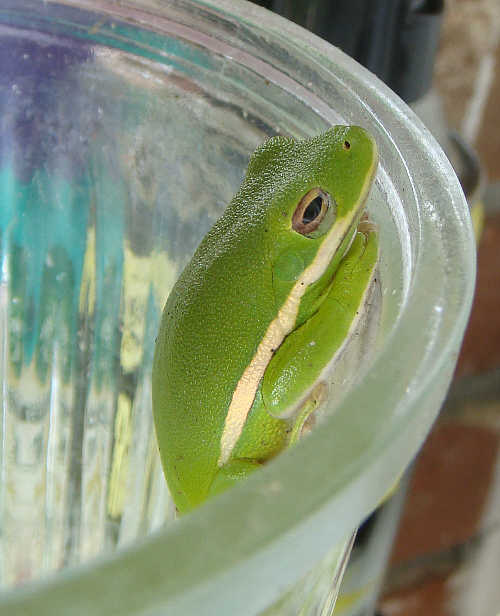
Nothing BUGS US more than losing Hale-and-Hearty, Ready-to-Read Good Friends from the DIGESTWORLD Reminder List.
So we've made it easy for Good Readers who have changed their Email addresses and Friends who would like to begin receiving the DIGESTWORLD Reminder at the first of each Month:
IT'S EASY to RE-SUBSCRIBE or SUBSCRIBE:
CLICK HERE!
As of August, 2011 we have begun using a Contact Manager with an Email Merge feature which allows us to send personalized Emails to everyone in our Contact List. You can receive the colorful Email containing the DIGESTWORLD Reminder beginning with "Dear [Your First Name]". It is important that we have your First Name, so if the name you are addressed by in your Reminder is not your first name, please notify us of the name you wish us to use. For convenience you can send a quick email to give us your name by Clicking Here. To Contact Bobby, his Email address is visible on this page.
NOTE: As of 2018 the Topica.com List messages are NO LONGER READABLE!
Please do your part by letting us know of any email address change so that you may continue receiving the DIGESTWORLD Reminders. Most of our Readers come from folks who don't get these Reminders, but we offer the DIGESTWORLD Reminder as a service to our regular Good Readers. To send us your new email address, CLICK HERE! .
If you discovered this page by a Google Search and want to SUBSCRIBE NOW
If you have enjoyed a particular issue, let us know, especially around the first of each month when those "lost soul" messages are bugging us, Send us a quick email by Clicking Here!
Simply Click the Link at right to send an Email Request: SUBSCRIBEIf you have a friend or two that you think would enjoy reading the DIGESTWORLD, suggest they view the current DIGESTWORLD Issue and perhaps they'll decide to Subscribe.To unsubscribe from the DIGESTWORLD Reminder List:
Click Link at right to send a Blank email to: UNSUBSCRIBEIf the above links which provide canned emails don't work on your system, you can send a Subscribe/Unsubscribe request to the address found on this page: http://www.doyletics.com/bobby.htm Please include your first and last name when Subscribing.
== == == == == == == == == == == == == == == == == == == == ==
10. GRATITUDE - in Three Easy Steps:
= = = = = = = = = = = = = = = = = = = = = =
Maintaining a website requires time and money, and apart from sending a donation to the Doyletics Foundation, there are several ways you can show your gratitude and support our efforts to keep doyletics.com on-line.
One would be for you to buy a copy of my Dolphin Novel, The SPIZZNET File. Books May be ordered in hardback or paperback form from Xlbiris the Publisher here:
online: http://www.xlibris.com/TheSPIZZNETFILE.html
email: orders@xlibris.com
The best source at the best price is to order your copies on-line is from the publisher Random House/Xlibris's website above.
Two would be for you to use the Google Search Engine for your web searches or to find an item on doyletics.com website. New reviews will have a place to do a Google Search at the top and the bottom of the reviews. Just enter a search phrase in the box below to do a Search. Note you can check whether to Search just this site or all websites.
Three would be for you to let us know you like us by Subscribing to our monthly Reminder. One short email each month with a link to our Latest DIGESTWORLD Issue will keep you apprised of our latest reviews, photography, poetry, Cajun stories, recipes, Movie Blurbs, Travels, and even more! Simply Click Here: Subscribe Me!
Thank you in advance!
~~~~~~~~~~~~~~~~~~~~~~~~~~~^~~~~~~~~~~~~~~~~~~~~~~~~~~~
Like Us? Subscribe to Receive a Monthly Email
Reminder of New Reviews & New DIGESTWORLD Issues — CLICK
~^~== == == == == == == == == == == == == == == == == == == == == ==
== == == == == == == == == == == == == == == ==
22+ Million Good Readers have Liked Us
22,454,155 as of November 7, 2019
Mo-to-Date Daily Ave 5,528 Readers
For Monthly DIGESTWORLD Email Reminder:
Subscribe! You'll Like Us, Too!
== == == == == == == == == == == == == == == ==
Any questions about this DIGESTWORLD ISSUE, Contact: Bobby Matherne
CLICK HERE TO OPEN OUR FIRST-AID KIT. Does your Face sometimes resemble the Faces Below? If so, Click on the Faces or Flags to Dig into our First Aid Kit.
To follow Research in the science of doyletics, Read our Monthly DIGESTWORLD Issues.
Click Here to get Monthly Reminder.
For Copies of Reviewed Steiner Books, Click on SteinerBooks Logo below.
Visit Bobby's Other Reviews, Articles, and Essays
Books are Lighthouses Erected in the Sea of Time
Counselor?
Visit the Counselor's Corner for Suggestions
on Incorporating Doyletics in Your Work.
e-mediatelytm is a Trademark of 21st Century Education, Inc. Prototyped 2000.